Portugal Table Olives Market Top 5 Importing Countries and Market Competition (HHI) Analysis
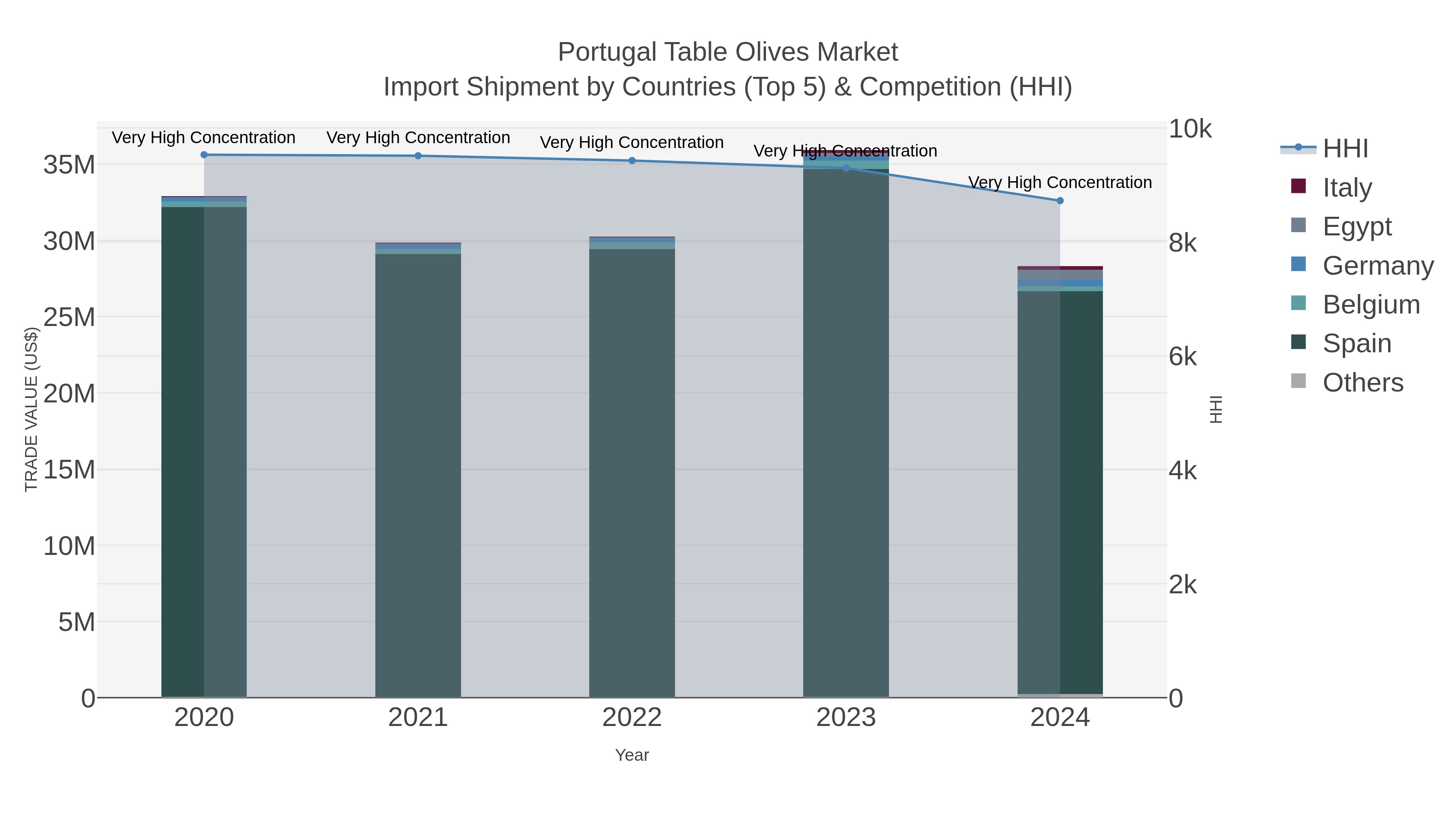
Despite a decline in the import shipments of table olives to Portugal in 2024, the market remained highly concentrated with the top exporting countries being Spain, Egypt, Germany, Belgium, and Italy. The high concentration is reflected in the Herfindahl-Hirschman Index (HHI). The negative Compound Annual Growth Rate (CAGR) from 2020 to 2024 indicates a challenging market environment. Furthermore, the significant drop in the growth rate from 2023 to 2024 highlights potential challenges faced by the industry. Monitoring these trends will be crucial for stakeholders to navigate the competitive landscape effectively.
Portugal Table Olives Market Synopsis
The Portugal Table Olives Market is characterized by a strong tradition of olive production, with a focus on high-quality products such as green, black, and stuffed olives. The market is primarily driven by domestic consumption, with table olives being a staple in Portuguese cuisine. There is also a growing trend towards organic and gourmet table olives, appealing to health-conscious consumers and food enthusiasts. Major players in the market include both large-scale producers and small family-owned businesses, with a diverse range of products catering to different consumer preferences. The marketing strategies often emphasize the traditional methods of olive cultivation and processing, highlighting the authenticity and quality of the products. Overall, the Portugal Table Olives Market presents opportunities for innovation and growth, particularly in expanding exports to international markets.
Portugal Table Olives Market Trends
The Portugal Table Olives market is experiencing growth driven by increasing consumer demand for healthy and convenient snack options. There is a rising trend towards organic and gourmet table olives, as consumers are becoming more conscious about the quality and origin of their food choices. Additionally, innovative flavors and packaging designs are creating opportunities for manufacturers to differentiate their products in the market. With a focus on promoting the Mediterranean diet and the health benefits of olives, there is a potential for further expansion both domestically and in international markets. Collaborations with local farmers and sustainable production practices are also becoming important factors for consumers, presenting opportunities for companies to highlight their commitment to ethical sourcing and environmental responsibility.
Portugal Table Olives Market Challenges
In the Portugal Table Olives Market, challenges such as increasing competition from other countries` products, fluctuating olive prices due to weather conditions affecting harvests, and the need for sustainable production practices to meet consumer demands for organic and environmentally-friendly products are prevalent. Additionally, complying with strict food safety regulations and ensuring consistent quality standards pose challenges for producers. Furthermore, the market is also impacted by shifting consumer preferences towards healthier snacking options, requiring producers to innovate and offer value-added products to cater to changing tastes. Overall, navigating these challenges while maintaining profitability and market share in a competitive landscape remains a key concern for stakeholders in the Portugal Table Olives Market.
Portugal Table Olives Market Investment Opportunities
The Portugal Table Olives Market is primarily driven by factors such as increasing consumer awareness about the health benefits of table olives, growing demand for Mediterranean cuisine, and the rising trend of healthy snacking options. The popularity of table olives as a versatile ingredient in various dishes and appetizers, along with the increasing availability of different varieties and flavors, is also contributing to market growth. Additionally, the focus on sustainable farming practices and the promotion of local produce are further driving the market as consumers seek out high-quality, locally sourced table olives. The convenience factor of table olives as a ready-to-eat snack or ingredient in cooking, coupled with the rising disposable income levels and changing dietary preferences, are expected to fuel continued growth in the Portugal Table Olives Market.
Portugal Table Olives Market Government Polices
In Portugal, the Table Olives Market is subject to various government policies aimed at regulating production, ensuring quality standards, and promoting exports. The sector is governed by the Common Agricultural Policy (CAP) of the European Union, which provides financial support to olive farmers and promotes sustainable agriculture practices. Additionally, the Portuguese government has implemented quality control measures through the Protected Designation of Origin (PDO) and Protected Geographical Indication (PGI) labels to protect the authenticity and reputation of traditional Portuguese table olives. Export promotion initiatives led by governmental agencies like the Portuguese Trade and Investment Agency (AICEP) aim to increase market access and visibility for Portuguese table olives in international markets. Overall, government policies in Portugal for the Table Olives Market focus on ensuring product quality, supporting farmers, and enhancing market competitiveness through export promotion efforts.
Portugal Table Olives Market Future Outlook
The future outlook for the Portugal Table Olives Market appears promising, with anticipated growth driven by increasing consumer demand for healthy and natural food products. Factors such as rising awareness of the health benefits of olives, growing preference for Mediterranean diet, and expanding export opportunities are expected to contribute to market growth. Additionally, technological advancements in olive cultivation and processing techniques are likely to enhance the quality and yield of table olives, further boosting market prospects. With a favorable climate for olive cultivation and a strong tradition of olive production, Portugal is well-positioned to capitalize on these opportunities and strengthen its position as a key player in the global table olives market.
Key Highlights of the Report:
- Portugal Table Olives Market Outlook
- Market Size of Portugal Table Olives Market, 2025
- Forecast of Portugal Table Olives Market, 2032
- Historical Data and Forecast of Portugal Table Olives Revenues & Volume for the Period 2022- 2032
- Portugal Table Olives Market Trend Evolution
- Portugal Table Olives Market Drivers and Challenges
- Portugal Table Olives Price Trends
- Portugal Table Olives Porter's Five Forces
- Portugal Table Olives Industry Life Cycle
- Historical Data and Forecast of Portugal Table Olives Market Revenues & Volume By Type for the Period 2022- 2032
- Historical Data and Forecast of Portugal Table Olives Market Revenues & Volume By Black Olive for the Period 2022- 2032
- Historical Data and Forecast of Portugal Table Olives Market Revenues & Volume By Green Olive for the Period 2022- 2032
- Historical Data and Forecast of Portugal Table Olives Market Revenues & Volume By Application for the Period 2022- 2032
- Historical Data and Forecast of Portugal Table Olives Market Revenues & Volume By Online Store for the Period 2022- 2032
- Historical Data and Forecast of Portugal Table Olives Market Revenues & Volume By Supermarket for the Period 2022- 2032
- Historical Data and Forecast of Portugal Table Olives Market Revenues & Volume By Convenience Store for the Period 2022- 2032
- Historical Data and Forecast of Portugal Table Olives Market Revenues & Volume By Other for the Period 2022- 2032
- Portugal Table Olives Import Export Trade Statistics
- Market Opportunity Assessment By Type
- Market Opportunity Assessment By Application
- Portugal Table Olives Top Companies Market Share
- Portugal Table Olives Competitive Benchmarking By Technical and Operational Parameters
- Portugal Table Olives Company Profiles
- Portugal Table Olives Key Strategic Recommendations






































