Qatar 3D Rendering Software Market Growth Rate
According to 6Wresearch internal databases and industry insights, the Qatar 3D Rendering Software Market is projected to grow at a steady compound annual growth rate (CAGR) of 8.24% during the forecast period 2026–2032.
Qatar 3D Rendering Software Market Year-wise Growth Rate and Key Drivers
This graph illustrates the annual growth rates of the Qatar 3D Rendering Software Market from 2021 to 2032, highlighting a steady upward trajectory and projected market expansion over the forecast period.
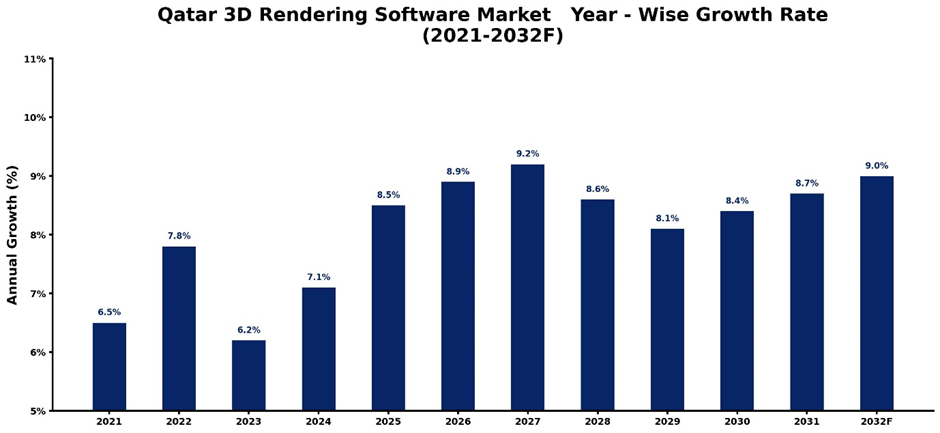
The following table summarizes the historical and forecasted growth rates of the Qatar 3D Rendering Software Market, along with the rationale behind each year’s performance.
| Year | Estimated Growth (%) | Market Rationale |
| 2021 | 6.5% | Recovery-led digital spending in construction. |
| 2022 | 7.8% | Pre-World Cup media and advertising peak. |
| 2023 | 6.2% | Post-event maintenance and concentration on infrastructure. |
| 2024 | 7.1% | Integration of rendering tools which are AI-driven. |
| 2025 | 8.5% | Increase in luxury residential and retail projects. |
| 2026 | 8.9% | Rising need "Digital Twins" in urban planning. |
| 2027 | 9.2% | VR/AR in real estate are getting highly adopted. |
| 2028 | 8.6% | Maturation of cloud-rendering ecosystems. |
| 2029 | 8.1% | Concentration on sustainable "Green Building" modeling. |
| 2030 | 8.4% | Strategic alignment with Qatar National Vision goals. |
| 2031 | 8.7% | Gaming and local media production growth. |
| 2032 | 9% | Advanced automation in industrial product design. |
Topics Covered in the Qatar 3D Rendering Software Market Report
The Qatar 3D Rendering Software Industry report categorizes the market by Type, Deployment, Application, and End User. It offers a surgical analysis of emerging trends such as real-time ray tracing and the integration of Building Information Modeling (BIM) with advanced rendering engines.
Qatar 3D Rendering Software Market Highlights
| Report Name | Qatar 3D Rendering Software Market |
| Forecast period | 2026-2032 |
| CAGR | 8.24% |
| Growing Sector | Cloud-Based Deployment |
Qatar 3D Rendering Software Market Synopsis
The Qatar 3D Rendering Software Market consists of the utilization of specialized applications to convert 3D models into highly detailed 2D images or cinematic animations. This is proliferating realistic lighting, textures, and shadows and in the Qatari landscape, this market is inextricably associated to the AEC (Architecture, Engineering, and Construction) sector. These software tools, such as V-Ray, Lumion, and Unreal Engine, are important for stakeholders to visualize multi-billion dollar projects before ground is even broken. As the nation transition toward a knowledge-based economy, the requirement for high-fidelity visualization in marketing, gaming, and virtual tourism has positioned 3D rendering as a critical pillar of Qatar’s digital infrastructure.
Evaluation of Growth Drivers in Qatar 3D Rendering Software Market (2026–2032)
Below are some major drivers and their influence on the market dynamics:
| Drivers | Primary Segment Affected | Why It Matters (Evidence) |
| Urban Expansion | Architectural Visualization | Massive investments in Lusail City and Lusail Winter Wonderland demand high-end pre-visualization. |
| Cloud Computing | Cloud-Based Deployment | The launch of Microsoft and Google Cloud regions in Qatar enables low-latency, heavy-duty remote rendering. |
| Media Diversification | Gaming & Animation | Qatar’s focus on becoming a regional media hub drives demand for high-quality CGI and animation. |
| E-Commerce Growth | Product Design | Retailers are deploying 3D product configurators. |
| BIM Integration | Architects & Designers | Mandatory BIM implementation for government projects demands 3D rendering workflows. |
Qatar 3D Rendering Software Market is projected to grow at a CAGR of 8.24% during 2026–2032. The market is switching from traditional offline rendering to real-time visualization, and this shift is spurred by the need for rapid decision-making in the construction and design phases. The proliferation of the Metaverse and VR/AR applications in Qatar's tourism sector is making a secondary surge in demand for high-performance rendering engines that can manage interactive environments. Rising fund allocation in smart city infrastructure, luxury hospitality developments, and digital twin technologies further proliferate the deployment of advanced rendering solutions.
Evaluation of Restraints in Qatar 3D Rendering Software Market
Below are some major restraints and their influence on the market dynamics:
| Restraints | Primary Segment Affected | What This Means (Evidence) |
| High License Costs | Media & Entertainment | Premium software costs and subscription models can be a barrier for small-scale local creative studios. |
| Skill Gap | Workforce Development | A shortage of certified technical artists proficient in advanced real-time engines limits market output. |
| Hardware Overhead | On-Premise Deployment | The extreme cost of high-end GPUs and server maintenance hinders the adoption of offline rendering. |
| Software Piracy | Software Developers | Unauthorized use of design software impacts the revenue stream for international software vendors. |
| Cybersecurity | Enterprises | Risks associated with hosting sensitive architectural data on third-party cloud rendering farms. |
Qatar 3D Rendering Software Market Challenges
The primary challenge for Qatar 3D Rendering Software Industry is in the interoperability between different design platforms. In a market where multi-national firms partner on large-scale projects, data loss at the time of transfer between CAD, BIM, and rendering software persist to be a technical bottleneck. Furthermore, the extreme environmental conditions of Qatar require specialized simulation tools (heat/light maps) within rendering software that are often computationally expensive. Additionally, strict local compliance standards for data sovereignty dictate that sensitive architectural and public infrastructure telemetry must be hosted within onshore data centers.
Qatar 3D Rendering Software Market Trends
Major trends responsible for Qatar 3D Rendering Software Market Growth includes:
- AI-Enhanced Rendering: To drastically decrease render times while maintaining photorealism there is rising usage of AI denoising and DLSS.
- Digital Twins: To monitor traffic, energy, and security in a virtual interface, real-time 3D rendering of entire city blocks in Doha is helping in achieving this.
- Sustainability Visualization: Rising use of lighting analysis within 3D software to streamline energy productivity in "Pearl-Qatar" developments.
- Browser-Based Rendering: Movement toward WebGL and cloud-streamed 3D content for real estate websites, removing the need for local hardware.
Investment Opportunities in the Qatar 3D Rendering Software Market
Below are the investment opportunities available in Qatar 3D Rendering Software Market:
- Localized Content Creation: Fund allocation in studios that specialize in Arabic-centric architectural and cultural rendering for local developers.
- Training and Certification: Launching specialized academies for Unreal Engine and Unity training to bridge the regional skill gap.
- SaaS-based Render Farms: Creating local cloud-render clusters to give data-sovereignty compliant rendering for government projects.
Top 5 Leading Players in Qatar 3D Rendering Software Market
Below are some of the leading companies in the Qatar 3D Rendering Software Market:
1. Autodesk Inc.
| Company Name | Autodesk Inc. |
|---|---|
| Established Year | 1982 |
| Headquarters | San Rafael, California, USA |
| Official Website | Click Here |
Autodesk is the worldwide market leader in 3D modeling and rendering software, extensively used in Qatar’s construction and architecture sector.
2. Trimble Inc.
| Company Name | Trimble Inc. |
|---|---|
| Established Year | 1978 |
| Headquarters | Sunnyvale, California, USA |
| Official Website | Click Here |
Trimble is known for its SketchUp software, broadly adopted by architects, interior designers, and urban planners in Qatar.
3. Dassault Systèmes
| Company Name | Dassault Systèmes |
|---|---|
| Established Year | 1981 |
| Headquarters | Vélizy-Villacoublay, France |
| Official Website | Click Here |
Dassault Systèmes gives high-end platforms like CATIA and SolidWorks, essential for engineering-intensive projects, infrastructure development, and smart city initiatives aligned with Qatar National Vision 2030.
4. Chaos Group
| Company Name | Chaos Group |
|---|---|
| Established Year | 1997 |
| Headquarters | Sofia, Bulgaria |
| Official Website | Click Here |
Creators of V-Ray, Chaos Group is the industry-standard plugin for photorealistic rendering.
5. Lumion
| Company Name | Lumion |
|---|---|
| Established Year | 2010 |
| Headquarters | Utrecht, Netherlands |
| Official Website | Click Here |
Lumion has an expertise in 3D rendering software which is favored by architects for rapid, realistic environmental visualization.
Government Initiatives being implemented in the Qatar 3D Rendering Software Market
According to Qatar’s government data, they have been proactive through the "Tasmu" Smart Qatar Program, which supports the use of advanced digital tools to augment urban living. For instance, the Ministry of Municipality has pushed for the incorporation of 3D modeling in urban planning to visualize the affect of new developments on the city's skyline. Furthermore, the Qatar Free Zones Authority (QFZA) provide incentives for tech companies specializing in 3D visualization and AI, creating a localized ecosystem for software development. Additionally, the Ministry of Communications and Information Technology (MCIT) has launched dedicated funding frameworks and localized sandbox environments having the objective off accelerating the incorporation of real-time architectural rendering.
Future Insights of the Qatar 3D Rendering Software Market
The future of the Qatar 3D Rendering Software Market Growth points toward total immersion. We expect to see 3D rendering move from static images to "live" virtual environments where Qatari investors can walk through unbuilt properties using VR headsets in real-time. The convergence of 5G and cloud rendering will permit these high-fidelity experiences to be streamed directly to mobile devices. This is revolutionizing the sales cycle in the real estate by 2030 and by then, such technologies are likely to redefine the sales and marketing cycle in the real estate, automotive, and hospitality sectors.
Market Segmentation Analysis
The report offers a comprehensive study of the following market segments and their leading categories:
By Type
The software segment held a commanding 72.15% of the Qatar 3D rendering market value in 2025, driven by the massive procurement of professional licenses for large-scale infrastructure projects; however, services are expected to rise at a CAGR of 9.40% through 2032 as firms increasingly outsource complex visualization tasks to specialized local agencies.
By Deployment
On-premise deployment represented 54.60% of the Qatar 3D rendering Qatar 3D Rendering Software Market Share in 2025. This is owing to data security protocols in government projects; conversely, the cloud-based category is projected to surge at a CAGR of 10.15% through 2032. It is accelerated by the accessibility of scalable GPU power and remote collaboration needs.
By Application
Architectural visualization captured a dominant 48.90% of the Qatar 3D rendering market size in 2025. It is encouraged by the country's relentless pursuit of iconic landmarks. Meanwhile, the virtual reality (VR) segment is forecast to grow at the fastest CAGR of 11.20% during the 2026–2032 period as immersive marketing becomes the standard in luxury retail.
By End User
According to Rishil, Senior Research Analyst, 6Wresearch, The architects & designers segment led the market with 43.25% of the revenue in 2025. It is owing to the critical role of visualization in project approvals; however, the media & entertainment category is anticipated to grow at a CAGR of 8.95% through 2032. It is spurred by Qatar’s burgeoning gaming industry.
Note: Market size estimations and growth projections presented in this report are based on 6Wresearch’s advanced forecasting approach, validated with industry datasets as of June 2026.
Key Attractiveness of the Report:
- 10 Years of Market Numbers
- Historical Data Starting from 2022 to 2025
- Base Year: 2025
- Forecast Data until 2032
- Key Performance Indicators Impacting the Market
- Major Upcoming Developments and Projects
Key Highlights of the Report:
- Qatar 3D Rendering Software Market Outlook
- Market Size of Qatar 3D Rendering Software Market,2025
- Forecast of Qatar 3D Rendering Software Market, 2032
- Historical Data and Forecast of Qatar 3D Rendering Software Revenues & Volume for the Period 2022-2032
- Qatar 3D Rendering Software Market Trend Evolution
- Qatar 3D Rendering Software Market Drivers and Challenges
- Qatar 3D Rendering Software Price Trends
- Qatar 3D Rendering Software Porter's Five Forces
- Qatar 3D Rendering Software Industry Life Cycle
- Historical Data and Forecast of Qatar 3D Rendering Software Market Revenues & Volume By Type for the Period 2022-2032
- Historical Data and Forecast of Qatar 3D Rendering Software Market Revenues & Volume By Software for the Period 2022-2032
- Historical Data and Forecast of Qatar 3D Rendering Software Market Revenues & Volume By Services for the Period 2022-2032
- Historical Data and Forecast of Qatar 3D Rendering Software Market Revenues & Volume By Deployment for the Period 2022-2032
- Historical Data and Forecast of Qatar 3D Rendering Software Market Revenues & Volume By Cloud-Based for the Period 2022-2032
- Historical Data and Forecast of Qatar 3D Rendering Software Market Revenues & Volume By On-Premise for the Period 2022-2032
- Historical Data and Forecast of Qatar 3D Rendering Software Market Revenues & Volume By Standalone for the Period 2022-2032
- Historical Data and Forecast of Qatar 3D Rendering Software Market Revenues & Volume By Offline Rendering for the Period 2022-2032
- Historical Data and Forecast of Qatar 3D Rendering Software Market Revenues & Volume By Application for the Period 2022-2032
- Historical Data and Forecast of Qatar 3D Rendering Software Market Revenues & Volume By Architectural Visualization for the Period 2022-2032
- Historical Data and Forecast of Qatar 3D Rendering Software Market Revenues & Volume By Gaming & Animation for the Period 2022-2032
- Historical Data and Forecast of Qatar 3D Rendering Software Market Revenues & Volume By Product Design for the Period 2022-2032
- Historical Data and Forecast of Qatar 3D Rendering Software Market Revenues & Volume By Virtual Reality for the Period 2022-2032
- Historical Data and Forecast of Qatar 3D Rendering Software Market Revenues & Volume By End User for the Period 2022-2032
- Historical Data and Forecast of Qatar 3D Rendering Software Market Revenues & Volume By Architects & Designers for the Period 2022-2032
- Historical Data and Forecast of Qatar 3D Rendering Software Market Revenues & Volume By Media & Entertainment for the Period 2022-2032
- Historical Data and Forecast of Qatar 3D Rendering Software Market Revenues & Volume By Manufacturers for the Period 2022-2032
- Historical Data and Forecast of Qatar 3D Rendering Software Market Revenues & Volume By Healthcare for the Period 2022-2032
- Qatar 3D Rendering Software Import Export Trade Statistics
- Market Opportunity Assessment By Type
- Market Opportunity Assessment By Deployment
- Market Opportunity Assessment By Application
- Market Opportunity Assessment By End User
- Qatar 3D Rendering Software Top Companies Market Share
- Qatar 3D Rendering Software Competitive Benchmarking By Technical and Operational Parameters
- Qatar 3D Rendering Software Company Profiles
- Qatar 3D Rendering Software Key Strategic Recommendations
Market Covered
The report offers an extensive study of the following market segments:
By Type
- Software
- Services
By Deployment
- Cloud-Based
- On-Premise
- Standalone
- Offline Rendering
By Application
- Architectural Visualization
- Gaming & Animation
- Product Design
- Virtual Reality
By End User
- Architects & Designers
- Media & Entertainment
- Manufacturers
- Healthcare






































