Qatar AC Power Sources Market Size, Share & Growth Rate
The Qatar AC Power Sources Market was estimated at USD 428 Million in 2025 and is projected to reach USD 594 Million by 2032, growing at a CAGR of 4.8% from 2026 to 2032. This positive trajectory is driven primarily by the nations strategic focus on enhancing its industrial capabilities through advanced manufacturing processes and increasing investments in automation technologies. The ongoing diversification of Qatar's economy, particularly away from oil dependency, is further stimulating demand across various sectors, including construction, manufacturing, and automotive.
Qatar AC Power Sources Market Year-wise Growth Rate and Key Drivers
This graph highlights how the Qatar AC Power Sources Market has steadily grown over the years, supported by major growth factors.
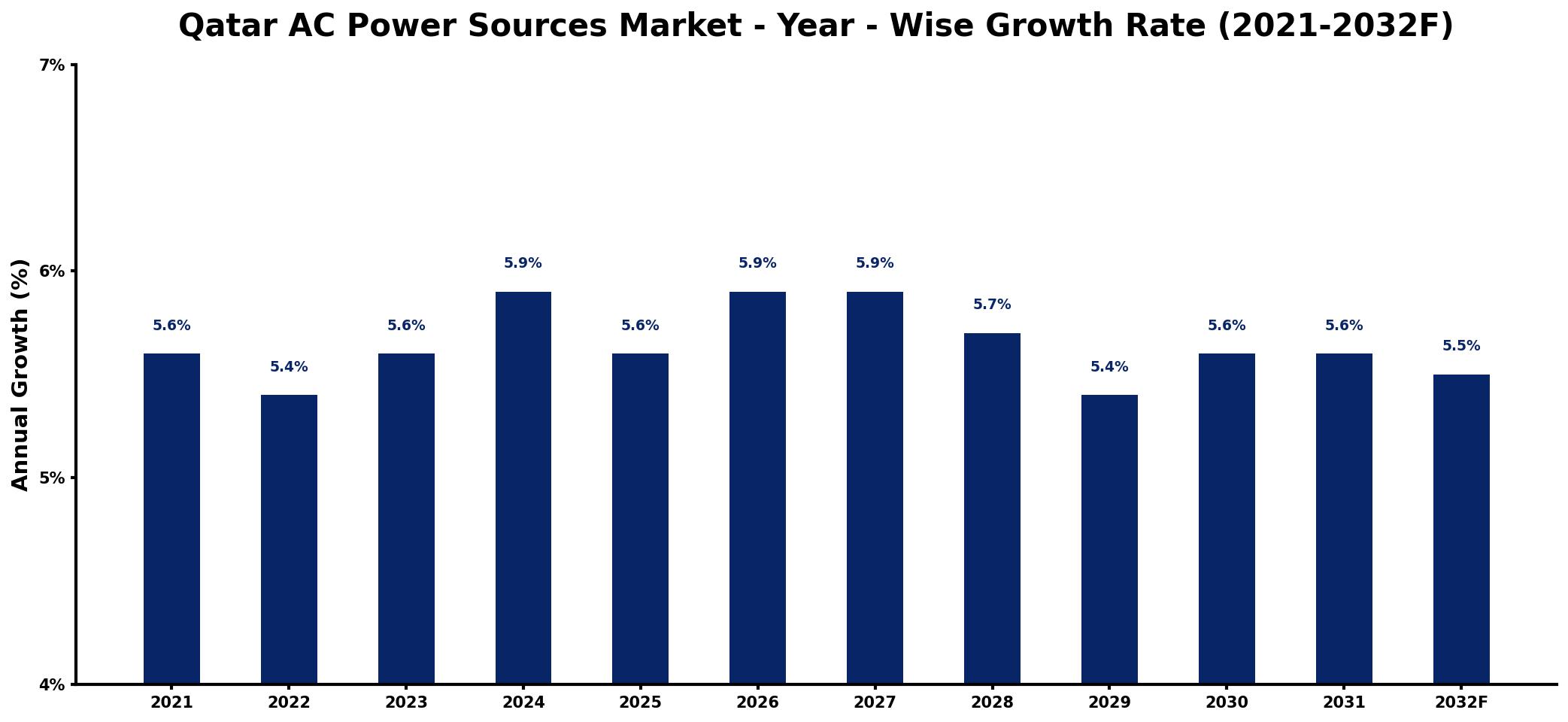
The table below presents the year‑wise growth rates along with the key drivers influencing the market
| Year | Growth Rate | Major Drivers |
| 2021 | 5.6% | Rising demand for renewable energy |
| 2022 | 5.4% | Increased investments in infrastructure |
| 2023 | 5.6% | Expansion of urban development projects |
| 2024 | 5.9% | Growing adoption of smart technologies |
| 2025 | 5.6% | Surge in industrial activity levels |
| 2026 | 5.9% | Enhanced government sustainability initiatives |
| 2027 | 5.9% | Growth in residential energy efficiency |
| 2028 | 5.7% | Rising awareness of environmental impact |
| 2029 | 5.4% | Demand for innovative energy solutions |
| 2030 | 5.6% | Increased focus on energy security |
| 2031 | 5.6% | growing emerging market penetration |
| 2032 | 5.5% | rising procurement volume requirements |
Note: Market size estimations and growth projections presented in this report are based on 6Wresearch's proprietary forecasting methodology, utilizing the latest available industry data, government publications, and primary research inputs.
Qatar AC Power Sources Market Synopsis
The push for industrial automation is the strongest force currently shaping the Qatar AC Power Sources Market. As sectors such as manufacturing and energy strive for enhanced operational efficiency, the demand for reliable and advanced AC power sources has surged significantly. This trend reflects Qatar's commitment to adopting cutting-edge technologies that enable precision and high performance in its industrial landscape.
Furthermore, the rapid adoption of smart technologies within the infrastructure development projects signifies a shift in demand for AC power solutions. Companies are increasingly integrating sophisticated power sources to improve their operational capabilities, particularly in smart grids and industrial applications, fostering the market's growth.
Qatar AC Power Sources Market Key Takeaways
- Robust growth forecast, driven by a focus on industrial automation and technological advancements.
- Significant demand across sectors, including manufacturing, automotive, and construction.
- Increased investments in smart technologies are shaping the landscape of power sources.
- Commitment to enhancing operational efficiency propels market adoption of advanced solutions.
- Long-term growth trajectory supported by governmental initiatives and infrastructure projects.
Evaluation of Restraints in Qatar AC Power Sources Market
Despite the favorable growth indicators, several constraints impede the Qatar AC Power Sources Market. A major challenge is the adaptation of existing infrastructure to accommodate emerging technologies, which can involve significant financial and logistical hurdles. Additionally, the market may face resistance from traditional sectors that are slow to transition from established practices to more modern power solutions. Furthermore, the need for skilled technical support and maintenance capabilities for advanced systems is critical, as gaps in expertise could hinder widespread implementation and operational effectiveness.
Qatar AC Power Sources Market Trends
Several current and emerging trends are shaping the demand for AC power sources in Qatar. One prominent trend is the integration of IoT and smart technologies in industrial applications, allowing for enhanced monitoring and control of power sources. Additionally, the rise of renewable energy initiatives is pushing for hybrid systems that combine traditional AC power sources with sustainable energy solutions. This dual approach not only improves efficiency but also aligns with Qatar's vision for a greener, more sustainable economy.
Qatar AC Power Sources Market Opportunities
Opportunities for growth in the Qatar AC Power Sources Market are abundant, particularly in sectors focusing on smart manufacturing and renewable energy. Investments in infrastructure projects, including the expansion of smart grids and high-tech manufacturing facilities, present potential avenues for market players. Moreover, as businesses increasingly prioritize energy efficiency and sustainable practices, the demand for innovative AC power solutions that offer both performance and eco-friendliness is likely to rise, providing ample scope for investment and development.
Government Initiatives in the Qatar AC Power Sources Market
The Qatari government has rolled out several initiatives aimed at fostering growth in the AC Power Sources Market. These initiatives include public spending on infrastructure and energy projects, as well as programs focused on enhancing manufacturing capabilities through advanced technologies. By promoting investment in industrial innovation and emphasizing sustainability, Qatar is positioning itself as a regional leader in modern energy solutions, thereby creating a conducive environment for market expansion.
Future Insights of the Qatar AC Power Sources Market
Looking ahead to 2026-2032, the Qatar AC Power Sources Market is poised for continued growth, supported by both technological advancements and government initiatives. As industries evolve and require more reliable and efficient power solutions, the market is likely to witness the emergence of cutting-edge innovations tailored to specific industrial needs. The collaboration between government entities and private sectors will further drive the adoption of sustainable practices and smart technologies, reinforcing Qatar's competitive stance on a global scale.
Qatar AC Power Sources Market Latest Developments (2025 - 2026)
In recent months, the Qatar AC Power Sources Market has seen a surge in strategic partnerships aimed at enhancing technology offerings within the sector. Key developments include initiatives focusing on integrating renewable energy sources into traditional power systems, reflecting the nation's shift towards a more sustainable energy framework. Moreover, advancements in smart technologies and automation are being prioritized, allowing businesses to streamline operations while improving energy efficiency.
Qatar AC Power Sources Market - Key Attractiveness of the Report
- 10 Years of Market Numbers
- Historical Data Starting from 2022 to 2025
- Base Year: 2025
- Forecast Data until 2032
- Key Performance Indicators Impacting the Market
- Major Upcoming Developments and Projects
Key Highlights of the Report:
- Qatar AC Power Sources Market Outlook
- Market Size of Qatar AC Power Sources Market, 2025
- Forecast of Qatar AC Power Sources Market, 2032
- Historical Data and Forecast of Qatar AC Power Sources Revenues & Volume for the Period 2022-2032F
- Qatar AC Power Sources Market Trend Evolution
- Qatar AC Power Sources Market Drivers and Challenges
- Qatar AC Power Sources Price Trends
- Qatar AC Power Sources Porter's Five Forces
- Qatar AC Power Sources Industry Life Cycle
- Historical Data and Forecast of Qatar AC Power Sources Market Revenues & Volume By Phase Type for the Period 2022-2032F
- Historical Data and Forecast of Qatar AC Power Sources Market Revenues & Volume By Single-phase for the Period 2022-2032F
- Historical Data and Forecast of Qatar AC Power Sources Market Revenues & Volume By Three-phase for the Period 2022-2032F
- Historical Data and Forecast of Qatar AC Power Sources Market Revenues & Volume By Modulation Type for the Period 2022-2032F
- Historical Data and Forecast of Qatar AC Power Sources Market Revenues & Volume By PWM for the Period 2022-2032F
- Historical Data and Forecast of Qatar AC Power Sources Market Revenues & Volume By Linear for the Period 2022-2032F
- Historical Data and Forecast of Qatar AC Power Sources Market Revenues & Volume By Application for the Period 2022-2032F
- Historical Data and Forecast of Qatar AC Power Sources Market Revenues & Volume By Aerospace for the Period 2022-2032F
- Historical Data and Forecast of Qatar AC Power Sources Market Revenues & Volume By Defense & Government Services for the Period 2022-2032F
- Historical Data and Forecast of Qatar AC Power Sources Market Revenues & Volume By Energy for the Period 2022-2032F
- Historical Data and Forecast of Qatar AC Power Sources Market Revenues & Volume By Wireless Communication & Infrastructure for the Period 2022-2032F
- Historical Data and Forecast of Qatar AC Power Sources Market Revenues & Volume By Consumer Electronics & Appliances for the Period 2022-2032F
- Historical Data and Forecast of Qatar AC Power Sources Market Revenues & Volume By Others for the Period 2022-2032F
- Qatar AC Power Sources Import Export Trade Statistics
- Market Opportunity Assessment By Phase Type
- Market Opportunity Assessment By Modulation Type
- Market Opportunity Assessment By Application
- Qatar AC Power Sources Top Companies Market Share
- Qatar AC Power Sources Competitive Benchmarking By Technical and Operational Parameters
- Qatar AC Power Sources Company Profiles
- Qatar AC Power Sources Key Strategic Recommendations






































