Qatar Acetic Acid Market Growth Rate
According to 6Wresearch internal databases and industry insights, the Qatar Acetic Acid Market is projected to grow at a steady compound annual growth rate (CAGR) of 3% during the forecast period 2026–2032.
Qatar Acetic Acid Market Year-wise Growth Rate and Key Drivers (2022–2032)
This graph illustrates the annual growth rates of the Qatar Acetic Acid Market from 2022 to 2032, highlighting a steady upward trajectory and projected market expansion over the forecast period.
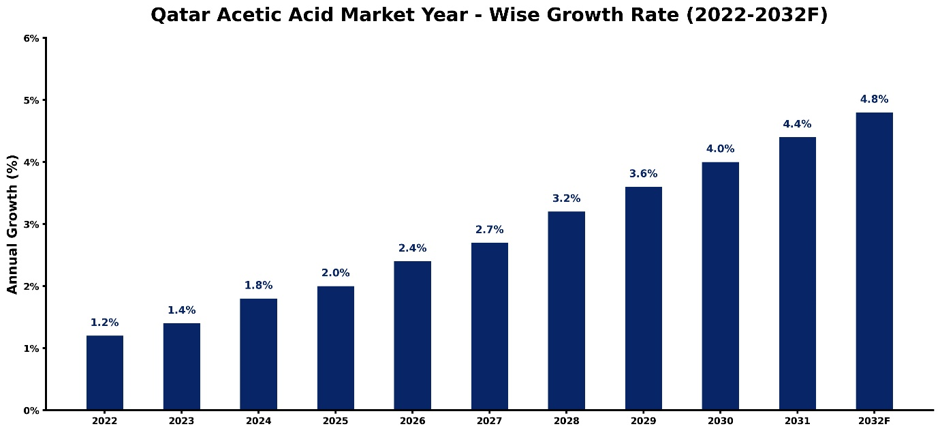
The following table summarizes the historical and forecasted growth rates of the Qatar Acetic Acid Market, along with the rationale behind each year’s performance.
| Year | Estimated Growth (%) | Market Rationale |
| 2022 | 1.2% | Market growth remained limited due to global chemical supply chain constraints, higher freight costs, and slower downstream manufacturing activity. |
| 2023 | 1.4% | Recovery in industrial production and improving demand from coatings, adhesives, and polymer-related industries supported gradual market improvement. |
| 2024 | 1.8% | Increased petrochemical sector activity and rising consumption of acetate-based chemicals contributed to stronger demand. |
| 2025 | 2% | Stable industrial output, expansion of manufacturing applications, and improved chemical trade activity supported market growth. |
| 2026 | 2.4% | Growth driven by increasing demand for VAM production, infrastructure-related coatings, and chemical processing applications. |
| 2027 | 2.7% | Higher utilization of petrochemical facilities and increasing downstream chemical integration support market expansion. |
| 2028 | 3.2% | Growing demand from packaging, adhesives, textiles, and specialty chemical applications strengthens consumption. |
| 2029 | 3.6% | Market growth remains steady as mature industrial applications balance against moderate capacity additions. |
| 2030 | 4% | Demand continues to expand through industrial diversification initiatives and chemical manufacturing investments. |
| 2031 | 4.4% | Growth stabilizes due to improved supply efficiency and gradual maturity of major end-use industries. |
| 2032 | 4.8% | Long-term demand remains supported by petrochemical integration and increasing regional chemical consumption. |
Topics Covered in the Qatar Acetic Acid Market Report
The Qatar Acetic Acid Market Report provides a comprehensive analysis based on Application. It offers detailed insights into key industry trends, growth drivers, emerging opportunities, competitive developments, and high-growth segments. The report presents an objective assessment of current dynamics and future prospects, enabling stakeholders to make informed business decisions and develop effective strategies aligned with the evolving industry landscape.
Qatar Acetic Acid Market Highlights
| Report Name | Qatar Acetic Acid Market |
| Forecast period | 2026–2032 |
| CAGR | 3% |
| Growing Sector | Vinyl Acetate Monomer (VAM) |
Qatar Acetic Acid Market Synopsis
In Qatar Acetic Acid Market, the acid is a key industrial organic acid widely used as a chemical intermediate in the production of vinyl acetate monomer (VAM), acetate esters, acetic anhydride, purified terephthalic acid (PTA), and various specialty chemicals. In Qatar, the market is closely linked with the country’s strong petrochemical ecosystem, availability of natural gas-based feedstock, and growing focus on downstream chemical value chains. Qatar’s chemical sector benefits from its position as one of the leading global natural gas producers, enabling competitive feedstock availability for methanol-to-acetic acid production routes.
Evaluation of Growth Drivers in Qatar Acetic Acid Market (2026–2032)
Below are major drivers influencing the market dynamics:
| Drivers | Primary Segment Affected | Why It Matters (Evidence) |
| Expansion of Petrochemical Downstream Activities | Industrial Chemical Manufacturers | Qatar’s strong natural gas ecosystem supports competitive chemical production, enabling greater integration of acetic acid into downstream manufacturing. |
| Rising Demand for Vinyl Acetate Monomer | Polymer & Adhesive Industry | VAM demand is increasing due to applications in adhesives, paints, coatings, and packaging materials. |
| Infrastructure and Construction Development | Coatings and Specialty Chemicals | Qatar’s infrastructure investments continue generating demand for paints, sealants, and construction chemicals containing acetate-based derivatives. |
| Growth of Packaging Manufacturing | Acetate Ester and Polymer Applications | Increasing consumption of flexible packaging and industrial films supports demand for chemical intermediates. |
| Industrial Diversification Programs | Chemical Processing Sector | Government-led diversification strategies encourage development of non-energy industries and value-added chemical production. |
Qatar Acetic Acid Market is projected to grow at a CAGR of 3% during 2026–2032, supported by increasing demand from downstream chemical industries and strengthening petrochemical integration. The market outlook persists to be positive as Qatar continues expanding manufacturing capabilities beyond upstream energy activities and the rising utilization of acetic acid derivatives in adhesives, coatings, polymers, and specialty chemicals will remain a key demand contributor. Vinyl acetate monomer applications are expected to maintain leadership due to their importance in producing polyvinyl acetate and ethylene-vinyl acetate products used across construction, packaging, and consumer industries.
Evaluation of Restraints in Qatar Acetic Acid Market
Below are major restraints affecting market development:
| Restraints | Primary Segment Affected | What This Means (Evidence) |
| Dependence on Global Chemical Demand Cycles | Export-Oriented Chemical Producers | International fluctuations in polymer and specialty chemical demand can impact production and pricing stability. |
| Limited Domestic Downstream Consumption | Specialty Chemical Applications | Qatar’s relatively smaller domestic manufacturing base limits immediate consumption growth compared with larger Asian chemical markets. |
| Raw Material Price Volatility | Chemical Producers | Changes in methanol and natural gas pricing can influence acetic acid production economics. |
| Competition from Regional Producers | Industrial Chemical Suppliers | Established chemical producers in the Middle East create competitive pressure on pricing and export opportunities. |
| Environmental Compliance Requirements | Chemical Manufacturing Companies | Increasing sustainability regulations require investments in emission reduction and cleaner production technologies. |
Qatar Acetic Acid Market Challenges
The Qatar Acetic Acid Industry faces challenges associated with maintaining competitiveness in a highly integrated global chemical industry. Although Qatar benefits from robust feedstock advantages, fluctuations in international chemical prices Persist to be a leading concern for producers and global acetic acid supply-demand cycles, especially from major Asian markets, influence regional pricing conditions. Another challenge is the limited scale of domestic downstream industries compared with chemical manufacturing hubs such as China, India, and Southeast Asia. Approximately a significant portion of regional chemical demand is driven by export markets, making producers dependent on international trade conditions. Qatar’s acetic acid market experiences price fluctuations of around 5–10% annually due to changes in feedstock costs, import dependency, and global chemical supply-demand conditions.
Qatar Acetic Acid Market Trends
Important trends shaping the Qatar Acetic Acid Market are detailed below:
- Increasing Integration of Petrochemical Value Chains: Qatar is focusing on converting raw hydrocarbon advantages into higher-value chemical products. This trend is encouraging investments in downstream chemical processing rather than relying only on raw material exports.
- Shift Toward Sustainable Chemical Production: Chemical producers are highly deploying energy-efficient processes and emission-control technologies to meet global environmental standards.
- Expansion of Specialty Chemical Applications: The requirement for acetate-based solvents and intermediates is rising owing to applications in coatings, pharmaceuticals, and industrial formulations.
- Increasing Regional Chemical Trade Activity: Qatar’s strategic location supports chemical exports across Asia, Africa, and neighbouring Middle Eastern markets.
Investment Opportunities in the Qatar Acetic Acid Market
Attractive investment opportunities within the Qatar Acetic Acid Market include the following:
- Development of Downstream Chemical Manufacturing Facilities: Investment opportunities are present in expanding downstream industries that consume acetic acid derivatives.
- Growth Opportunities in Vinyl Acetate Monomer Production: Rising need for construction materials, packaging solutions, and industrial adhesives makes various prospects for VAM-related investments.
- Regional Export Development: Qatar’s geographic position gives opportunities for supplying chemical products to evolving markets across the Middle East, Africa, and Asia.
Top Players in Qatar Acetic Acid Market
A list of leading companies operating in the Qatar Acetic Acid Market is presented below:
1. Celanese Corporation
| Company Name | Celanese Corporation |
|---|---|
| Established Year | 1918 |
| Headquarters | Irving, Texas, United States |
| Official Website | Click Here |
Celanese Corporation is one of the world’s largest producers of acetic acid and acetyl-based products, holding a robust position in the global chemicals industry.
2. SABIC
| Company Name | SABIC |
|---|---|
| Established Year | 1976 |
| Headquarters | Riyadh, Saudi Arabia |
| Official Website | Click Here |
SABIC is one of the largest petrochemical companies in the Middle East and a major regional supplier of chemical products, including acetic acid derivatives and industrial intermediates.
3. Qatar Chemical Company Ltd. (Q-Chem)
| Company Name | Qatar Chemical Company Ltd. (Q-Chem) |
|---|---|
| Established Year | 1997 |
| Headquarters | Mesaieed Industrial City, Qatar |
| Official Website | Click Here |
Qatar Chemical Company Ltd. (Q-Chem) is a major domestic petrochemical producer and an important contributor to Qatar’s industrial chemical sector.
4. INEOS
| Company Name | INEOS |
|---|---|
| Established Year | 1998 |
| Headquarters | London, United Kingdom |
| Official Website | Click Here |
INEOS is among the world’s largest chemical producers, functioning across multiple segments including petrochemicals, specialty chemicals, and intermediate products.
5. BASF
| Company Name | BASF |
|---|---|
| Established Year | 1865 |
| Headquarters | Ludwigshafen, Germany |
| Official Website | Click Here |
BASF is one of the world’s largest chemical companies, supplying a broad range of organic acids, intermediates, and specialty chemical solutions for industrial applications.
Government Initiatives Being Implemented in the Qatar Acetic Acid Market
According to Qatar’s government data, the Qatar Acetic Acid Market is supported by government initiatives. These initiatives are highly focused on solidifying petrochemical capabilities, augmenting industrial diversification, and increasing value-added manufacturing and under the framework of Qatar’s long-term economic development strategy, authorities are supporting the spread of non-energy industries by utilizing the country’s natural gas resources for advanced chemical production. One major initiative is the advancement of integrated industrial zones such as Mesaieed Industrial City. It is where petrochemical companies function alongside supporting infrastructure, logistics facilities, and chemical processing units.
Future Insights of the Qatar Acetic Acid Market
The Qatar Acetic Acid Market Growth is expected to experience stability between 2026 and 2032. It is supported by expanding downstream chemical applications and increasing industrial integration and the market will continue benefiting from Qatar’s competitive natural gas position. It will give various advantages for chemical production economics and vinyl acetate monomer is predicted to remain the leading application area. This is owing to its large usage in adhesives, paints, coatings, and polymer products. With construction and manufacturing activities continuing across the region, the requirement for acetate-based materials is projected to remain resilient. Qatar’s chemical manufacturing sector is expected to expand significantly, with downstream industries contributing over 50% of regional chemical demand growth through increased use of acetate-based materials.
Market Segmentation Analysis
This report presents a detailed analysis of the market segments along with their leading categories.
By Application – Vinyl Acetate Monomer Dominates Market, Specialty Applications Maintain Steady Expansion
According to Sumit Sagar, Senior Research Analyst, 6Wresearch, Vinyl Acetate Monomer (VAM) represented the dominant application segment of the Qatar Acetic Acid Market in 2025. It is supported by strong demand from adhesives, coatings, paints, packaging films, and polymer manufacturing industries. The segment is projected to expand at a CAGR of 2.7% during 2026–2032. Vinyl Acetate Monomer (VAM) accounted for an estimated 55% of the Qatar Acetic Acid Market Share in 2025. Acetic anhydride is expected to remain the second-important application area, supported by demand from pharmaceuticals, cellulose acetate production, and specialty chemical manufacturing. The segment accounted for an estimated 18.4% share in 2025 and is projected to grow at around 2.3% CAGR through 2032.
Note: Market size estimations and growth projections presented in this report are based on 6Wresearch's proprietary forecasting methodology, utilizing the latest available industry data, government publications, and primary research inputs.
Key Attractiveness of the Report:
- 10 Years of Market Numbers
- Historical Data Starting from 2022 to 2025
- Base Year: 2025
- Forecast Data until 2032
- Key Performance Indicators Impacting the Market
- Major Upcoming Developments and Projects
Key Highlights of the Report:
- Qatar Acetic Acid Market Outlook
- Market Size of Qatar Acetic Acid Market, 2025
- Forecast of Qatar Acetic Acid Market, 2032
- Historical Data and Forecast of Qatar Acetic Acid Revenues & Volume for the Period 2022-2032
- Qatar Acetic Acid Market Trend Evolution
- Qatar Acetic Acid Market Drivers and Challenges
- Qatar Acetic Acid Price Trends
- Qatar Acetic Acid Porter's Five Forces
- Qatar Acetic Acid Industry Life Cycle
- Historical Data and Forecast of Qatar Acetic Acid Market Revenues & Volume By Application for the Period 2022-2032
- Historical Data and Forecast of Qatar Acetic Acid Market Revenues & Volume By Vinyl Acetate Monomer for the Period 2022-2032
- Historical Data and Forecast of Qatar Acetic Acid Market Revenues & Volume By Acetic Anhydride for the Period 2022-2032
- Historical Data and Forecast of Qatar Acetic Acid Market Revenues & Volume By Acetate Esters for the Period 2022-2032
- Historical Data and Forecast of Qatar Acetic Acid Market Revenues & Volume By Purified Terephthalic Acid for the Period 2022-2032
- Historical Data and Forecast of Qatar Acetic Acid Market Revenues & Volume By Ethanol for the Period 2022-2032
- Historical Data and Forecast of Qatar Acetic Acid Market Revenues & Volume By Other Application for the Period 2022-2032
- Qatar Acetic Acid Import Export Trade Statistics
- Market Opportunity Assessment By Application
- Qatar Acetic Acid Top Companies Market Share
- Qatar Acetic Acid Competitive Benchmarking By Technical and Operational Parameters
- Qatar Acetic Acid Company Profiles
- Qatar Acetic Acid Key Strategic Recommendations
Market Covered
The report provides an extensive study of the following market segments:
By Application
- Vinyl Acetate Monomer (VAM)
- Acetic Anhydride
- Acetate Esters
- Purified Terephthalic Acid (PTA)
- Ethanol
- Other Applications






































