Qatar Acetone Market Growth Rate
According to 6Wresearch internal databases and industry insights, the Qatar Acetone Market is projected to grow at a compound annual growth rate (CAGR) of 5.3% during the forecast period 2026–2032.
Qatar Acetone Market Year-wise Growth Rate and Key Drivers (2022–2032)
This graph illustrates the annual growth rates of the Qatar Acetone Market from 2022 to 2032, highlighting a steady upward trajectory and projected market expansion over the forecast period.
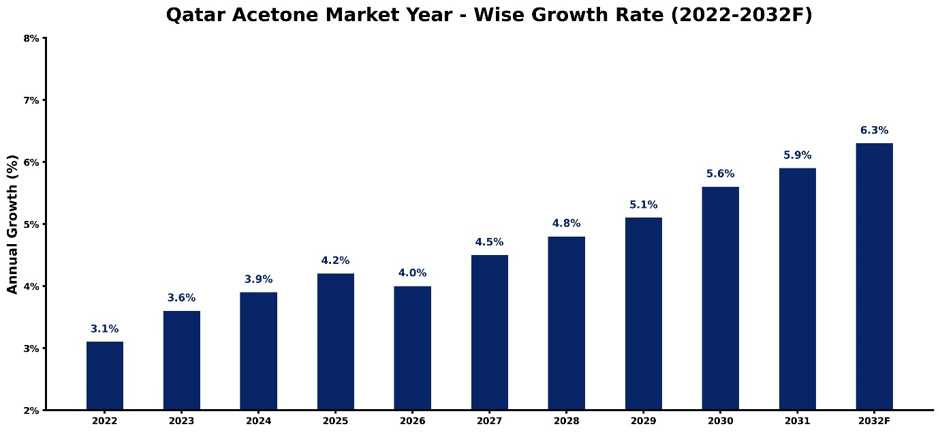
The following table summarizes the historical and forecasted growth rates of the Qatar Acetone Market, along with the rationale behind each year’s performance.
| Year | Estimated Growth (%) | Market Rationale |
| 2022 | 3.1% | Market recovery was supported by improving industrial operations after pandemic-related disruptions, with demand gradually increasing from coatings and chemical processing sectors. |
| 2023 | 3.6% | Growth accelerated due to infrastructure projects, higher construction activity, and increased consumption of solvent-based products. |
| 2024 | 3.9% | Rising demand from paints, coatings, and plastics industries supported market expansion, while chemical manufacturing investments strengthened supply stability. |
| 2025 | 4.2% | Market growth was driven by stronger industrial output, increasing import activity, and higher acetone consumption in pharmaceutical and cosmetic manufacturing. |
| 2026 | 4% | Growth remains steady as industrial demand expands, supported by construction development and diversification of Qatar’s chemical sector. |
| 2027 | 4.5% | Increased utilization of acetone in specialty chemicals, adhesives, and polymer applications contributes to consistent market progression. |
| 2028 | 4.8% | Expansion of manufacturing facilities and rising demand for high-quality solvents support market growth. |
| 2029 | 5.1% | Growing downstream chemical applications and increased demand from electronics and automotive-related industries enhance consumption. |
| 2030 | 5.6% | Market maintains stable growth due to continued industrial investment and broader adoption of acetone-based formulations. |
| 2031 | 5.9% | Mature demand patterns in major end-use industries result in moderate but consistent market development. |
| 2032 | 6.3% | Long-term growth is supported by industrial diversification, chemical sector advancement, and increasing specialty application requirements. |
Topics Covered in the Qatar Acetone Market Report
The Qatar Acetone Market Report provides a comprehensive analysis based on Application, and End User. It offers detailed insights into key industry trends, growth drivers, emerging opportunities, competitive developments, and high-growth segments. The report presents an objective assessment of current dynamics and future prospects, enabling stakeholders to make informed business decisions and develop effective strategies aligned with the evolving industry landscape.
Qatar Acetone Market Highlights
| Report Name | Qatar Acetone Market |
| Forecast period | 2026–2032 |
| CAGR | 5.3% |
| Growing Sector | Solvent Applications |
Qatar Acetone Market Synopsis
The Qatar Acetone Market showcases the demand, supply, and consumption dynamics of acetone, a volatile organic compound broadly utilised as an industrial solvent and chemical intermediate and acetone is a clear, highly flammable liquid primarily utilized for dissolving paints, coatings, adhesives, resins, plastics, and pharmaceutical ingredients. It also serves as an important raw material in the production of Bisphenol A (BPA) and Methyl Methacrylate (MMA). These are essential components in polycarbonate plastics, acrylic sheets, and specialty polymers, and in Qatar, acetone demand is closely related with construction activities, industrial manufacturing, petrochemical development, and consumer product manufacturing.
Evaluation of Growth Drivers in Qatar Acetone Market (2026–2032)
Below are some major drivers and their influence on the market dynamics:
| Drivers | Primary Segment Affected | Why It Matters (Evidence) |
| Expansion of Construction and Infrastructure Activities | Paints & Coatings | Qatar’s continuous infrastructure development increases demand for acetone-based coating solvents used in protective paints, industrial coatings, and surface treatment applications. |
| Growth of Chemical and Petrochemical Processing | BPA & MMA Production | Expansion of downstream chemical industries increases the requirement for acetone as a feedstock and processing chemical. |
| Increasing Pharmaceutical Manufacturing Activities | Pharmaceuticals | Acetone is widely used for extraction, purification, and formulation processes, supporting demand from pharmaceutical producers. |
| Rising Cosmetic and Personal Care Consumption | Cosmetics | Growing demand for nail polish removers, cosmetic formulations, and personal care products contributes to acetone consumption. |
| Development of Specialty Manufacturing Industries | Adhesives and Electronics | Increasing adoption of high-performance adhesives and cleaning solvents in electronics manufacturing supports market opportunities. |
The Qatar Acetone Market is projected to grow at a CAGR of 5.3% during 2026–2032. It is supported by expanding industrial applications and rising need from solvent-intensive sectors, and the solvent-application segment is predicted to maintain its leading position. This is owing to broad usage of acetone in coatings, cleaning agents, adhesives, and chemical processing, and Qatar’s investment in industrial diversification initiatives is expected to augment demand from downstream chemical industries. Whereas rising pharmaceutical and consumer product manufacturing activities will further solidify Qatar Acetone Market Growth.
Evaluation of Restraints in Qatar Acetone Market
Below are some major restraints and their influence on the market dynamics:
| Restraints | Primary Segment Affected | What This Means (Evidence) |
| Dependence on Imported Acetone Supply | Industrial Users | Qatar’s acetone market remains influenced by international supply conditions, creating exposure to logistics disruptions and price fluctuations. |
| Volatility in Raw Material Prices | Chemical Manufacturers | Acetone production is linked with petrochemical feedstocks, making market pricing sensitive to crude oil and propylene price movements. |
| Strict Environmental Regulations | Paints & Coatings | Increasing regulations regarding volatile organic compound (VOC) emissions may encourage industries to shift toward alternative solvents. |
| Limited Domestic Production Capacity | Specialty Chemical Users | Lower local production availability raises reliance on regional suppliers. |
| Storage and Handling Challenges | Distributors and End Users | Acetone’s highly flammable nature needs specialized storage facilities. |
Qatar Acetone Market Challenges
The Qatar Acetone Industry goes through various challenges. It has accelerated growth patterns during the forecast period, and the main challenge is the country’s reliance on imported acetone supplies. This exposes end users to global price fluctuations, transportation costs, and supply chain uncertainties, and rising environmental issues regarding VOC emissions are supporting industries to explore alternative solvents and water-based formulations.
Another challenge is maintaining compliance with industrial safety regulations owing to acetone’s high volatility and flammability. Qatar imports more than 90% of its chemical requirements, increasing the acetone industry’s exposure to international supply chain disruptions, transportation costs, and price fluctuations. Acetone demand in the chemical industry is driven by solvent applications, with industrial solvents accounting for more than 50% of global acetone consumption.
Qatar Acetone Market Trends
Principal trends driving growth in the Qatar Acetone Market are outlined below:
- Increasing Preference for High-Purity Acetone in Specialty Applications: Demand for high-purity acetone is increasing across pharmaceutical, electronics, and laboratory applications due to its superior cleaning performance and low impurity levels.
- Rising Utilization in Construction-Related Coatings and Surface Treatments: Qatar’s ongoing infrastructure development is supporting higher intake of acetone-based solvents.
- Expansion of Downstream Chemical Manufacturing: The creation of downstream chemical industries is making new opportunities for acetone consumption.
- Growing Demand from Pharmaceutical and Healthcare Manufacturing: The pharmaceutical sector is becoming an important consumer of acetone owing to its role as a processing solvent in drug manufacturing and extraction procedures.
Investment Opportunities in the Qatar Acetone Market
Strategic investment opportunities in the Qatar Acetone Market include the following:
- Development of Local Chemical Distribution Networks: Fund allocation in regional storage facilities and distribution infrastructure can augment acetone attainability.
- Expansion into Specialty-Grade Acetone Supply: Investors can concentrate on supplying pharmaceutical-grade and electronic-grade acetone, which cater to increased margins compared with conventional industrial-grade products.
- Integration with Qatar’s Downstream Petrochemical Sector: Prospects lie for companies allocating funds in acetone-related chemical processing and downstream applications.
Top Players in Qatar Acetone Market
Below are some of the leading companies operating in the Qatar acetone market:
1. INEOS Phenol
| Company Name | INEOS Phenol |
|---|---|
| Established Year | 1998 |
| Headquarters | Lyndhurst, United Kingdom |
| Official Website | Click Here |
One of the world’s largest producers of phenol and acetone, catering chemical intermediates for solvents, coatings, plastics, and industrial applications across global markets.
2. SABIC (Saudi Basic Industries Corporation)
| Company Name | SABIC (Saudi Basic Industries Corporation) |
|---|---|
| Established Year | 1976 |
| Headquarters | Riyadh, Saudi Arabia |
| Official Website | Click Here |
A major Middle Eastern petrochemical supplier giving acetone, solvents, and base chemicals to downstream industries in Qatar and regional markets.
3. LG Chem
| Company Name | LG Chem |
|---|---|
| Established Year | 1947 |
| Headquarters | Seoul, South Korea |
| Official Website | Click Here |
A major chemical manufacturer exporting acetone and specialty chemical solutions used in polymers, coatings, electronics, and industrial applications.
4. Shell Chemicals (Shell plc)
| Company Name | Shell Chemicals (Shell plc) |
|---|---|
| Established Year | 1907 |
| Headquarters | London, United Kingdom |
| Official Website | Click Here |
A worldwide petrochemical supplier producing acetone, phenol, and chemical intermediates through integrated manufacturing and distribution networks.
5. Mitsubishi Chemical Group Corporation
| Company Name | Mitsubishi Chemical Group Corporation |
|---|---|
| Established Year | 1933 |
| Headquarters | Tokyo, Japan |
| Official Website | Click Here |
A major chemical producer supplying high-quality acetone and derivatives for polymer manufacturing, coatings, adhesives, and industrial processing applications.
Government Initiatives Being Implemented in the Qatar Acetone Market
According to Qatar’s government data, they are focusing on industrial diversification, manufacturing development, and solidifying the chemical sector. This is being done via initiatives having the objective of decreasing reliance on traditional energy revenues. Programs aligned with Qatar National Vision 2030 are supporting fund allocation in advanced manufacturing, petrochemical expansion, and downstream industries. Government-backed industrial zones such as Qatar Free Zones and Qatar Science & Technology Park support companies engaged in chemical research, manufacturing, and technology-driven industrial activities.
Future Insights of the Qatar Acetone Market
The Qatar Acetone Market is predicted to demonstrate steady growth through 2032. It is supported by expanding industrial applications and increasing demand from solvent-intensive industries, and the market outlook remains positive as Qatar continues to strengthen its manufacturing capabilities and augment downstream chemical production. The solvent application segment is predicted to remain the primary revenue contributor owing to broad usage in paints, coatings, adhesives, and cleaning applications. Meanwhile, BPA and MMA applications are predicted to experience increasing demand as polymers. The solvent application segment accounts for more than 50% of global acetone consumption, driven by extensive use in paints, coatings, adhesives, and industrial cleaning applications.
Market Segmentation Analysis
This report offers a comprehensive study of the following market segments and their leading categories:
By Application – Solvent Segment Dominates Qatar Acetone Market, BPA and MMA Applications Show Expanding Potential
According to Sumit Sagar, Senior Research Analyst, 6Wresearch, the solvent application segment dominated the Qatar acetone market, accounting for approximately 56.80% of the Qatar Acetone Market Share in 2025, supported by extensive utilisation of acetone as a cleaning agent, degreasing solvent, paint thinner, adhesive remover, and processing chemical across industrial applications. Meanwhile, the Methyl Methacrylate (MMA) segment is expected to register notable growth with a CAGR of 4.60% during 2026–2032, spurred by increasing demand for acrylic materials and speciality applications.
By End-Use – Paints & Coatings Lead Qatar Acetone Consumption, Pharmaceuticals and Electronics Drive Future Growth
The paints & coatings segment held 28.40% of market share in 2025. The segment is expected to expand at a CAGR of 4.35% during 2026–2032, supported by continuous construction activity. The pharmaceuticals segment is projected to experience strong growth with a CAGR of 4.75% during 2026–2032, supported by increasing healthcare investments.
Note: Market size estimations and growth projections presented in this report are based on 6Wresearch's proprietary forecasting methodology, utilizing the latest available industry data, government publications, and primary research inputs.
Key Attractiveness of the Report:
- 10 Years of Market Numbers
- Historical Data Starting from 2022 to 2025
- Base Year: 2025
- Forecast Data until 2032
- Key Performance Indicators Impacting the Market
- Major Upcoming Developments and Projects
Key Highlights of the Report:
- Qatar Acetone Market Outlook
- Market Size of Qatar Acetone Market, 2025
- Forecast of Qatar Acetone Market, 2032
- Historical Data and Forecast of Qatar Acetone Revenues & Volume for the Period 2022-2032
- Qatar Acetone Market Trend Evolution
- Qatar Acetone Market Drivers and Challenges
- Qatar Acetone Price Trends
- Qatar Acetone Porter's Five Forces
- Qatar Acetone Industry Life Cycle
- Historical Data and Forecast of Qatar Acetone Market Revenues & Volume By Application for the Period 2022-2032
- Historical Data and Forecast of Qatar Acetone Market Revenues & Volume By Solvent for the Period 2022-2032
- Historical Data and Forecast of Qatar Acetone Market Revenues & Volume By Bisphenol A (BPA) for the Period 2022-2032
- Historical Data and Forecast of Qatar Acetone Market Revenues & Volume By Methyl Methacrylate (MMA) for the Period 2022-2032
- Historical Data and Forecast of Qatar Acetone Market Revenues & Volume By Others for the Period 2022-2032
- Historical Data and Forecast of Qatar Acetone Market Revenues & Volume By End-Use for the Period 2022-2032
- Historical Data and Forecast of Qatar Acetone Market Revenues & Volume By Paints & Coatings for the Period 2022-2032
- Historical Data and Forecast of Qatar Acetone Market Revenues & Volume By Plastic for the Period 2022-2032
- Historical Data and Forecast of Qatar Acetone Market Revenues & Volume By Automotive for the Period 2022-2032
- Historical Data and Forecast of Qatar Acetone Market Revenues & Volume By Adhesives for the Period 2022-2032
- Historical Data and Forecast of Qatar Acetone Market Revenues & Volume By Pharmaceuticals for the Period 2022-2032
- Historical Data and Forecast of Qatar Acetone Market Revenues & Volume By Cosmetics for the Period 2022-2032
- Historical Data and Forecast of Qatar Acetone Market Revenues & Volume By Electrical & Electronics for the Period 2022-2032
- Historical Data and Forecast of Qatar Acetone Market Revenues & Volume By Others for the Period 2022-2032
- Qatar Acetone Import Export Trade Statistics
- Market Opportunity Assessment By Application
- Market Opportunity Assessment By End-Use
- Qatar Acetone Top Companies Market Share
- Qatar Acetone Competitive Benchmarking By Technical and Operational Parameters
- Qatar Acetone Company Profiles
- Qatar Acetone Key Strategic Recommendations
Market Covered
The report offers a comprehensive study of the following market segments and their leading categories:
By Application
- Solvent
- Bisphenol A (BPA)
- Methyl Methacrylate (MMA)
- Others
By End-Use
- Paints & Coatings
- Plastic
- Automotive
- Adhesives
- Pharmaceuticals
- Cosmetics
- Electrical & Electronics
- Others






































