Qatar Acrylate Monomers Market Growth Rate
According to 6Wresearch internal databases and industry insights, the Qatar Acrylate Monomers Market is projected to grow at a steady compound annual growth rate (CAGR) of approximately 5.1% during the forecast period 2026–2032.
Qatar Acrylate Monomers Market Year-wise Growth Rate and Key Drivers (2022–2032)
This graph illustrates the annual growth rates of the Qatar Acrylate Monomers Market from 2022 to 2032, highlighting a steady upward trajectory and projected market expansion over the forecast period.
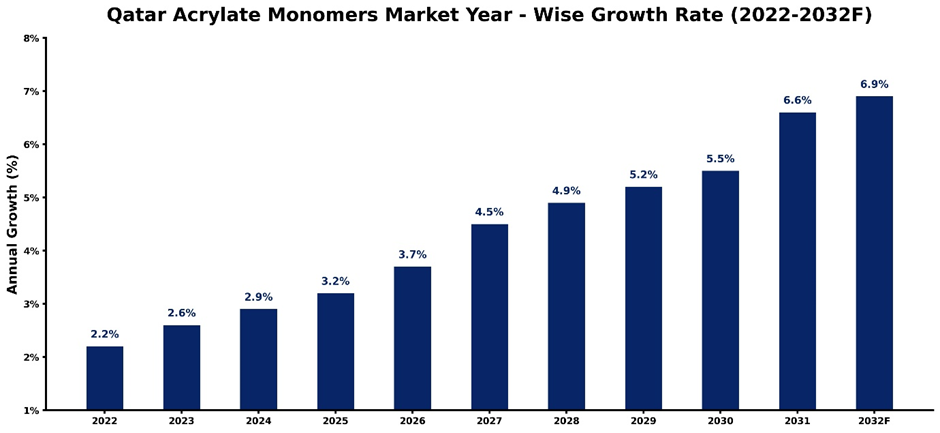 The following table summarizes the historical and forecasted growth rates of the Qatar Acrylate Monomers Market, along with the rationale behind each year’s performance.
| Year | Estimated Growth (%) | Market Rationale |
| 2022 | 2.2% | Market growth remained limited due to supply chain disruptions and fluctuations in international chemical availability. |
| 2023 | 2.6% | Demand improved with increasing consumption of acrylic materials in coatings, adhesives, and industrial applications. |
| 2024 | 2.9% | Growth was supported by construction activities and rising demand for polymer-based materials. |
| 2025 | 3.2% | Market expansion increased due to higher utilization of acrylic coatings, plastics, and specialty formulations. |
| 2026 | 3.7% | Growth is supported by infrastructure projects, industrial manufacturing, and increasing demand for acrylic polymers. |
| 2027 | 4.5% | Rising consumption in paints, coatings, and adhesive applications contributes to market development. |
| 2028 | 4.9% | Increased adoption of advanced polymer materials supports higher acrylate monomer consumption. |
| 2029 | 5.2% | Demand growth is driven by industrial diversification and expanding chemical applications. |
| 2030 | 5.5% | Stronger construction and manufacturing activities support market expansion. |
| 2031 | 6.6% | Growing preference for durable coatings and specialty acrylic formulations drives demand. |
| 2032 | 6.9% | Long-term market growth continues due to increasing use across multiple industrial applications. |
Topics Covered in the Qatar Acrylate Monomers Market Report
The Qatar Acrylate Monomers Market Report provides a comprehensive analysis based on type and application. It offers detailed insights into key industry trends, growth drivers, emerging opportunities, competitive developments, and high-growth segments. The report presents an objective assessment of current dynamics and future prospects, enabling stakeholders to make informed business decisions and develop effective strategies aligned with the evolving industry landscape.
Qatar Acrylate Monomers Market Highlights
| Report Name | Qatar Acrylate Monomers Market |
| Forecast period | 2026-2032 |
| CAGR | 5.1% |
| Growing Sector | Paints and Coatings & Adhesive Applications |
Qatar Acrylate Monomers Market Synopsis
The Qatar Acrylate Monomers Market is expected to grow at a steady pace during 2026–2032. The Acrylate Monomers Market focuses on chemical intermediates such as Butyl Acrylate, Ethyl Acrylate, Ethylhexyl Acrylate, and Methyl Acrylate, which are widely used in manufacturing acrylic polymers, coatings, adhesives, plastics, and printing inks. The market supported by rising demand for acrylic-based materials, expanding construction activities, and increasing industrial applications and they help in accelerating Qatar Acrylate Monomers Market Growth.
Evaluation of Growth Drivers in Qatar Acrylate Monomers Market (2026–2032)
Below are some major drivers and their influence on the market dynamics:
| Drivers | Primary Segment Affected | Why It Matters (Evidence) |
| Expansion of Construction and Infrastructure Projects | Paints and Coatings | Growing infrastructure development increases demand for acrylic coatings, protective finishes, and construction materials. |
| Rising Demand for Acrylic-Based Adhesives | Adhesives Industry | Acrylic monomers facilitate production of high-performance adhesives utilised in construction, packaging, and industrial applications. |
| Growth in Industrial Manufacturing | Plastics and Specialty Materials | Rising industrial activities maker rising requirements for polymer-based materials. |
| Increasing Use of Protective Coatings | Coating Manufacturers | Acrylate-based coatings cater weather resistance and surface protection, promoting industrial and architectural applications. |
| Development of Specialty Polymer Solutions | Chemical and Manufacturing Sector | Industries are deploying advanced acrylic formulations to augment product performance and efficiency. |
The Qatar Acrylate Monomers Market is projected to grow at a compound annual growth rate (CAGR) of 5.1% during 2026–2032, proliferated by increasing utilisation from paints and coatings, adhesives, plastics, and printing ink industries. Qatar’s infrastructure expansion, industrial diversification programs, and rising need for durable polymer materials are predicted to support the advancement of Qatar Acrylate Monomers Market. Increasing deployment of acrylic-based solutions for construction, automotive-related materials, and industrial applications will further solidify market prospects. Rising need for premium-performance and sustainable polymer formulations is expected to support creative innovation.
Evaluation of Restraints in Qatar Acrylate Monomers Market
Below are some major restraints and their influence on market dynamics:
| Restraints | Primary Segment Affected | What This Means (Evidence) |
| Dependence on Imported Chemical Materials | Chemical Manufacturers and End Users | Reliance on international suppliers increases exposure to supply disruptions and price fluctuations. |
| Raw Material Price Volatility | Producers and Distributors | Changes in petrochemical feedstock costs directly accelerate acrylate monomer production prices. |
| Environmental Regulations | Coating and Adhesive Manufacturers | Rising concentration on VOC reduction needs companies to create compliant formulations. |
| Limited Domestic Manufacturing Capacity | Industrial Users | Qatar’s specialized chemical production base persist to be limited, increasing import dependency. |
| Availability of Alternative Materials | End-Use Industries | Bio-based polymers and alternative chemical solutions may decrease need in certain applications. |
Qatar Acrylate Monomers Market Challenges
The Qatar Acrylate Monomers Industry faces challenges related to supply chain dependency, environmental compliance, and raw material cost fluctuations. Since acrylate monomers are mainly derived from petrochemical feedstocks, changes in crude oil prices and worldwide chemical market conditions can directly affect the prices of production. Another leading challenge is Qatar’s shortage of domestic manufacturing capacity for specialized acrylic intermediates, which raises reliance on suppliers globally. Reliance on imports reveals market participants to transportation delays and fluctuations in global attainability.
Qatar Acrylate Monomers Market Trends
Key developments impacting the Qatar Acrylate Monomers Market are highlighted below:
- Increasing Demand for High-Performance Coatings: The demand for acrylate monomers is increasing as manufacturers adopt acrylic coatings for infrastructure, industrial equipment, and commercial buildings due to their durability, weather resistance, and long service life.
- Growing Adoption of Acrylic Adhesive Solutions: Industries are enormously utilizing acrylic-based adhesives in construction and industrial assembly applications due to their robust bonding capability.
- Rising Preference for Sustainable Polymer Formulations: Chemical manufacturers are concentrating on creating environmentally improved acrylic materials.
- Expansion of Specialty Plastic Applications: Acrylate monomers are getting significance in plastic manufacturing owing to their ability to enrich flexibility in polymer products.
Investment Opportunities in the Qatar Acrylate Monomers Market
Key areas of investment potential in the Qatar Acrylate Monomers Market are outlined below:
- Development of Local Chemical Distribution Infrastructure: To decrease reliability on international suppliers, money allocation in storage facilities, chemical logistics, and regional supply networks
- Expansion of Downstream Acrylic Polymer Production: Launching local polymer processing capabilities can make prospects by converting imported monomers into higher-value acrylic products.
- Advanced Low-VOC Coating Technologies: Companies are allocating funds in environmentally compliant acrylic coating solutions can advantage from increasing need for sustainable construction materials.
Top Players in Qatar Acrylate Monomers Market
The following is a comprehensive list of key companies operating in the Qatar Acrylate Monomers Market:
1. BASF
| Company Name | BASF |
|---|---|
| Established Year | 1865 |
| Headquarters | Ludwigshafen, Germany |
| Official Website | Click Here |
BASF is a global chemical company catering acrylic monomers, polymer dispersions, and specialty chemical solutions used in coatings, adhesives, plastics, and industrial applications.
2. Dow Inc.
| Company Name | Dow Inc. |
|---|---|
| Established Year | 1897 |
| Headquarters | Midland, Michigan, USA |
| Official Website | Click Here |
Dow creates advanced material solutions, including acrylic-based polymers and specialty chemicals used in coatings, adhesives, packaging, and industrial applications.
3. Arkema
| Company Name | Arkema |
|---|---|
| Established Year | 2004 |
| Headquarters | Colombes, France |
| Official Website | Click Here |
Arkema specializes in specialty chemicals and advanced materials, including acrylic monomers and polymer solutions.
4. Mitsubishi Chemical Group
| Company Name | Mitsubishi Chemical Group |
|---|---|
| Established Year | 1933 |
| Headquarters | Tokyo, Japan |
| Official Website | Click Here |
Mitsubishi Chemical Group provides specialty materials and chemical solutions utilised in polymer manufacturing and industrial applications.
5. Evonik Industries
| Company Name | Evonik Industries |
|---|---|
| Established Year | 2007 |
| Headquarters | Essen, Germany |
| Official Website | Click Here |
Evonik creates specialty chemicals and performance materials used in coatings, adhesives, plastics, and industrial formulations.
Government Initiatives Being Implemented in Qatar Acrylate Monomers Market
According to Qatar’s government data, initiatives related to industrial development, infrastructure expansion, and economic diversification are expected to indirectly support the Qatar Acrylate Monomers Market. The country’s emphasis on solidifying non-hydrocarbon industries and creating advanced manufacturing capabilities is making increased need for specialty chemical materials. Under Qatar National Vision 2030, the government is supporting industrial diversification, private-sector growth, and sustainable development and these initiatives support construction, and chemical-related industries that make use of acrylate monomer-based products.
Future Insights of the Qatar Acrylate Monomers Market
The Qatar Acrylate Monomers Market is expected to witness steady expansion through 2032, supported by increasing demand from paints and coatings, adhesives, plastics, and printing ink applications. The market growth will be influenced by Qatar’s infrastructure development, industrial diversification, and rising adoption of advanced polymer materials across various sectors.
Future demand is expected to remain strong as industries increasingly utilize acrylate monomers for producing durable coatings, flexible adhesives, and high-performance polymer solutions. Growing construction activities, industrial manufacturing, and the need for improved material performance will continue supporting market development.
Market Segmentation Analysis
This report presents a detailed analysis of the market segments along with their leading categories.
By Type – Butyl Acrylate Dominates Market Demand
According to Sumit Sagar, Senior Research Analyst, 6Wresearch, by type, Butyl Acrylate accounted for approximately 38.5% of the Qatar Acrylate Monomers Market Share in 2025 and is expected to grow at a CAGR of 5.4% during 2026–2032. The segment maintains market leadership owing to its large utilization in acrylic emulsions, pressure-sensitive adhesives, coatings, sealants, and polymer manufacturing.
By Application – Paints and Coatings Lead Market Growth
By application, The Paints and Coatings segment dominated the market with nearly 44.5% share in 2025 and is projected to expand at a CAGR of 5.6% from 2026–2032. The segment leads due to widespread use of acrylate monomers in acrylic paints, protective coatings, and industrial finishes.
Note: Market size estimations and growth projections presented in this report are based on 6Wresearch's proprietary forecasting methodology, utilizing the latest available industry data, government publications, and primary research inputs.
Key Attractiveness of the Report:
- 10 Years of Market Numbers
- Historical Data Starting from 2022 to 2025
- Base Year: 2025
- Forecast Data until 2032
- Key Performance Indicators Impacting the Market
- Major Upcoming Developments and Projects
Key Highlights of the Report:
- Qatar Acrylate Monomers Market Outlook
- Market Size of Qatar Acrylate Monomers Market, 2025
- Forecast of Qatar Acrylate Monomers Market, 2032
- Historical Data and Forecast of Qatar Acrylate Monomers Revenues & Volume for the Period 2022-2032
- Qatar Acrylate Monomers Market Trend Evolution
- Qatar Acrylate Monomers Market Drivers and Challenges
- Qatar Acrylate Monomers Price Trends
- Qatar Acrylate Monomers Porter's Five Forces
- Qatar Acrylate Monomers Industry Life Cycle
- Historical Data and Forecast of Qatar Acrylate Monomers Market Revenues & Volume By Type for the Period 2022-2032
- Historical Data and Forecast of Qatar Acrylate Monomers Market Revenues & Volume By Butyl Acrylate for the Period 2022-2032
- Historical Data and Forecast of Qatar Acrylate Monomers Market Revenues & Volume By Ethyl Acrylate for the Period 2022-2032
- Historical Data and Forecast of Qatar Acrylate Monomers Market Revenues & Volume By Ethylhexyl Acrylate for the Period 2022-2032
- Historical Data and Forecast of Qatar Acrylate Monomers Market Revenues & Volume By Methyl Acrylate for the Period 2022-2032
- Historical Data and Forecast of Qatar Acrylate Monomers Market Revenues & Volume By Application for the Period 2022-2032
- Historical Data and Forecast of Qatar Acrylate Monomers Market Revenues & Volume By Paints and Coatings for the Period 2022-2032
- Historical Data and Forecast of Qatar Acrylate Monomers Market Revenues & Volume By Plastics for the Period 2022-2032
- Historical Data and Forecast of Qatar Acrylate Monomers Market Revenues & Volume By Adhesives for the Period 2022-2032
- Historical Data and Forecast of Qatar Acrylate Monomers Market Revenues & Volume By Printing Inks for the Period 2022-2032
- Qatar Acrylate Monomers Import Export Trade Statistics
- Market Opportunity Assessment By Type
- Market Opportunity Assessment By Application
- Qatar Acrylate Monomers Top Companies Market Share
- Qatar Acrylate Monomers Competitive Benchmarking By Technical and Operational Parameters
- Qatar Acrylate Monomers Company Profiles
- Qatar Acrylate Monomers Key Strategic Recommendations
Market Covered
The report offers an extensive study of the following market segments:
By Type
- Butyl Acrylate
- Ethyl Acrylate
- Ethylhexyl Acrylate
- Methyl Acrylate
By Application
- Paints and Coatings
- Plastics
- Adhesives
- Printing Inks






































