Qatar Acrylic Elastomers Market Growth Rate
According to 6Wresearch internal databases and industry insights, the Qatar Acrylic Elastomers Market is anticipated to expand at a moderate compound annual growth rate (CAGR) of 4.8% during the forecast period 2026–2032.
Qatar Acrylic Elastomers Market Year-wise Growth Rate and Key Drivers (2022–2032)
This graph illustrates the annual growth rates of the Qatar Acrylic Elastomers Market from 2022 to 2032, highlighting a steady upward trajectory and projected market expansion over the forecast period.
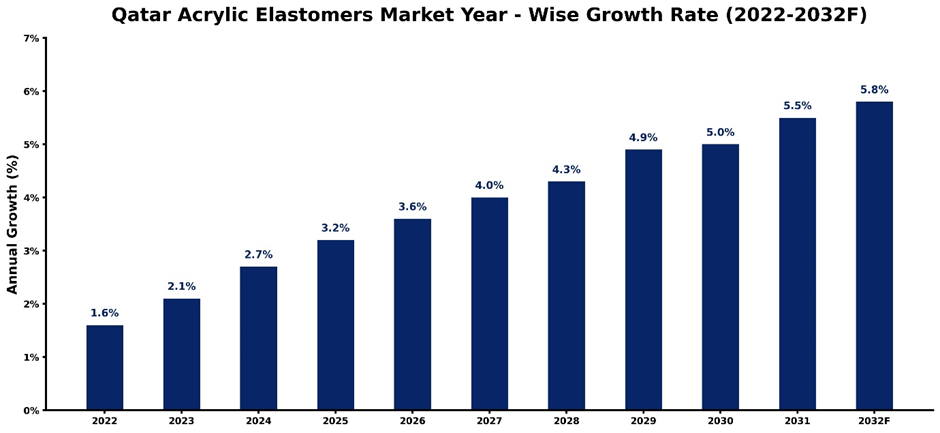 The following table summarizes the historical and forecasted growth rates of the Qatar Acrylic Elastomers Market, along with the rationale behind each year’s performance.
| Year | Estimated Growth (%) | Market Rationale |
| 2022 | 1.6% | Market recovery after pandemic-related disruptions supported by improving automotive servicing activities and resumed construction projects. |
| 2023 | 2.1% | Growth strengthened due to rising demand for durable sealing solutions in industrial equipment and vehicle components. |
| 2024 | 2.7% | Increased infrastructure investments and replacement demand for high-performance rubber materials supported market expansion. |
| 2025 | 3.2% | Automotive component suppliers and industrial manufacturers increased adoption of acrylic elastomers for applications requiring thermal and oil resistance. |
| 2026 | 3.6% | Rising industrial activities and demand for advanced elastomer solutions in Qatar’s manufacturing sector are expected to drive growth. |
| 2027 | 4% | Expansion of automotive service networks and industrial equipment applications will contribute to steady market development. |
| 2028 | 4.3% | Increased usage in construction machinery, HVAC systems, and specialized industrial applications will support demand. |
| 2029 | 4.9% | Growing preference for long-life sealing materials and replacement of conventional elastomers will enhance adoption. |
| 2030 | 5% | Industrial diversification programs and technology upgrades in manufacturing facilities will create additional opportunities. |
| 2031 | 5.5% | Higher utilization across automotive and industrial sectors will sustain market momentum. |
| 2032 | 5.8% | Mature industrial adoption and continued demand for heat-resistant elastomer solutions will maintain steady expansion. |
Topics Covered in the Qatar Acrylic Elastomers Market Report
The Qatar Acrylic Elastomers Market Report provides a comprehensive analysis based on type and application. It offers detailed insights into key industry trends, growth drivers, emerging opportunities, competitive developments, and high-growth segments. The report presents an objective assessment of current dynamics and future prospects, enabling stakeholders to make informed business decisions and develop effective strategies aligned with the evolving industry landscape.
Qatar Acrylic Elastomers Market Highlights
| Report Name | Qatar Acrylic Elastomers Market |
| Forecast period | 2026-2032 |
| CAGR | 4.8% |
| Growing Sector | Automotive Applications |
Qatar Acrylic Elastomers Market Synopsis
The Qatar Acrylic Elastomers Market is expected to grow at a steady pace during the forecast period 2026–2032. Acrylic elastomers are specialized synthetic rubber materials produced from acrylic ester-based polymers and are designed to withstand high temperatures, oxidation, ozone exposure, and petroleum-based fluids. The market growth is being influenced by the rising need for high-performance elastomer materials that can deliver extended durability, reduced maintenance requirements, and reliable performance under challenging operating environments.
Evaluation of Growth Drivers in Qatar Acrylic Elastomers Market (2026–2032)
Below are some major drivers and their influence on the market dynamics:
| Drivers | Primary Segment Affected | Why It Matters (Evidence) |
| Expansion of Automotive Manufacturing and Maintenance Activities | Automotive Applications | Acrylic elastomers are increasingly used in engine seals, transmission components, gaskets, and hoses due to their ability to withstand high temperatures and automotive fluids. |
| Industrial Equipment Modernization | Industrial Applications | Growing investment in machinery upgrades is increasing demand for durable sealing and vibration-control materials with extended operational life. |
| Infrastructure Development and Construction Activities | Construction Applications | Qatar’s infrastructure expansion creates demand for reliable elastomer components used in construction machinery, HVAC systems, and building equipment. |
| Increasing Preference for High-Performance Materials | Manufacturers and End Users | Industries are shifting from conventional rubber products toward advanced elastomers offering better resistance against heat, oil, and environmental degradation. |
| Growth of Specialty Chemical Distribution Networks | Specialty Chemical Suppliers | Improved availability of engineered polymer materials is supporting easier adoption among local manufacturers and industrial users. |
Qatar Acrylic Elastomers Market is Projected to Grow at a compound annual growth rate (CAGR) of 4.8% During 2026–2032, spurred by rising intake from automotive, industrial, and construction sectors. The country’s extreme climatic conditions, where equipment and components usually function under high temperatures, are supporting industries to deploy materials with superior thermal stability and durability. Automotive applications are expected to remain the leading contributor to market share during the forecast period, supported by demand for engine compartment components, sealing systems, and replacement parts. The replacement demand for advanced elastomer-based components is expected to rise by approximately 22% during the forecast period, supported by increasing maintenance requirements.
Evaluation of Restraints in Qatar Acrylic Elastomers Market
Below are some major restraints and their influence on market dynamics:
| Restraints | Primary Segment Affected | What This Means (Evidence) |
| High Material Cost Compared with Conventional Elastomers | Industrial Users | Acrylic elastomers generally involve higher production costs, which may restrict adoption among cost-sensitive manufacturers. |
| Limited Local Production Capability | Specialty Chemical Suppliers | Qatar depends majorly on imported advanced polymer materials and supply chain conditions. |
| Availability of Alternative Elastomer Materials | Automotive and Industrial Applications | Materials such as silicone rubber, fluorocarbon elastomers, and nitrile rubber may compete with acrylic elastomers in certain applications. |
| Technical Knowledge Requirements | Manufacturers | Proper material selection and processing require specialized expertise, which may decrease deployment among smaller industrial users. |
| Fluctuation in Raw Material Prices | Chemical Industry Participants | Changes in petrochemical feedstock prices can accelerate manufacturing prices. |
Qatar Acrylic Elastomers Market Challenges
The Qatar Acrylic Elastomers Industry witness numerous challenges despite positive development prospects. One leading challenge is the reliance on imported specialty polymer materials, and it exposes suppliers and end users to international costing fluctuations. Additionally, deployment among price-sensitive customers may get affected owing to competition from substitute elastomers with wider access and lesser costs. Another leading challenge is the lack of domestic manufacturing ecosystem for advanced elastomer products.
Industries usually need technical support for material selection and application-specific performance testing. Thus, it is making a need for robust technical capabilities among suppliers and distributors. Approximately 65% of acrylic elastomer requirements in Qatar are fulfilled through imports, increasing exposure to global raw material price fluctuations.
Qatar Acrylic Elastomers Market Trends
Significant trends driving the Qatar Acrylic Elastomers Market Growth are presented below:
- Increasing Adoption of Heat-Resistant Elastomer Materials: Industries in Qatar are gradually shifting toward advanced elastomer solutions that can withstand elevated temperatures, oil exposure, and harsh environmental conditions.
- Growing Demand from Automotive Sealing Applications: Automotive manufacturers and component suppliers are raising the consumptions of acrylic elastomers in oil seals, gaskets and under-the-hood applications.
- Rising Preference for Long-Life Industrial Component: To decrease equipment downtime and maintenance frequency, industrial operators are prioritizing materials.
- Expansion of High-Performance Polymer Applications in Construction Equipment: Construction machinery functioning in Qatar’s hot climate needs components with robust resistance against temperature variations.
Investment Opportunities in the Qatar Acrylic Elastomers Market
Potential investment opportunities in the Qatar Acrylic Elastomers Market include the following:
- Development of Local Elastomer Processing and Compounding Facilities: To decrease reliance on imported finished elastomer products., investment in local blending, compounding, and processing capabilities can prove beneficial in an excellent manner.
- Expansion into Automotive Component Manufacturing: Qatar’s rising automotive service and industrial ecosystem caters various prospects opportunities for companies manufacturing seals, gaskets, hoses, and other rubber-based components utilising acrylic elastomers.
- Industrial Maintenance and Replacement Market Growth: Existing industrial facilities need regular replacement of high-performance components.
Top Players in Qatar Acrylic Elastomers Market
A comprehensive list of major companies operating in the Qatar Acrylic Elastomers Market is provided below:
1. Arkema
| Company Name | Arkema |
|---|---|
| Established Year | 2004 |
| Headquarters | Colombes, France |
| Official Website | Click Here |
Arkema is a wordwide specialty materials company offering advanced polymer solutions, including high-performance elastomer materials used in automotive, industrial, and engineering applications.
2. Zeon Corporation
| Company Name | Zeon Corporation |
|---|---|
| Established Year | 1950 |
| Headquarters | Tokyo, Japan |
| Official Website | Click Here |
Zeon Corporation specializes in synthetic rubber and specialty polymer technologies. The company gives high-performance elastomer materials used in automotive components, industrial products, and specialized engineering applications.
3. NOK Corporation
| Company Name | NOK Corporation |
|---|---|
| Established Year | 1939 |
| Headquarters | Tokyo, Japan |
| Official Website | Click Here |
NOK Corporation specializes in sealing products and premium-performance rubber components for automotive and industrial applications.
4. Trelleborg AB
| Company Name | Trelleborg AB |
|---|---|
| Established Year | 1905 |
| Headquarters | Trelleborg, Sweden |
| Official Website | Click Here |
Trelleborg AB is a worldwide engineering group providing advanced polymer solutions and engineered elastomer products.
Government Initiatives Being Implemented in the Qatar Acrylic Elastomers Market
According to Qatar’s government data, they are actively promoting industrial diversification, advanced manufacturing, and infrastructure development through initiatives focused on reducing dependency on hydrocarbon-based activities and strengthening non-energy sectors. These efforts are making a favorable environment for the growth of specialty chemical and advanced material industries, compromising of acrylic elastomers. Under the framework of Qatar National Vision 2030, the country is supporting allocation of money in manufacturing, chemical processing, and technology-driven industries to augment local production capabilities and creates robust industrial value chains.
Future Insights of the Qatar Acrylic Elastomers Market
The Qatar Acrylic Elastomers Market is expected to witness steady expansion through 2032 as industries highly deploy materials catering enhanced durability. Automotive applications are projected to remain the largest demand contributor owing to continuous vehicle maintenance needs and rising utilisation of advanced sealing technologies. Industrial applications are also predicted to gain momentum as Qatar is continuously allocating money in manufacturing capabilities and infrastructure development. Furthermore, increasing knowledge regarding the benefits of high-performance elastomers, consisting of reduced maintenance frequency and augmented component reliability.
Market Segmentation Analysis
This report presents a detailed analysis of the market segments along with their leading categories.
By Type – Ethylene Acrylic Elastomers Lead Due to Superior Performance Characteristics
According to Sumit Sagar, Senior Research Analyst, 6Wresearch, Among product types, Ethylene Acrylic Elastomers are expected to dominate the Qatar Acrylic Elastomers Market Share, accounting for approximately 58.6% in 2025. The segment is projected to grow at a CAGR of 5.1% during 2026–2032. The dominance of ethylene acrylic elastomers is attributed to their excellent resistance against heat and petroleum-based fluids, creating them suitable for automotive engine seals, hoses, gaskets, and industrial applications.
By Application – Automotive Segment Dominates Market Demand, Industrial Segment Gains Momentum
The Automotive segment is projected to hold the largest market share of approximately 46.2% in 2025. The segment’s leadership is driven by increasing demand for high-performance sealing components, including engine oil seals, transmission seals, gaskets, and hoses. Conversely, the industrial segment is expected to grow at a CAGR of around 4.9% during 2026–2032, supported by demand from machinery and heavy-duty industrial applications. The demand for acrylic elastomer-based sealing and component solutions is projected to increase by approximately 26%.
Note: Market size estimations and growth projections presented in this report are based on 6Wresearch's proprietary forecasting methodology, utilizing the latest available industry data, government publications, and primary research inputs.
Key Attractiveness of the Report:
- 10 Years of Market Numbers
- Historical Data Starting from 2022 to 2025
- Base Year: 2025
- Forecast Data until 2032
- Key Performance Indicators Impacting the Market
- Major Upcoming Developments and Projects
Key Highlights of the Report:
- Qatar Acrylic Elastomers Market Outlook
- Market Size of Qatar Acrylic Elastomers Market, 2025
- Forecast of Qatar Acrylic Elastomers Market, 2032
- Historical Data and Forecast of Qatar Acrylic Elastomers Revenues & Volume for the Period 2022-2032
- Qatar Acrylic Elastomers Market Trend Evolution
- Qatar Acrylic Elastomers Market Drivers and Challenges
- Qatar Acrylic Elastomers Price Trends
- Qatar Acrylic Elastomers Porter's Five Forces
- Qatar Acrylic Elastomers Industry Life Cycle
- Historical Data and Forecast of Qatar Acrylic Elastomers Market Revenues & Volume By Type for the Period 2022-2032
- Historical Data and Forecast of Qatar Acrylic Elastomers Market Revenues & Volume By Acrylic Co-Monomer Elastomer for the Period 2022-2032
- Historical Data and Forecast of Qatar Acrylic Elastomers Market Revenues & Volume By Ethylene Acrylic Elastomers for the Period 2022-2032
- Historical Data and Forecast of Qatar Acrylic Elastomers Market Revenues & Volume By Application for the Period 2022-2032
- Historical Data and Forecast of Qatar Acrylic Elastomers Market Revenues & Volume By Automotive for the Period 2022-2032
- Historical Data and Forecast of Qatar Acrylic Elastomers Market Revenues & Volume By Construction for the Period 2022-2032
- Historical Data and Forecast of Qatar Acrylic Elastomers Market Revenues & Volume By Industrial for the Period 2022-2032
- Qatar Acrylic Elastomers Import Export Trade Statistics
- Market Opportunity Assessment By Type
- Market Opportunity Assessment By Application
- Qatar Acrylic Elastomers Top Companies Market Share
- Qatar Acrylic Elastomers Competitive Benchmarking By Technical and Operational Parameters
- Qatar Acrylic Elastomers Company Profiles
- Qatar Acrylic Elastomers Key Strategic Recommendations
Market Covered
The report offers an extensive study of the following market segments:
By Type
- Acrylic Co-Monomer Elastomer
- Ethylene Acrylic Elastomers
By Application
- Automotive
- Construction
- Industrial






































