Qatar Adjuvants Market Growth Rate
According to 6Wresearch internal databases and industry insights, the Qatar Adjuvants Market is estimated to expand at a compound annual growth rate (CAGR) of approximately 4.9% during 2026–2032.
Qatar Adjuvants Market Year-wise Growth Rate and Key Drivers (2022–2032)
This graph illustrates the annual growth rates of the Qatar Adjuvants Market from 2022 to 2032, highlighting a steady upward trajectory and projected market expansion over the forecast period. 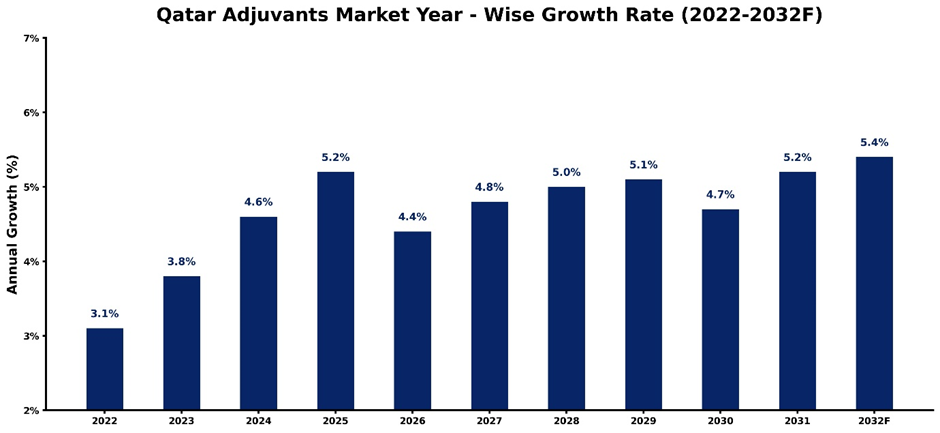
The following table presents the estimated annual growth rates of the market for each year, along with the key factors influencing market performance during the respective period. The values are intended to highlight year-wise drivers rather than provide a direct comparison between individual years.
| Year | Estimated Growth (%) | Market Rationale |
| 2022 | 3.1% | Continued vaccination requirements and normalization of healthcare procurement following the pandemic period. |
| 2023 | 3.8% | Increasing demand for preventive healthcare and wider utilization of vaccines across population groups. |
| 2024 | 4.6% | Strengthening healthcare infrastructure and greater emphasis on preventive disease management. |
| 2025 | 5.2% | Expansion of vaccine availability and increasing formulation requirements for human and veterinary applications. |
| 2026 | 4.4% | Broader immunization programs and continued investment in healthcare-system resilience. |
| 2027 | 4.8% | Rising adoption of advanced vaccine technologies and greater demand for improved antigen response. |
| 2028 | 5% | Increasing research activity and application of next-generation adjuvant systems. |
| 2029 | 5.1% | Growth in adult, elderly, travel-related and specialty vaccination requirements. |
| 2030 | 4.7% | Increasing preference for high-performance and better-tolerated vaccine formulations. |
| 2031 | 5.2% | Expansion of preventive healthcare and increasing use of differentiated vaccine platforms. |
| 2032 | 5.4% | Wider adoption of advanced adjuvant technologies across human and veterinary vaccine development. |
Topics Covered in the Qatar Adjuvants Market Report
The Qatar Adjuvants Market Report provides a comprehensive analysis based on material, type and application. It offers detailed insights into key industry trends, growth drivers, emerging opportunities, competitive developments, and high-growth segments. The report presents an objective assessment of current dynamics and future prospects, enabling stakeholders to make informed business decisions and develop effective strategies aligned with the evolving industry landscape.
Qatar Adjuvants Market Highlights
| Report Name | Qatar Adjuvants Market |
| Forecast period | 2026-2032 |
| CAGR | 4.9% |
| Growing Sector | Agricultural input enhancers |
Qatar Adjuvants Market Synopsis
The Qatar Adjuvants Market is expected to register moderate and sustained growth through 2032, supported mainly by the country's increasing preventive-healthcare infrastructure and increasing availability of vaccines across different population groups. Adjuvants are substances integrated into vaccine formulations to augment, direct, or prolong the immune response created against an antigen. Growth is accelerated by vaccine procurement volumes, introduction of additional vaccines, pharmaceutical-quality requirements, research and development activity, and need for formulations capable of creating robust immune responses while sustaining acceptable safety and stability profiles.
Evaluation of Growth Drivers in Qatar Adjuvants Market (2026–2032)
Below are some major drivers and their influence on the market dynamics:
| Drivers | Primary Segment Affected | Why It Matters (Evidence) |
| Expansion of preventive healthcare | Human Vaccines | Qatar's National Health Strategy 2024–2030 focuses on proactive prevention. |
| Wider national immunization coverage | Human Vaccines | Qatar's national schedule included 15 vaccines in 2025, covering 17 diseases and multiple population groups, including children, adults, elderly people, pregnant women and healthcare workers. |
| Introduction of newer vaccine technologies | Human Vaccines | Increasing availability of specialized vaccines creates demand for formulation technologies capable of improving antigen-specific immune responses. |
| Veterinary disease prevention | Veterinary Vaccines | Qatar's animal-health framework recognizes vaccination and veterinary biological preparations as part of disease-control activities. |
| Growth in pharmaceutical R&D | Human Vaccines | Qatar's health strategy identifies research, development and innovation as important components of future healthcare-system development. |
| Demand for improved vaccine stability | Human / Veterinary Vaccines | Formulators increasingly require adjuvant systems that provide reproducible performance, formulation stability and controlled immune stimulation. |
| Greater focus on population resilience | Human Vaccines | Qatar's health strategy incorporates health-system efficiency, resilience and emergency preparedness, supporting continued attention to vaccination infrastructure. |
Qatar Adjuvants Market is projected to grow at a compound annual growth rate (CAGR) of 4.9% during 2026–2032, accelerated by vaccine registration requirements, pharmaceutical-quality standards, dependence on imported specialty ingredients, formulation-development costs, and the need to demonstrate safety and consistent immunological performance. Human vaccines are predicted to remain the largest application category, while veterinary vaccines are likely to provide an additional source of market demand.
Evaluation of Restraints in Qatar Adjuvants Market
Below are some major restraints and their influence on market dynamics:
| Restraints | Primary Segment Affected | What This Means (Evidence) |
| Regulatory approval requirements | Human / Veterinary Vaccines | Vaccine-related products must meet applicable regulatory and quality requirements, increasing development and commercialization timelines. |
| High formulation-development costs | Advanced Adjuvants | Novel adjuvant systems require extensive compatibility, stability, toxicology and immunogenicity evaluation before broad adoption. |
| Dependence on imported specialty ingredients | All Segments | Qatar's relatively small domestic specialty-pharmaceutical manufacturing base means many advanced adjuvant inputs are sourced internationally. |
| Complex cold-chain requirements | Human / Veterinary Vaccines | Vaccine products can require controlled storage and transportation, increasing supply-chain requirements. |
| Limited domestic vaccine manufacturing scale | Human Vaccines | A comparatively limited local manufacturing ecosystem restricts the immediate scale of domestic adjuvant consumption. |
| Safety and tolerability considerations | Human Vaccines | Strong immune stimulation must be balanced against reactogenicity, tolerability and formulation compatibility. |
| Small addressable market | Specialty Adjuvants | Qatar's population and vaccine-manufacturing base are smaller than those of major pharmaceutical markets, limiting economies of scale. |
Qatar Adjuvants Market Challenges
The Qatar Adjuvants Market Industry faces a combination of technical, regulatory and commercial challenges. The principal challenge is achieving a stronger immune response without creating unacceptable reactogenicity or compromising formulation stability. Advanced adjuvants can require extensive formulation development due to their performance depends on antigen characteristics, dosage, delivery system, storage conditions and the target population. While suppliers need to demonstrate reproducible quality rather than simply catering a higher immunostimulatory effect affecting the growth of the market.
Qatar Adjuvants Market Trends
Important trends shaping the Qatar Adjuvants Market are detailed below:
- Greater emphasis on formulation tolerability: Vaccine manufacturers highly need adjuvants that balance immunogenicity with acceptable safety and tolerability, particularly for mass vaccination programs.
- Expansion of adult and specialty vaccination: Qatar's national immunization schedule comprises of vaccines for various population groups beyond childhood, including adults, elderly people, pregnant women, travelers and healthcare workers.
- Growth of veterinary immunization: Animal-health programs make an additional demand stream for adjuvants, particularly for vaccines used in livestock and other commercially important animal populations.
Investment Opportunities in the Qatar Adjuvants Market
Growth-oriented investment opportunities in the Qatar Adjuvants Market include the following:
- Cold-chain and specialty pharmaceutical logistics: Owing to many vaccine products needing controlled handling, companies capable of providing compliant storage and distribution can participate in the broader adjuvant-value chain.
- Veterinary vaccine formulations: Veterinary vaccination caters an additional commercial opportunity, particularly for livestock and animal-health applications where oil-emulsion systems are widely used.
- Research and formulation collaborations: Qatar's concentrate on healthcare innovation and research creates prospects for collaborations involving universities, healthcare institutions, pharmaceutical companies and specialist formulation suppliers.
Top Players in Qatar Adjuvants Market
A detailed compilation of major companies active in the Qatar Adjuvants Market is presented below:
1. Croda International
| Company Name | Croda International |
|---|---|
| Established Year | 1925 |
| Headquarters | Snaith, East Yorkshire, United Kingdom |
| Official Website | Click Here |
Croda is a leading specialty-chemical and pharmaceutical-ingredient supplier with a significant presence in vaccine adjuvants.
2. SEPPIC
| Company Name | SEPPIC |
|---|---|
| Established Year | 1943 |
| Headquarters | Paris, France |
| Official Website | Click Here |
SEPPIC, an Air Liquide Healthcare company, creating specialty ingredients and adjuvant systems for pharmaceutical and animal-health applications.
3. BASF SE
| Company Name | BASF SE |
|---|---|
| Established Year | 1865 |
| Headquarters | Ludwigshafen, Germany |
| Official Website | Click Here |
BASF offers specialty chemical ingredients and formulation technologies used across pharmaceutical and agricultural industries.
Government Initiatives Being Implemented in the Qatar Adjuvants Market
According to Qatar’s government data, several healthcare, immunization, veterinary-health and research initiatives are indirectly supporting the development of the Qatar Adjuvants Market. The National Health Strategy 2024–2030, launched in September 2024, concentrates on augmenting population health, strengthening healthcare-service quality, enhancing health-system efficiency and resilience, and promoting prevention, research and innovation. These priorities provide a supportive environment for vaccine technologies and associated formulation components. In addition, Qatar's National Immunization Program continues to support demand for vaccine-related products.
Future Insights of the Qatar Adjuvants Market
The Qatar Adjuvants Market is expected to sustain a positive growth trajectory over the coming years, proliferated by the continued growth of preventive healthcare, vaccination programs, pharmaceutical development and veterinary disease-control activities. Human vaccine applications are estimated to remain the main demand center as Qatar continues to solidify immunization coverage and improve access to vaccines for different population groups. The rising focus on preventive healthcare is likely to support demand for adjuvant technologies that can enhance immune responses and improve the performance of vaccine formulations.
Market Segmentation Analysis
This report presents a detailed analysis of the market segments along with their leading categories.
By Type – Oil Emulsions Segment Dominates, While Saponins Register Strong Growth
According to Sumit Sagar, Senior Research Analyst, 6Wresearch, Oil Emulsions accounted for approximately 41.6% of the Qatar Adjuvants Market Share in 2025, making them the dominating type segment. Their established formulation characteristics, particularly their capability to make sustained antigen exposure, support persistent usage in selected vaccine applications.
In contrast, saponin-based adjuvants are estimated to grow at approximately 7% CAGR during 2026–2032, making them one of the faster-growing categories. Their growth is associated with increasing research into adjuvant systems capable of producing strong humoral and cellular immune responses.
By Application – Human Vaccines Segment Dominates the Market
By Application, human Vaccines represented approximately 46.8% of the industry share in 2025, making them the dominating application segment. The segment is projected to grow at approximately 5% CAGR during 2026–2032, supported by Qatar's extensive preventive-healthcare infrastructure and the persistent growth of the national immunization schedule.
Note: Market size estimations and growth projections presented in this report are based on 6Wresearch's proprietary forecasting methodology, utilizing the latest available industry data, government publications, and primary research inputs.
Key Attractiveness of the Report:
- 10 Years of Market Numbers
- Historical Data Starting from 2022 to 2025
- Base Year: 2025
- Forecast Data until 2032
- Key Performance Indicators Impacting the Market
- Major Upcoming Developments and Projects
Key Highlights of the Report:
- Qatar Adjuvants Market Outlook
- Market Size of Qatar Adjuvants Market, 2025
- Forecast of Qatar Adjuvants Market, 2032
- Historical Data and Forecast of Qatar Adjuvants Revenues & Volume for the Period 2022-2032
- Qatar Adjuvants Market Trend Evolution
- Qatar Adjuvants Market Drivers and Challenges
- Qatar Adjuvants Price Trends
- Qatar Adjuvants Porter's Five Forces
- Qatar Adjuvants Industry Life Cycle
- Historical Data and Forecast of Qatar Adjuvants Market Revenues & Volume By Type for the Period 2022-2032
- Historical Data and Forecast of Qatar Adjuvants Market Revenues & Volume By Oil Emulsions for the Period 2022-2032
- Historical Data and Forecast of Qatar Adjuvants Market Revenues & Volume By Mineral Salts for the Period 2022-2032
- Historical Data and Forecast of Qatar Adjuvants Market Revenues & Volume By Microbial Products for the Period 2022-2032
- Historical Data and Forecast of Qatar Adjuvants Market Revenues & Volume By Cytokins for the Period 2022-2032
- Historical Data and Forecast of Qatar Adjuvants Market Revenues & Volume By Saponins for the Period 2022-2032
- Historical Data and Forecast of Qatar Adjuvants Market Revenues & Volume By Others for the Period 2022-2032
- Historical Data and Forecast of Qatar Adjuvants Market Revenues & Volume By Application for the Period 2022-2032
- Historical Data and Forecast of Qatar Adjuvants Market Revenues & Volume By Herbicides for the Period 2022-2032
- Historical Data and Forecast of Qatar Adjuvants Market Revenues & Volume By Insecticides for the Period 2022-2032
- Historical Data and Forecast of Qatar Adjuvants Market Revenues & Volume By Fungicides for the Period 2022-2032
- Historical Data and Forecast of Qatar Adjuvants Market Revenues & Volume By Human Vaccines for the Period 2022-2032
- Historical Data and Forecast of Qatar Adjuvants Market Revenues & Volume By Veterinary Vaccines for the Period 2022-2032
- Historical Data and Forecast of Qatar Adjuvants Market Revenues & Volume By Others for the Period 2022-2032
- Qatar Adjuvants Import Export Trade Statistics
- Market Opportunity Assessment By Type
- Market Opportunity Assessment By Application
- Qatar Adjuvants Top Companies Market Share
- Qatar Adjuvants Competitive Benchmarking By Technical and Operational Parameters
- Qatar Adjuvants Company Profiles
- Qatar Adjuvants Key Strategic Recommendations
Market Covered
The report offers an extensive study of the following market segments:
By Type
- Oil Emulsions
- Mineral Salts
- Microbial Products
- Cytokins
- Saponins
- Others
By Application
- Herbicides
- Insecticides
- Fungicides
- Human Vaccines
- Veterinary Vaccines
- Others






































