Qatar Alcoholic Spirits Market Summary
The qatar alcoholic spirits market was estimated at USD 480 Million in 2025 and is projected to reach USD 644 Million by 2032, growing at a CAGR of 5.1% from 2026 to 2032.
Qatar Alcoholic Spirits Market Year-wise Growth Rate and Key Drivers
This graph highlights how the Qatar Alcoholic Spirits Market has steadily grown over the past five years, supported by major growth factors.
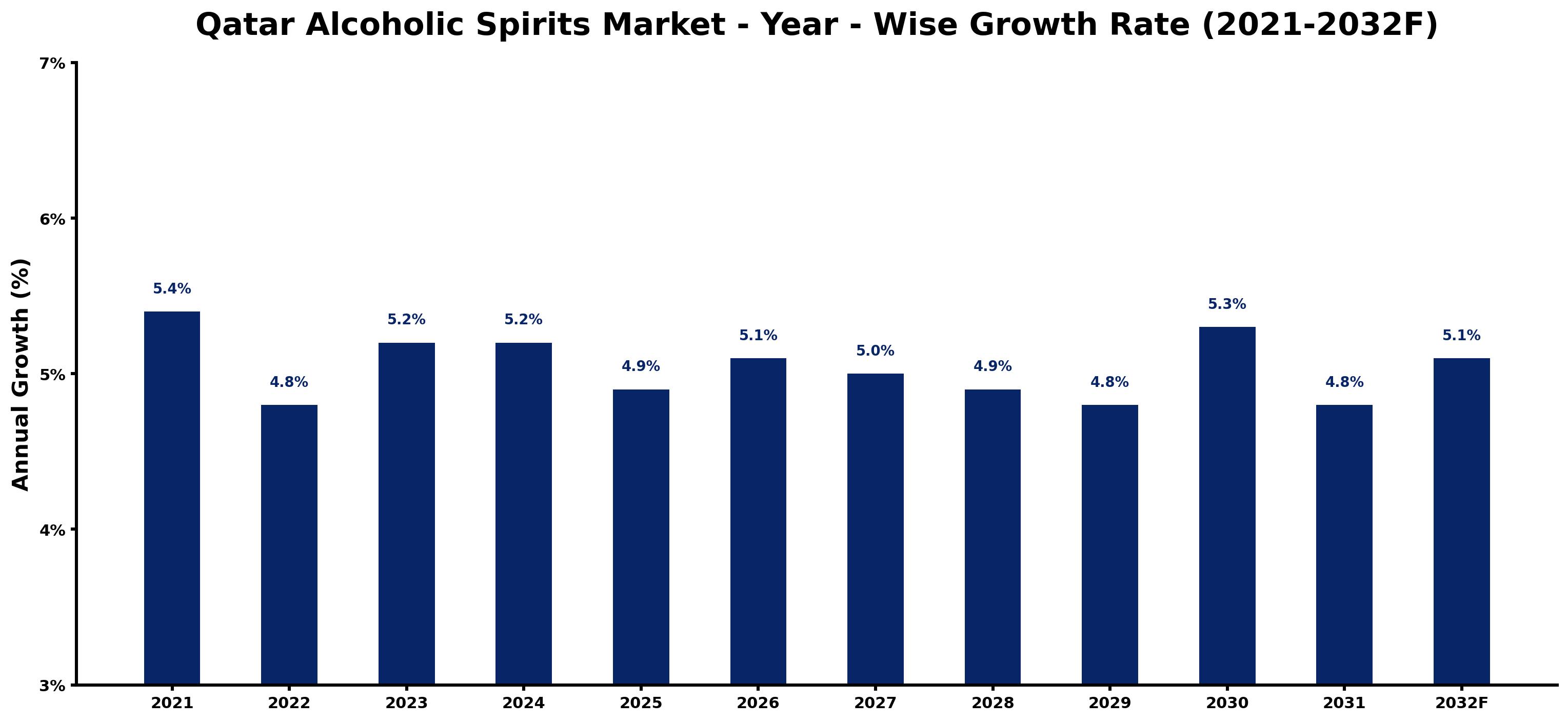
The table below presents the year wise growth rates along with the key drivers influencing the market
| Year | Growth Rate | Major Drivers |
| 2021 | 5.4% | Tourism rebounds, sparking interest in premium and luxury spirit brands. |
| 2022 | 4.8% | Local distilleries emerge, driving competition and innovation in product offerings. |
| 2023 | 5.2% | Cultural events highlight craft distilling, increasing consumer appreciation for artisanal spirits. |
| 2024 | 5.2% | Increased disposable incomes enable consumers to explore higher-priced alcoholic options. |
| 2025 | 4.9% | Social gatherings and nightlife optimization lead to expanded bar and restaurant menus. |
| 2026 | 5.1% | E-commerce platforms enhance accessibility to a wider variety of spirits. |
| 2027 | 5.0% | Increased focus on food pairing encourages cocktail crafting and spirit experimentation. |
| 2028 | 4.9% | Consumer trends shift towards health-conscious drinking, promoting low-alcohol options. |
| 2029 | 4.8% | Sustainability efforts in production resonate with environmentally aware consumers. |
| 2030 | 5.3% | Growing expatriate population diversifies tastes and preferences for various alcoholic beverages. |
| 2031 | 4.8% | High-profile events like World Cup attract global brands, elevating market visibility. |
| 2032 | 5.1% | Innovative flavor profiles and limited editions stimulate interest in niche markets. |
Note - Market size estimations and growth projections presented in this report are based on 6Wresearch's advanced forecasting approach, validated with industry datasets as of June 2026.
Qatar Alcoholic Spirits Market Synopsis
The Qatar Alcoholic Spirits Market is projected to reach 5.1% and witness significant growth during the forecast period (2026-2032). This growth is primarily fueled by increasing demand from both domestic consumers and international travelers. The market is further influenced by rising disposable incomes and a burgeoning luxury lifestyle trend among affluent residents, which positively impacts the consumption of premium alcohol products.
Qatar Alcoholic Spirits Market Growth Drivers
Several key factors are driving the expansion of the Qatar Alcoholic Spirits Market. Firstly, the increase in high-net-worth individuals has stimulated demand for luxury alcoholic spirits, both among local affluent consumers and tourists. This demographic shift indicates a broader acceptance and demand for premium beverage offerings.
- The growing influx of tourists, particularly from Europe and Far East Asia, is a significant factor contributing to market growth.
- Government initiatives aimed at promoting tourism, such as hospitality industry expansion and cultural events, are driving increased alcohol consumption opportunities.
- Increased consumer spending on luxury items, including alcoholic beverages, reflects changing social dynamics and market trends.
- Rising disposable incomes allow consumers to indulge in higher-quality alcohol, thus expanding the market for premium spirits.
- Promotional activities by the government help in attracting international tourists, subsequently increasing revenue streams for local manufacturers.
Qatar Alcoholic Spirits Market Challenges and Restraints
Despite the anticipated growth, the Qatar Alcoholic Spirits Market faces several challenges. Stringent regulations regarding alcohol consumption remain a significant barrier to market development. These regulations are largely influenced by the country's adherence to Sharia law, which affects the production, sale, and distribution of alcoholic beverages.
- The limitations on advertising and distribution channels for alcoholic beverages can hinder visibility and accessibility in the market.
- Religious beliefs can constrain the overall consumption patterns among local populations, creating a less supportive environment for alcohol products.
- Stringent licensing requirements for alcohol sales restrict the number of establishments allowed to sell alcoholic beverages.
- The potential for sudden regulatory changes poses a risk to market stability and long-term planning for manufacturers.
- Market players must navigate these challenges while attempting to meet the evolving tastes and preferences of a diverse consumer base.
Qatar Alcoholic Spirits Market Government Investment and Initiatives
The Qatari government has initiated several measures to bolster the tourism sector, indirectly supporting the alcoholic spirits market. Investments in infrastructure and hospitality projects are aimed at enhancing the overall visitor experience, which includes an increase in the availability of alcoholic beverages in licensed establishments.
- Government policies are increasingly focused on diversifying the economy, which includes promoting tourism as a key growth area.
- Strategic plans to improve the hospitality sector provide an environment conducive to greater consumption of alcoholic spirits.
- Public spending on tourism campaigns enhances Qatar's global image, attracting more international visitors.
- Collaboration with private sectors to host international events creates opportunities for increased alcohol sales during peak tourist seasons.
- Regulatory frameworks are being periodically evaluated to align with global tourism standards, aiming to create a balanced approach to alcohol sales and consumption.
Qatar Alcoholic Spirits Market Latest Developments (May 2025 - June 2026)
The period from May 2025 to June 2026 saw notable shifts within the Qatar Alcoholic Spirits Market, impacted heavily by the aftermath of the COVID-19 pandemic. Following the lifting of the ban on alcohol sales in November 2025, there was a cautious yet optimistic recovery in the market.
- Subsequent to the reopening, alcohol sales were subject to strict regulations, including limits on operating hours and restrictions on promotional activities.
- The tourism sector began to recover with enhanced interest from foreign travelers, contributing to improved sales of alcoholic beverages.
- Local producers began adapting their strategies to meet the evolving preferences of consumers, emphasizing premium offerings to capture the growing affluent demographic.
- As government initiatives to boost tourism continued, a gradual relaxation of regulatory measures surrounding alcohol sales was anticipated.
- Overall, the market exhibited resilience amidst challenges, with a focus on luxury experiences aligning with consumer demand trends.
Qatar Alcoholic Spirits Market - Key Attractiveness of the Report
- 10 Years of Market Numbers
- Historical Data Starting from 2022 to 2025
- Base Year: 2025
- Forecast Data until 2032
- Key Performance Indicators Impacting the Market
- Major Upcoming Developments and Projects
Key Highlights of the Report:
- Qatar Alcoholic Spirits Market Outlook
- Market Size of Qatar Alcoholic Spirits Market, 2025
- Forecast of Qatar Alcoholic Spirits Market, 2032
- Historical Data and Forecast of Qatar Alcoholic Spirits Revenues & Volume for the Period 2022-2032F
- Qatar Alcoholic Spirits Market Trend Evolution
- Qatar Alcoholic Spirits Market Drivers and Challenges
- Qatar Alcoholic Spirits Price Trends
- Qatar Alcoholic Spirits Porter's Five Forces
- Qatar Alcoholic Spirits Industry Life Cycle
- Historical Data and Forecast of Qatar Alcoholic Spirits Market Revenues & Volume By ?Product Type for the Period 2022-2032F
- Historical Data and Forecast of Qatar Alcoholic Spirits Market Revenues & Volume By Brandy & Cognac for the Period 2022-2032F
- Historical Data and Forecast of Qatar Alcoholic Spirits Market Revenues & Volume By Rum for the Period 2022-2032F
- Historical Data and Forecast of Qatar Alcoholic Spirits Market Revenues & Volume By Tequila for the Period 2022-2032F
- Historical Data and Forecast of Qatar Alcoholic Spirits Market Revenues & Volume By White Spirits for the Period 2022-2032F
- Historical Data and Forecast of Qatar Alcoholic Spirits Market Revenues & Volume By Whiskey for the Period 2022-2032F
- Historical Data and Forecast of Qatar Alcoholic Spirits Market Revenues & Volume By Liqueurs for the Period 2022-2032F
- Historical Data and Forecast of Qatar Alcoholic Spirits Market Revenues & Volume By Others for the Period 2022-2032F
- Historical Data and Forecast of Qatar Alcoholic Spirits Market Revenues & Volume By Distribution Channels for the Period 2022-2032F
- Historical Data and Forecast of Qatar Alcoholic Spirits Market Revenues & Volume By Supermarkets & Hypermarkets for the Period 2022-2032F
- Historical Data and Forecast of Qatar Alcoholic Spirits Market Revenues & Volume By Liquor Specialist Stores for the Period 2022-2032F
- Historical Data and Forecast of Qatar Alcoholic Spirits Market Revenues & Volume By Grocery Retailers for the Period 2022-2032F
- Historical Data and Forecast of Qatar Alcoholic Spirits Market Revenues & Volume By Online Retailing for the Period 2022-2032F
- Historical Data and Forecast of Qatar Alcoholic Spirits Market Revenues & Volume By Other for the Period 2022-2032F
- Qatar Alcoholic Spirits Import Export Trade Statistics
- Market Opportunity Assessment By ?Product Type
- Market Opportunity Assessment By Distribution Channels
- Qatar Alcoholic Spirits Top Companies Market Share
- Qatar Alcoholic Spirits Competitive Benchmarking By Technical and Operational Parameters
- Qatar Alcoholic Spirits Company Profiles
- Qatar Alcoholic Spirits Key Strategic Recommendations






































