Qatar Aluminium Sulphate Market Size, Share & Growth Rate
The Qatar Aluminium Sulphate Market was estimated at USD 321 Million in 2025 and is projected to reach USD 447 Million by 2032, growing at a CAGR of 4.8% from 2026 to 2032. This upward trend is largely driven by the growing needs of water treatment facilities, where aluminium sulphate is pivotal as a flocculating agent and coagulant. As Qatar continues to invest in urban development and improve wastewater management systems, the demand for aluminium sulphate is poised for significant expansion across various industries.
Qatar Aluminium Sulphate Market Year-wise Growth Rate and Key Drivers
This graph highlights how the Qatar Aluminium Sulphate Market has steadily grown over the years, supported by major growth factors.
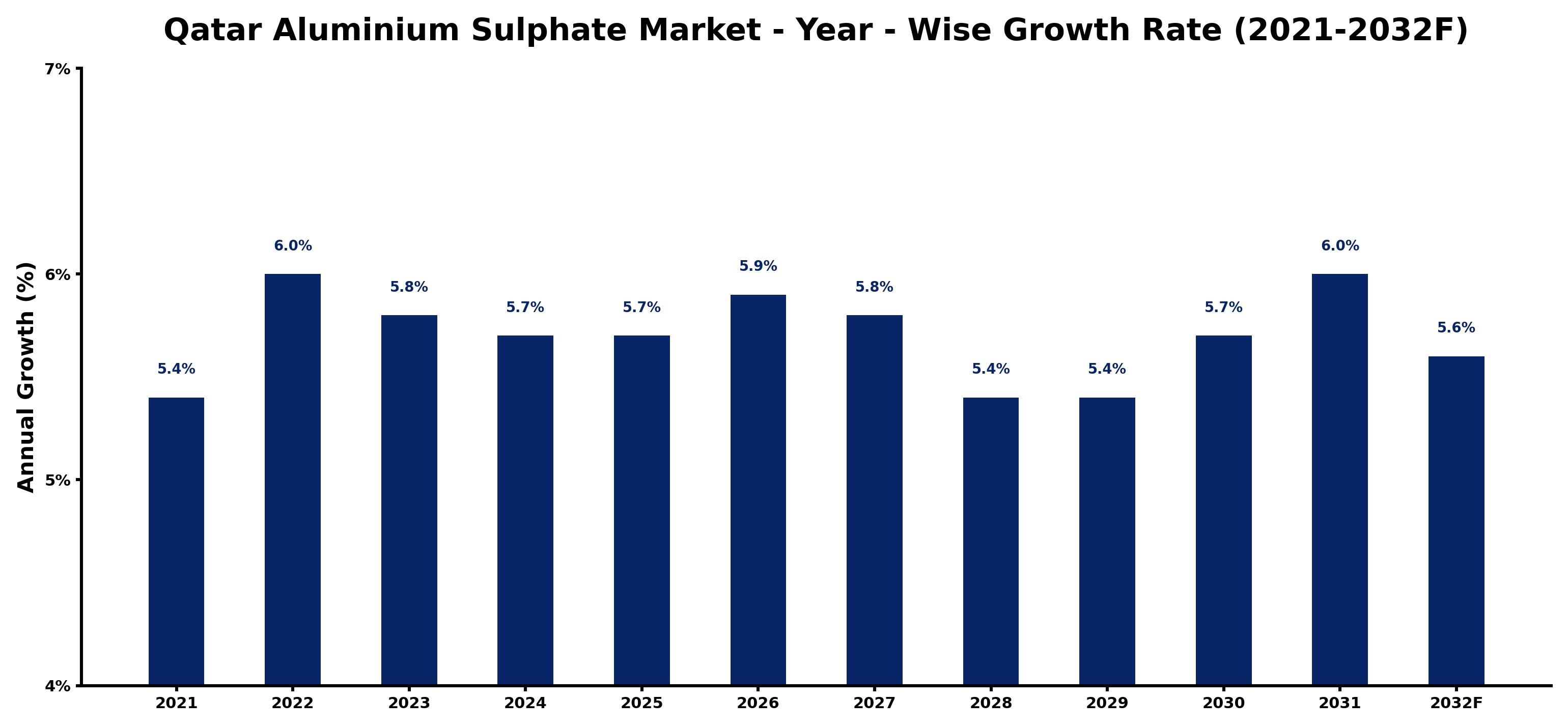
The table below presents the year‑wise growth rates along with the key drivers influencing the market
| Year | Growth Rate | Major Drivers |
| 2021 | 5.4% | Increased construction projects demand chemicals |
| 2022 | 6.0% | Water treatment applications expanded significantly |
| 2023 | 5.8% | Agricultural sector growth stimulated usage |
| 2024 | 5.7% | Industrial applications drove higher consumption |
| 2025 | 5.7% | Regulatory support enhanced market stability |
| 2026 | 5.9% | Rising environmental awareness boosted demand |
| 2027 | 5.8% | Food processing sector expanded rapidly |
| 2028 | 5.4% | Chemical manufacturing growth increased usage |
| 2029 | 5.4% | Infrastructure development projects increased demand |
| 2030 | 5.7% | Urbanization trends supported market growth |
| 2031 | 6.0% | Technological advancements improved production efficiency |
| 2032 | 5.6% | Export opportunities enhanced market reach |
Note - Market size estimations and growth projections presented in this report are based on 6Wresearch's advanced forecasting approach, validated with industry datasets as of June 2026.
Qatar Aluminium Sulphate Market Synopsis
The aluminium sulphate market in Qatar is characterized by its essential role in water treatment, particularly in the wake of increasing urbanization and public health concerns. With a substantial push for safe drinking water, the industry is witnessing heightened activity in both production and application sectors. As a result, aluminium sulphate has gained prominence across various segments, including paper manufacturing, textiles, and food processing.
Moreover, Qatar's commitment to sustainable practices is reshaping the market landscape. Investments in technology and infrastructure to enhance waste management processes ensure that aluminium sulphate continues to meet the evolving regulatory standards while addressing the challenges presented by resource efficiency and environmental impact.
Qatar Aluminium Sulphate Market Key Takeaways
- Significant growth is driven by the demand for efficient water treatment solutions.
- Expanding urban population and increased public health awareness fuel product application in various sectors.
- Government initiatives emphasize sustainable practices and environmental compliance.
- Market dynamics are influenced by competition from alternative coagulants and flocculants.
- Innovations in production methods aim to mitigate waste and enhance efficiency.
Evaluation of Restraints in Qatar Aluminium Sulphate Market
While the Qatar Aluminium Sulphate market is expanding, it faces significant restraints that could limit its growth trajectory. One primary concern involves waste management, as the production of aluminium sulphate can generate hazardous by-products if not handled correctly. This environmental concern necessitates stringent regulations and effective disposal practices, which can strain operational costs. Additionally, the presence of alternative coagulants in the market poses competitive pressures, potentially impacting pricing strategies and market share for aluminium sulphate producers.
Qatar Aluminium Sulphate Market Trends
The trends in the Qatar Aluminium Sulphate market are evolving in response to both technological advancements and regulatory changes. A notable trend is the increasing adoption of environmentally friendly production methods that seek to reduce waste and emissions. Furthermore, as the construction sector grows, the demand for aluminium sulphate in applications beyond water treatment—such as concrete curing—continues to rise. This diversification is essential for market sustainability as industries increasingly look for sustainable raw materials.
Qatar Aluminium Sulphate Market Opportunities
The Qatar Aluminium Sulphate market presents considerable opportunities, particularly in the water treatment sector, which is expanding alongside urban development initiatives. Investments aimed at enhancing wastewater treatment facilities are expected to drive demand, leading to increased market penetration. Additionally, the push for sustainable agricultural practices offers an avenue for aluminium sulphate in animal feed formulations, enhancing its utility across diverse applications. Businesses that can innovate in production and waste management stand to benefit significantly from this evolving landscape.
Government Initiatives in the Qatar Aluminium Sulphate Market
The Qatari government actively promotes sustainable development through various initiatives and policies aimed at enhancing water quality and management. These initiatives often include funding for modernizing water treatment facilities and supporting research into efficient production methods for chemicals like aluminium sulphate. By providing incentives for environmentally conscious practices, the government is paving the way for a more resilient industry that aligns with global sustainability goals.
Future Insights of the Qatar Aluminium Sulphate Market
Looking ahead to 2026-2032, the Qatar Aluminium Sulphate market is set to undergo transformative growth driven by increasing infrastructural investments and heightened awareness of water quality issues. As regulatory frameworks become stricter regarding water treatment processes, the demand for high-quality aluminium sulphate will likely increase. Additionally, continued urbanization and industrialization in Qatar suggest a robust market for aluminium sulphate, making it a critical component in the drive toward sustainable development and public health improvement.
Qatar Aluminium Sulphate Market Latest Developments (May 2025 - June 2026)
Recent developments in the Qatar Aluminium Sulphate market indicate a strategic shift towards sustainability and innovation. The industry has seen increased collaborations aimed at enhancing the efficiency of production processes while minimizing environmental impact. Notably, advancements in technology have facilitated more effective waste management strategies in aluminium sulphate production, aligning with global trends for greener industrial practices. Such developments are expected to strengthen the market's resilience and drive future growth.
Qatar Aluminium Sulphate Market - Key Attractiveness of the Report
- 10 Years of Market Numbers
- Historical Data Starting from 2022 to 2025
- Base Year: 2025
- Forecast Data until 2032
- Key Performance Indicators Impacting the Market
- Major Upcoming Developments and Projects
Key Highlights of the Report:
- Qatar Aluminium Sulphate Market Outlook
- Market Size of Qatar Aluminium Sulphate Market, 2025
- Forecast of Qatar Aluminium Sulphate Market, 2032
- Historical Data and Forecast of Qatar Aluminium Sulphate Revenues & Volume for the Period 2022-2032F
- Qatar Aluminium Sulphate Market Trend Evolution
- Qatar Aluminium Sulphate Market Drivers and Challenges
- Qatar Aluminium Sulphate Price Trends
- Qatar Aluminium Sulphate Porter's Five Forces
- Qatar Aluminium Sulphate Industry Life Cycle
- Historical Data and Forecast of Qatar Aluminium Sulphate Market Revenues & Volume By Applications for the Period 2022-2032F
- Historical Data and Forecast of Qatar Aluminium Sulphate Market Revenues & Volume By Food and beverages industry for the Period 2022-2032F
- Historical Data and Forecast of Qatar Aluminium Sulphate Market Revenues & Volume By Health care industry for the Period 2022-2032F
- Historical Data and Forecast of Qatar Aluminium Sulphate Market Revenues & Volume By Water purification and water treatment plants for the Period 2022-2032F
- Historical Data and Forecast of Qatar Aluminium Sulphate Market Revenues & Volume By Pepper industry for the Period 2022-2032F
- Historical Data and Forecast of Qatar Aluminium Sulphate Market Revenues & Volume By Others for the Period 2022-2032F
- Historical Data and Forecast of Qatar Aluminium Sulphate Market Revenues & Volume By Functionality for the Period 2022-2032F
- Historical Data and Forecast of Qatar Aluminium Sulphate Market Revenues & Volume By As an additive for the Period 2022-2032F
- Historical Data and Forecast of Qatar Aluminium Sulphate Market Revenues & Volume By As BOD and COD removal for the Period 2022-2032F
- Historical Data and Forecast of Qatar Aluminium Sulphate Market Revenues & Volume By Colour removal for the Period 2022-2032F
- Historical Data and Forecast of Qatar Aluminium Sulphate Market Revenues & Volume By Cell separation for the Period 2022-2032F
- Historical Data and Forecast of Qatar Aluminium Sulphate Market Revenues & Volume By Product Form for the Period 2022-2032F
- Historical Data and Forecast of Qatar Aluminium Sulphate Market Revenues & Volume By Liquid for the Period 2022-2032F
- Historical Data and Forecast of Qatar Aluminium Sulphate Market Revenues & Volume By Solid for the Period 2022-2032F
- Qatar Aluminium Sulphate Import Export Trade Statistics
- Market Opportunity Assessment By Applications
- Market Opportunity Assessment By Functionality
- Market Opportunity Assessment By Product Form
- Qatar Aluminium Sulphate Top Companies Market Share
- Qatar Aluminium Sulphate Competitive Benchmarking By Technical and Operational Parameters
- Qatar Aluminium Sulphate Company Profiles
- Qatar Aluminium Sulphate Key Strategic Recommendations






































