Qatar Antifreeze Market Size Growth Rate
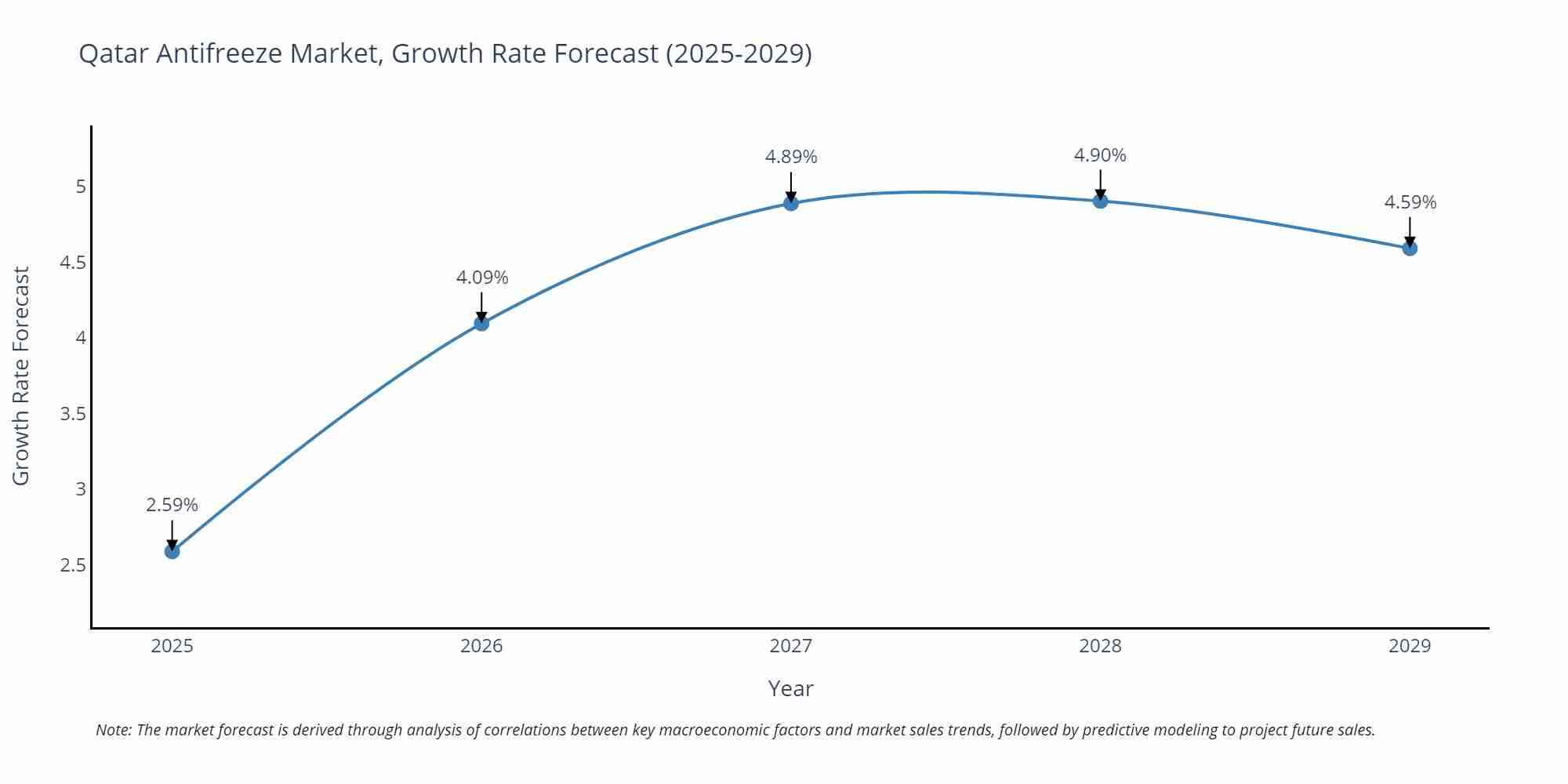
The Qatar Antifreeze Market is projected to witness mixed growth rate patterns during 2025 to 2029. Growth accelerates to 4.90% in 2028, following an initial rate of 2.59%, before easing to 4.59% at the end of the period.
Qatar Antifreeze Market Synopsis
The Qatar Antifreeze market has been witnessing steady growth, driven by the importance of antifreeze in automotive and industrial applications. Antifreeze, also known as coolant, is used to regulate engine temperature and prevent freezing and overheating in cooling systems. The growing number of vehicles on the road and the emphasis on vehicle maintenance have led to an increased demand for antifreeze in the automotive sector. Additionally, the industrial sector`s expansion has contributed to the higher consumption of antifreeze for various equipment and machinery. As Qatar automotive and industrial sectors continue to grow, the antifreeze market is anticipated to expand.
Drivers of The Market
The Qatar Antifreeze market is driven by several factors influencing the automotive and industrial sectors. Firstly, antifreeze or coolant is essential for preventing engine freezing and overheating, making it a critical component in the automotive industry. The increasing production and sales of vehicles in Qatar have contributed to the demand for antifreeze. Secondly, antifreeze is also used in industrial applications to protect equipment and machinery from freezing during extreme temperatures, driving its demand in the industrial sector.
Challenges of The Market
The Qatar Antifreeze market faces specific challenges in catering to various industries and applications where antifreeze is essential for temperature regulation and freeze protection. One of the significant challenges is the need for effective and long-lasting antifreeze formulations that can withstand extreme temperatures while preventing corrosion and fouling in cooling systems. Ensuring compatibility with various materials and cooling system components is crucial for maintaining system efficiency.
Covid-19 Impact of the Market
The Covid-19 pandemic had an impact on the Qatar Antifreeze market, particularly in the automotive and industrial sectors. The slowdown in vehicle sales and manufacturing reduced the demand for antifreeze products. However, as industries resumed operations and the automotive market recovered, the demand for antifreeze for vehicle cooling and industrial applications picked up. Moreover, the growing focus on environmentally friendly antifreeze solutions presented opportunities for manufacturers.
Key Highlights of the Report:
- Qatar Antifreeze Market Outlook
- Market Size of Qatar Antifreeze Market, 2024
- Forecast of Qatar Antifreeze Market, 2031
- Historical Data and Forecast of Qatar Antifreeze Revenues & Volume for the Period 2021-2031
- Qatar Antifreeze Market Trend Evolution
- Qatar Antifreeze Market Drivers and Challenges
- Qatar Antifreeze Price Trends
- Qatar Antifreeze Porter's Five Forces
- Qatar Antifreeze Industry Life Cycle
- Historical Data and Forecast of Qatar Antifreeze Market Revenues & Volume By Product for the Period 2021-2031
- Historical Data and Forecast of Qatar Antifreeze Market Revenues & Volume By Ethylene Glycol for the Period 2021-2031
- Historical Data and Forecast of Qatar Antifreeze Market Revenues & Volume By Propylene Glycol for the Period 2021-2031
- Historical Data and Forecast of Qatar Antifreeze Market Revenues & Volume By Glycerin for the Period 2021-2031
- Historical Data and Forecast of Qatar Antifreeze Market Revenues & Volume By Application for the Period 2021-2031
- Historical Data and Forecast of Qatar Antifreeze Market Revenues & Volume By Automotive for the Period 2021-2031
- Historical Data and Forecast of Qatar Antifreeze Market Revenues & Volume By Aerospace for the Period 2021-2031
- Historical Data and Forecast of Qatar Antifreeze Market Revenues & Volume By Industrial heat transfer and cooling applications for the Period 2021-2031
- Historical Data and Forecast of Qatar Antifreeze Market Revenues & Volume By Technology for the Period 2021-2031
- Historical Data and Forecast of Qatar Antifreeze Market Revenues & Volume By OAT for the Period 2021-2031
- Historical Data and Forecast of Qatar Antifreeze Market Revenues & Volume By HOAT for the Period 2021-2031
- Historical Data and Forecast of Qatar Antifreeze Market Revenues & Volume By IAT for the Period 2021-2031
- Qatar Antifreeze Import Export Trade Statistics
- Market Opportunity Assessment By Product
- Market Opportunity Assessment By Application
- Market Opportunity Assessment By Technology
- Qatar Antifreeze Top Companies Market Share
- Qatar Antifreeze Competitive Benchmarking By Technical and Operational Parameters
- Qatar Antifreeze Company Profiles
- Qatar Antifreeze Key Strategic Recommendations






































