Qatar App Analytics Market Size & Growth Rate (2026-2032)
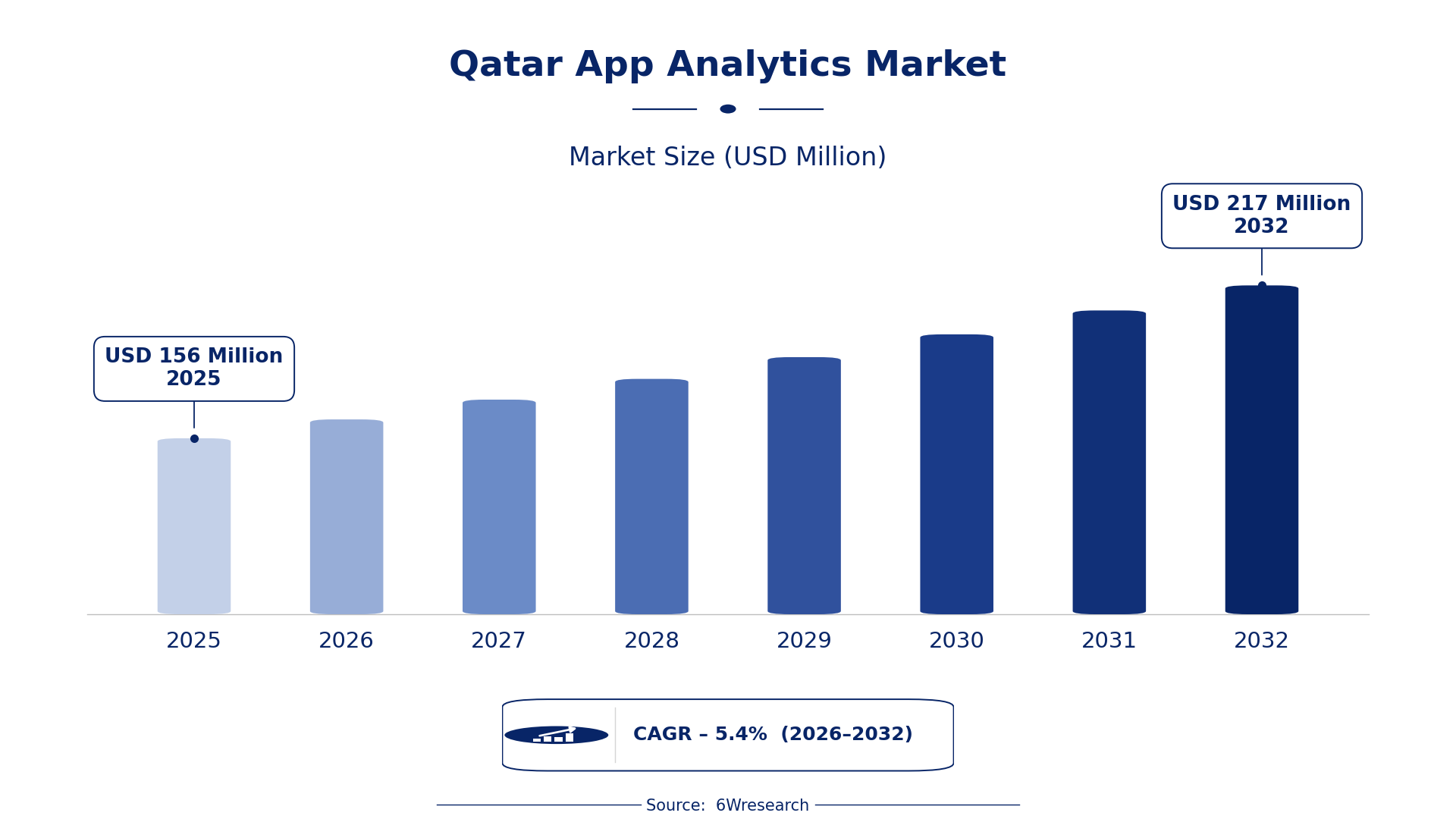
The Qatar App Analytics Market was estimated at USD 156 Million in 2025 and is projected to reach USD 217 Million by 2032, growing at a CAGR of 5.4% from 2026 to 2032.
Qatar App Analytics Market Synopsis
Qatar's App Analytics Market is currently experiencing substantial growth as businesses increasingly prioritize understanding user interactions with mobile applications. This trend is driven by the imperative to optimize app performance and enhance user engagement metrics, especially in sectors such as finance, healthcare, and retail.
The integration of app analytics tools into corporate strategies is no longer optional; it’s a necessity. Companies are utilizing these insights to refine user experiences and stay competitive, indicating a growing recognition of data-driven decision-making across the region.
Qatar App Analytics Market Year-wise Growth Rate and Key Drivers
This graph illustrates the annual growth rates of the Qatar App Analytics Market from 2021 to 2032, highlighting a steady upward trajectory and projected expansion over the forecast period.
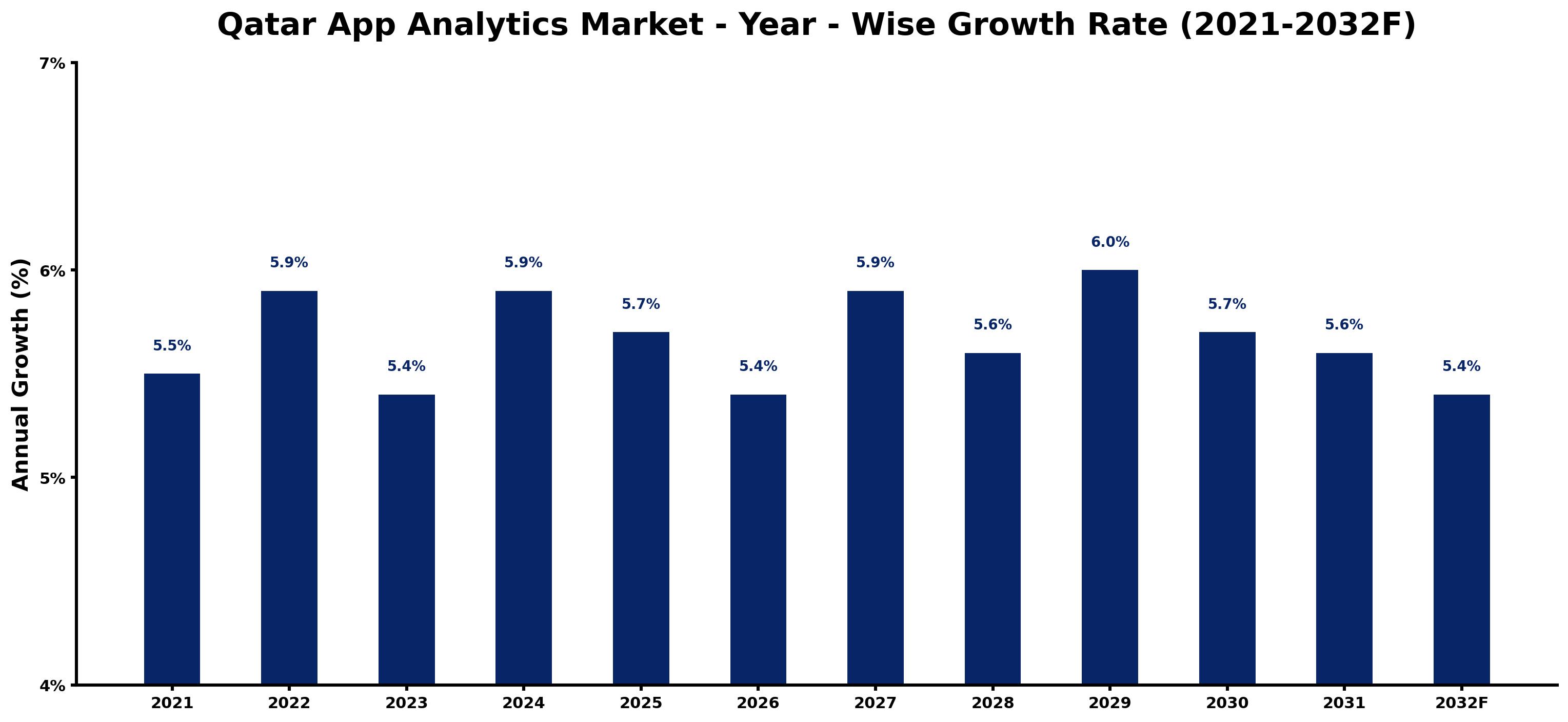
The table below presents the year‑wise growth rates along with the key drivers influencing the market
| Year | Growth Rate | Major Drivers |
| 2021 | 5.5% | Qatar National Vision 2030 promoting digital innovation initiatives. |
| 2022 | 5.9% | Increased mobile penetration driving app usage growth. |
| 2023 | 5.4% | Strong demand for localized content and analytic insights. |
| 2024 | 5.9% | Growing focus on data privacy influencing analytics adoption. |
| 2025 | 5.7% | Government support for tech startups boosting app ecosystem. |
| 2026 | 5.4% | Emergence of e-commerce platforms requiring advanced analytics. |
| 2027 | 5.9% | Increased smartphone adoption enhancing app usage metrics. |
| 2028 | 5.6% | Higher internet speeds enabling richer app analytics capabilities. |
| 2029 | 6.0% | Investment in smart city initiatives boosting app development. |
| 2030 | 5.7% | Emerging fintech apps driving analytics demand in Qatar. |
| 2031 | 5.6% | Rising consumer expectations for personalized app experiences. |
| 2032 | 5.4% | Growing interest in mobile health applications and analytics. |
Note: Market size estimations and growth projections presented in this report are based on 6Wresearch's proprietary forecasting methodology, utilizing the latest available industry data, government publications, and primary research inputs.
Qatar App Analytics Market Key Takeaways
Below are some of the specific key takeaways from the market, including:
- The increasing proliferation of mobile applications drives the demand for app analytics solutions.
- Data privacy and consent challenges present significant hurdles for analytics platforms.
- COVID-19 accelerated mobile app usage, emphasizing the need for deeper user behavior insights.
- Key players are focusing on innovations to address the evolving needs of Qatar's digital ecosystem.
- Government initiatives are shaping a regulatory framework that supports app analytics development.
Evaluation of Restraints in Qatar App Analytics Market
In Qatar, the App Analytics Market encounters notable constraints, particularly concerning data privacy and user consent. Businesses must navigate a landscape where compliance with stringent data protection regulations is essential. This often results in limited access to comprehensive user data, hindering the effectiveness of analytics solutions. on top of that, the complexities of ensuring data security while providing actionable insights challenge organizations looking to harness the full potential of app analytics.
Qatar App Analytics Market Trends
Several trends are shaping the Qatar App Analytics Market. The shift towards cloud-based analytics solutions is gaining momentum, providing businesses with scalable and flexible options for data management. Additionally, there is an increasing focus on real-time analytics, allowing companies to make immediate adjustments based on user behavior. Enhanced integration of artificial intelligence in analytics tools is also emerging, offering deeper insights and predictive capabilities.
Qatar App Analytics Market Opportunities
Opportunities abound in the Qatar App Analytics Market, particularly as organizations seek to enhance user engagement and retention. The demand for personalized app experiences creates a significant opening for companies offering advanced analytics solutions. on top of that, as more sectors adopt mobile technology, the necessity for tailored analytics tools will expand, paving the way for innovative product offerings and strategic partnerships.
Government Initiatives in the Qatar App Analytics Market
The Qatari government is actively shaping the App Analytics Market through various initiatives aimed at fostering a supportive regulatory environment. With a focus on enhancing digital infrastructure and ensuring data protection, these policies are critical for the market's growth. The government recognizes the potential of app analytics to drive innovation and efficiency across industries, making policy reform essential at this juncture.
- A national digital infrastructure upgrade programme now in its rollout phase aims to enhance connectivity and data exchange across sectors.
- A regulatory framework introduced in 2025 mandates stricter compliance with user data privacy, impacting app analytics practices.
- Currently ongoing is an initiative to promote public-private partnerships focused on developing advanced analytics tools for local businesses.
- Planned for 2027 is a government-sponsored project aimed at supporting startups in the app analytics space, fostering innovation.
Future Insights of the Qatar App Analytics Market
Looking ahead to 2026-2032, the Qatar App Analytics Market is expected to experience dynamic growth. As mobile applications become increasingly central to business operations, the demand for sophisticated analytics will rise. Companies will seek solutions that not only track performance but also provide actionable insights into user engagement. This trend, coupled with ongoing government support, positions the market for significant expansion, making it an attractive avenue for investment.
Qatar App Analytics Market Latest Developments
Over the past year, the Qatar App Analytics Market has witnessed a surge in activity as businesses adapt to evolving consumer demands and technological advancements. Recent developments reflect a strong commitment to enhancing analytics capabilities, driven by the need for data-driven decision-making.
- A major technology vendor launched an advanced app analytics platform in early 2025, integrating AI for improved user insights.
- An ongoing initiative began in mid-2025 to collaborate with local startups, focusing on developing innovative analytics solutions tailored to regional needs.
- By the end of 2025, a regional operator plans to complete a comprehensive upgrade of its analytics tools to enhance user engagement metrics.
- Upcoming in late 2026 is a rollout of a nationwide training program aimed at equipping businesses with analytics skills and knowledge.
Qatar App Analytics Market - Key Attractiveness of the Report
- 10 Years of Market Numbers
- Historical Data Starting from 2022 to 2025
- Base Year: 2025
- Forecast Data until 2032
- Key Performance Indicators Impacting the Market
- Major Upcoming Developments and Projects
Key Highlights of the Report:
- Qatar App Analytics Market Outlook
- Market Size of Qatar App Analytics Market, 2025
- Forecast of Qatar App Analytics Market, 2032
- Historical Data and Forecast of Qatar App Analytics Revenues & Volume for the Period 2022-2032F
- Qatar App Analytics Market Trend Evolution
- Qatar App Analytics Market Drivers and Challenges
- Qatar App Analytics Price Trends
- Qatar App Analytics Porter's Five Forces
- Qatar App Analytics Industry Life Cycle
- Historical Data and Forecast of Qatar App Analytics Market Revenues & Volume By Component for the Period 2022-2032F
- Historical Data and Forecast of Qatar App Analytics Market Revenues & Volume By Software for the Period 2022-2032F
- Historical Data and Forecast of Qatar App Analytics Market Revenues & Volume By Services for the Period 2022-2032F
- Historical Data and Forecast of Qatar App Analytics Market Revenues & Volume By Application for the Period 2022-2032F
- Historical Data and Forecast of Qatar App Analytics Market Revenues & Volume By Revenue analytics for the Period 2022-2032F
- Historical Data and Forecast of Qatar App Analytics Market Revenues & Volume By App performance analytics and operations for the Period 2022-2032F
- Historical Data and Forecast of Qatar App Analytics Market Revenues & Volume By User analytics for the Period 2022-2032F
- Historical Data and Forecast of Qatar App Analytics Market Revenues & Volume By Ad monitoring and marketing analytics for the Period 2022-2032F
- Historical Data and Forecast of Qatar App Analytics Market Revenues & Volume By Type for the Period 2022-2032F
- Historical Data and Forecast of Qatar App Analytics Market Revenues & Volume By Mobile app analytics for the Period 2022-2032F
- Historical Data and Forecast of Qatar App Analytics Market Revenues & Volume By Web app analytics for the Period 2022-2032F
- Historical Data and Forecast of Qatar App Analytics Market Revenues & Volume By Vertical for the Period 2022-2032F
- Historical Data and Forecast of Qatar App Analytics Market Revenues & Volume By Banking, Financial Services, and Insurance (BFSI) for the Period 2022-2032F
- Historical Data and Forecast of Qatar App Analytics Market Revenues & Volume By Retail for the Period 2022-2032F
- Historical Data and Forecast of Qatar App Analytics Market Revenues & Volume By Media and entertainment for the Period 2022-2032F
- Historical Data and Forecast of Qatar App Analytics Market Revenues & Volume By Logistics, travel, and transportation for the Period 2022-2032F
- Historical Data and Forecast of Qatar App Analytics Market Revenues & Volume By Telecom and IT for the Period 2022-2032F
- Historical Data and Forecast of Qatar App Analytics Market Revenues & Volume By Others for the Period 2022-2032F
- Qatar App Analytics Import Export Trade Statistics
- Market Opportunity Assessment By Component
- Market Opportunity Assessment By Application
- Market Opportunity Assessment By Type
- Market Opportunity Assessment By Vertical
- Qatar App Analytics Top Companies Market Share
- Qatar App Analytics Competitive Benchmarking By Technical and Operational Parameters
- Qatar App Analytics Company Profiles
- Qatar App Analytics Key Strategic Recommendations






































