Qatar Architectural Hardware Market Summary
The qatar architectural hardware market was estimated at USD 170 Million in 2025 and is projected to reach USD 227 Million by 2032, growing at a CAGR of 4.8% from 2026 to 2032.
Qatar Architectural Hardware Market Year-wise Growth Rate and Key Drivers
This graph highlights how the Qatar Architectural Hardware Market has steadily grown over the past five years, supported by major growth factors.
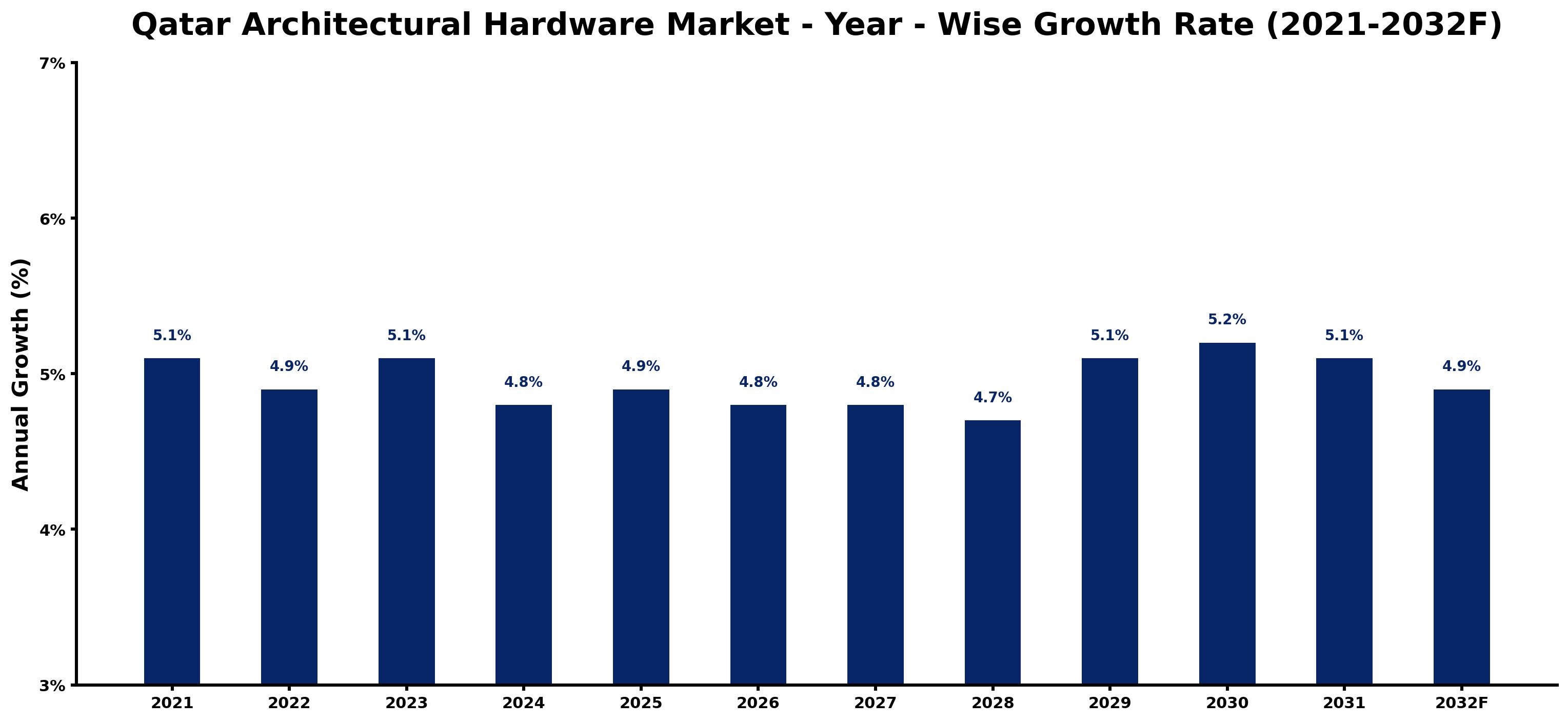
The table below presents the year wise growth rates along with the key drivers influencing the market
| Year | Growth Rate | Major Drivers |
| 2021 | 5.1% | Post-pandemic recovery in construction ignites interest in architectural hardware solutions. |
| 2022 | 4.9% | The local focus on sustainable buildings demands innovative hardware designs and materials. |
| 2023 | 5.1% | Expanding residential projects in Lusail City create substantial hardware demand spikes. |
| 2024 | 4.8% | Increased foreign investments signal confidence in long-term infrastructure development. |
| 2025 | 4.9% | Transition towards smart home technologies influences architectural hardware market trends. |
| 2026 | 4.8% | High-profile events, such as the World Cup, boost construction and renovation activities. |
| 2027 | 4.8% | Collaborations between local firms and international brands enhance product accessibility and variety. |
| 2028 | 4.7% | Changes in consumer preferences towards premium products shape hardware manufacturing strategies. |
| 2029 | 5.1% | Economic diversification efforts broaden the construction sector beyond traditional projects. |
| 2030 | 5.2% | Technological integration in construction facilitates smoother installations and increased efficiency. |
| 2031 | 5.1% | Increasing urbanization leads to a higher demand for high-quality architectural solutions. |
| 2032 | 4.9% | Focus on luxury developments in hospitality sectors drives growth in premium hardware segments. |
Note - Market size estimations and growth projections presented in this report are based on 6Wresearch's advanced forecasting approach, validated with industry datasets as of June 2026.
Qatar Architectural Hardware Market Synopsis
The Qatar Architectural Hardware Market is projected to reach 4.8% and witness significant growth during the forecast period (2026-2032). This market encompasses a wide array of hardware products essential for the construction and design of both residential and commercial buildings, including door handles, locks, hinges, knobs, and window fittings. As Qatar continues to develop its urban landscape and infrastructure, the demand for high-quality architectural hardware is anticipated to rise substantially.
Qatar Architectural Hardware Market Growth Drivers
Several key factors are propelling the expansion of the Qatar Architectural Hardware Market. These include:
- The ongoing surge in construction and infrastructure projects, driven by a rapidly growing population and urbanization trends.
- Significant investments in the tourism and hospitality sectors, which are contributing to the development of hotels, resorts, and entertainment facilities.
- Government initiatives aimed at diversifying the economy, which are leading to increased capital inflow into the construction and real estate sectors.
- A rising consumer preference for high-quality, aesthetically pleasing architectural hardware products that enhance the overall design of buildings.
- The increasing emphasis on safety and security in construction designs, leading to higher demand for advanced locking systems and safety fittings.
Qatar Architectural Hardware Market Challenges and Restraints
Despite its growth potential, the Qatar Architectural Hardware Market faces a number of challenges that could hinder its progress. These include:
- Volatile economic conditions, which may lead to fluctuations in construction spending and project delays.
- Intense competition from imported architectural hardware products that may offer a wider range of options at competitive prices.
- The necessity to stay abreast of technological advancements and evolving design trends within the hardware sector to remain relevant.
- Compliance with stringent regulations and industry standards that can complicate manufacturing and distribution processes.
- The impact of fluctuating raw material prices, which may affect production costs and pricing strategies.
Qatar Architectural Hardware Market Government Investment and Initiatives
The Qatari government has implemented several policies and investment initiatives aimed at fostering growth in the architectural hardware market. These initiatives include substantial public spending on infrastructure projects and a focus on vision-oriented planning such as the Qatar National Vision 2030. The government has allocated budgets for the development of educational, residential, and commercial buildings, which are foundational for urban growth. Incentives for local manufacturers are also being considered to reduce dependency on imports and stimulate domestic production, thus enhancing the overall market landscape.
Qatar Architectural Hardware Market Trends and Opportunities
The Qatar Architectural Hardware Market is witnessing several trends that indicate its future direction. These trends include:
- Increased adoption of smart technology in architectural hardware, such as smart locks and automated window fittings, which cater to the demand for high-tech solutions.
- A growing emphasis on sustainability and eco-friendly materials in construction, leading to innovative architectural hardware that aligns with environmental standards.
- The introduction of customized hardware solutions to meet specific aesthetic and functional requirements of modern architectural designs.
- Expansion in online retail and e-commerce platforms for architectural hardware, providing greater access and convenience for consumers.
- Collaboration between construction firms and hardware manufacturers to ensure that hardware products are well-integrated into the design and construction processes.
Qatar Architectural Hardware Market Latest Developments (May 2025 - June 2026)
The period from May 2025 to June 2026 has seen notable developments in the Qatar Architectural Hardware Market. The industry has been focused on recovering from the impacts of the Covid-19 pandemic, with companies prioritizing supply chain resilience and workforce safety. Market players have increasingly incorporated health protocols into their operations. Additionally, there has been a noticeable shift towards integrating advanced materials and technology in hardware products, reflecting a broader trend towards modernization in the construction sector. The government's revitalization of infrastructure projects post-pandemic has provided added stimulus, ensuring an upward trajectory for architectural hardware demands.
Qatar Architectural Hardware Market - Key Attractiveness of the Report
- 10 Years of Market Numbers
- Historical Data Starting from 2022 to 2025
- Base Year: 2025
- Forecast Data until 2032
- Key Performance Indicators Impacting the Market
- Major Upcoming Developments and Projects
Key Highlights of the Report:
- Qatar Architectural Hardware Market Outlook
- Market Size of Qatar Architectural Hardware Market, 2025
- Forecast of Qatar Architectural Hardware Market, 2032
- Historical Data and Forecast of Qatar Architectural Hardware Revenues & Volume for the Period 2022-2032F
- Qatar Architectural Hardware Market Trend Evolution
- Qatar Architectural Hardware Market Drivers and Challenges
- Qatar Architectural Hardware Price Trends
- Qatar Architectural Hardware Porter's Five Forces
- Qatar Architectural Hardware Industry Life Cycle
- Historical Data and Forecast of Qatar Architectural Hardware Market Revenues & Volume By Application for the Period 2022-2032F
- Historical Data and Forecast of Qatar Architectural Hardware Market Revenues & Volume By Doors for the Period 2022-2032F
- Historical Data and Forecast of Qatar Architectural Hardware Market Revenues & Volume By Windows for the Period 2022-2032F
- Historical Data and Forecast of Qatar Architectural Hardware Market Revenues & Volume By Furniture for the Period 2022-2032F
- Historical Data and Forecast of Qatar Architectural Hardware Market Revenues & Volume By Shower for the Period 2022-2032F
- Historical Data and Forecast of Qatar Architectural Hardware Market Revenues & Volume By End-user for the Period 2022-2032F
- Historical Data and Forecast of Qatar Architectural Hardware Market Revenues & Volume By Commercial for the Period 2022-2032F
- Historical Data and Forecast of Qatar Architectural Hardware Market Revenues & Volume By Industrial for the Period 2022-2032F
- Historical Data and Forecast of Qatar Architectural Hardware Market Revenues & Volume By Residential for the Period 2022-2032F
- Qatar Architectural Hardware Import Export Trade Statistics
- Market Opportunity Assessment By Application
- Market Opportunity Assessment By End-user
- Qatar Architectural Hardware Top Companies Market Share
- Qatar Architectural Hardware Competitive Benchmarking By Technical and Operational Parameters
- Qatar Architectural Hardware Company Profiles
- Qatar Architectural Hardware Key Strategic Recommendations






































