Qatar Aromatic Compounds Market Size, Share & Growth Rate
The Qatar Aromatic Compounds Market was estimated at USD 1340 Million in 2025 and is projected to reach USD 1943 Million by 2032, growing at a CAGR of 5.5% from 2026 to 2032. This growth trajectory is fueled by an increasing demand for aromatic compounds across various sectors, particularly in the petrochemical and pharmaceutical industries. Qatar's strategic initiatives to diversify its economy beyond hydrocarbons further bolster the anticipated demand, positioning the country as a competitive player in the regional aromatic compounds market.
Qatar Aromatic Compounds Market Year-wise Growth Rate and Key Drivers
This graph highlights how the Qatar Aromatic Compounds Market has steadily grown over the years, supported by major growth factors.
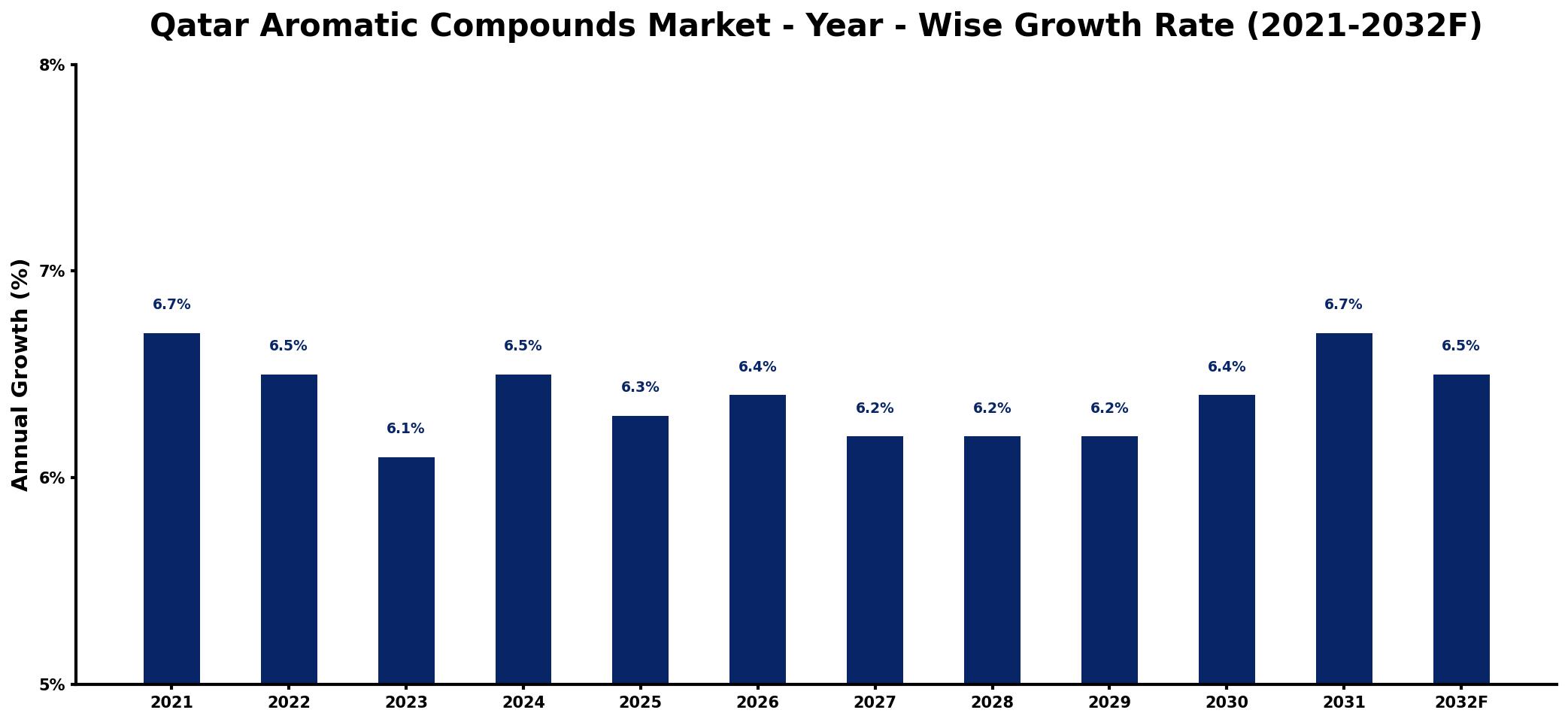
The table below presents the year‑wise growth rates along with the key drivers influencing the market
| Year | Growth Rate | Major Drivers |
| 2021 | 6.7% | Increased demand from fragrance industry |
| 2022 | 6.5% | Growth in personal care applications |
| 2023 | 6.1% | Rising consumer interest in sustainability |
| 2024 | 6.5% | Expansion of food flavoring sector |
| 2025 | 6.3% | Investments in chemical manufacturing facilities |
| 2026 | 6.4% | Boost in home fragrance market |
| 2027 | 6.2% | strengthening international trade flows |
| 2028 | 6.2% | Rising popularity of natural ingredients |
| 2029 | 6.2% | Increased export opportunities in region |
| 2030 | 6.4% | rising end-use demand growth |
| 2031 | 6.7% | Growing trend of eco-friendly products |
| 2032 | 6.5% | Increase in luxury product offerings |
Note: Market size estimations and growth projections presented in this report are based on 6Wresearch's proprietary forecasting methodology, utilizing the latest available industry data, government publications, and primary research inputs.
Qatar Aromatic Compounds Market Synopsis
The aromatic compounds market in Qatar is increasingly pivotal to the nations industrial landscape, as these compounds are integral to the production of diverse chemical products. With the ongoing development of downstream industries, Qatar aims to enhance its chemical manufacturing capabilities and meet the rising demand for specialized aromatic products.
As environmental concerns mount globally, Qatars aromatic compounds sector is also under pressure to adopt sustainable practices. This need for eco-friendly production methods is driving innovation and investment in research and development, ensuring the market aligns with both economic growth and environmental stewardship.
Qatar Aromatic Compounds Market Key Takeaways
- The market is positioned for steady growth driven by increased demand in various applications.
- Qatar's economic diversification strategy enhances the relevance of aromatic compounds in local industries.
- Technological advancements in production methods are crucial for competitiveness.
- Environmental sustainability is becoming a central focus, influencing production practices.
- Post-pandemic recovery is expected to rebound market activity significantly.
Evaluation of Restraints in Qatar Aromatic Compounds Market
Despite the promising outlook, the Qatar Aromatic Compounds Market faces considerable restraints. Primarily, the pressure for compliance with stringent environmental regulations poses challenges to production practices. Concerns regarding pollution and waste generation have led to increased scrutiny on operations. Producers must navigate these regulatory landscapes while maintaining profitability, requiring a delicate balance between sustainable practices and economic viability. Additionally, the need for skilled labor and technological investments can hinder rapid expansion, making strategic planning essential for stakeholders in the market.
Qatar Aromatic Compounds Market Trends
Several key trends are shaping the Qatar Aromatic Compounds Market. A notable shift towards green chemistry is influencing the production landscape, with companies investing in sustainable practices and materials. Furthermore, there is a growing emphasis on innovation, with firms exploring advanced methodologies for enhancing the efficiency and output of aromatic compounds. Additionally, the integration of digital technologies into manufacturing processes is becoming increasingly common, enhancing operational efficiencies and decision-making capabilities in real-time.
Qatar Aromatic Compounds Market Opportunities
The aromatic compounds market in Qatar is ripe with opportunities for growth and investment. As the country seeks to diversify its economy, there are significant prospects for expanding production capacities and exploring new applications in emerging sectors such as renewable energy and specialty chemicals. Moreover, partnerships and collaborations with international firms can provide access to advanced technologies and innovative solutions, driving forward the local industry's competitive edge in the global market.
Government Initiatives in the Qatar Aromatic Compounds Market
The Qatari government is actively fostering an environment conducive to growth in the aromatic compounds sector through various initiatives and incentives. Policies aimed at enhancing industrial diversification and sustainability are being implemented to support local manufacturers. Government investments in infrastructure development, research and development grants, and regulatory frameworks geared towards environmental compliance are all part of a broader strategy to bolster the chemical industry in Qatar. This support is crucial for ensuring that the aromatic compounds market can thrive within the national economic landscape.
Future Insights of the Qatar Aromatic Compounds Market
Looking ahead to the years 2026-2032, the Qatar Aromatic Compounds Market is set to evolve significantly. The anticipated recovery from COVID-19, coupled with growing industrial demand, suggests a robust market climate. Continued investment in R&D and sustainability will likely characterize this period, paving the way for innovative production methods and enhanced product offerings. With global chemical markets recovering and evolving, Qatar's position as a key player is expected to solidify, positioning it advantageously in regional and international supply chains.
Qatar Aromatic Compounds Market Latest Developments (2025 - 2026)
Recent developments in the Qatar Aromatic Compounds Market indicate a continued focus on technological advancements and sustainability. Several initiatives have emerged, aiming at reducing the environmental footprint of chemical production. Industry stakeholders are also exploring collaborations aimed at improving production efficiency and integrating cutting-edge technologies. Moreover, there is a concerted effort to align with global best practices, enhancing Qatars competitive edge in the aromatic compounds sector.
Qatar Aromatic Compounds Market - Key Attractiveness of the Report
- 10 Years of Market Numbers
- Historical Data Starting from 2022 to 2025
- Base Year: 2025
- Forecast Data until 2032
- Key Performance Indicators Impacting the Market
- Major Upcoming Developments and Projects
Key Highlights of the Report:
- Qatar Aromatic Compounds Market Outlook
- Market Size of Qatar Aromatic Compounds Market, 2025
- Forecast of Qatar Aromatic Compounds Market, 2032
- Historical Data and Forecast of Qatar Aromatic Compounds Revenues & Volume for the Period 2022-2032F
- Qatar Aromatic Compounds Market Trend Evolution
- Qatar Aromatic Compounds Market Drivers and Challenges
- Qatar Aromatic Compounds Price Trends
- Qatar Aromatic Compounds Porter's Five Forces
- Qatar Aromatic Compounds Industry Life Cycle
- Historical Data and Forecast of Qatar Aromatic Compounds Market Revenues & Volume By Type for the Period 2022-2032F
- Historical Data and Forecast of Qatar Aromatic Compounds Market Revenues & Volume By Benzene for the Period 2022-2032F
- Historical Data and Forecast of Qatar Aromatic Compounds Market Revenues & Volume By Xylene for the Period 2022-2032F
- Historical Data and Forecast of Qatar Aromatic Compounds Market Revenues & Volume By Toluene for the Period 2022-2032F
- Historical Data and Forecast of Qatar Aromatic Compounds Market Revenues & Volume By Application for the Period 2022-2032F
- Historical Data and Forecast of Qatar Aromatic Compounds Market Revenues & Volume By Solvent for the Period 2022-2032F
- Historical Data and Forecast of Qatar Aromatic Compounds Market Revenues & Volume By Additive for the Period 2022-2032F
- Historical Data and Forecast of Qatar Aromatic Compounds Market Revenues & Volume By End-use for the Period 2022-2032F
- Historical Data and Forecast of Qatar Aromatic Compounds Market Revenues & Volume By Packaging for the Period 2022-2032F
- Historical Data and Forecast of Qatar Aromatic Compounds Market Revenues & Volume By Detergent And Dyes for the Period 2022-2032F
- Historical Data and Forecast of Qatar Aromatic Compounds Market Revenues & Volume By Automobile for the Period 2022-2032F
- Historical Data and Forecast of Qatar Aromatic Compounds Market Revenues & Volume By Electronic Devices for the Period 2022-2032F
- Historical Data and Forecast of Qatar Aromatic Compounds Market Revenues & Volume By Medical Devices for the Period 2022-2032F
- Historical Data and Forecast of Qatar Aromatic Compounds Market Revenues & Volume By Pharmaceuticals for the Period 2022-2032F
- Historical Data and Forecast of Qatar Aromatic Compounds Market Revenues & Volume By Gasoline for the Period 2022-2032F
- Historical Data and Forecast of Qatar Aromatic Compounds Market Revenues & Volume By Tire for the Period 2022-2032F
- Qatar Aromatic Compounds Import Export Trade Statistics
- Market Opportunity Assessment By Type
- Market Opportunity Assessment By Application
- Market Opportunity Assessment By End-use
- Qatar Aromatic Compounds Top Companies Market Share
- Qatar Aromatic Compounds Competitive Benchmarking By Technical and Operational Parameters
- Qatar Aromatic Compounds Company Profiles
- Qatar Aromatic Compounds Key Strategic Recommendations






































