Qatar Ascorbic Acid Market Size, Share & Growth Rate
The Qatar Ascorbic Acid Market was estimated at USD 215 Million in 2025 and is projected to reach USD 286 Million by 2032, growing at a CAGR of 4.2% from 2026 to 2032. This growth is largely driven by a burgeoning awareness of health and wellness, which is pushing consumers towards vitamin-rich products. In Qatar, the food and beverage sector's increasing incorporation of ascorbic acid as a preservative and antioxidant further reinforces this positive trajectory.
Qatar Ascorbic Acid Market Year-wise Growth Rate and Key Drivers
This graph highlights how the Qatar Ascorbic Acid Market has steadily grown over the years, supported by major growth factors.
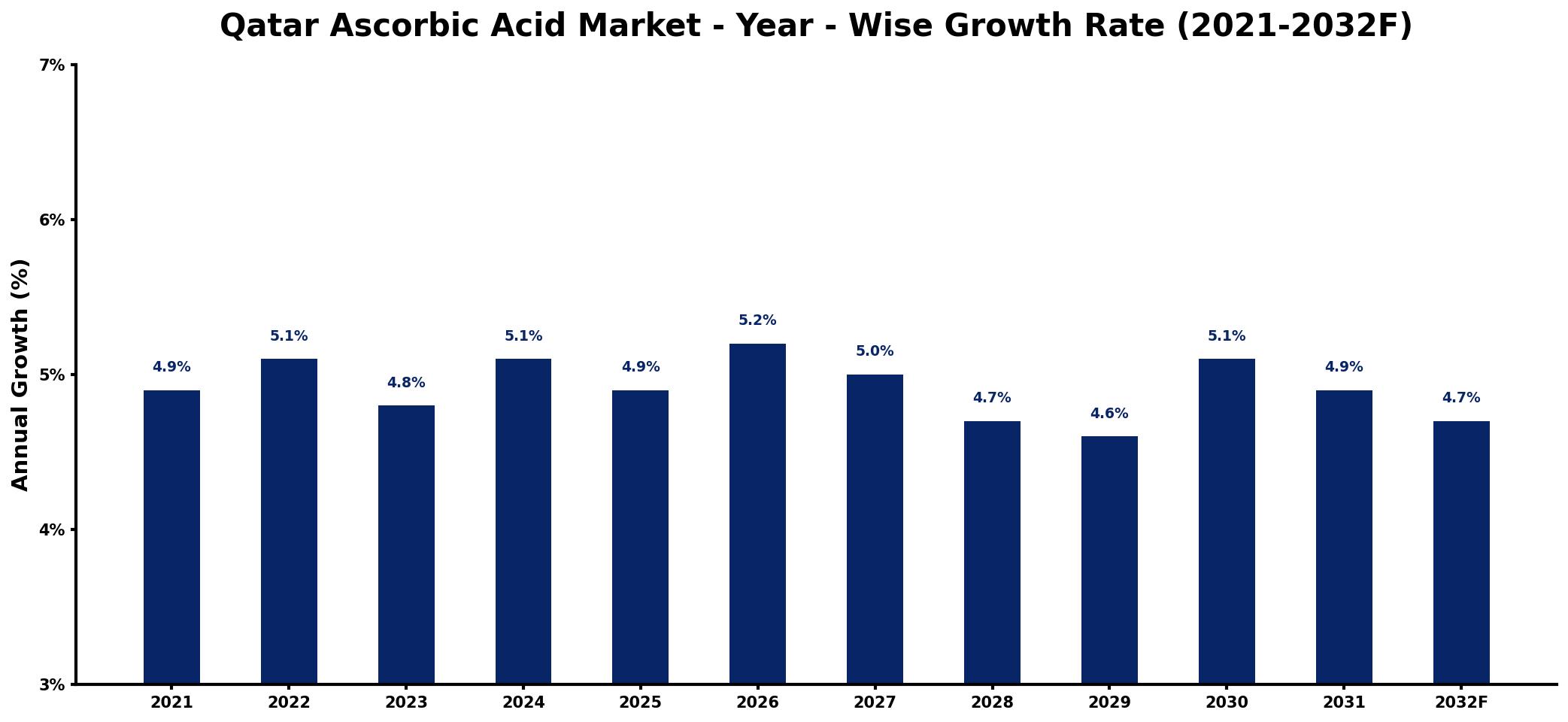
The table below presents the year‑wise growth rates along with the key drivers influencing the market
| Year | Growth Rate | Major Drivers |
| 2021 | 4.9% | Rising consumer health awareness |
| 2022 | 5.1% | Growth in dietary supplement market |
| 2023 | 4.8% | Increased demand for functional foods |
| 2024 | 5.1% | Expansion of pharmaceutical applications |
| 2025 | 4.9% | Investment in food fortification initiatives |
| 2026 | 5.2% | increased overall sector activity |
| 2027 | 5.0% | Emergence of new health trends |
| 2028 | 4.7% | Focus on preventive healthcare solutions |
| 2029 | 4.6% | increased domestic production output |
| 2030 | 5.1% | Rising popularity of wellness products |
| 2031 | 4.9% | Increased research funding for supplements |
| 2032 | 4.7% | strengthening international trade flows |
Note: Market size estimations and growth projections presented in this report are based on 6Wresearch's proprietary forecasting methodology, utilizing the latest available industry data, government publications, and primary research inputs.
Qatar Ascorbic Acid Market Synopsis
In recent years, the Qatar ascorbic acid market has demonstrated remarkable momentum, fueled by an increasing consumer focus on health. As consumers recognize the vital role of vitamin C in enhancing immunity and overall wellness, the demand for ascorbic acid has surged across various sectors. However, the future holds even more promise, as advancements in manufacturing processes are expected to enhance product availability and quality.
The continued expansion of the food and beverage industry, coupled with rising interest in skincare products featuring vitamin C, positions Qatar's ascorbic acid market for sustained growth. While challenges remain, such as reliance on imports, the outlook is optimistic as both consumers and industries increasingly prioritize the benefits of this essential nutrient.
Qatar Ascorbic Acid Market Key Takeaways
- The market is anticipated to grow at a CAGR of 4.2% from 2026 to 2032, driven by increasing health awareness.
- Ascorbic acid's diverse applications in food, pharmaceuticals, and cosmetics underscore its market importance.
- Advancements in production techniques are improving the availability and quality of ascorbic acid in Qatar.
- The dependence on imports presents challenges related to price stability and supply chain integrity.
- Key industries are continuously adapting to consumer demands, ensuring a robust market environment.
Evaluation of Restraints in Qatar Ascorbic Acid Market
Despite the positive growth outlook, the Qatar ascorbic acid market grapples with significant constraints. Primarily, the limited domestic production capabilities hinder the ability to meet rising demand. This situation results in a heavy reliance on imports, which can introduce volatility in pricing and availability. Furthermore, navigating complex regulatory landscapes for imported goods adds an additional layer of challenge for market participants. Ensuring compliance with quality control standards is crucial for maintaining product integrity and consumer safety, but it can also impose added operational burdens.
Qatar Ascorbic Acid Market Trends
Several current and emerging trends are shaping the Qatar ascorbic acid market. Firstly, there is a notable shift towards natural and organic products, leading to a rising demand for plant-based sources of vitamin C. Additionally, innovative formulations in cosmetic products are increasingly integrating ascorbic acid due to its antioxidant properties, further driving demand. The trend of incorporating health-promoting ingredients into food and beverages continues to evolve, and ascorbic acid remains a key component in these formulations. Furthermore, the post-COVID focus on health and immunity is expected to sustain interest in ascorbic acid well into the future.
Qatar Ascorbic Acid Market Opportunities
Significant growth and investment opportunities exist within the Qatar ascorbic acid market, particularly in expanding production capabilities. Domestic manufacturers could explore partnerships or innovations to reduce import dependency and stabilize supply. Additionally, the rising trend of health-conscious consumers offers a ripe market for new products enriched with ascorbic acid. The cosmetic sector is another promising area, where new skincare formulations can leverage the nutrient's benefits, opening avenues for new entrants and existing businesses to capitalize on the growing consumer preference for vitamin C-rich products.
Government Initiatives in the Qatar Ascorbic Acid Market
The Qatari government is actively promoting initiatives aimed at enhancing local production capabilities and supporting health-related industries. Policies focused on economic diversification are expected to encourage investment in the pharmaceutical and food sectors, indirectly benefiting the ascorbic acid market. Additionally, public health campaigns that emphasize the importance of vitamins in dietary intake can drive consumer demand, encouraging greater market growth. These initiatives reflect a commitment to fostering an environment conducive to innovation and health enhancement.
Future Insights of the Qatar Ascorbic Acid Market
Looking ahead to 2026-2032, the Qatar ascorbic acid market is set for steady growth propelled by ongoing consumer education about health benefits. Enhanced production practices and quality assurance measures will be essential in meeting rising demands. Additionally, as the food and beverage sectors evolve to incorporate more health-oriented ingredients, ascorbic acid will remain a cornerstone of product development. The integration of technology and sustainability in manufacturing processes will also play a vital role, positioning this market for innovation and resilience in the years to come.
Qatar Ascorbic Acid Market Latest Developments (2025 - 2026)
In the recent months, the Qatar ascorbic acid market has witnessed several noteworthy developments. Producers are increasingly investing in research and development to enhance product formulations, aligning with evolving consumer preferences for health and wellness products. Additionally, partnerships between local manufacturers and international suppliers are being explored to mitigate import challenges. The focus on sustainability is also gaining traction, with companies looking to adopt greener practices in production. These trends indicate a proactive approach to adapting to market demands and ensuring long-term success.
Qatar Ascorbic Acid Market - Key Attractiveness of the Report
- 10 Years of Market Numbers
- Historical Data Starting from 2022 to 2025
- Base Year: 2025
- Forecast Data until 2032
- Key Performance Indicators Impacting the Market
- Major Upcoming Developments and Projects
Key Highlights of the Report:
- Qatar Ascorbic Acid Market Outlook
- Market Size of Qatar Ascorbic Acid Market, 2025
- Forecast of Qatar Ascorbic Acid Market, 2032
- Historical Data and Forecast of Qatar Ascorbic Acid Revenues & Volume for the Period 2022-2032F
- Qatar Ascorbic Acid Market Trend Evolution
- Qatar Ascorbic Acid Market Drivers and Challenges
- Qatar Ascorbic Acid Price Trends
- Qatar Ascorbic Acid Porter's Five Forces
- Qatar Ascorbic Acid Industry Life Cycle
- Historical Data and Forecast of Qatar Ascorbic Acid Market Revenues & Volume By Grade for the Period 2022-2032F
- Historical Data and Forecast of Qatar Ascorbic Acid Market Revenues & Volume By Food & Pharmaceutical for the Period 2022-2032F
- Historical Data and Forecast of Qatar Ascorbic Acid Market Revenues & Volume By Industrial for the Period 2022-2032F
- Historical Data and Forecast of Qatar Ascorbic Acid Market Revenues & Volume By Application for the Period 2022-2032F
- Historical Data and Forecast of Qatar Ascorbic Acid Market Revenues & Volume By Food & Beverages for the Period 2022-2032F
- Historical Data and Forecast of Qatar Ascorbic Acid Market Revenues & Volume By Pharmaceutical for the Period 2022-2032F
- Historical Data and Forecast of Qatar Ascorbic Acid Market Revenues & Volume By Cosmetics for the Period 2022-2032F
- Historical Data and Forecast of Qatar Ascorbic Acid Market Revenues & Volume By Chemicals for the Period 2022-2032F
- Historical Data and Forecast of Qatar Ascorbic Acid Market Revenues & Volume By Agriculture for the Period 2022-2032F
- Historical Data and Forecast of Qatar Ascorbic Acid Market Revenues & Volume By Others for the Period 2022-2032F
- Qatar Ascorbic Acid Import Export Trade Statistics
- Market Opportunity Assessment By Grade
- Market Opportunity Assessment By Application
- Qatar Ascorbic Acid Top Companies Market Share
- Qatar Ascorbic Acid Competitive Benchmarking By Technical and Operational Parameters
- Qatar Ascorbic Acid Company Profiles
- Qatar Ascorbic Acid Key Strategic Recommendations






































