Qatar Bamboo Products Market Size, Share & Growth Rate
The Qatar Bamboo Products Market was estimated at USD 658 Million in 2025 and is projected to reach USD 947 Million by 2032, growing at a CAGR of 5.3% from 2026 to 2032. This robust growth trajectory is driven primarily by the rising consumer awareness surrounding sustainability and the growing inclination towards eco-friendly materials in construction and interior design. As Qatar positions itself as a leader in environmental initiatives, bamboo products are becoming increasingly favorable among consumers and businesses alike.
Qatar Bamboo Products Market Year-wise Growth Rate and Key Drivers
This graph highlights how the Qatar Bamboo Products Market has steadily grown over the years, supported by major growth factors.
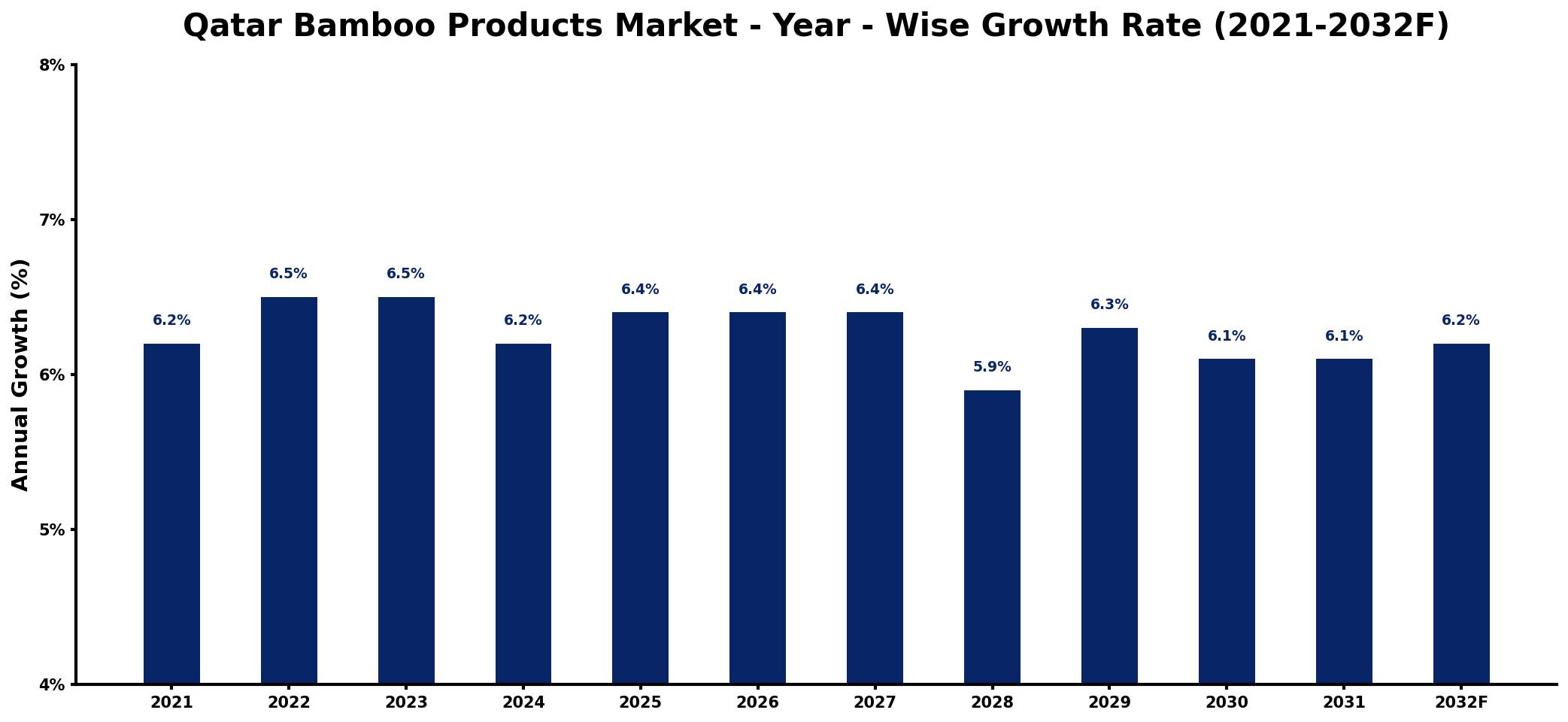
The table below presents the year‑wise growth rates along with the key drivers influencing the market
| Year | Growth Rate | Major Drivers |
| 2021 | 6.2% | Sustainable materials gaining traction |
| 2022 | 6.5% | Increased construction sector investments |
| 2023 | 6.5% | Rising consumer eco-consciousness levels |
| 2024 | 6.2% | Expansion in furniture design trends |
| 2025 | 6.4% | Growing interest in renewable resources |
| 2026 | 6.4% | Emerging markets increasing demand |
| 2027 | 6.4% | Innovations in manufacturing techniques |
| 2028 | 5.9% | Rising popularity in home decor |
| 2029 | 6.3% | Government incentives for green initiatives |
| 2030 | 6.1% | Enhanced awareness of environmental impact |
| 2031 | 6.1% | Collaborations with eco-friendly brands |
| 2032 | 6.2% | Diversification into new applications |
Note: Market size estimations and growth projections presented in this report are based on 6Wresearch's proprietary forecasting methodology, utilizing the latest available industry data, government publications, and primary research inputs.
Qatar Bamboo Products Market Synopsis
The strongest force shaping the Qatar Bamboo Products Market currently is the growing demand for sustainable and renewable resources. Increasingly, consumers are opting for bamboo-based solutions in furniture, flooring, and household items, motivated by environmental consciousness and a desire for durable alternatives.
Additionally, the alignment of bamboo product offerings with Qatars sustainability goals amplifies this trend. Companies are now focusing on quality assurance and sustainable practices, striving to overcome the barriers presented by limited local resources and competition from traditional materials.
Qatar Bamboo Products Market Key Takeaways
- The market is propelled by a shift towards sustainable living and eco-friendly materials.
- Key applications include bamboo furniture, flooring, and household items.
- Challenges such as limited local bamboo resources can impact pricing and availability.
- Consumer education and marketing strategies will be crucial for market expansion.
- The post-COVID recovery period has led to renewed interest in sustainable construction solutions.
Evaluation of Restraints in Qatar Bamboo Products Market
Despite its growth potential, the Qatar Bamboo Products Market faces significant restraints. Limited local bamboo resources pose a challenge, leading to higher transportation costs for imported goods. Furthermore, the competition from well-established materials such as wood and plastic adds pressure, making it essential for market participants to effectively communicate the benefits of bamboo products. Bridging the consumer knowledge gap regarding bamboo's sustainability benefits is also critical for fostering greater acceptance and sales within the market.
Qatar Bamboo Products Market Trends
Current trends in the Qatar Bamboo Products Market indicate a notable rise in consumer preference for versatility and eco-friendliness. The trend towards natural aesthetics in interior design continues to bolster the demand for bamboo furniture and flooring. Additionally, manufacturers are exploring innovative bamboo textiles for use in apparel and home decor. This diversification not only enhances product offerings but also aligns with global sustainability initiatives.
Qatar Bamboo Products Market Opportunities
Opportunities in the Qatar Bamboo Products Market are ripe for investment, especially in manufacturing and R&D. As sustainability takes center stage, companies can explore developing local bamboo cultivation initiatives to reduce reliance on imports. Additionally, there is potential for partnerships with architects and interior designers to promote bamboo as a preferred material in green building projects. Expanding consumer awareness campaigns will also create pathways for wider acceptance and growth.
Government Initiatives in the Qatar Bamboo Products Market
The Qatari government is actively promoting sustainability and eco-friendly initiatives, providing a favorable environment for the bamboo products market. Public spending on green building projects and materials supports the growth of sustainable practices. Various programs aimed at enhancing awareness of renewable resources are being implemented, aligning with national sustainability goals. Government incentives for green construction further bolster the market for bamboo products, emphasizing the material's role in eco-friendly development.
Future Insights of the Qatar Bamboo Products Market
Looking ahead to 2026-2032, the Qatar Bamboo Products Market is expected to undergo substantial transformation. As environmental sustainability remains at the forefront of consumer priorities, the market is likely to witness a surge in the adoption of bamboo products. With increased investment in local bamboo cultivation and innovative product development, market players can anticipate favorable conditions for growth. Enhanced consumer education will play a crucial role in solidifying bamboo's place as a primary material in both residential and commercial applications.
Qatar Bamboo Products Market Latest Developments (2025 - 2026)
Recent developments in the Qatar Bamboo Products Market have focused on promoting sustainable manufacturing practices and expanding product lines. A notable shift towards eco-friendly bamboo textiles is being observed, driven by consumer demand for sustainable fashion. The emphasis on collaboration among stakeholders, including designers and environmental groups, has also increased, fostering a community committed to sustainability. Innovative marketing campaigns aimed at educating consumers about the benefits of bamboo are taking shape, further enhancing market visibility.
Qatar Bamboo Products Market - Key Attractiveness of the Report
- 10 Years of Market Numbers
- Historical Data Starting from 2022 to 2025
- Base Year: 2025
- Forecast Data until 2032
- Key Performance Indicators Impacting the Market
- Major Upcoming Developments and Projects
Key Highlights of the Report:
- Qatar Bamboo Products Market Outlook
- Market Size of Qatar Bamboo Products Market, 2025
- Forecast of Qatar Bamboo Products Market, 2032
- Historical Data and Forecast of Qatar Bamboo Products Revenues & Volume for the Period 2022-2032F
- Qatar Bamboo Products Market Trend Evolution
- Qatar Bamboo Products Market Drivers and Challenges
- Qatar Bamboo Products Price Trends
- Qatar Bamboo Products Porter's Five Forces
- Qatar Bamboo Products Industry Life Cycle
- Historical Data and Forecast of Qatar Bamboo Products Market Revenues & Volume By Species for the Period 2022-2032F
- Historical Data and Forecast of Qatar Bamboo Products Market Revenues & Volume By Bambusa Tulda for the Period 2022-2032F
- Historical Data and Forecast of Qatar Bamboo Products Market Revenues & Volume By Bambusa Bambos for the Period 2022-2032F
- Historical Data and Forecast of Qatar Bamboo Products Market Revenues & Volume By Dendrocalamus Strictus for the Period 2022-2032F
- Historical Data and Forecast of Qatar Bamboo Products Market Revenues & Volume By Others for the Period 2022-2032F
- Historical Data and Forecast of Qatar Bamboo Products Market Revenues & Volume By Application for the Period 2022-2032F
- Historical Data and Forecast of Qatar Bamboo Products Market Revenues & Volume By Raw Material for the Period 2022-2032F
- Historical Data and Forecast of Qatar Bamboo Products Market Revenues & Volume By Industrial Products for the Period 2022-2032F
- Historical Data and Forecast of Qatar Bamboo Products Market Revenues & Volume By Furniture for the Period 2022-2032F
- Historical Data and Forecast of Qatar Bamboo Products Market Revenues & Volume By Shoots for the Period 2022-2032F
- Historical Data and Forecast of Qatar Bamboo Products Market Revenues & Volume By Others for the Period 2022-2032F
- Historical Data and Forecast of Qatar Bamboo Products Market Revenues & Volume By End User Industry for the Period 2022-2032F
- Historical Data and Forecast of Qatar Bamboo Products Market Revenues & Volume By Wood and Furniture for the Period 2022-2032F
- Historical Data and Forecast of Qatar Bamboo Products Market Revenues & Volume By Construction for the Period 2022-2032F
- Historical Data and Forecast of Qatar Bamboo Products Market Revenues & Volume By Paper and Pulp for the Period 2022-2032F
- Historical Data and Forecast of Qatar Bamboo Products Market Revenues & Volume By Chopsticks for the Period 2022-2032F
- Historical Data and Forecast of Qatar Bamboo Products Market Revenues & Volume By Toothpicks for the Period 2022-2032F
- Qatar Bamboo Products Import Export Trade Statistics
- Market Opportunity Assessment By Species
- Market Opportunity Assessment By Application
- Market Opportunity Assessment By End User Industry
- Qatar Bamboo Products Top Companies Market Share
- Qatar Bamboo Products Competitive Benchmarking By Technical and Operational Parameters
- Qatar Bamboo Products Company Profiles
- Qatar Bamboo Products Key Strategic Recommendations






































