Qatar Belt and Chain Drives Market Size, Share & Growth Rate
The Qatar Belt and Chain Drives Market was estimated at USD 868 Million in 2025 and is projected to reach USD 1447 Million by 2032, growing at a CAGR of 7.6% from 2026 to 2032. This growth trajectory is primarily driven by the substantial industrial growth in Qatar, which necessitates the implementation of reliable power transmission solutions across various sectors. The quest for efficiency in operations further fuels the demand for these systems, as they provide a cost-effective means to transmit power effectively and reliably.
Qatar Belt and Chain Drives Market Year-wise Growth Rate and Key Drivers
This graph highlights how the Qatar Belt and Chain Drives Market has steadily grown over the years, supported by major growth factors.
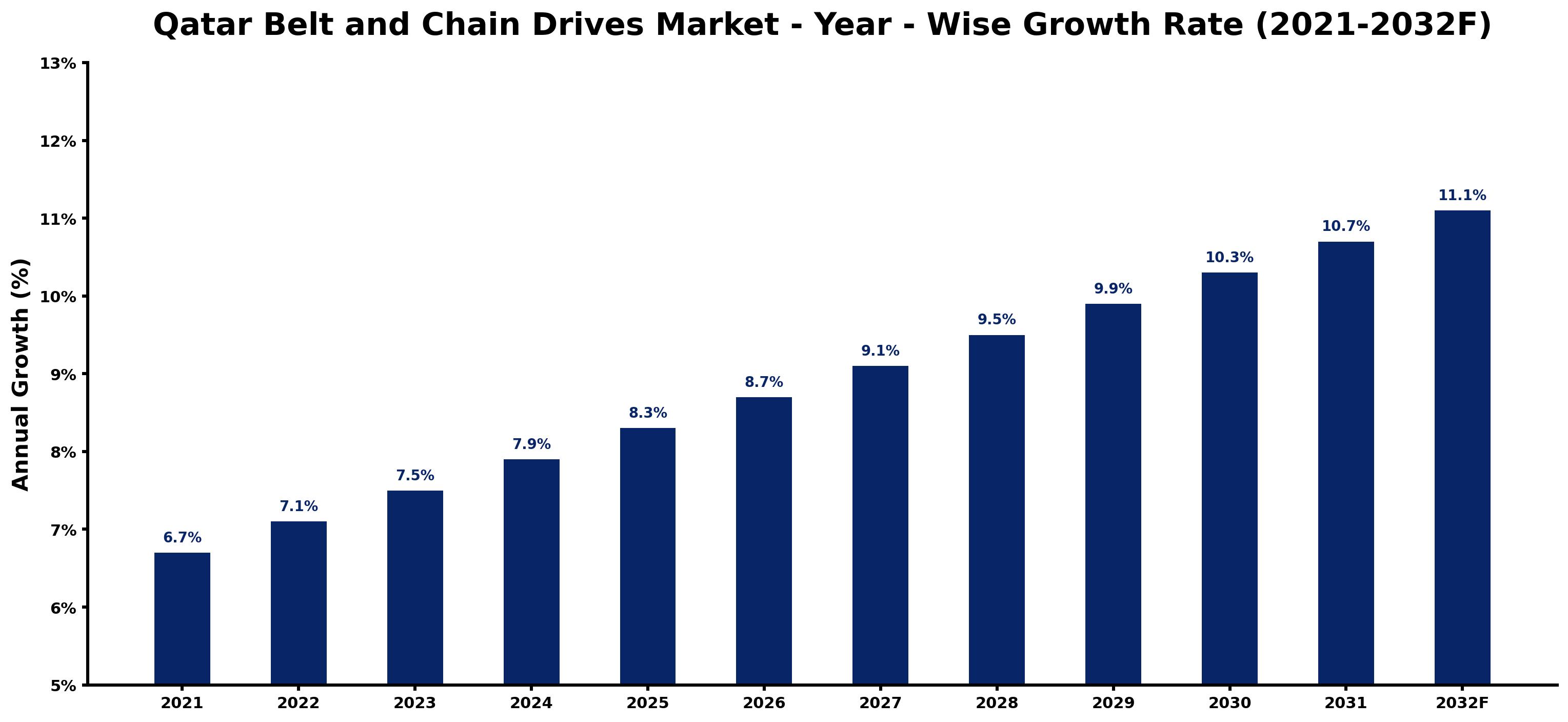
The table below presents the year‑wise growth rates along with the key drivers influencing the market
| Year | Growth Rate | Major Drivers |
| 2021 | 6.7% | Increasing industrial automation investments |
| 2022 | 7.1% | Increasing adoption of advanced technologies |
| 2023 | 7.5% | Expansion of manufacturing activities |
| 2024 | 7.9% | Expansion of transportation and logistics networks |
| 2025 | 8.3% | Expansion of transportation and logistics networks |
| 2026 | 8.7% | Increasing industrial infrastructure investments |
| 2027 | 9.1% | Increasing industrial infrastructure investments |
| 2028 | 9.5% | Expansion of manufacturing activities |
| 2029 | 9.9% | Increasing smart city development projects |
| 2030 | 10.3% | Rapid growth in telecom and data center sectors |
| 2031 | 10.7% | Expansion of transportation and logistics networks |
| 2032 | 11.1% | Growing urbanization and commercial development |
Note - Market size estimations and growth projections presented in this report are based on 6Wresearch’s advanced forecasting approach, validated with industry datasets as of June 2026.
Qatar Belt and Chain Drives Market Synopsis
The most significant factor currently shaping the Qatar Belt and Chain Drives market is the rapid expansion of industrial activities, particularly in construction and manufacturing. As these sectors thrive, the demand for advanced power transmission systems, especially belt and chain drives, continues to rise, highlighting their critical role in operational efficiency.
Moreover, the focus on maintenance-free and low-maintenance solutions is propelling the adoption of these drive systems. With fewer moving parts than alternative systems, belt and chain drives offer reduced downtime and maintenance costs, making them an attractive choice for industries aiming to optimize performance.
Qatar Belt and Chain Drives Market Key Takeaways
- Significant growth expected with an estimated market size reaching USD 1447 Million by 2032.
- Industrial expansion in Qatar is a primary driver for increased adoption of belt and chain drives.
- The need for efficient power transmission systems is becoming crucial across multiple industries.
- Lower maintenance requirements enhance the appeal of belt and chain drives over competing systems.
- Emerging technologies could reshape competitive dynamics in the power transmission market.
Evaluation of Restraints in Qatar Belt and Chain Drives Market
While the Qatar Belt and Chain Drives market is poised for growth, it is not without its challenges. The increasing presence of alternative power transmission systems, such as direct drives and electric motors, presents significant competition, particularly in applications demanding high precision and efficiency. Furthermore, the proper maintenance of belt and chain systems is essential; misalignment and incorrect tension can severely impact operational efficiency. Industries must remain vigilant about these factors to ensure that they harness the full potential of their drive systems.
Qatar Belt and Chain Drives Market Trends
Current trends in the Qatar Belt and Chain Drives market include a growing emphasis on automation and digitalization within industrial processes. This shift enhances the monitoring and maintenance of power transmission systems, fostering predictive maintenance strategies that minimize downtime. Additionally, the integration of advanced materials and coatings is evolving, leading to improved efficiency and durability of belt and chain drives, thereby positioning them favorably against competing technologies.
Qatar Belt and Chain Drives Market Opportunities
With Qatar's industrial landscape rapidly evolving, significant investment opportunities lie in upgrading existing facilities with modern belt and chain drive systems. Sectors such as construction and manufacturing are particularly ripe for innovation, as they seek to enhance productivity and operational efficiency. Furthermore, the potential for collaboration with technology providers in automation and sensor technologies presents exciting pathways for growth in this market.
Government Initiatives in the Qatar Belt and Chain Drives Market
The Qatari government is committed to fostering a diversified economy, leading to increased public spending on infrastructure and industrial projects. Policies aimed at enhancing industrial capabilities support the growth of the Belt and Chain Drives market, driving demand for reliable power transmission systems. Additionally, governmental incentives aimed at technological adoption and modernization bolster the investment environment for manufacturers and suppliers in this sector.
Future Insights of the Qatar Belt and Chain Drives Market
Looking ahead to 2026-2032, the Qatar Belt and Chain Drives market is expected to experience robust growth, bolstered by sustained industrial expansion and the continuous quest for efficiency. The demand for reliable, low-maintenance solutions will shape future developments, while the integration of smart technologies will likely redefine operational paradigms. Companies that strategically invest in innovation and align with market needs will stand to benefit the most in this evolving landscape.
Qatar Belt and Chain Drives Market Latest Developments (May 2025 - June 2026)
Recent developments in the Qatar Belt and Chain Drives market indicate a trend toward the adoption of enhanced materials and technologies aimed at increasing system efficiency. Key players are actively exploring partnerships with tech companies to integrate IoT solutions for real-time monitoring and predictive maintenance. This evolution not only aims to boost performance but also seeks to align with the broader trends of digital transformation in industrial settings.
Qatar Belt and Chain Drives Market - Key Attractiveness of the Report
- 10 Years of Market Numbers
- Historical Data Starting from 2022 to 2025
- Base Year: 2025
- Forecast Data until 2032
- Key Performance Indicators Impacting the Market
- Major Upcoming Developments and Projects
Key Highlights of the Report:
- Qatar Belt and Chain Drives Market Outlook
- Market Size of Qatar Belt and Chain Drives Market, 2025
- Forecast of Qatar Belt and Chain Drives Market, 2032
- Historical Data and Forecast of Qatar Belt and Chain Drives Revenues & Volume for the Period 2022-2032F
- Qatar Belt and Chain Drives Market Trend Evolution
- Qatar Belt and Chain Drives Market Drivers and Challenges
- Qatar Belt and Chain Drives Price Trends
- Qatar Belt and Chain Drives Porter's Five Forces
- Qatar Belt and Chain Drives Industry Life Cycle
- Historical Data and Forecast of Qatar Belt and Chain Drives Market Revenues & Volume By Type for the Period 2022-2032F
- Historical Data and Forecast of Qatar Belt and Chain Drives Market Revenues & Volume By Transmission Chain for the Period 2022-2032F
- Historical Data and Forecast of Qatar Belt and Chain Drives Market Revenues & Volume By Silent Chain for the Period 2022-2032F
- Historical Data and Forecast of Qatar Belt and Chain Drives Market Revenues & Volume By Leaf Chain for the Period 2022-2032F
- Historical Data and Forecast of Qatar Belt and Chain Drives Market Revenues & Volume By Roller Chain for the Period 2022-2032F
- Historical Data and Forecast of Qatar Belt and Chain Drives Market Revenues & Volume By Others for the Period 2022-2032F
- Historical Data and Forecast of Qatar Belt and Chain Drives Market Revenues & Volume By End users for the Period 2022-2032F
- Historical Data and Forecast of Qatar Belt and Chain Drives Market Revenues & Volume By Automotive for the Period 2022-2032F
- Historical Data and Forecast of Qatar Belt and Chain Drives Market Revenues & Volume By Industrial Machinery for the Period 2022-2032F
- Historical Data and Forecast of Qatar Belt and Chain Drives Market Revenues & Volume By Agriculture for the Period 2022-2032F
- Historical Data and Forecast of Qatar Belt and Chain Drives Market Revenues & Volume By Others for the Period 2022-2032F
- Qatar Belt and Chain Drives Import Export Trade Statistics
- Market Opportunity Assessment By Type
- Market Opportunity Assessment By End users
- Qatar Belt and Chain Drives Top Companies Market Share
- Qatar Belt and Chain Drives Competitive Benchmarking By Technical and Operational Parameters
- Qatar Belt and Chain Drives Company Profiles
- Qatar Belt and Chain Drives Key Strategic Recommendations






































