Qatar Blast Furnace Market Summary
The qatar blast furnace market was estimated at USD 268 Million in 2025 and is projected to reach USD 351 Million by 2032, growing at a CAGR of 4.6% from 2026 to 2032.
Qatar Blast Furnace Market Year-wise Growth Rate and Key Drivers
This graph highlights how the Qatar Blast Furnace Market has steadily grown over the past five years, supported by major growth factors.
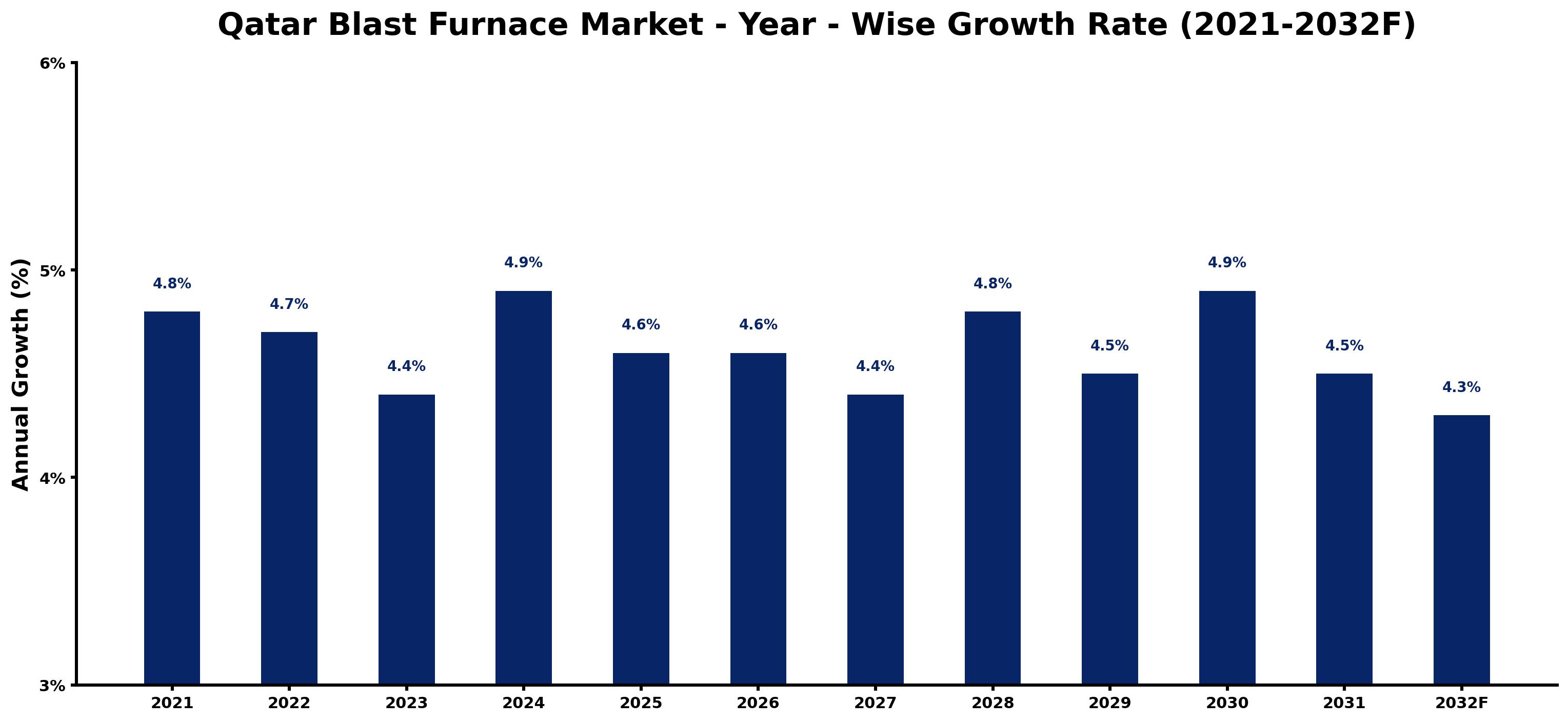
The table below presents the year wise growth rates along with the key drivers influencing the market
| Year | Growth Rate | Major Drivers |
| 2021 | 4.8% | Construction of major infrastructure projects laid groundwork for increased blast furnace demand. |
| 2022 | 4.7% | Localization efforts in GCC prompted investments in domestic steel production capabilities. |
| 2023 | 4.4% | Hot climate requirements necessitated energy-efficient technologies within blast furnace operations. |
| 2024 | 4.9% | Emerging market players sought innovative materials to enhance efficiency and output. |
| 2025 | 4.6% | Increased regional collaboration fostered competitiveness among Gulf steel manufacturers. |
| 2026 | 4.6% | Sustainability targets encouraged steel producers to explore eco-friendly blast furnace technologies. |
| 2027 | 4.4% | Rising urbanization in Qatar spurred robust demand for construction-grade steel products. |
| 2028 | 4.8% | Technological breakthroughs in automation led to improved operational efficiencies in furnaces. |
| 2029 | 4.5% | Global supply chain disruptions motivated local production to safeguard against import dependencies. |
| 2030 | 4.9% | Investment in research and development became a priority for leading steel manufacturers. |
| 2031 | 4.5% | Shift towards circular economy principles influenced raw material sourcing and production methods. |
| 2032 | 4.3% | Emerging trends in smart manufacturing transformed traditional blast furnace operations. |
Note - Market size estimations and growth projections presented in this report are based on 6Wresearch's advanced forecasting approach, validated with industry datasets as of June 2026.
Qatar Blast Furnace Market Synopsis
The Qatar Blast Furnace Market is projected to reach 4.6% and witness significant growth during the forecast period (2026-2032). The blast furnace serves as an integral apparatus within the iron and steel sector, functioning primarily to smelt iron ore into pig iron, which is essential for steel production. This process utilizes a combination of iron ore, coke, and limestone, in conjunction with hot air, to yield molten iron and slag, positioning the blast furnace as a cornerstone technology within the industry.
Qatar Blast Furnace Market Growth Drivers
The growth trajectory of the Qatar Blast Furnace Market is largely influenced by several dynamic factors. The primary driver is the escalating demand for steel products, significantly fueled by the booming construction and infrastructure sectors. As Qatar progresses with ambitious development projects, the need for steel will increase, directly enhancing the operational capacity of blast furnaces. Additionally, ongoing investment in industrial expansion and government initiatives aimed at bolstering the steel industry further catalyze market growth.
- Increased construction activities necessitate a greater volume of steel for structural applications, boosting blast furnace operations.
- Government policies promoting industrial growth and sustainability create a conducive environment for the blast furnace market to thrive.
- The export potential of Qatar's steel production allows local manufacturers to tap into broader markets, enhancing production incentives.
- Technological advancements in blast furnace efficiency can lead to improved production rates and reduced operational costs.
- The rising automotive sector in Qatar requires substantial steel supplies, underscoring the importance of blast furnaces in meeting this demand.
Qatar Blast Furnace Market Challenges and Restraints
Despite its growth potential, the Qatar Blast Furnace Market faces significant challenges that could hinder its advancement. Environmental concerns are at the forefront, as blast furnace operations contribute to greenhouse gas emissions, prompting stricter regulatory frameworks aimed at sustainability. Furthermore, global overcapacity in the steel production sphere poses price volatility, which can adversely impact local operators' competitiveness. The ongoing evolution within the steel industry, including the rise of alternative steelmaking technologies, may also affect the demand for traditional blast furnace production.
- Environmental regulations necessitate investment in cleaner technologies, which could raise operational costs for blast furnace operators.
- Fluctuations in raw material prices, influenced by global market conditions, can affect the profitability of blast furnace operations.
- The transition towards more sustainable steelmaking methods may divert investment away from traditional blast furnace technologies.
- Economic downturns, such as those triggered by the Covid-19 pandemic, can lead to reduced demand and operational disruptions within the industry.
- Competition from newer steel production technologies may result in a decline in market share for blast furnace-produced pig iron.
Qatar Blast Furnace Market Government Investment and Initiatives
The government of Qatar plays a pivotal role in shaping the landscape of the blast furnace market through various investments and initiatives. Significant public spending in infrastructure development not only boosts steel demand but also encourages advancements in blast furnace technologies. Initiatives aimed at diversifying the economy, particularly within the industrial sector, further enhance prospects for the steel industry and its associated operations. Government support for environmentally sustainable practices is also increasingly prevalent, prompting investments in emissions-reducing technologies in blast furnace operations.
- Policy frameworks promoting local steel production contribute to economic diversification and job creation within the industrial sector.
- Investment in research and development by the government supports innovation in blast furnace technology and operational efficiency.
- Public-private partnerships focus on enhancing industrial capabilities, thereby improving the competitiveness of local blast furnace operations.
- Government initiatives aimed at achieving carbon neutrality encourage the adoption of cleaner technologies in blast furnace operations.
- Funding allocated for infrastructure improvements directly correlates with increased demand for steel, subsequently driving the blast furnace market forward.
Qatar Blast Furnace Market Latest Developments (May 2025 - June 2026)
The period from May 2025 to June 2026 has seen notable developments within the Qatar Blast Furnace Market, reflecting broader industry trends. The momentum towards sustainable steel production has intensified, with operators exploring innovative methods to reduce emissions and enhance efficiency. Environmental concerns have prompted discussions among stakeholders regarding the future of blast furnace technologies in light of rising competitiveness from alternative production methods. Furthermore, the ongoing recovery from the Covid-19 pandemic has led to gradual stabilization in steel demand, which is positively affecting operational capacities and market outlook.
- Heightened focus on sustainability has driven investments into emission-reducing technologies, with operators seeking to comply with stricter environmental regulations.
- The gradual recovery of the construction sector post-pandemic is expected to bolster demand for steel, thereby benefiting blast furnace operations.
- Strategic alliances within the industry are forming to address challenges related to resource allocation and technological advancements.
- The exploration of hybrid production techniques that combine traditional blast furnace capabilities with newer technologies is gaining traction.
- Market players are increasingly adopting digital solutions to optimize production processes and enhance operational efficiency.
Qatar Blast Furnace Market - Key Attractiveness of the Report
- 10 Years of Market Numbers
- Historical Data Starting from 2022 to 2025
- Base Year: 2025
- Forecast Data until 2032
- Key Performance Indicators Impacting the Market
- Major Upcoming Developments and Projects
Key Highlights of the Report:
- Qatar Blast Furnace Market Outlook
- Market Size of Qatar Blast Furnace Market, 2025
- Forecast of Qatar Blast Furnace Market, 2032
- Historical Data and Forecast of Qatar Blast Furnace Revenues & Volume for the Period 2022-2032F
- Qatar Blast Furnace Market Trend Evolution
- Qatar Blast Furnace Market Drivers and Challenges
- Qatar Blast Furnace Price Trends
- Qatar Blast Furnace Porter's Five Forces
- Qatar Blast Furnace Industry Life Cycle
- Historical Data and Forecast of Qatar Blast Furnace Market Revenues & Volume By Type for the Period 2022-2032F
- Historical Data and Forecast of Qatar Blast Furnace Market Revenues & Volume By Cold Blast Blowers for the Period 2022-2032F
- Historical Data and Forecast of Qatar Blast Furnace Market Revenues & Volume By Hot Blast Ovens for the Period 2022-2032F
- Historical Data and Forecast of Qatar Blast Furnace Market Revenues & Volume By Applications for the Period 2022-2032F
- Historical Data and Forecast of Qatar Blast Furnace Market Revenues & Volume By Electronics for the Period 2022-2032F
- Historical Data and Forecast of Qatar Blast Furnace Market Revenues & Volume By Automobile for the Period 2022-2032F
- Historical Data and Forecast of Qatar Blast Furnace Market Revenues & Volume By Casting for the Period 2022-2032F
- Historical Data and Forecast of Qatar Blast Furnace Market Revenues & Volume By Others for the Period 2022-2032F
- Qatar Blast Furnace Import Export Trade Statistics
- Market Opportunity Assessment By Type
- Market Opportunity Assessment By Applications
- Qatar Blast Furnace Top Companies Market Share
- Qatar Blast Furnace Competitive Benchmarking By Technical and Operational Parameters
- Qatar Blast Furnace Company Profiles
- Qatar Blast Furnace Key Strategic Recommendations






































