Qatar Blow Moulding Machines Market Size, Share & Growth Rate
The Qatar Blow Moulding Machines Market was estimated at USD 155 Million in 2025 and is projected to reach USD 211 Million by 2032, growing at a CAGR of 4.5% from 2026 to 2032. This growth trajectory is primarily driven by the booming packaging sector, which is increasingly relying on blow moulding technology for the production of efficient and innovative plastic solutions. The rise in domestic consumption and export demand for packaged products is a key factor fueling this robust expansion.
Qatar Blow Moulding Machines Market Year-wise Growth Rate and Key Drivers
This graph highlights how the Qatar Blow Moulding Machines Market has steadily grown over the years, supported by major growth factors.
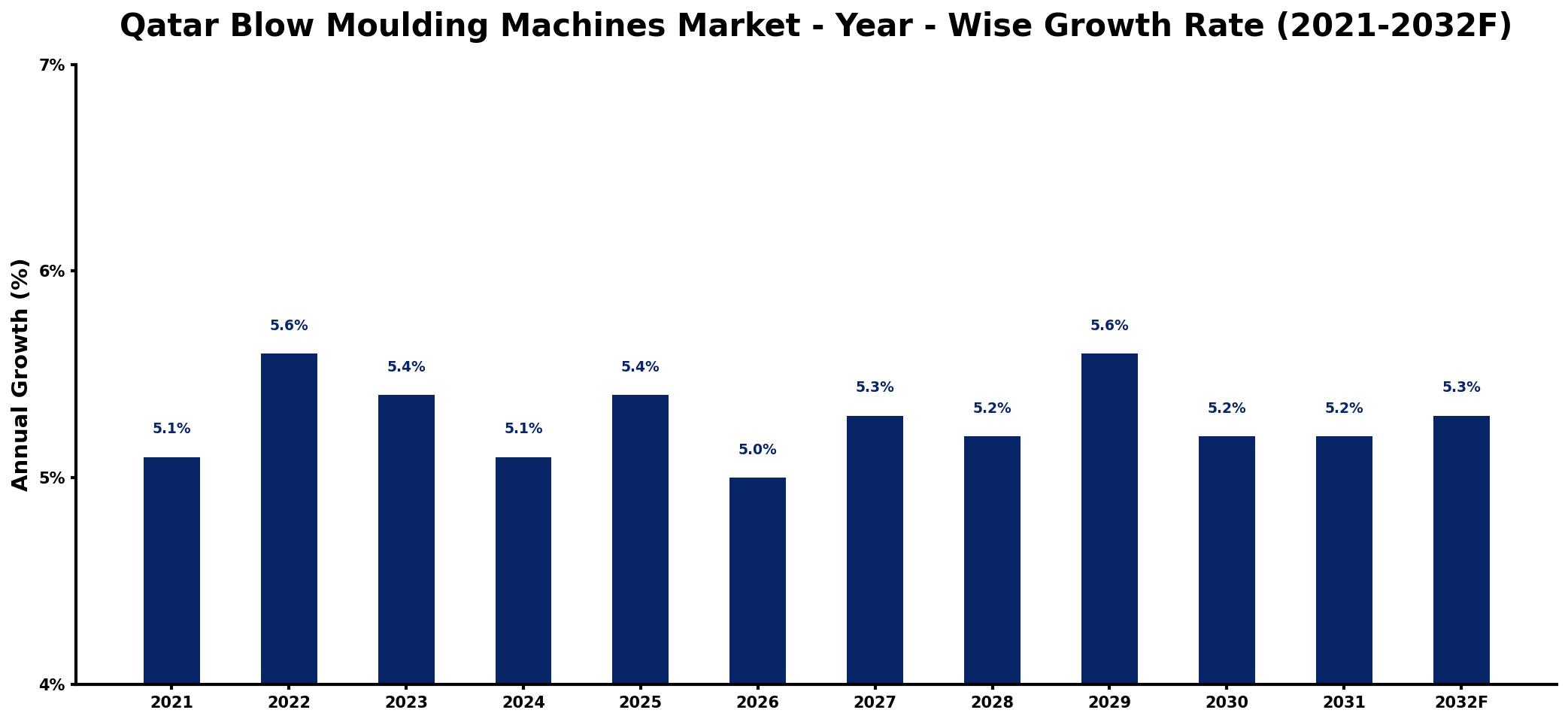
The table below presents the year‑wise growth rates along with the key drivers influencing the market
| Year | Growth Rate | Major Drivers |
| 2021 | 5.1% | Increased demand for packaging solutions |
| 2022 | 5.6% | Expansion of consumer goods sector |
| 2023 | 5.4% | rising end-use demand growth |
| 2024 | 5.1% | Rising investments in manufacturing facilities |
| 2025 | 5.4% | Surge in sustainable packaging initiatives |
| 2026 | 5.0% | Technological advancements in production |
| 2027 | 5.3% | Growth in e-commerce logistics requirements |
| 2028 | 5.2% | Increased focus on energy efficiency |
| 2029 | 5.6% | Rising demand for custom packaging |
| 2030 | 5.2% | increased pharmaceutical industry usage |
| 2031 | 5.2% | growing emerging market penetration |
| 2032 | 5.3% | Increased applications in healthcare sector |
Note: Market size estimations and growth projections presented in this report are based on 6Wresearch's proprietary forecasting methodology, utilizing the latest available industry data, government publications, and primary research inputs.
Qatar Blow Moulding Machines Market Synopsis
Recently, the Qatar Blow Moulding Machines Market has gained significant momentum, primarily fueled by escalating demand for plastic packaging across various industries. However, as the market matures, players are focusing on advanced technologies and sustainability initiatives to maintain their competitive edge.
Looking ahead, the market is positioned for sustained growth, driven by a combination of local manufacturing sector expansion and increased investment in automation. With sustainability becoming an imperative, manufacturers are adapting by embracing eco-friendly technologies, thereby enhancing their production capabilities.
Qatar Blow Moulding Machines Market Key Takeaways
- The market is set for steady growth driven by increasing demand for plastic packaging.
- Technological advancements and automation are crucial for maintaining product quality.
- Sustainability concerns are reshaping the production landscape towards eco-friendly practices.
- The resurgence of economic activity post-COVID-19 is revitalizing demand for blow moulding machines.
- The local manufacturing sector's growth presents substantial opportunities for market players.
Evaluation of Restraints in Qatar Blow Moulding Machines Market
Despite the promising outlook for the Qatar Blow Moulding Machines Market, several restraints may impact its trajectory. One significant concern is the growing scrutiny surrounding plastic production due to environmental sustainability. As global attitudes shift, there is increasing pressure on manufacturers to adopt more sustainable practices, which could limit traditional blow moulding applications. Furthermore, the market may face saturation as competition intensifies, compelling companies to innovate continually to differentiate themselves and cater to evolving consumer preferences.
Qatar Blow Moulding Machines Market Trends
The market is currently experiencing several key trends that are shaping both demand and technology. There is a marked shift towards energy-efficient blow moulding machinery, driven by the dual imperatives of cost reduction and sustainability. Furthermore, the increasing use of recyclable materials in packaging is prompting the development of advanced blow moulding processes that accommodate such materials. Additionally, manufacturers are leveraging automation and smart technologies to streamline production, improve quality control, and enhance operational efficiencies.
Qatar Blow Moulding Machines Market Opportunities
Significant opportunities for growth and investment in the Qatar Blow Moulding Machines Market lie in diversification and innovation. Companies can explore new applications for blow moulding technologies, including biodegradable and recyclable materials, which are gaining traction due to environmental concerns. The ongoing expansion of local and regional packaging needs also opens avenues for robust supply chain partnerships and collaborations, enhancing export opportunities for domestic players.
Government Initiatives in the Qatar Blow Moulding Machines Market
The Qatari government is actively supporting the growth of its manufacturing sector, including the blow moulding machines market, through various initiatives. Policies aimed at promoting industrialization and sustainability are in place, which include incentives for businesses adopting eco-friendly technologies. Public investment in infrastructure and manufacturing capabilities further bolsters the market, facilitating a conducive environment for innovation and growth.
Future Insights of the Qatar Blow Moulding Machines Market
From 2026 to 2032, the Qatar Blow Moulding Machines Market is expected to evolve significantly. The integration of advanced technologies such as AI and IoT will likely drive operational efficiencies and enhance product customization. Furthermore, as sustainability becomes a central theme in manufacturing, companies that adapt swiftly to meet eco-friendly standards will thrive. Overall, the outlook remains optimistic, as demand from the packaging sector continues to strengthen, supported by government policies and technological advancements.
Qatar Blow Moulding Machines Market Latest Developments (2025 - 2026)
In recent months, there has been a notable shift towards innovation within the Qatar Blow Moulding Machines Market. Manufacturers are increasingly adopting smart technologies that integrate machine learning for enhanced efficiency. Concurrently, there has been a rise in partnerships among companies focusing on sustainable packaging solutions, reflecting a collective effort to address environmental concerns. As the market progresses, investments in R&D aimed at developing advanced blow moulding machinery are expected to gain momentum, further enhancing the competitive landscape.
Qatar Blow Moulding Machines Market - Key Attractiveness of the Report
- 10 Years of Market Numbers
- Historical Data Starting from 2022 to 2025
- Base Year: 2025
- Forecast Data until 2032
- Key Performance Indicators Impacting the Market
- Major Upcoming Developments and Projects
Key Highlights of the Report:
- Qatar Blow Moulding Machines Market Outlook
- Market Size of Qatar Blow Moulding Machines Market, 2025
- Forecast of Qatar Blow Moulding Machines Market, 2032
- Historical Data and Forecast of Qatar Blow Moulding Machines Revenues & Volume for the Period 2022-2032F
- Qatar Blow Moulding Machines Market Trend Evolution
- Qatar Blow Moulding Machines Market Drivers and Challenges
- Qatar Blow Moulding Machines Price Trends
- Qatar Blow Moulding Machines Porter's Five Forces
- Qatar Blow Moulding Machines Industry Life Cycle
- Historical Data and Forecast of Qatar Blow Moulding Machines Market Revenues & Volume By Type for the Period 2022-2032F
- Historical Data and Forecast of Qatar Blow Moulding Machines Market Revenues & Volume By Extrusion for the Period 2022-2032F
- Historical Data and Forecast of Qatar Blow Moulding Machines Market Revenues & Volume By Injection for the Period 2022-2032F
- Historical Data and Forecast of Qatar Blow Moulding Machines Market Revenues & Volume By Injection Stretch for the Period 2022-2032F
- Historical Data and Forecast of Qatar Blow Moulding Machines Market Revenues & Volume By Application for the Period 2022-2032F
- Historical Data and Forecast of Qatar Blow Moulding Machines Market Revenues & Volume By Packaging for the Period 2022-2032F
- Historical Data and Forecast of Qatar Blow Moulding Machines Market Revenues & Volume By Consumable for the Period 2022-2032F
- Historical Data and Forecast of Qatar Blow Moulding Machines Market Revenues & Volume By Automotive for the Period 2022-2032F
- Historical Data and Forecast of Qatar Blow Moulding Machines Market Revenues & Volume By Electronics for the Period 2022-2032F
- Historical Data and Forecast of Qatar Blow Moulding Machines Market Revenues & Volume By Construction for the Period 2022-2032F
- Historical Data and Forecast of Qatar Blow Moulding Machines Market Revenues & Volume By Other Applications for the Period 2022-2032F
- Historical Data and Forecast of Qatar Blow Moulding Machines Market Revenues & Volume By Raw Material for the Period 2022-2032F
- Historical Data and Forecast of Qatar Blow Moulding Machines Market Revenues & Volume By Polyethylene Terephthalate (PET) for the Period 2022-2032F
- Historical Data and Forecast of Qatar Blow Moulding Machines Market Revenues & Volume By Polyethylene (PE) for the Period 2022-2032F
- Historical Data and Forecast of Qatar Blow Moulding Machines Market Revenues & Volume By Polypropylene (PP) for the Period 2022-2032F
- Historical Data and Forecast of Qatar Blow Moulding Machines Market Revenues & Volume By Polybutylene Terephthalate (PBT) for the Period 2022-2032F
- Historical Data and Forecast of Qatar Blow Moulding Machines Market Revenues & Volume By Polyvinyl chloride (PVC) for the Period 2022-2032F
- Historical Data and Forecast of Qatar Blow Moulding Machines Market Revenues & Volume By Polystyrene (PS) for the Period 2022-2032F
- Historical Data and Forecast of Qatar Blow Moulding Machines Market Revenues & Volume By Others Plastic Materials for the Period 2022-2032F
- Qatar Blow Moulding Machines Import Export Trade Statistics
- Market Opportunity Assessment By Type
- Market Opportunity Assessment By Application
- Market Opportunity Assessment By Raw Material
- Qatar Blow Moulding Machines Top Companies Market Share
- Qatar Blow Moulding Machines Competitive Benchmarking By Technical and Operational Parameters
- Qatar Blow Moulding Machines Company Profiles
- Qatar Blow Moulding Machines Key Strategic Recommendations






































