Qatar Building Construction Market Size, Share & Growth Rate
The Qatar Building Construction Market was estimated at USD 326 Million in 2025 and is projected to reach USD 453 Million by 2032, growing at a CAGR of 4.8% from 2026 to 2032. This growth trajectory is underpinned by extensive infrastructure investments, particularly in preparation for major international events like the FIFA World Cup. Furthermore, the governments push for urban development and modernization is catalyzing a robust pipeline of residential and commercial projects, ensuring continued momentum in the market.
Qatar Building Construction Market Year-wise Growth Rate and Key Drivers
This graph highlights how the Qatar Building Construction Market has steadily grown over the years, supported by major growth factors.
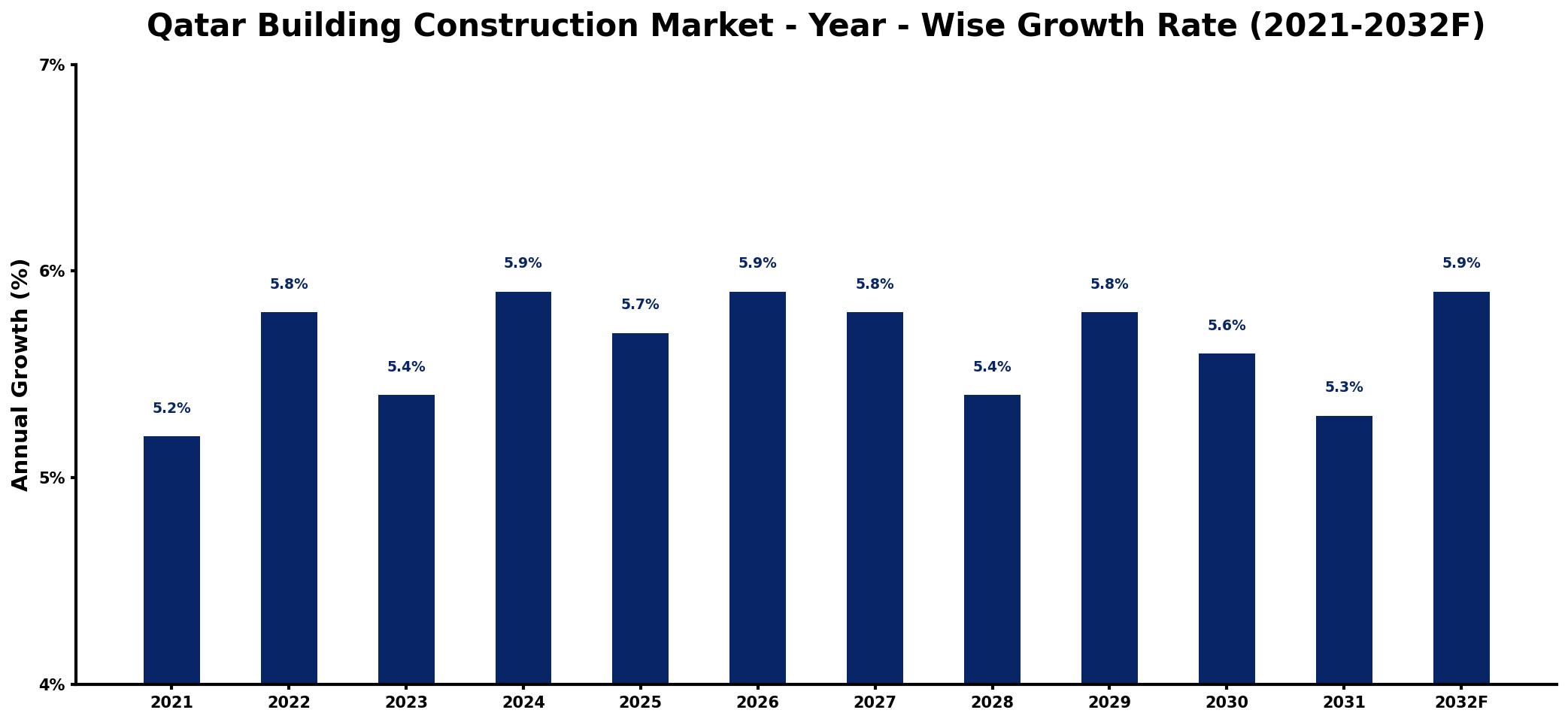
The table below presents the year‑wise growth rates along with the key drivers influencing the market
| Year | Growth Rate | Major Drivers |
| 2021 | 5.2% | Increased infrastructure investments nationwide |
| 2022 | 5.8% | Rising demand for residential projects |
| 2023 | 5.4% | Expansion of tourism facilities planned |
| 2024 | 5.9% | Government initiatives for urban development |
| 2025 | 5.7% | Boost in energy sector projects |
| 2026 | 5.9% | Growing demand for commercial spaces |
| 2027 | 5.8% | Enhanced logistics and transport networks |
| 2028 | 5.4% | Increased focus on sustainable practices |
| 2029 | 5.8% | Rise in public-private partnerships |
| 2030 | 5.6% | Elevated spending on educational facilities |
| 2031 | 5.3% | Strengthened regional trade agreements established |
| 2032 | 5.9% | Growing interest in smart technologies |
Note: Market size estimations and growth projections presented in this report are based on 6Wresearch's proprietary forecasting methodology, utilizing the latest available industry data, government publications, and primary research inputs.
Qatar Building Construction Market Synopsis
The building construction market in Qatar is thriving, fueled by an ambitious vision for infrastructure that aligns with the nations rapid urbanization and economic diversification goals. With a growing population and a surging demand for housing, commercial spaces, and public infrastructure, the market reflects a vibrant landscape of opportunities.
Significant government investment in projects, such as stadiums and other public amenities, is pivotal in shaping this dynamic sector. Additionally, the integration of sustainable practices and advanced technologies into construction processes is not only enhancing efficiency but also appealing to global investors eager to participate in Qatars booming economy.
Qatar Building Construction Market Key Takeaways
- The market is projected to grow significantly due to strategic government investments and international events like the FIFA World Cup.
- Urbanization and demographic growth are key factors driving the demand for residential and commercial construction.
- The adoption of innovative construction technologies and sustainable practices is on the rise, enhancing project outcomes.
- Foreign investments are being attracted by favorable policies designed to streamline construction processes.
- The market is characterized by a competitive landscape, requiring firms to continuously adapt and innovate.
Evaluation of Restraints in Qatar Building Construction Market
Despite the promising outlook, the Qatar building construction market faces inherent challenges. The sector is prone to cycles influenced by economic volatility, particularly fluctuations in oil prices, which can lead to uncertain government spending. Moreover, stringent regulations and rapidly evolving building codes require companies to maintain agility to remain competitive. Additionally, the high level of competition between local and international firms can create pressure on profit margins, necessitating a focus on efficiency and cost management to thrive in this environment.
Qatar Building Construction Market Trends
Several trends are shaping the Qatar building construction market, notably the integration of smart technologies in building design and construction management. These technologies enhance efficiency, reduce costs, and improve safety outcomes. Furthermore, the emphasis on sustainability is driving the adoption of green building practices, aligning with global standards and investor expectations. As Qatar continues its push towards economic diversification, there is a marked trend towards mixed-use developments that combine residential, commercial, and recreational spaces, responding to the evolving needs of a modern urban population.
Qatar Building Construction Market Opportunities
The landscape of opportunities in Qatar's building construction market is vast. The need for residential units and commercial spaces continues to rise, especially in burgeoning urban areas. Investments in public infrastructure, driven by governmental initiatives, present lucrative opportunities for construction firms. Moreover, as Qatar solidifies its position as a regional hub, there are significant prospects for collaboration with international partners, facilitating knowledge transfer and innovation in construction techniques. The focus on sustainability presents additional avenues for companies that can provide eco-friendly solutions and technologies.
Government Initiatives in the Qatar Building Construction Market
The Qatari government is actively fostering growth in the building construction market through various initiatives aimed at enhancing infrastructure and urban development. Key public spending programs focus on constructing world-class facilities in preparation for major global events and diversifying the economy through infrastructure projects. Additionally, regulatory frameworks are continuously being refined to attract foreign investments, with policies designed to streamline construction processes, facilitating easier project approvals and implementation.
Future Insights of the Qatar Building Construction Market
Looking ahead to 2026-2032, the Qatar building construction market is anticipated to witness robust expansion driven by ongoing government investments and strategic urban planning initiatives. As the nation progresses towards its Vision 2030 goals, there will likely be an increased focus on smart cities and sustainable developments that enhance the quality of life for residents. Additionally, emerging technologies, such as Building Information Modeling (BIM) and modular construction, are expected to play significant roles in optimizing project delivery and cost efficiency, setting the stage for a more innovative construction sector.
Qatar Building Construction Market Latest Developments (2025 - 2026)
In recent months, the Qatar building construction market has been marked by a resurgence in project activity as the economy rebounds from the impacts of COVID-19. Increased government spending on infrastructure and housing is driving the resumption of delayed projects, particularly in preparation for the forthcoming FIFA World Cup. Furthermore, the adoption of new technologies and building practices is becoming more pronounced, with firms exploring sustainable solutions that align with global trends.
Qatar Building Construction Market - Key Attractiveness of the Report
- 10 Years of Market Numbers
- Historical Data Starting from 2022 to 2025
- Base Year: 2025
- Forecast Data until 2032
- Key Performance Indicators Impacting the Market
- Major Upcoming Developments and Projects
Key Highlights of the Report:
- Qatar Building Construction Market Outlook
- Market Size of Qatar Building Construction Market, 2025
- Forecast of Qatar Building Construction Market, 2032
- Historical Data and Forecast of Qatar Building Construction Revenues & Volume for the Period 2022-2032F
- Qatar Building Construction Market Trend Evolution
- Qatar Building Construction Market Drivers and Challenges
- Qatar Building Construction Price Trends
- Qatar Building Construction Porter's Five Forces
- Qatar Building Construction Industry Life Cycle
- Historical Data and Forecast of Qatar Building Construction Market Revenues & Volume By Type for the Period 2022-2032F
- Historical Data and Forecast of Qatar Building Construction Market Revenues & Volume By Residential for the Period 2022-2032F
- Historical Data and Forecast of Qatar Building Construction Market Revenues & Volume By Non-residential for the Period 2022-2032F
- Historical Data and Forecast of Qatar Building Construction Market Revenues & Volume By Construction Type for the Period 2022-2032F
- Historical Data and Forecast of Qatar Building Construction Market Revenues & Volume By New Construction for the Period 2022-2032F
- Historical Data and Forecast of Qatar Building Construction Market Revenues & Volume By Renovation for the Period 2022-2032F
- Historical Data and Forecast of Qatar Building Construction Market Revenues & Volume By Application for the Period 2022-2032F
- Historical Data and Forecast of Qatar Building Construction Market Revenues & Volume By Owned for the Period 2022-2032F
- Historical Data and Forecast of Qatar Building Construction Market Revenues & Volume By Rental for the Period 2022-2032F
- Historical Data and Forecast of Qatar Building Construction Market Revenues & Volume By End User for the Period 2022-2032F
- Historical Data and Forecast of Qatar Building Construction Market Revenues & Volume By Private for the Period 2022-2032F
- Historical Data and Forecast of Qatar Building Construction Market Revenues & Volume By Public for the Period 2022-2032F
- Qatar Building Construction Import Export Trade Statistics
- Market Opportunity Assessment By Type
- Market Opportunity Assessment By Construction Type
- Market Opportunity Assessment By Application
- Market Opportunity Assessment By End User
- Qatar Building Construction Top Companies Market Share
- Qatar Building Construction Competitive Benchmarking By Technical and Operational Parameters
- Qatar Building Construction Company Profiles
- Qatar Building Construction Key Strategic Recommendations






































