Qatar Chamotte Market Size, Share & Growth Rate
The Qatar Chamotte Market was estimated at USD 157 Million in 2025 and is projected to reach USD 208 Million by 2032, growing at a CAGR of 4.1% from 2026 to 2032. This growth is significantly fueled by the booming construction sector, primarily driven by large-scale infrastructure projects leading up to the FIFA World Cup. Additionally, the increasing utilization of chamotte in the manufacturing and industrial sectors solidifies its demand in refractory applications.
Qatar Chamotte Market Year-wise Growth Rate and Key Drivers
This graph highlights how the Qatar Chamotte Market has steadily grown over the years, supported by major growth factors.
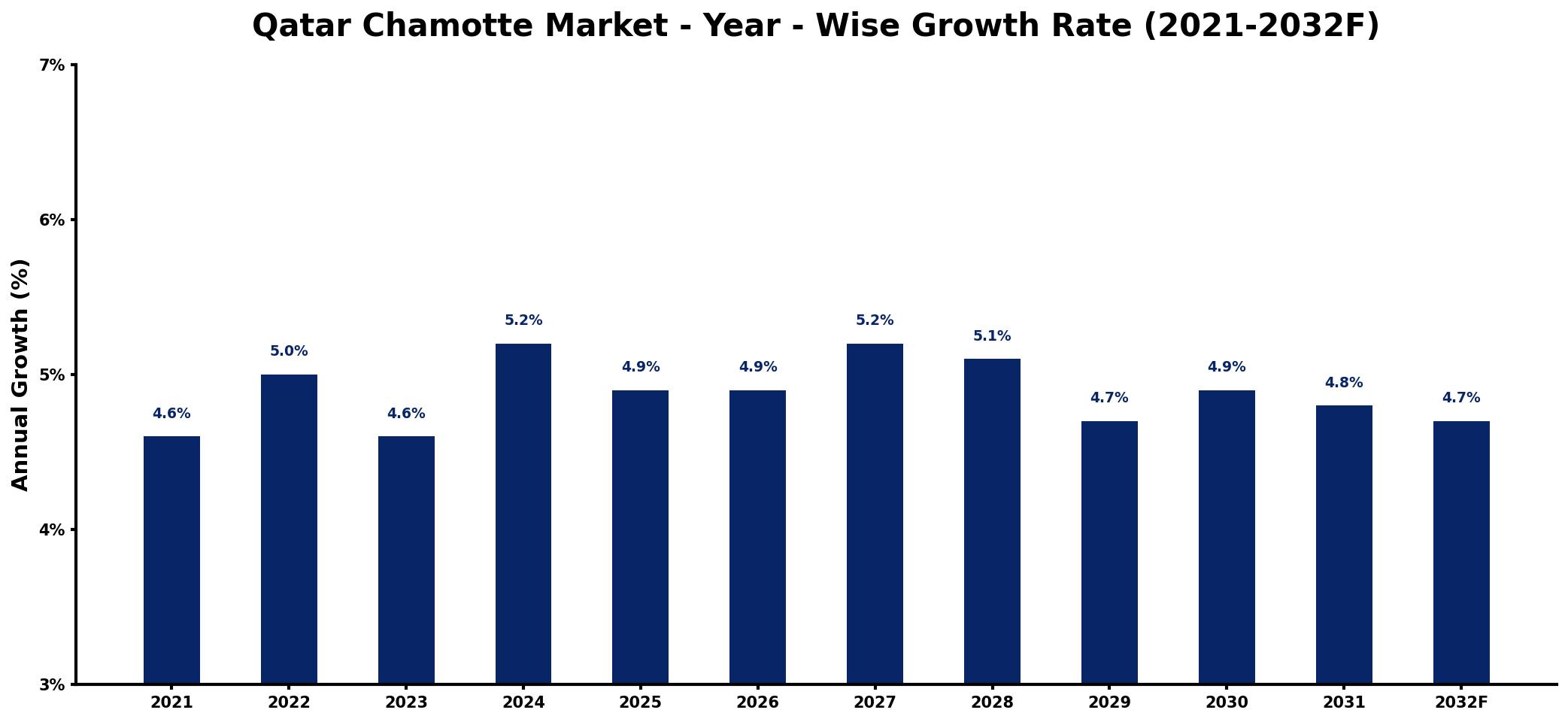
The table below presents the year‑wise growth rates along with the key drivers influencing the market
| Year | Growth Rate | Major Drivers |
| 2021 | 4.6% | Rising construction project investments |
| 2022 | 5.0% | Increased demand from ceramics sector |
| 2023 | 4.6% | Expansion of manufacturing capacities |
| 2024 | 5.2% | Growth in energy sector applications |
| 2025 | 4.9% | Surge in infrastructure development projects |
| 2026 | 4.9% | Higher exports to regional markets |
| 2027 | 5.2% | Technological advancements in production |
| 2028 | 5.1% | Growing popularity of sustainable materials |
| 2029 | 4.7% | Increased use in refractory applications |
| 2030 | 4.9% | Demand from automotive industry rising |
| 2031 | 4.8% | Investments in research and development |
| 2032 | 4.7% | improved raw material availability |
Note: Market size estimations and growth projections presented in this report are based on 6Wresearch's proprietary forecasting methodology, utilizing the latest available industry data, government publications, and primary research inputs.
Qatar Chamotte Market Synopsis
The chamotte market in Qatar is witnessing a robust expansion, propelled by the nation's vigorous infrastructure and industrial development initiatives. This upward trend is particularly noticeable as Qatar prepares to host a global sporting event, spurring increased activity across construction and manufacturing industries.
As a crucial input in refractory products, ceramics, and construction materials, chamotte plays a vital role in the region's economic landscape. Its applications in high-temperature settings underscore its importance across diverse industries, making it a key material for sustained growth.
Qatar Chamotte Market Key Takeaways
- The market is on an upward trajectory due to infrastructure investments and industrial growth.
- Chamotte's role in refractory applications is pivotal, particularly in the petrochemical and steel manufacturing sectors.
- Demand for chamotte in ceramics, driven by construction activities, is also significant.
- Environmental regulations necessitate sustainable mining practices, impacting the supply chain.
- COVID-19-related disruptions have led to fluctuations, but recovery is evident as projects resume.
Evaluation of Restraints in Qatar Chamotte Market
Despite promising prospects, the Qatar chamotte market faces notable challenges that could hinder its growth trajectory. A primary concern is the limited availability of high-quality chamotte clay reserves within the country, compelling manufacturers to rely on imports. This dependency not only raises production costs but also introduces potential uncertainties in supply chain management. Furthermore, as global environmental standards become increasingly stringent, the need for responsible mining and processing practices adds layers of complexity that industry stakeholders must navigate. Balancing economic growth with environmental sustainability will remain a critical focus for the foreseeable future.
Qatar Chamotte Market Trends
Emerging trends in the Qatar chamotte market reflect a broader shift towards innovation and sustainability. Manufacturers are increasingly investing in advanced processing techniques to enhance the quality of chamotte products while minimizing environmental impact. Additionally, the rise in digitalization within the industrial sector is facilitating better data management and operational efficiency, which can lead to optimized production processes. Moreover, the growing preference for sustainable building materials is encouraging the use of chamotte in eco-friendly construction practices, thereby expanding its market potential.
Qatar Chamotte Market Opportunities
Significant growth opportunities exist within the Qatar chamotte market, particularly in segments tied to infrastructure and industrial expansion. The government's focus on large-scale projects creates a sustained demand for high-quality refractory materials, including chamotte. Additionally, the ongoing development of the petrochemical and steel manufacturing sectors indicates a robust pipeline for chamotte applications. Companies that invest in sustainable practices and innovative product offerings will likely capture greater market share, positioning themselves favorably in an evolving landscape.
Government Initiatives in the Qatar Chamotte Market
The Qatari government has actively supported the development of the chamotte market through various policies aimed at promoting infrastructure growth and industrial diversification. Public spending on mega-projects, particularly those associated with the FIFA World Cup, has bolstered demand for construction materials, including chamotte. Furthermore, initiatives focusing on sustainability and responsible resource management are fostering an environment conducive to ethical mining practices, which are crucial for the markets long-term viability.
Future Insights of the Qatar Chamotte Market
Looking ahead to 2026-2032, the Qatar chamotte market is poised for positive growth, bolstered by ongoing investments in infrastructure and industrial sectors. The continued emphasis on high-quality refractory materials will drive demand, especially in light of the regions expanding petrochemical and construction landscapes. Companies that adapt to regulatory changes and invest in sustainable practices will not only mitigate risks but also enhance their competitive edge. The overall outlook remains optimistic, reflecting the strategic alignment of the market with Qatars broader development objectives.
Qatar Chamotte Market Latest Developments (2025 - 2026)
Recent developments within the Qatar chamotte market indicate a resurgence in demand as construction and industrial activities ramp up post-pandemic. Several key initiatives aimed at improving the quality and sustainability of chamotte production have gained traction among manufacturers. The industry is also witnessing a shift towards collaborative projects involving public and private sectors to enhance resource management and promote innovation in product offerings.
Qatar Chamotte Market - Key Attractiveness of the Report
- 10 Years of Market Numbers
- Historical Data Starting from 2022 to 2025
- Base Year: 2025
- Forecast Data until 2032
- Key Performance Indicators Impacting the Market
- Major Upcoming Developments and Projects
Key Highlights of the Report:
- Qatar Chamotte Market Outlook
- Market Size of Qatar Chamotte Market, 2025
- Forecast of Qatar Chamotte Market, 2032
- Historical Data and Forecast of Qatar Chamotte Revenues & Volume for the Period 2022-2032F
- Qatar Chamotte Market Trend Evolution
- Qatar Chamotte Market Drivers and Challenges
- Qatar Chamotte Price Trends
- Qatar Chamotte Porter's Five Forces
- Qatar Chamotte Industry Life Cycle
- Historical Data and Forecast of Qatar Chamotte Market Revenues & Volume By Type for the Period 2022-2032F
- Historical Data and Forecast of Qatar Chamotte Market Revenues & Volume By Clinker for the Period 2022-2032F
- Historical Data and Forecast of Qatar Chamotte Market Revenues & Volume By Cement Clinker for the Period 2022-2032F
- Historical Data and Forecast of Qatar Chamotte Market Revenues & Volume By Application for the Period 2022-2032F
- Historical Data and Forecast of Qatar Chamotte Market Revenues & Volume By Cement for the Period 2022-2032F
- Historical Data and Forecast of Qatar Chamotte Market Revenues & Volume By Silicate Material for the Period 2022-2032F
- Historical Data and Forecast of Qatar Chamotte Market Revenues & Volume By Others for the Period 2022-2032F
- Qatar Chamotte Import Export Trade Statistics
- Market Opportunity Assessment By Type
- Market Opportunity Assessment By Application
- Qatar Chamotte Top Companies Market Share
- Qatar Chamotte Competitive Benchmarking By Technical and Operational Parameters
- Qatar Chamotte Company Profiles
- Qatar Chamotte Key Strategic Recommendations






































