Qatar Chromium Sulphate Market Size, Share & Growth Rate
The Qatar Chromium Sulphate Market was estimated at USD 220 Million in 2025 and is projected to reach USD 293 Million by 2032, growing at a CAGR of 4.2% from 2026 to 2032. The trajectory of this market is primarily driven by the robust demand from the leather tanning and textile industries, which continue to thrive as consumer preferences for leather goods expand. Additionally, the compound's utility in water treatment processes further supports this growth, as industries seek effective solutions for both production and environmental management.
Qatar Chromium Sulphate Market Year-wise Growth Rate and Key Drivers
This graph highlights how the Qatar Chromium Sulphate Market has steadily grown over the years, supported by major growth factors.
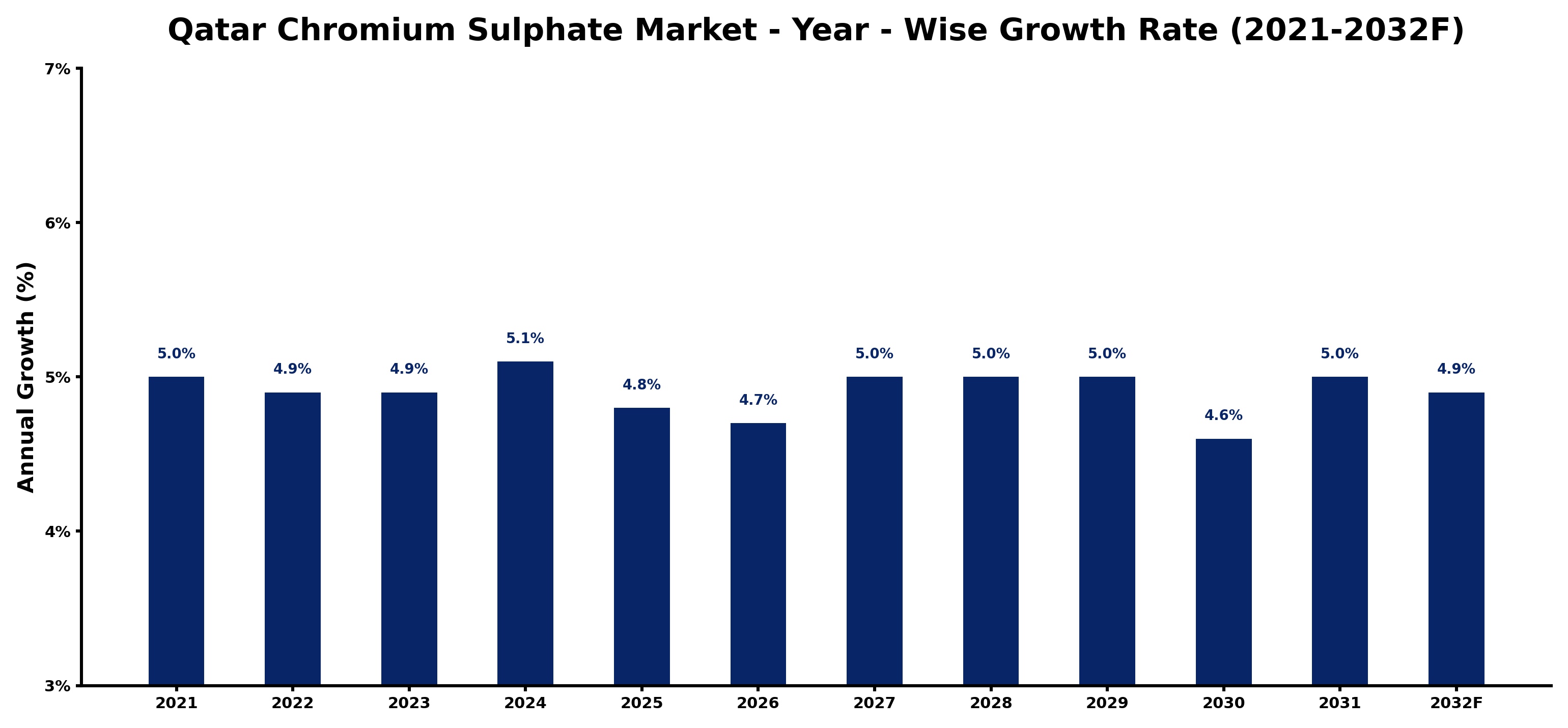
The table below presents the year‑wise growth rates along with the key drivers influencing the market
| Year | Growth Rate | Major Drivers |
| 2021 | 5.0% | Increased industrial applications emerged |
| 2022 | 4.9% | Construction sector demand surged |
| 2023 | 4.9% | Leather production expanded significantly |
| 2024 | 5.1% | Textile industry growth accelerated |
| 2025 | 4.8% | Environmental regulations enhanced sustainability |
| 2026 | 4.7% | Agricultural sector utilization increased |
| 2027 | 5.0% | Chemical manufacturing expanded operations |
| 2028 | 5.0% | Automotive industry demand rose sharply |
| 2029 | 5.0% | Cosmetic formulations gained popularity |
| 2030 | 4.6% | Pharmaceutical applications diversified offerings |
| 2031 | 5.0% | Research and development investments increased |
| 2032 | 4.9% | Global trade agreements enhanced exports |
Note - Market size estimations and growth projections presented in this report are based on 6Wresearch’s advanced forecasting approach, validated with industry datasets as of June 2026.
Qatar Chromium Sulphate Market Synopsis
In Qatar, the chromium sulphate market is characterized by its niche demand, heavily reliant on imports, particularly from India, China, and Turkey. Although the market size was around 300 tons in 2018, a slight growth is anticipated as local industries increasingly adopt chromium sulphate in leather tanning and ceramic production.
Despite its relatively modest consumption levels, the significance of chromium sulphate in key industrial applications positions it as a compound of interest. The local production capabilities remain limited, yet the increasing demand from the leather and textile sectors underlines the compound's importance in Qatar's industrial landscape.
Qatar Chromium Sulphate Market Key Takeaways
- The market is projected to grow at a CAGR of 4.2% from 2026 to 2032.
- Key applications include leather tanning, textiles, and ceramic production.
- Majority of the demand is met through imports, predominantly from India.
- Environmental regulations present challenges in waste management and compliance.
- The recovery of end-use industries post-COVID-19 will be crucial for market growth.
Evaluation of Restraints in Qatar Chromium Sulphate Market
The Qatar Chromium Sulphate market faces significant restraints primarily stemming from environmental concerns associated with chromium compounds. Regulatory frameworks aimed at mitigating environmental impact necessitate stringent waste management practices. The industry's ability to comply with these regulations can limit operational flexibility and escalate costs, creating a dual challenge of meeting industrial demands while ensuring sustainable practices. Addressing these issues requires investment in advanced treatment technologies and adherence to best practices in production and disposal.
Qatar Chromium Sulphate Market Trends
Emerging trends in the Qatar chromium sulphate market are increasingly being shaped by sustainability initiatives and the quest for environmentally-friendly production methods. As global awareness around environmental impact rises, industries are leaning towards adopting greener technologies in their tanning and dyeing processes. Furthermore, there is an observable shift in consumer preferences towards high-quality, sustainably sourced leather products, which enhances the demand for effective tanning agents such as chromium sulphate.
Qatar Chromium Sulphate Market Opportunities
Opportunities for growth in the Qatar chromium sulphate market lie predominantly in the enhancement of production processes and the exploration of innovative applications. As local industries seek to improve their operational efficiency, the demand for high-quality chromium sulphate is likely to increase. Additionally, investments in sustainable practices could unlock new avenues for product development, particularly in environmentally-friendly alternatives that align with global market trends.
Government Initiatives in the Qatar Chromium Sulphate Market
The Qatari government has been active in promoting regulations that encourage sustainability in industrial operations, including those involving chromium sulphate. Initiatives aimed at reducing environmental impacts and ensuring compliance with international standards are shaping the operational landscape for this market. Programs focused on waste management and technology transfer in industrial sectors reinforce the commitment to responsible chemical use, thereby influencing market dynamics positively.
Future Insights of the Qatar Chromium Sulphate Market
Looking ahead to 2026-2032, the Qatar chromium sulphate market is poised for gradual yet steady growth. The recovery of the leather and textile industries post-pandemic will play a significant role in stimulating demand. Additionally, as industries embrace sustainable practices and innovative technologies, the market will likely see an evolution in its applications and production methods. The focus on quality and environmental compliance will become increasingly central, reshaping the competitive landscape.
Qatar Chromium Sulphate Market Latest Developments (May 2025 - June 2026)
Recent developments in the Qatar chromium sulphate market have centered around shifts towards more sustainable practices and the adoption of innovative tanning technologies. Industry players are increasingly seeking partnerships and collaborations to enhance production efficiency and minimize environmental impact. Additionally, the growing focus on quality standards in leather and textiles has spurred advancements in the application of chromium sulphate, positioning it as a vital component in meeting evolving market demands.
Qatar Chromium Sulphate Market - Key Attractiveness of the Report
- 10 Years of Market Numbers
- Historical Data Starting from 2022 to 2025
- Base Year: 2025
- Forecast Data until 2032
- Key Performance Indicators Impacting the Market
- Major Upcoming Developments and Projects
Key Highlights of the Report:
- Qatar Chromium Sulphate Market Outlook
- Market Size of Qatar Chromium Sulphate Market, 2025
- Forecast of Qatar Chromium Sulphate Market, 2032
- Historical Data and Forecast of Qatar Chromium Sulphate Revenues & Volume for the Period 2022-2032F
- Qatar Chromium Sulphate Market Trend Evolution
- Qatar Chromium Sulphate Market Drivers and Challenges
- Qatar Chromium Sulphate Price Trends
- Qatar Chromium Sulphate Porter's Five Forces
- Qatar Chromium Sulphate Industry Life Cycle
- Historical Data and Forecast of Qatar Chromium Sulphate Market Revenues & Volume By Products for the Period 2022-2032F
- Historical Data and Forecast of Qatar Chromium Sulphate Market Revenues & Volume By Basic Chromium Sulphate 21%-23% for the Period 2022-2032F
- Historical Data and Forecast of Qatar Chromium Sulphate Market Revenues & Volume By Basic Chromium Sulphate 24%-26% for the Period 2022-2032F
- Historical Data and Forecast of Qatar Chromium Sulphate Market Revenues & Volume By Applications for the Period 2022-2032F
- Historical Data and Forecast of Qatar Chromium Sulphate Market Revenues & Volume By Tanning Agent for the Period 2022-2032F
- Historical Data and Forecast of Qatar Chromium Sulphate Market Revenues & Volume By Dyeing for the Period 2022-2032F
- Historical Data and Forecast of Qatar Chromium Sulphate Market Revenues & Volume By Painting & Coating for the Period 2022-2032F
- Qatar Chromium Sulphate Import Export Trade Statistics
- Market Opportunity Assessment By Products
- Market Opportunity Assessment By Applications
- Qatar Chromium Sulphate Top Companies Market Share
- Qatar Chromium Sulphate Competitive Benchmarking By Technical and Operational Parameters
- Qatar Chromium Sulphate Company Profiles
- Qatar Chromium Sulphate Key Strategic Recommendations






































