Qatar Cloud Computing Market Size & Growth Rate (2026-2032)
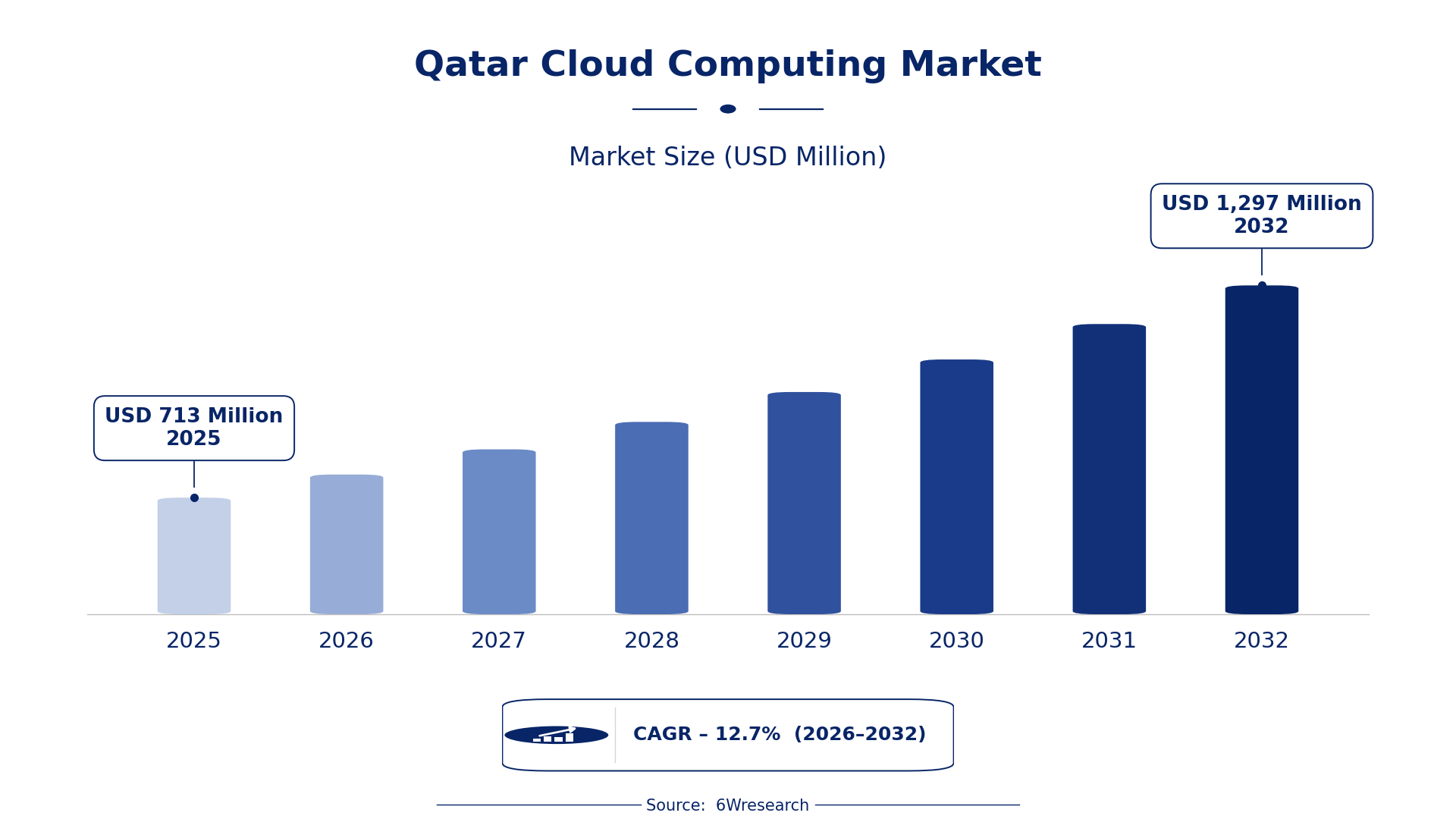
The Qatar Cloud Computing Market was estimated at USD 713 Million in 2025 and is projected to reach USD 1297 Million by 2032, growing at a CAGR of 12.7% from 2026 to 2032.
Qatar Cloud Computing Market Synopsis
The Qatar Cloud Computing Market is witnessing a remarkable transformation, driven by a surge in digital initiatives across various sectors. Businesses are increasingly shifting to cloud solutions, prioritizing agility and cost-effectiveness while enhancing operational efficiencies. This transition is not just a trend; it's becoming a fundamental aspect of how companies operate in Qatar.
Organizations are rapidly adopting Infrastructure as a Service (IaaS), Platform as a Service (PaaS), and Software as a Service (SaaS) models to meet their evolving needs. The rise of hybrid and multi-cloud strategies indicates a clear shift towards optimizing both performance and security in this competitive market.
Qatar Cloud Computing Market Year-wise Growth Rate and Key Drivers
This graph illustrates the annual growth rates of the Qatar Cloud Computing Market from 2021 to 2032, highlighting a steady upward trajectory and projected expansion over the forecast period.
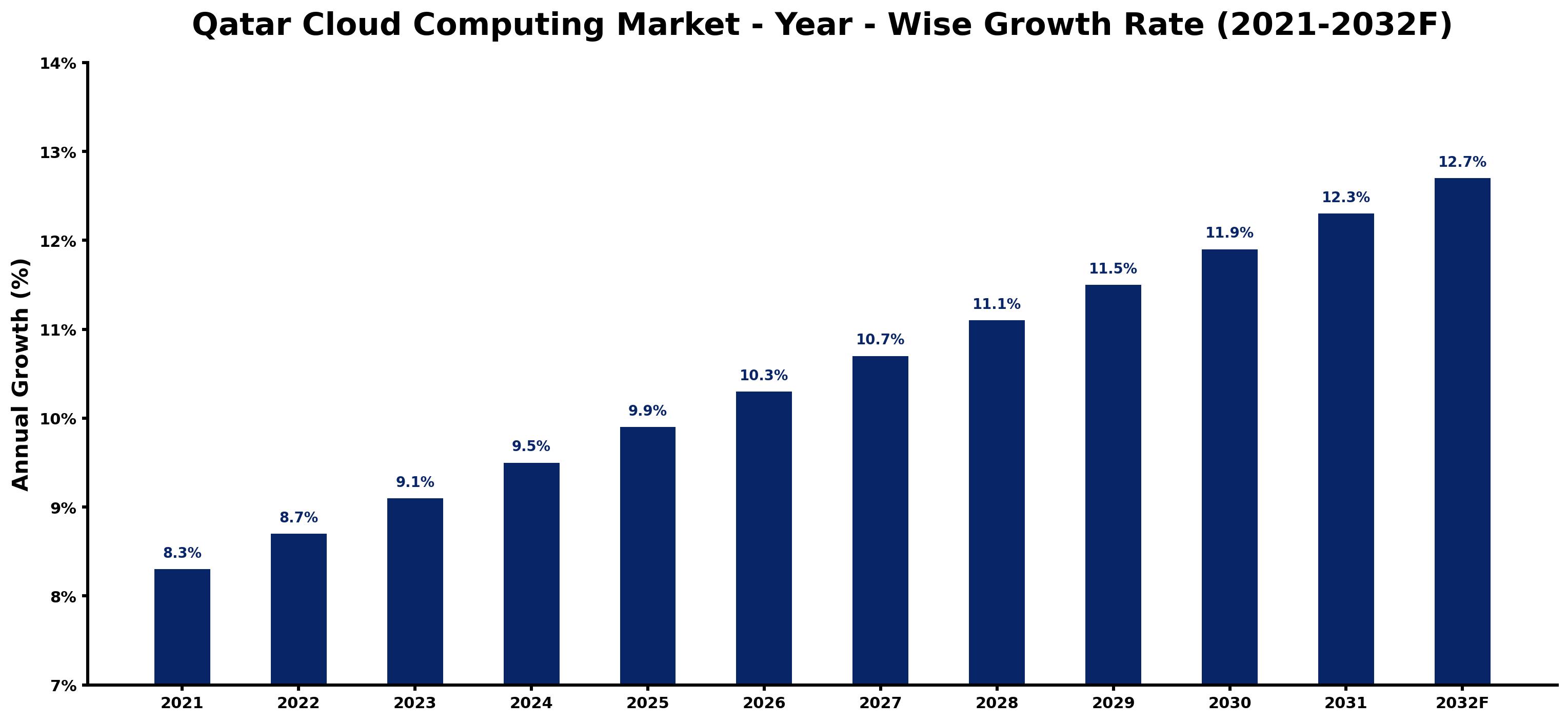
The table below presents the year‑wise growth rates along with the key drivers influencing the market
| Year | Growth Rate | Major Drivers |
| 2021 | 8.3% | Government's commitment to digital economy funding initiatives. |
| 2022 | 8.7% | Qatar's growing startup ecosystem boosts cloud adoption. |
| 2023 | 9.1% | Rising investments in AI-driven cloud solutions by corporations. |
| 2024 | 9.5% | Increased cloud security regulations by Qatar Central Bank. |
| 2025 | 9.9% | Growing e-commerce sector necessitates robust cloud infrastructure. |
| 2026 | 10.3% | Strategic partnerships between local firms and global cloud providers. |
| 2027 | 10.7% | Surge in data center construction supports cloud services. |
| 2028 | 11.1% | Enhanced internet penetration facilitates wider cloud usage. |
| 2029 | 11.5% | Local educational institutions pivoting to online learning platforms. |
| 2030 | 11.9% | Qatar hosting major sporting events increases data management needs. |
| 2031 | 12.3% | Increased mobile app development drives cloud service demands. |
| 2032 | 12.7% | Local enterprises migrating to hybrid cloud solutions. |
Note: Market size estimations and growth projections presented in this report are based on 6Wresearch's proprietary forecasting methodology, utilizing the latest available industry data, government publications, and primary research inputs.
Qatar Cloud Computing Market Key Takeaways
Below are some of the specific key takeaways from the market, including:
- The adoption of cloud solutions is being accelerated by the need for digital transformation across various industries.
- Hybrid and multi-cloud strategies are emerging as preferred models for organizations looking to enhance flexibility.
- Government initiatives are providing a supportive framework for cloud adoption, increasing awareness and security measures.
- The market is experiencing growing competition from both local and international service providers.
- Data security concerns are prompting organizations to adopt more robust cloud strategies.
Evaluation of Restraints in Qatar Cloud Computing Market
Despite the positive momentum, the Qatar Cloud Computing Market faces notable challenges. Service reliability remains a major concern, as organizations grapple with the potential for downtime and its impacts on business operations. Data security is another critical issue; businesses are acutely aware of the risks associated with data breaches and the need for stringent compliance measures. Additionally, vendor lock-in scenarios pose significant challenges, as companies seek to maintain flexibility and avoid dependency on a single provider, which can limit their operational agility.
Qatar Cloud Computing Market Trends
The trends shaping the Qatar Cloud Computing Market reflect broader global shifts in technology. An increasing number of organizations are embracing hybrid and multi-cloud architectures to optimize their IT environments. This approach not only enhances flexibility but also allows for better resource allocation and management. on top of that, the focus on data privacy and compliance is intensifying, driving demand for cloud solutions that incorporate advanced security features.
There is also a growing interest in edge computing, which complements cloud services by processing data closer to its source. This trend is gaining traction in sectors such as manufacturing and healthcare, where real-time data processing is critical. As the market matures, businesses are increasingly looking for tailored solutions that address their unique needs while ensuring seamless integration with existing systems.
Qatar Cloud Computing Market Opportunities
The Qatar Cloud Computing Market offers substantial opportunities for growth and investment. One significant area lies in the development of sector-specific cloud solutions, particularly for industries such as healthcare and finance, where compliance and data protection are paramount. Companies that can provide specialized services tailored to these sectors will find a receptive market.
Additionally, partnerships between local firms and international cloud service providers could lead to enhanced offerings and market penetration. The ongoing government push for digital infrastructure improvements also presents an avenue for investment, as new programs and initiatives emerge to support cloud adoption.
Government Initiatives in the Qatar Cloud Computing Market
The Qatari government is actively shaping the cloud computing environment through various initiatives aimed at fostering a secure and innovative digital economy. Regulatory frameworks are being developed to support the growth of cloud services, ensuring that businesses can operate in a secure and compliant manner. These policies are essential in creating a conducive environment for cloud adoption across sectors.
- A national digital infrastructure upgrade programme, which aims to enhance connectivity and support cloud services, is currently underway.
- A regulatory framework introduced in 2025 is focused on enhancing data protection and compliance for cloud service providers.
- A public-private initiative planned for 2027 seeks to expand access to cloud services in underserved areas, driving inclusivity.
- Recent initiatives to promote cloud literacy and training among local businesses have been launched to accelerate adoption.
- Ongoing discussions about establishing a national cloud strategy are expected to outline future priorities and investments in this sector.
Future Insights of the Qatar Cloud Computing Market
Looking ahead to 2026-2032, the Qatar Cloud Computing Market is set to experience sustained growth, driven by continued digital transformation efforts across various sectors. As organizations increasingly recognize the benefits of cloud technologies, investments in hybrid and multi-cloud solutions will likely rise. The emphasis on data security and compliance will further shape service offerings, as businesses seek to mitigate risks associated with cloud adoption.
on top of that, the expansion of cloud services into new sectors, alongside government support, will create a vibrant ecosystem for innovation. The continuous evolution of technology, including advancements in artificial intelligence and machine learning, will also play a crucial role in enhancing cloud capabilities, allowing organizations to derive more value from their data.
Qatar Cloud Computing Market Latest Developments
In the past year, the Qatar Cloud Computing Market has seen a flurry of activity as businesses accelerate their digital transformation strategies. The urgency to adopt scalable and efficient cloud solutions has led to various initiatives aimed at enhancing infrastructure and service offerings. Key players are actively engaging in partnerships and collaborations to boost their presence and capabilities in the market.
- A leading regional operator launched a new cloud service platform in early 2025, aimed at providing enhanced scalability and performance.
- A major technology vendor is currently rolling out advanced security features for its cloud services, responding to growing data protection concerns.
- A public-private partnership announced in Q3 2025 aims to develop a cloud skills training program to support workforce development.
- An upcoming initiative set for mid-2026 will focus on expanding cloud access to small and medium enterprises, enhancing their digital capabilities.
- A recently completed project in late 2025 upgraded data center facilities to support increasing demand for cloud services across sectors.
Qatar Cloud Computing Market - Key Attractiveness of the Report
- 10 Years of Market Numbers
- Historical Data Starting from 2022 to 2025
- Base Year: 2025
- Forecast Data until 2032
- Key Performance Indicators Impacting the Market
- Major Upcoming Developments and Projects
Key Highlights of the Report:
- Qatar Cloud Computing Market Outlook
- Market Size of Qatar Cloud Computing Market, 2025
- Forecast of Qatar Cloud Computing Market, 2032
- Historical Data and Forecast of Qatar Cloud Computing Revenues & Volume for the Period 2022-2032F
- Qatar Cloud Computing Market Trend Evolution
- Qatar Cloud Computing Market Drivers and Challenges
- Qatar Cloud Computing Price Trends
- Qatar Cloud Computing Porter's Five Forces
- Qatar Cloud Computing Industry Life Cycle
- Historical Data and Forecast of Qatar Cloud Computing Market Revenues & Volume By Service Model for the Period 2022-2032F
- Historical Data and Forecast of Qatar Cloud Computing Market Revenues & Volume By Infrastructure as a Service for the Period 2022-2032F
- Historical Data and Forecast of Qatar Cloud Computing Market Revenues & Volume By Platform as a Service for the Period 2022-2032F
- Historical Data and Forecast of Qatar Cloud Computing Market Revenues & Volume By Software as a Service for the Period 2022-2032F
- Historical Data and Forecast of Qatar Cloud Computing Market Revenues & Volume By Infrastructure as a Service for the Period 2022-2032F
- Historical Data and Forecast of Qatar Cloud Computing Market Revenues & Volume By Primary Storage for the Period 2022-2032F
- Historical Data and Forecast of Qatar Cloud Computing Market Revenues & Volume By Disaster Recovery and Backup for the Period 2022-2032F
- Historical Data and Forecast of Qatar Cloud Computing Market Revenues & Volume By Archiving for the Period 2022-2032F
- Historical Data and Forecast of Qatar Cloud Computing Market Revenues & Volume By Computer for the Period 2022-2032F
- Historical Data and Forecast of Qatar Cloud Computing Market Revenues & Volume By Platform as a Service for the Period 2022-2032F
- Historical Data and Forecast of Qatar Cloud Computing Market Revenues & Volume By Application Development and Platforms for the Period 2022-2032F
- Historical Data and Forecast of Qatar Cloud Computing Market Revenues & Volume By Application Testing and Quality for the Period 2022-2032F
- Historical Data and Forecast of Qatar Cloud Computing Market Revenues & Volume By Analytics and Reporting for the Period 2022-2032F
- Historical Data and Forecast of Qatar Cloud Computing Market Revenues & Volume By Integration and Orchestration for the Period 2022-2032F
- Historical Data and Forecast of Qatar Cloud Computing Market Revenues & Volume By Data Management for the Period 2022-2032F
- Historical Data and Forecast of Qatar Cloud Computing Market Revenues & Volume By Software as a Service for the Period 2022-2032F
- Historical Data and Forecast of Qatar Cloud Computing Market Revenues & Volume By Customer Relationship Management for the Period 2022-2032F
- Historical Data and Forecast of Qatar Cloud Computing Market Revenues & Volume By Enterprise Resource Management for the Period 2022-2032F
- Historical Data and Forecast of Qatar Cloud Computing Market Revenues & Volume By Human Capital Management for the Period 2022-2032F
- Historical Data and Forecast of Qatar Cloud Computing Market Revenues & Volume By Content Management for the Period 2022-2032F
- Historical Data and Forecast of Qatar Cloud Computing Market Revenues & Volume By Collaboration and Productivity Suites for the Period 2022-2032F
- Historical Data and Forecast of Qatar Cloud Computing Market Revenues & Volume By Supply Chain Management for the Period 2022-2032F
- Historical Data and Forecast of Qatar Cloud Computing Market Revenues & Volume By Others for the Period 2022-2032F
- Historical Data and Forecast of Qatar Cloud Computing Market Revenues & Volume By Organization Size for the Period 2022-2032F
- Historical Data and Forecast of Qatar Cloud Computing Market Revenues & Volume By Large Enterprises for the Period 2022-2032F
- Historical Data and Forecast of Qatar Cloud Computing Market Revenues & Volume By SMEs for the Period 2022-2032F
- Historical Data and Forecast of Qatar Cloud Computing Market Revenues & Volume By Deployment Model for the Period 2022-2032F
- Historical Data and Forecast of Qatar Cloud Computing Market Revenues & Volume By Public Cloud for the Period 2022-2032F
- Historical Data and Forecast of Qatar Cloud Computing Market Revenues & Volume By Private Cloud for the Period 2022-2032F
- Historical Data and Forecast of Qatar Cloud Computing Market Revenues & Volume By Verticals for the Period 2022-2032F
- Historical Data and Forecast of Qatar Cloud Computing Market Revenues & Volume By BFSI for the Period 2022-2032F
- Historical Data and Forecast of Qatar Cloud Computing Market Revenues & Volume By Telecommunication for the Period 2022-2032F
- Historical Data and Forecast of Qatar Cloud Computing Market Revenues & Volume By IT & ITeS for the Period 2022-2032F
- Historical Data and Forecast of Qatar Cloud Computing Market Revenues & Volume By Government & Public Sector for the Period 2022-2032F
- Historical Data and Forecast of Qatar Cloud Computing Market Revenues & Volume By Retail & Consumer Goods for the Period 2022-2032F
- Historical Data and Forecast of Qatar Cloud Computing Market Revenues & Volume By Manufacturing for the Period 2022-2032F
- Historical Data and Forecast of Qatar Cloud Computing Market Revenues & Volume By Energy & Utility for the Period 2022-2032F
- Historical Data and Forecast of Qatar Cloud Computing Market Revenues & Volume By Media & Entertainment for the Period 2022-2032F
- Qatar Cloud Computing Import Export Trade Statistics
- Market Opportunity Assessment By Service Model
- Market Opportunity Assessment By Infrastructure as a Service
- Market Opportunity Assessment By Platform as a Service
- Market Opportunity Assessment By Software as a Service
- Market Opportunity Assessment By Organization Size
- Market Opportunity Assessment By Deployment Model
- Market Opportunity Assessment By Verticals
- Qatar Cloud Computing Top Companies Market Share
- Qatar Cloud Computing Competitive Benchmarking By Technical and Operational Parameters
- Qatar Cloud Computing Company Profiles
- Qatar Cloud Computing Key Strategic Recommendations






































