Qatar Cold Formed Steel Market Summary
The qatar cold formed steel market was estimated at USD 190 Million in 2025 and is projected to reach USD 269 Million by 2032, growing at a CAGR of 5.9% from 2026 to 2032.
Qatar Cold Formed Steel Market Year-wise Growth Rate and Key Drivers
This graph highlights how the Qatar Cold Formed Steel Market has steadily grown over the past five years, supported by major growth factors.
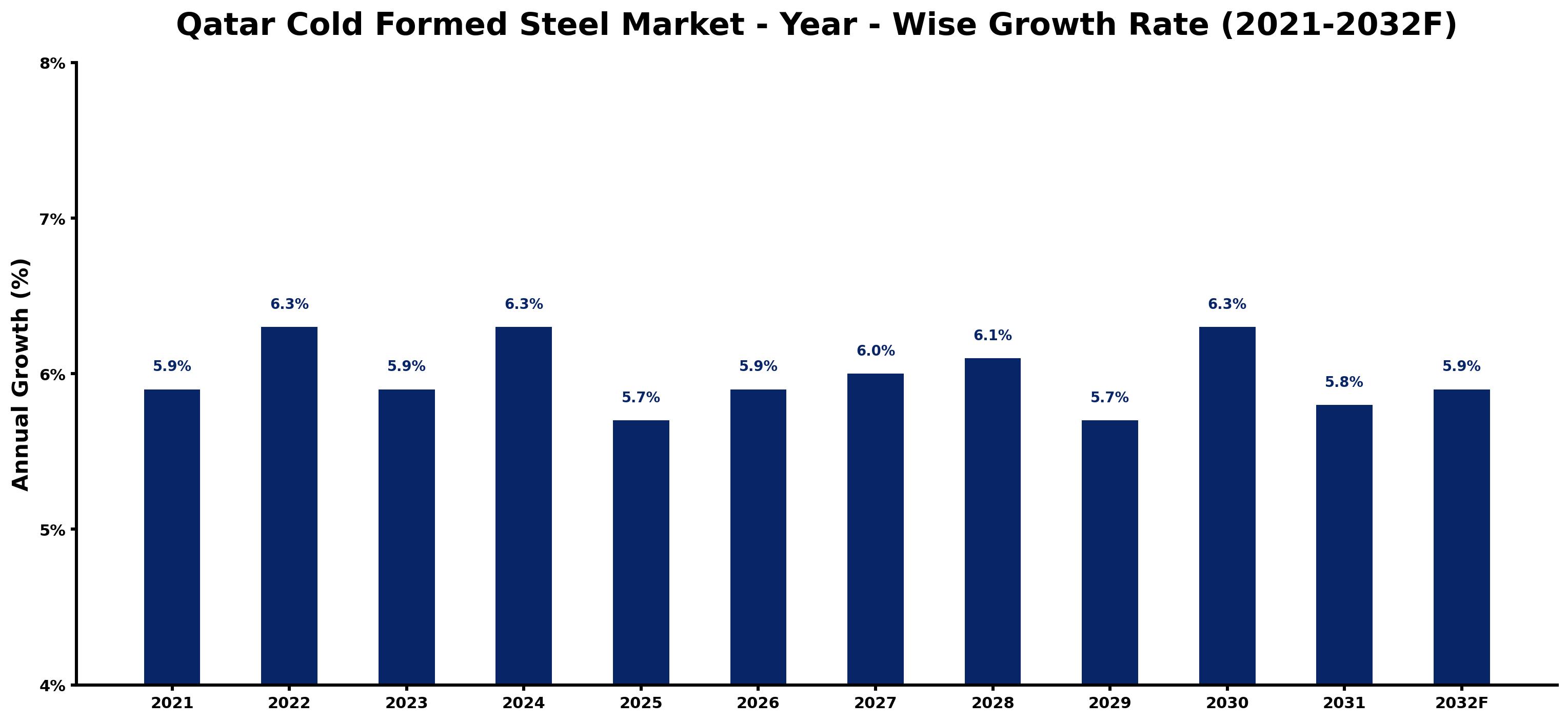
The table below presents the year wise growth rates along with the key drivers influencing the market
| Year | Growth Rate | Major Drivers |
| 2021 | 5.9% | Post-pandemic recovery in construction projects initiates a resurgence in steel usage. |
| 2022 | 6.3% | Localization efforts in the Gulf Cooperation Council enhance regional cold-formed steel production. |
| 2023 | 5.9% | Major infrastructure developments linked to Qatar's World Cup preparations stimulate market activity. |
| 2024 | 6.3% | Sustainability standards compel builders to opt for resource-efficient cold-formed steel solutions. |
| 2025 | 5.7% | Growing urbanization in Qatar drives heightened demand for residential and commercial structures. |
| 2026 | 5.9% | Partnerships between local firms and international players optimize manufacturing capacities and technology. |
| 2027 | 6.0% | Investment in smart city initiatives boosts infrastructure requirements, elevating steel consumption. |
| 2028 | 6.1% | Demand shifts towards innovative steel designs, catering to Qatar's unique climatic challenges. |
| 2029 | 5.7% | Advancements in steel processing techniques enhance product lifespan and structural efficiency. |
| 2030 | 6.3% | Integration of cold-formed steel in renewable energy projects expands its market application. |
| 2031 | 5.8% | A global emphasis on sustainable construction fuels preference for cold-formed materials. |
| 2032 | 5.9% | Transition to circular economy practices drives innovation in steel recycling and reuse. |
Note - Market size estimations and growth projections presented in this report are based on 6Wresearch's advanced forecasting approach, validated with industry datasets as of June 2026.
Qatar Cold Formed Steel Market Synopsis
The Qatar Cold Formed Steel Market is projected to reach 5.9% and witness significant growth during the forecast period (2026-2032). The market is characterized by a surge in demand driven by rapid urbanization and industrial development across the region. Increased investments from both regional and international stakeholders in various infrastructure projects have significantly contributed to the growth of cold formed steel (CFS) usage in Qatar. The inherent advantages of CFS, including its superior strength-to-weight ratio, corrosion resistance, thermal insulation, and ease of fabrication, position it as a preferred choice in construction and building projects. The anticipated growth trajectory of this market is expected to be supported by these favorable attributes.
Qatar Cold Formed Steel Market Growth Drivers
The Qatar Cold Formed Steel Market is set to expand due to several key drivers:
- The ambitious infrastructure development projects led by the Qatari government are fueling demand. These projects include significant renovations of roads, highways, and the construction of new residential and industrial complexes.
- The increasing population and rapid urbanization in Qatar necessitate more robust construction materials, thus enhancing the demand for CFS in a range of applications.
- With the focus on sustainability, the construction sector is increasingly opting for materials like cold formed steel that offer lower environmental impacts without compromising structural integrity.
- Technological advancements in production processes are yielding higher quality CFS products. This enhances market appeal as construction companies seek reliable and superior materials.
- Institutional frameworks promoting the use of local materials and sustainable construction practices are incentivizing construction firms to prefer CFS over traditional alternatives.
Qatar Cold Formed Steel Market Challenges and Restraints
While the Qatar Cold Formed Steel Market has a positive outlook, it is not without its challenges. Key obstacles include:
- Limited availability of raw materials poses a significant constraint. The local production capabilities have yet to fully meet the increasing market demand due to infrastructural limitations in sourcing and storing these materials.
- High import costs associated with CFS due to taxes and tariffs can make it difficult for local companies to remain competitive against international players.
- Operational disruptions caused by external factors, including the recent impacts of the Covid-19 pandemic, have resulted in labor shortages and project delays that hinder growth momentum.
- The fluctuating global steel prices can exert pressure on profit margins for manufacturers relying on imported raw materials for CFS production.
- Market players also face challenges related to project management efficiency, as delays can lead to cost overruns and compromised timelines, affecting overall project viability.
Qatar Cold Formed Steel Market Government Investment and Initiatives
The Qatari government is actively fostering the growth of the cold formed steel sector through various initiatives and investments:
- Significant public spending on infrastructure is a cornerstone of the country's economic strategy, with increased budget allocations for construction and urban development.
- Regulatory frameworks are being established to promote the use of locally-sourced materials, including cold formed steel, in a bid to stimulate domestic production capabilities.
- There are ongoing public-private partnerships aimed at enhancing the manufacturing ecosystem for cold formed steel, thereby increasing its availability in the market.
- Investment incentives and subsidies are being offered to enterprises that utilize sustainable materials or adopt innovative construction practices, further encouraging CFS use.
- The government's long-term vision includes a focus on sustainable urban development, which aligns with the characteristics of cold formed steel as a material that supports eco-friendly construction.
Qatar Cold Formed Steel Market Latest Developments (May 2025 - June 2026)
In the period from May 2025 to June 2026, the Qatar Cold Formed Steel Market has witnessed several notable developments:
- There has been an uptick in large-scale infrastructure projects initiated by the government, with a noticeable emphasis on sustainable practices that favor the use of cold formed steel.
- Investment in technology and equipment upgrades for local manufacturing facilities is ongoing, aimed at improving efficiency and quality in CFS production.
- Industry stakeholders are increasingly collaborating on research and development initiatives to explore advanced applications for cold formed steel in modern construction.
- Market players are adapting to changing regulations and standards that prioritize sustainability and resilience in construction materials.
- The impact of global supply chain adjustments post-Covid-19 has led to a reevaluation of sourcing strategies for raw materials essential for CFS production.
Qatar Cold Formed Steel Market - Key Attractiveness of the Report
- 10 Years of Market Numbers
- Historical Data Starting from 2022 to 2025
- Base Year: 2025
- Forecast Data until 2032
- Key Performance Indicators Impacting the Market
- Major Upcoming Developments and Projects
Key Highlights of the Report:
- Qatar Cold Formed Steel Market Outlook
- Market Size of Qatar Cold Formed Steel Market, 2025
- Forecast of Qatar Cold Formed Steel Market, 2032
- Historical Data and Forecast of Qatar Cold Formed Steel Revenues & Volume for the Period 2022-2032F
- Qatar Cold Formed Steel Market Trend Evolution
- Qatar Cold Formed Steel Market Drivers and Challenges
- Qatar Cold Formed Steel Price Trends
- Qatar Cold Formed Steel Porter's Five Forces
- Qatar Cold Formed Steel Industry Life Cycle
- Historical Data and Forecast of Qatar Cold Formed Steel Market Revenues & Volume By Types for the Period 2022-2032F
- Historical Data and Forecast of Qatar Cold Formed Steel Market Revenues & Volume By Steel Sheet for the Period 2022-2032F
- Historical Data and Forecast of Qatar Cold Formed Steel Market Revenues & Volume By Strip for the Period 2022-2032F
- Historical Data and Forecast of Qatar Cold Formed Steel Market Revenues & Volume By Plate for the Period 2022-2032F
- Historical Data and Forecast of Qatar Cold Formed Steel Market Revenues & Volume By Flat Bar for the Period 2022-2032F
- Historical Data and Forecast of Qatar Cold Formed Steel Market Revenues & Volume By Application for the Period 2022-2032F
- Historical Data and Forecast of Qatar Cold Formed Steel Market Revenues & Volume By Construction for the Period 2022-2032F
- Historical Data and Forecast of Qatar Cold Formed Steel Market Revenues & Volume By Automotive for the Period 2022-2032F
- Historical Data and Forecast of Qatar Cold Formed Steel Market Revenues & Volume By Appliances for the Period 2022-2032F
- Historical Data and Forecast of Qatar Cold Formed Steel Market Revenues & Volume By Machinery Parts for the Period 2022-2032F
- Historical Data and Forecast of Qatar Cold Formed Steel Market Revenues & Volume By Industrial for the Period 2022-2032F
- Historical Data and Forecast of Qatar Cold Formed Steel Market Revenues & Volume By Others for the Period 2022-2032F
- Qatar Cold Formed Steel Import Export Trade Statistics
- Market Opportunity Assessment By Types
- Market Opportunity Assessment By Application
- Qatar Cold Formed Steel Top Companies Market Share
- Qatar Cold Formed Steel Competitive Benchmarking By Technical and Operational Parameters
- Qatar Cold Formed Steel Company Profiles
- Qatar Cold Formed Steel Key Strategic Recommendations






































