Qatar Communications Equipment Market Summary
The qatar communications equipment market was estimated at USD 334 Million in 2025 and is projected to reach USD 446 Million by 2032, growing at a CAGR of 5.1% from 2026 to 2032.
Qatar Communications Equipment Market Year-wise Growth Rate and Key Drivers
This graph highlights how the Qatar Communications Equipment Market has steadily grown over the past five years, supported by major growth factors.
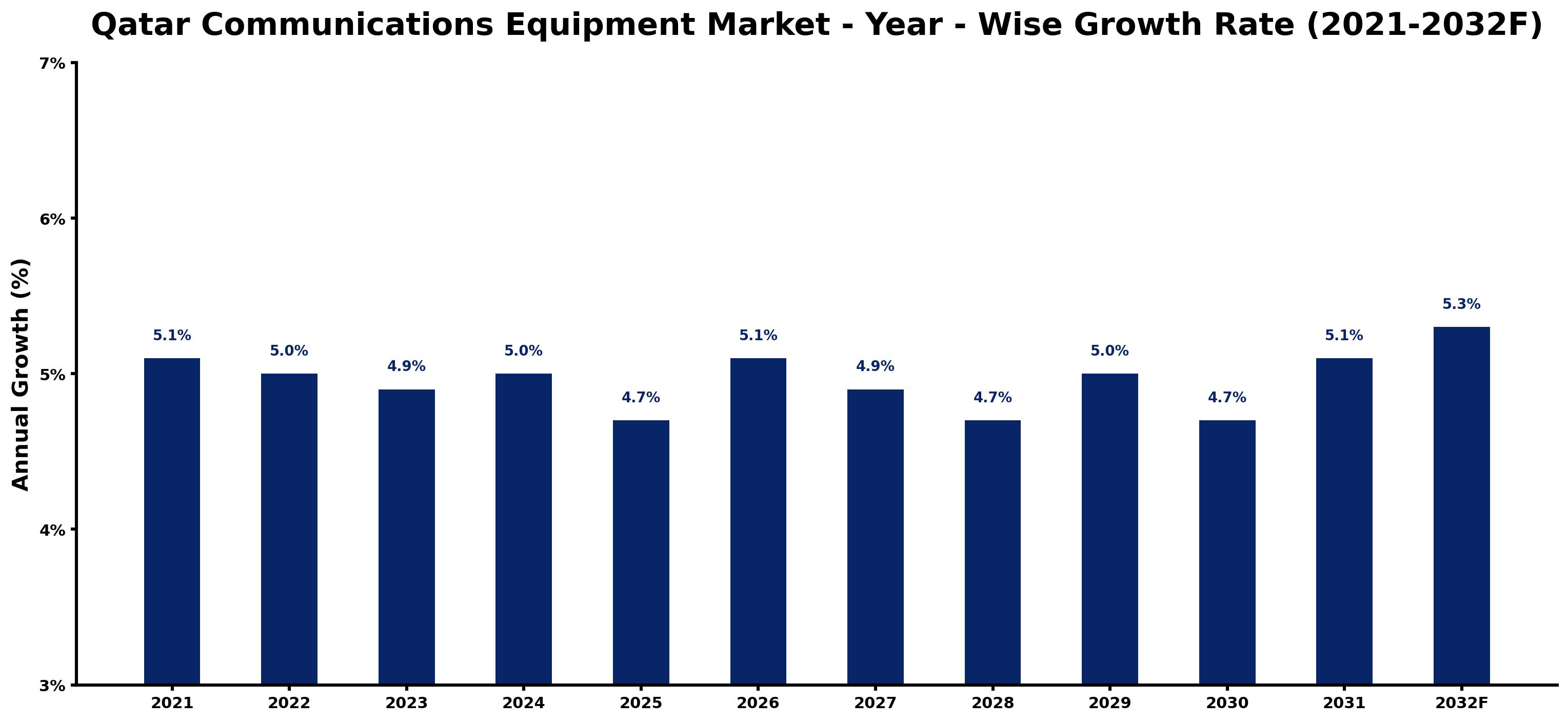
The table below presents the year wise growth rates along with the key drivers influencing the market
| Year | Growth Rate | Major Drivers |
| 2021 | 5.1% | Post-lockdown retail projects stimulated demand for enhanced communication solutions across sectors. |
| 2022 | 5.0% | Shift toward smart city initiatives influenced investments in advanced telecommunications infrastructure. |
| 2023 | 4.9% | Local companies began prioritizing partnerships with global tech firms for innovative equipment. |
| 2024 | 5.0% | Event-driven demand emerged as Qatar prepared for the World Cup and related activities. |
| 2025 | 4.7% | Increased competition among telecom providers led to service expansions and upgrades. |
| 2026 | 5.1% | The construction boom in Qatar required robust communication systems for ongoing projects. |
| 2027 | 4.9% | Emerging technologies in IoT pushed industries to enhance connectivity and equipment reliability. |
| 2028 | 4.7% | Evolving consumer expectations urged companies to improve digital and communication services urgently. |
| 2029 | 5.0% | Investment in 5G technology gained momentum as companies sought faster network capabilities. |
| 2030 | 4.7% | International trade agreements opened doors for innovative communications equipment manufacturers. |
| 2031 | 5.1% | Sustainability considerations urged firms to invest in more energy-efficient communication technologies. |
| 2032 | 5.3% | Integration of AI in communication tools transformed operational efficiency across all sectors. |
Note - Market size estimations and growth projections presented in this report are based on 6Wresearch's advanced forecasting approach, validated with industry datasets as of June 2026.
Qatar Communications Equipment Market Synopsis
The Qatar Communications Equipment Market is projected to reach 5.1% and witness significant growth during the forecast period (2026-2032). Over recent years, this market has benefitted from an increasing demand for advanced telecommunications services, digital transformation initiatives, and technological advancements. Qatar's commitment to becoming a technologically progressive nation has notably led to the rising adoption of communication equipment, enhancing various industries while improving overall connectivity.
Qatar Communications Equipment Market Growth Drivers
The growth trajectory of the Qatar Communications Equipment Market is buoyed by several key factors:
- Digital transformation across multiple sectors has significantly enhanced the demand for modern communications equipment, thus bolstering connectivity and facilitating efficient data exchange.
- The robust expansion of the telecommunications sector in Qatar, highlighted by the rollout of 5G networks, has created an urgent need for upgraded communication solutions to support increased mobile penetration.
- Government initiatives aimed at promoting information and communication technology (ICT) are pivotal, fostering the development of smart city projects that stimulate further investments in cutting-edge communication equipment.
- Growing consumer reliance on technology for both business operations and personal communication has amplified the demand for high-quality and reliable communications equipment.
- The surge in remote working trends, exacerbated by the Covid-19 pandemic, has necessitated innovative communication solutions to support a distributed workforce, driving market expansion.
Qatar Communications Equipment Market Challenges and Restraints
Despite the momentum in the Qatar Communications Equipment Market, several challenges threaten to impede sustained growth:
- The continuous improvement and expansion of communication infrastructure demand significant capital investment, which can create funding and coordination challenges for stakeholders involved.
- As the sophistication of communication networks rises, so does the threat landscape, with cyber threats and data breaches necessitating enhanced security measures for communications equipment.
- Navigating through stringent regulations and compliance requirements poses hurdles for companies operating in the telecommunications sector, potentially slowing down market development.
- Supply chain disruptions, especially those influenced by global events like the Covid-19 pandemic, can lead to project delays, thereby affecting overall market performance.
- Rapid technological advancements necessitate continual adaptation and innovation; companies that fail to keep pace may lose their competitive edge and market share.
Qatar Communications Equipment Market Government Investment and Initiatives
The Qatar government has initiated several strategic investments and initiatives aimed at enhancing the communications equipment market. These initiatives include:
- Promotion of ICT as a cornerstone of national development, which includes funding for infrastructure expansion and technological advancement in telecommunications.
- Support for smart city projects that integrate advanced communication technologies to improve urban living conditions and promote digital engagement among citizens.
- Implementation of regulatory frameworks that encourage foreign investment and collaboration in telecommunications sectors, thus bolstering the market's growth potential.
- Investment in educational programs aimed at developing a skilled workforce adept in modern communication technologies, fostering innovation and operational efficiency.
- Strengthening cybersecurity measures and policies to protect critical communication infrastructure, which enhances confidence and stability within the marketplace.
Qatar Communications Equipment Market Latest Developments (May 2025 - June 2026)
During the period from May 2025 to June 2026, the Qatar Communications Equipment Market witnessed several notable trends and developments:
- The demand for remote communication solutions surged, driven by ongoing adjustments to working practices post-Covid-19, which emphasized the need for robust telecommunications infrastructure.
- Increased investment in 5G technology rollout was evident, further enhancing mobile connectivity and paving the way for innovative applications in sectors such as healthcare and education.
- Regulatory bodies enhanced their focus on cybersecurity protocols, responding to rising threats in digital environments, thereby necessitating improvements in communications equipment safety and functionality.
- Public-private partnerships began to emerge, focusing on developing smart solutions and technologies that leverage comprehensive communication strategies to address urban challenges.
- Technological advancements continued to reshape the market landscape, emphasizing the integration of AI and IoT within communication systems to provide more efficient and scalable solutions.
Qatar Communications Equipment Market - Key Attractiveness of the Report
- 10 Years of Market Numbers
- Historical Data Starting from 2022 to 2025
- Base Year: 2025
- Forecast Data until 2032
- Key Performance Indicators Impacting the Market
- Major Upcoming Developments and Projects
Key Highlights of the Report:
- Qatar Communications Equipment Market Outlook
- Market Size of Qatar Communications Equipment Market, 2025
- Forecast of Qatar Communications Equipment Market, 2032
- Historical Data and Forecast of Qatar Communications Equipment Revenues & Volume for the Period 2022-2032F
- Qatar Communications Equipment Market Trend Evolution
- Qatar Communications Equipment Market Drivers and Challenges
- Qatar Communications Equipment Price Trends
- Qatar Communications Equipment Porter's Five Forces
- Qatar Communications Equipment Industry Life Cycle
- Historical Data and Forecast of Qatar Communications Equipment Market Revenues & Volume By Type for the Period 2022-2032F
- Historical Data and Forecast of Qatar Communications Equipment Market Revenues & Volume By Optical Communication Equipment for the Period 2022-2032F
- Historical Data and Forecast of Qatar Communications Equipment Market Revenues & Volume By Network Communication Equipment for the Period 2022-2032F
- Historical Data and Forecast of Qatar Communications Equipment Market Revenues & Volume By Mobile Communication Device for the Period 2022-2032F
- Historical Data and Forecast of Qatar Communications Equipment Market Revenues & Volume By Component for the Period 2022-2032F
- Historical Data and Forecast of Qatar Communications Equipment Market Revenues & Volume By WANs (Wide Area Network) for the Period 2022-2032F
- Historical Data and Forecast of Qatar Communications Equipment Market Revenues & Volume By Transceiver for the Period 2022-2032F
- Historical Data and Forecast of Qatar Communications Equipment Market Revenues & Volume By Switch for the Period 2022-2032F
- Historical Data and Forecast of Qatar Communications Equipment Market Revenues & Volume By Routers for the Period 2022-2032F
- Historical Data and Forecast of Qatar Communications Equipment Market Revenues & Volume By LANs (Local Area Network) for the Period 2022-2032F
- Historical Data and Forecast of Qatar Communications Equipment Market Revenues & Volume By Exchanges for the Period 2022-2032F
- Historical Data and Forecast of Qatar Communications Equipment Market Revenues & Volume By Application for the Period 2022-2032F
- Historical Data and Forecast of Qatar Communications Equipment Market Revenues & Volume By Telecom Operators for the Period 2022-2032F
- Historical Data and Forecast of Qatar Communications Equipment Market Revenues & Volume By Data Center for the Period 2022-2032F
- Historical Data and Forecast of Qatar Communications Equipment Market Revenues & Volume By End-users for the Period 2022-2032F
- Historical Data and Forecast of Qatar Communications Equipment Market Revenues & Volume By Banking, Financial Services and Insurance (BFSI) for the Period 2022-2032F
- Historical Data and Forecast of Qatar Communications Equipment Market Revenues & Volume By Personal for the Period 2022-2032F
- Historical Data and Forecast of Qatar Communications Equipment Market Revenues & Volume By Healthcare for the Period 2022-2032F
- Historical Data and Forecast of Qatar Communications Equipment Market Revenues & Volume By Government for the Period 2022-2032F
- Historical Data and Forecast of Qatar Communications Equipment Market Revenues & Volume By Enterprise for the Period 2022-2032F
- Historical Data and Forecast of Qatar Communications Equipment Market Revenues & Volume By Energy & Utilities for the Period 2022-2032F
- Historical Data and Forecast of Qatar Communications Equipment Market Revenues & Volume By Education for the Period 2022-2032F
- Historical Data and Forecast of Qatar Communications Equipment Market Revenues & Volume By Cloud for the Period 2022-2032F
- Qatar Communications Equipment Import Export Trade Statistics
- Market Opportunity Assessment By Type
- Market Opportunity Assessment By Component
- Market Opportunity Assessment By Application
- Market Opportunity Assessment By End-users
- Qatar Communications Equipment Top Companies Market Share
- Qatar Communications Equipment Competitive Benchmarking By Technical and Operational Parameters
- Qatar Communications Equipment Company Profiles
- Qatar Communications Equipment Key Strategic Recommendations






































