Qatar Computer-Aided Manufacturing Market Size & Growth Rate (2026-2032)

The Qatar Computer-Aided Manufacturing Market was estimated at USD 483 Million in 2025 and is projected to reach USD 832 Million by 2032, growing at a CAGR of 11.7% from 2026 to 2032.
Qatar Computer-Aided Manufacturing Market Synopsis
The Qatar Computer-Aided Manufacturing (CAM) market has gained notable momentum in recent years, driven by an increasing focus on automation and precision in manufacturing. As industries strive to optimize operations, the integration of CAM technologies has become essential for enhancing production efficiency and product quality.
Looking ahead, the market is set to expand further, fueled by the ongoing digital transformation across sectors. The push for smart manufacturing and the adoption of advanced technologies such as CNC machining and 3D printing will play a pivotal role in shaping the future trajectory of CAM in Qatar.
Qatar Computer-Aided Manufacturing Market Year-wise Growth Rate and Key Drivers
This graph illustrates the annual growth rates of the Qatar Computer-Aided Manufacturing Market from 2021 to 2032, highlighting a steady upward trajectory and projected expansion over the forecast period.
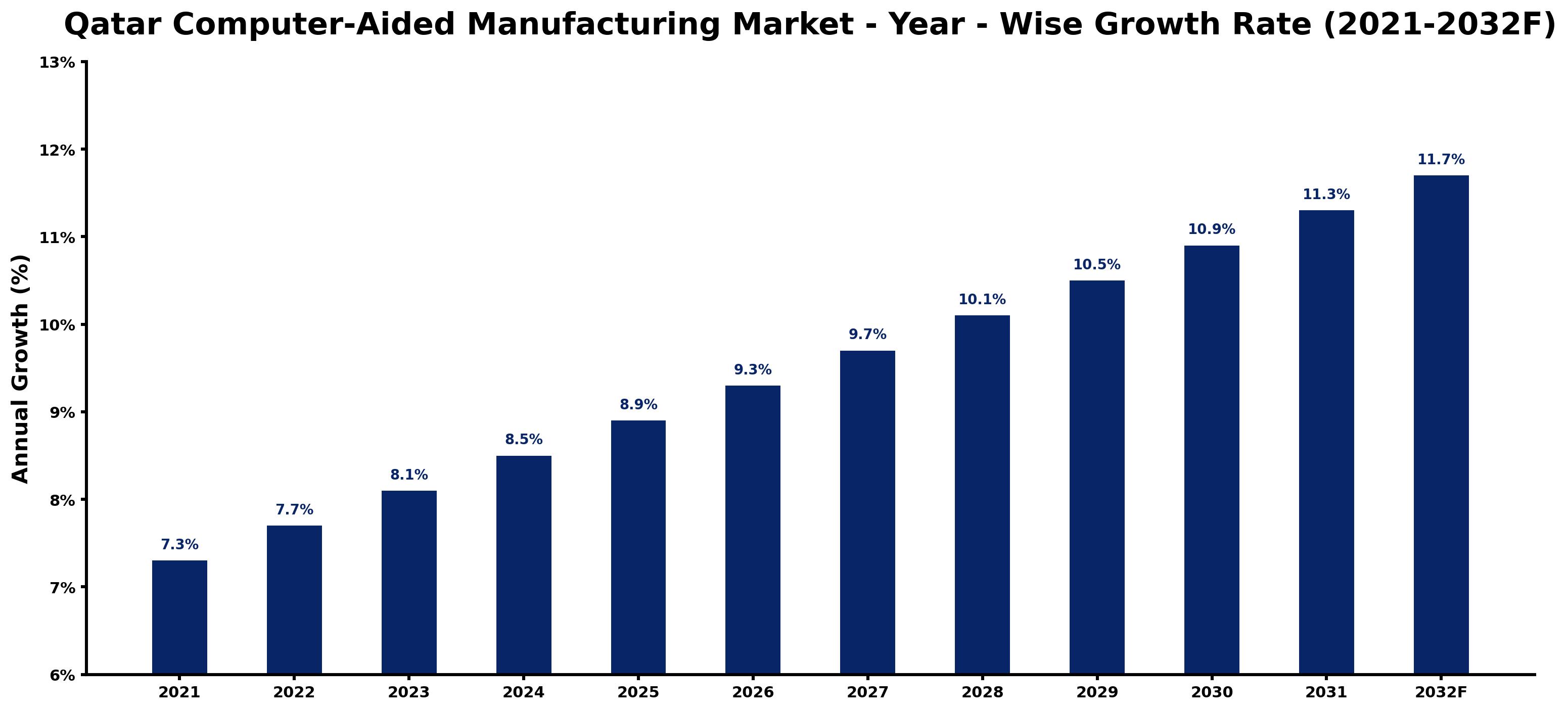
The table below presents the year‑wise growth rates along with the key drivers influencing the market
| Year | Growth Rate | Major Drivers |
| 2021 | 7.3% | Qatar National Vision 2030 drives manufacturing innovation. |
| 2022 | 7.7% | Increased demand for automation in oil and gas sectors. |
| 2023 | 8.1% | Local production incentives foster CAD technology adoption. |
| 2024 | 8.5% | Investment in smart manufacturing by Qatar Investment Authority. |
| 2025 | 8.9% | Government support for tech startups enhances CAD solutions. |
| 2026 | 9.3% | Rising need for advanced manufacturing amid FIFA 2022 preparations. |
| 2027 | 9.7% | Emergence of local universities specializing in manufacturing technologies. |
| 2028 | 10.1% | Qatar’s focus on sustainable manufacturing boosts CAD utilization. |
| 2029 | 10.5% | Growing construction projects demand precision in manufacturing techniques. |
| 2030 | 10.9% | Partnerships with global tech firms enhance software capabilities. |
| 2031 | 11.3% | Increased digital infrastructure supports advanced manufacturing processes. |
| 2032 | 11.7% | Regulatory reforms encourage innovation in CAD systems. |
Note: Market size estimations and growth projections presented in this report are based on 6Wresearch's proprietary forecasting methodology, utilizing the latest available industry data, government publications, and primary research inputs.
Qatar Computer-Aided Manufacturing Market Key Takeaways
Below are some of the specific key takeaways from the market, including:
- The increasing complexity of manufacturing processes drives demand for advanced CAM solutions.
- Integration with digital design tools enhances the interoperability of manufacturing systems.
- Investment in CAM technologies rose significantly post-COVID-19 to improve productivity.
- Local manufacturers are collaborating with global software providers to enhance operational capabilities.
- Skill gaps in the workforce present challenges that must be addressed for sustained growth.
Evaluation of Restraints in Qatar Computer-Aided Manufacturing Market
The Qatar Computer-Aided Manufacturing market faces several restraints that hinder its growth. A primary concern is the mismatch between diverse manufacturing techniques and available CAM solutions. As companies adopt various technologies, including CNC machining and additive manufacturing, the need for CAM systems that can seamlessly integrate and optimize these processes becomes crucial. Additionally, the complexity of ensuring compatibility with existing Computer-Aided Design (CAD) systems presents a significant hurdle. Workforce skill gaps further complicate the adoption of advanced CAM technologies, as organizations strive to keep pace with the rapid evolution in manufacturing processes.
Qatar Computer-Aided Manufacturing Market Trends
Several trends are emerging within the Qatar Computer-Aided Manufacturing market that could reshape its dynamics. A notable trend is the increasing adoption of smart manufacturing concepts, where data analytics and IoT are integrated into CAM systems. This allows for real-time monitoring and optimization of manufacturing processes. Another trend is the growing interest in sustainability, prompting manufacturers to seek CAM solutions that reduce waste and enhance energy efficiency. Additionally, the rise of additive manufacturing technologies is creating new avenues for product design and innovation, further driving demand for advanced CAM capabilities.
Qatar Computer-Aided Manufacturing Market Opportunities
The Qatar Computer-Aided Manufacturing market presents numerous opportunities for growth and investment. The push for industrial diversification is fostering an environment ripe for innovation in CAM technologies. Companies that focus on developing flexible and user-friendly CAM solutions will find a receptive market among local manufacturers seeking efficiency. Additionally, as Qatar continues to invest in infrastructure projects, there is an opportunity for CAM solutions to streamline processes in construction and related industries. Emphasizing collaboration between local firms and international technology providers could also open doors for enhanced capabilities and market expansion.
Government Initiatives in the Qatar Computer-Aided Manufacturing Market
The government of Qatar is actively shaping the Computer-Aided Manufacturing market through various initiatives aimed at enhancing the industrial sector's capabilities. With a focus on digital transformation and smart manufacturing, public policy is geared toward fostering innovation and attracting investment in advanced manufacturing technologies. These initiatives are crucial in supporting Qatar's economic diversification efforts and ensuring the manufacturing sector remains competitive on a global scale.
- A national digital infrastructure upgrade programme was recently launched to enhance connectivity and data management across manufacturing sectors.
- Ongoing initiatives promote collaboration between local manufacturers and global technology providers to advance CAM capabilities.
- A regulatory framework aimed at encouraging sustainable manufacturing practices is currently in the consultation phase.
- Planned investments in skill development programmes are expected to bridge workforce gaps in advanced manufacturing technologies by 2027.
Future Insights of the Qatar Computer-Aided Manufacturing Market
From 2026 to 2032, the Qatar Computer-Aided Manufacturing market is set to experience substantial growth driven by technological advancements and increased demand for precision in manufacturing processes. As industries continue to adopt smart manufacturing principles, the integration of CAM technologies with IoT and data analytics will become essential. The focus on sustainability will further influence product development, encouraging manufacturers to seek CAM solutions that enhance efficiency while minimizing environmental impact. Businesses that can adapt to these trends will be well-positioned to thrive in the evolving market landscape.
Qatar Computer-Aided Manufacturing Market Latest Developments
In the past year, the Qatar Computer-Aided Manufacturing market has seen a flurry of activity as companies adapt to changing demands and technological advancements. Manufacturers are increasingly prioritizing investment in CAM systems to streamline processes and improve efficiency. This trend reflects a broader commitment to enhancing operational capabilities amidst global competition.
- A major technology vendor announced the launch of a new CAM software suite in early 2025, designed to optimize CNC machining processes.
- An initiative that began in mid-2025 is currently underway to integrate CAM solutions with existing CAD systems across various sectors.
- A partnership between local manufacturers and an international technology firm is expected to enhance training programmes for CAM technologies by late 2025.
- A rollout of an upgraded cloud-based CAM platform is planned to begin in Q3 2026, aimed at improving accessibility for small and medium-sized enterprises.
Qatar Computer-Aided Manufacturing Market - Key Attractiveness of the Report
- 10 Years of Market Numbers
- Historical Data Starting from 2022 to 2025
- Base Year: 2025
- Forecast Data until 2032
- Key Performance Indicators Impacting the Market
- Major Upcoming Developments and Projects
Key Highlights of the Report:
- Qatar Computer-Aided Manufacturing Market Outlook
- Market Size of Qatar Computer-Aided Manufacturing Market, 2025
- Forecast of Qatar Computer-Aided Manufacturing Market, 2032
- Historical Data and Forecast of Qatar Computer-Aided Manufacturing Revenues & Volume for the Period 2022-2032F
- Qatar Computer-Aided Manufacturing Market Trend Evolution
- Qatar Computer-Aided Manufacturing Market Drivers and Challenges
- Qatar Computer-Aided Manufacturing Price Trends
- Qatar Computer-Aided Manufacturing Porter's Five Forces
- Qatar Computer-Aided Manufacturing Industry Life Cycle
- Historical Data and Forecast of Qatar Computer-Aided Manufacturing Market Revenues & Volume By Component for the Period 2022-2032F
- Historical Data and Forecast of Qatar Computer-Aided Manufacturing Market Revenues & Volume By Solution for the Period 2022-2032F
- Historical Data and Forecast of Qatar Computer-Aided Manufacturing Market Revenues & Volume By Services for the Period 2022-2032F
- Historical Data and Forecast of Qatar Computer-Aided Manufacturing Market Revenues & Volume By Training and education for the Period 2022-2032F
- Historical Data and Forecast of Qatar Computer-Aided Manufacturing Market Revenues & Volume By Support and maintenance for the Period 2022-2032F
- Historical Data and Forecast of Qatar Computer-Aided Manufacturing Market Revenues & Volume By Industry Vertical for the Period 2022-2032F
- Historical Data and Forecast of Qatar Computer-Aided Manufacturing Market Revenues & Volume By Automotive for the Period 2022-2032F
- Historical Data and Forecast of Qatar Computer-Aided Manufacturing Market Revenues & Volume By Aerospace and Defense for the Period 2022-2032F
- Historical Data and Forecast of Qatar Computer-Aided Manufacturing Market Revenues & Volume By Industrial Equipment for the Period 2022-2032F
- Historical Data and Forecast of Qatar Computer-Aided Manufacturing Market Revenues & Volume By High Tech for the Period 2022-2032F
- Historical Data and Forecast of Qatar Computer-Aided Manufacturing Market Revenues & Volume By Medical Devices and Component for the Period 2022-2032F
- Historical Data and Forecast of Qatar Computer-Aided Manufacturing Market Revenues & Volume By Energy and Utilities for the Period 2022-2032F
- Historical Data and Forecast of Qatar Computer-Aided Manufacturing Market Revenues & Volume By Others for the Period 2022-2032F
- Historical Data and Forecast of Qatar Computer-Aided Manufacturing Market Revenues & Volume By Deployment Type for the Period 2022-2032F
- Historical Data and Forecast of Qatar Computer-Aided Manufacturing Market Revenues & Volume By On-Premises for the Period 2022-2032F
- Historical Data and Forecast of Qatar Computer-Aided Manufacturing Market Revenues & Volume By Cloud for the Period 2022-2032F
- Historical Data and Forecast of Qatar Computer-Aided Manufacturing Market Revenues & Volume By Organization Size for the Period 2022-2032F
- Historical Data and Forecast of Qatar Computer-Aided Manufacturing Market Revenues & Volume By Large enterprises for the Period 2022-2032F
- Historical Data and Forecast of Qatar Computer-Aided Manufacturing Market Revenues & Volume By SMEs for the Period 2022-2032F
- Qatar Computer-Aided Manufacturing Import Export Trade Statistics
- Market Opportunity Assessment By Component
- Market Opportunity Assessment By Industry Vertical
- Market Opportunity Assessment By Deployment Type
- Market Opportunity Assessment By Organization Size
- Qatar Computer-Aided Manufacturing Top Companies Market Share
- Qatar Computer-Aided Manufacturing Competitive Benchmarking By Technical and Operational Parameters
- Qatar Computer-Aided Manufacturing Company Profiles
- Qatar Computer-Aided Manufacturing Key Strategic Recommendations






































