Qatar Condiments and Sauces Market Summary
The qatar condiments and sauces market was estimated at USD 312 Million in 2025 and is projected to reach USD 409 Million by 2032, growing at a CAGR of 4.4% from 2026 to 2032.
Qatar Condiments and Sauces Market Year-wise Growth Rate and Key Drivers
This graph highlights how the Qatar Condiments and Sauces Market has steadily grown over the past five years, supported by major growth factors.
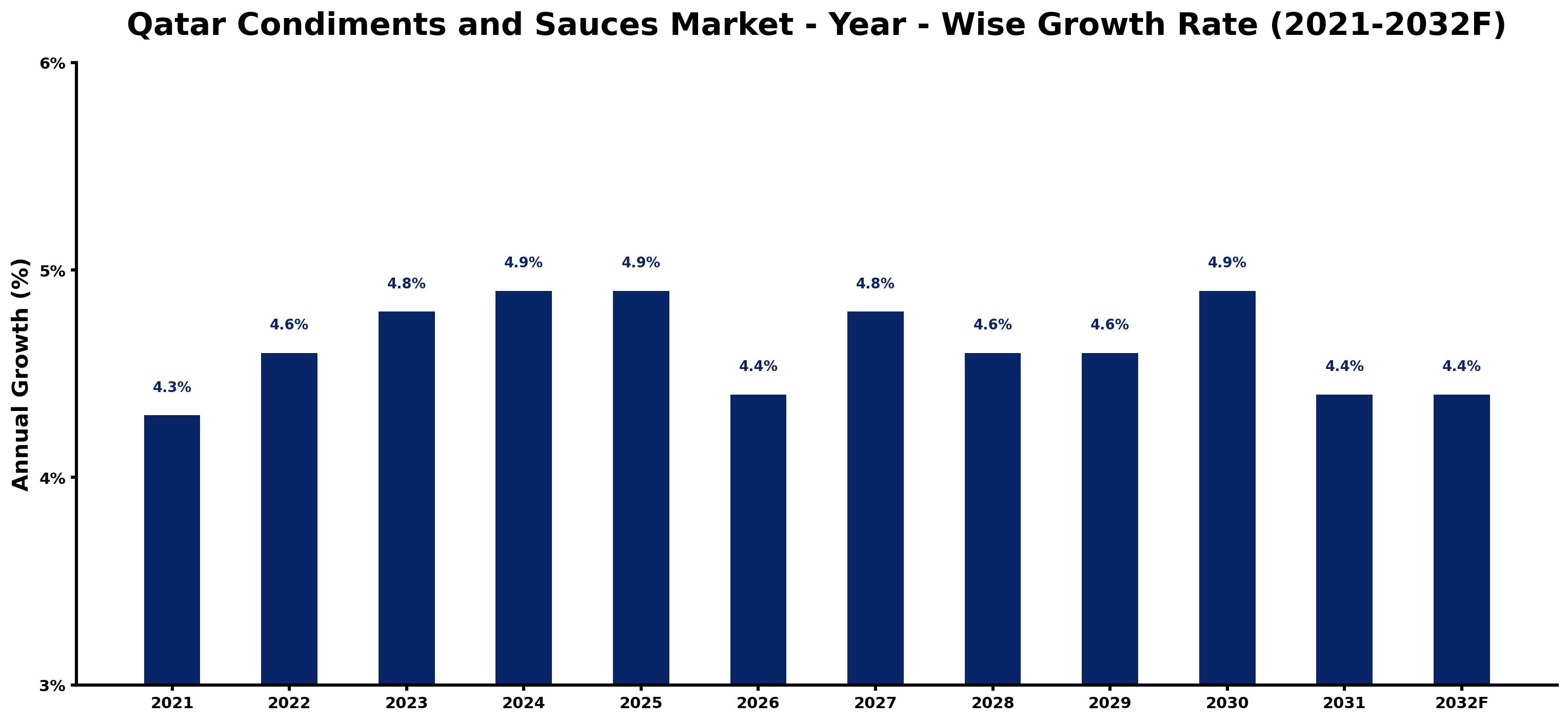
The table below presents the year wise growth rates along with the key drivers influencing the market
| Year | Growth Rate | Major Drivers |
| 2021 | 4.3% | Post-lockdown retail projects boosted home cooking, increasing condiment purchases significantly. |
| 2022 | 4.6% | Local cuisine trends encouraged consumers to explore diverse flavor profiles and ingredients. |
| 2023 | 4.8% | Food service sector expansion fueled a demand for premium sauces and condiments. |
| 2024 | 4.9% | The influx of expatriates introduced global culinary influences, altering local preferences. |
| 2025 | 4.9% | Increased tourism led to higher consumption of traditional and international condiments. |
| 2026 | 4.4% | Health-conscious consumers pushed for organic and reduced-sodium condiment options. |
| 2027 | 4.8% | E-commerce platforms emerged, enabling easier access to gourmet sauces and condiments. |
| 2028 | 4.6% | Sustainability became a priority, with brands adopting eco-friendly packaging solutions. |
| 2029 | 4.6% | The growing popularity of cooking shows inspired home chefs to experiment with flavors. |
| 2030 | 4.9% | Culinary schools began offering courses focused on global condiment preparations. |
| 2031 | 4.4% | Local food festivals showcased artisanal condiments, sparking consumer interest and loyalty. |
| 2032 | 4.4% | Innovative flavor combinations and fusion sauces emerged, reflecting multicultural influences. |
Note - Market size estimations and growth projections presented in this report are based on 6Wresearch's advanced forecasting approach, validated with industry datasets as of June 2026.
Qatar Condiments and Sauces Market Synopsis
The Qatar Condiments and Sauces Market is projected to reach 4.4% and witness significant growth during the forecast period (2026-2032). This market has been propelled by various factors, including an increase in demand from the food service sector, which encompasses restaurants, hotels, and cafes. The influx of foreign tourists is also anticipated to contribute to a positive market landscape, as their preferences often favor diverse and flavorful culinary experiences. Moreover, there is a notable shift toward health consciousness among consumers, which is expected to stimulate the demand for organic alternatives in condiments and sauces. Additionally, the evolving consumer taste towards exotic flavors presents unique opportunities for market players.
Qatar Condiments and Sauces Market Growth Drivers
The growth trajectory of the Qatar Condiments and Sauces Market can be attributed to several key drivers:
- The rise in disposable income levels among consumers has enabled higher spending power, facilitating increased expenditure on dining out and international cuisines.
- The burgeoning tourism industry is fostering a greater demand for diverse dining experiences, thus encouraging the introduction of a wider range of condiments and sauces.
- An increasing focus on healthy eating is prompting consumers to opt for condiments made from organic and natural ingredients, steering manufacturers towards product innovation.
- Changing consumer preferences have led to a growing appetite for exotic flavors, driving manufacturers to expand their offerings beyond traditional products.
- The expanding retail landscape and e-commerce platforms are improving product availability, thus encouraging consumption among various demographic groups.
Qatar Condiments and Sauces Market Challenges and Restraints
While the Qatar Condiments and Sauces Market presents significant growth potential, several challenges need to be addressed:
- The prevalence of counterfeit products poses a considerable risk to brand integrity and consumer trust, potentially affecting overall sales of authentic products.
- Despite stringent government regulations, maintaining consistent quality control across the supply chain remains a challenge, impacting market stability.
- The high costs associated with sourcing organic raw materials can lead to increased prices for consumers, which may inhibit sales growth.
- Changing regulations and import restrictions may pose hurdles for manufacturers looking to expand their product lines with international offerings.
- Economic fluctuations caused by external factors can influence consumer spending habits, with potential ramifications on market dynamics.
Qatar Condiments and Sauces Market Government Investment and Initiatives
The Qatari government has recognized the significance of the condiments and sauces sector as part of its broader economic diversification strategy. Initiatives aimed at enhancing food security and supporting local agricultural production contribute to the stability of the market. Public investment in infrastructure, including logistics and supply chain enhancements, is designed to facilitate the smooth distribution of food products, including condiments and sauces. Additionally, government programs promoting health and nutrition encourage manufacturers to develop healthier products, aligning with consumer demand for organic and low-calorie options. By fostering a favorable business environment through incentives and support, the government plays a pivotal role in the growth of the Qatar Condiments and Sauces Market.
Qatar Condiments and Sauces Market Latest Developments (May 2025 - June 2026)
The period from May 2025 to June 2026 has seen substantial developments in the Qatar Condiments and Sauces Market. A noticeable trend is the increasing focus on product diversification, with manufacturers exploring innovative recipes and ingredient sourcing. Health-focused product lines, including gluten-free and vegan variants, are becoming more prominent in response to consumer preferences. Additionally, advancements in packaging technologies aimed at extending shelf life and enhancing convenience are gaining traction. Collaborative partnerships among food service operators and condiment manufacturers are emerging as an effective strategy to enhance menu offerings. Furthermore, the market is witnessing a gradual recovery from the impacts of the COVID-19 pandemic, with a resurgence in the dining-out culture driving sales.
Qatar Condiments and Sauces Market - Key Attractiveness of the Report
- 10 Years of Market Numbers
- Historical Data Starting from 2022 to 2025
- Base Year: 2025
- Forecast Data until 2032
- Key Performance Indicators Impacting the Market
- Major Upcoming Developments and Projects
Key Highlights of the Report:
- Qatar Condiments and Sauces Market Outlook
- Market Size of Qatar Condiments and Sauces Market, 2025
- Forecast of Qatar Condiments and Sauces Market, 2032
- Historical Data and Forecast of Qatar Condiments and Sauces Revenues & Volume for the Period 2022-2032F
- Qatar Condiments and Sauces Market Trend Evolution
- Qatar Condiments and Sauces Market Drivers and Challenges
- Qatar Condiments and Sauces Price Trends
- Qatar Condiments and Sauces Porter's Five Forces
- Qatar Condiments and Sauces Industry Life Cycle
- Historical Data and Forecast of Qatar Condiments and Sauces Market Revenues & Volume By Product Types for the Period 2022-2032F
- Historical Data and Forecast of Qatar Condiments and Sauces Market Revenues & Volume By Table Sauces for the Period 2022-2032F
- Historical Data and Forecast of Qatar Condiments and Sauces Market Revenues & Volume By Cooking Sauces for the Period 2022-2032F
- Historical Data and Forecast of Qatar Condiments and Sauces Market Revenues & Volume By Pickled Products for the Period 2022-2032F
- Historical Data and Forecast of Qatar Condiments and Sauces Market Revenues & Volume By Purees & Pastes for the Period 2022-2032F
- Historical Data and Forecast of Qatar Condiments and Sauces Market Revenues & Volume By Dips for the Period 2022-2032F
- Historical Data and Forecast of Qatar Condiments and Sauces Market Revenues & Volume By Others for the Period 2022-2032F
- Historical Data and Forecast of Qatar Condiments and Sauces Market Revenues & Volume By Distribution Channel for the Period 2022-2032F
- Historical Data and Forecast of Qatar Condiments and Sauces Market Revenues & Volume By Online for the Period 2022-2032F
- Historical Data and Forecast of Qatar Condiments and Sauces Market Revenues & Volume By Offline for the Period 2022-2032F
- Qatar Condiments and Sauces Import Export Trade Statistics
- Market Opportunity Assessment By Product Types
- Market Opportunity Assessment By Distribution Channel
- Qatar Condiments and Sauces Top Companies Market Share
- Qatar Condiments and Sauces Competitive Benchmarking By Technical and Operational Parameters
- Qatar Condiments and Sauces Company Profiles
- Qatar Condiments and Sauces Key Strategic Recommendations






































