Qatar Contactless Payment Market Size & Growth Rate (2026-2032)
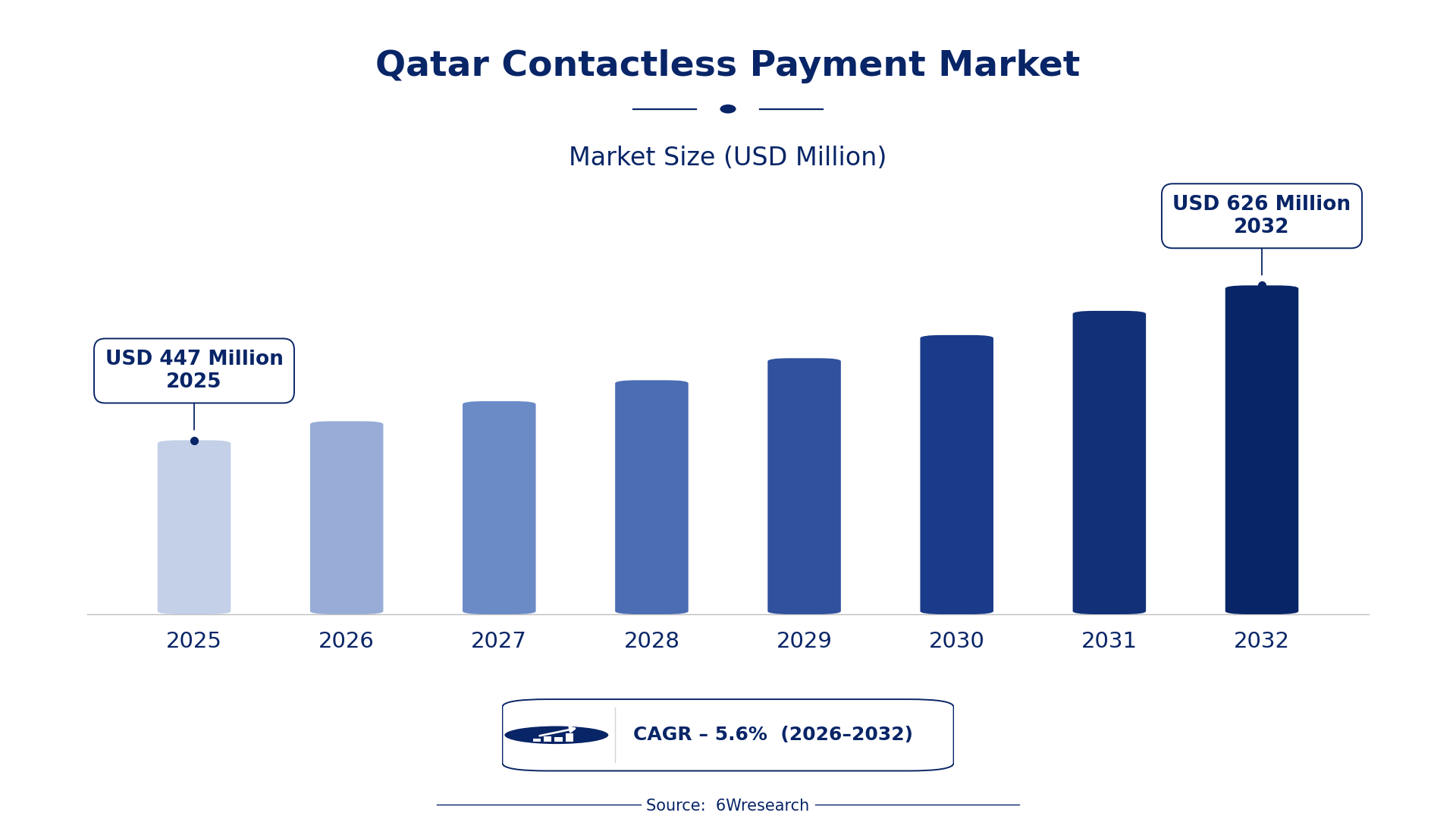
The Qatar Contactless Payment Market was estimated at USD 447 Million in 2025 and is projected to reach USD 626 Million by 2032, growing at a CAGR of 5.6% from 2026 to 2032.
Qatar Contactless Payment Market Synopsis
The surge in consumer demand for convenience is the most influential factor shaping the Qatar Contactless Payment Market today. As the pandemic shifted payment preferences, more consumers are opting for contactless options to minimize physical interactions.
Retailers and businesses are responding by investing in technology that facilitates touch-free transactions. This shift, combined with government support for a cashless economy, is driving the rapid acceptance and integration of contactless payment systems across various sectors.
Qatar Contactless Payment Market Year-wise Growth Rate and Key Drivers
This graph illustrates the annual growth rates of the Qatar Contactless Payment Market from 2021 to 2032, highlighting a steady upward trajectory and projected expansion over the forecast period.
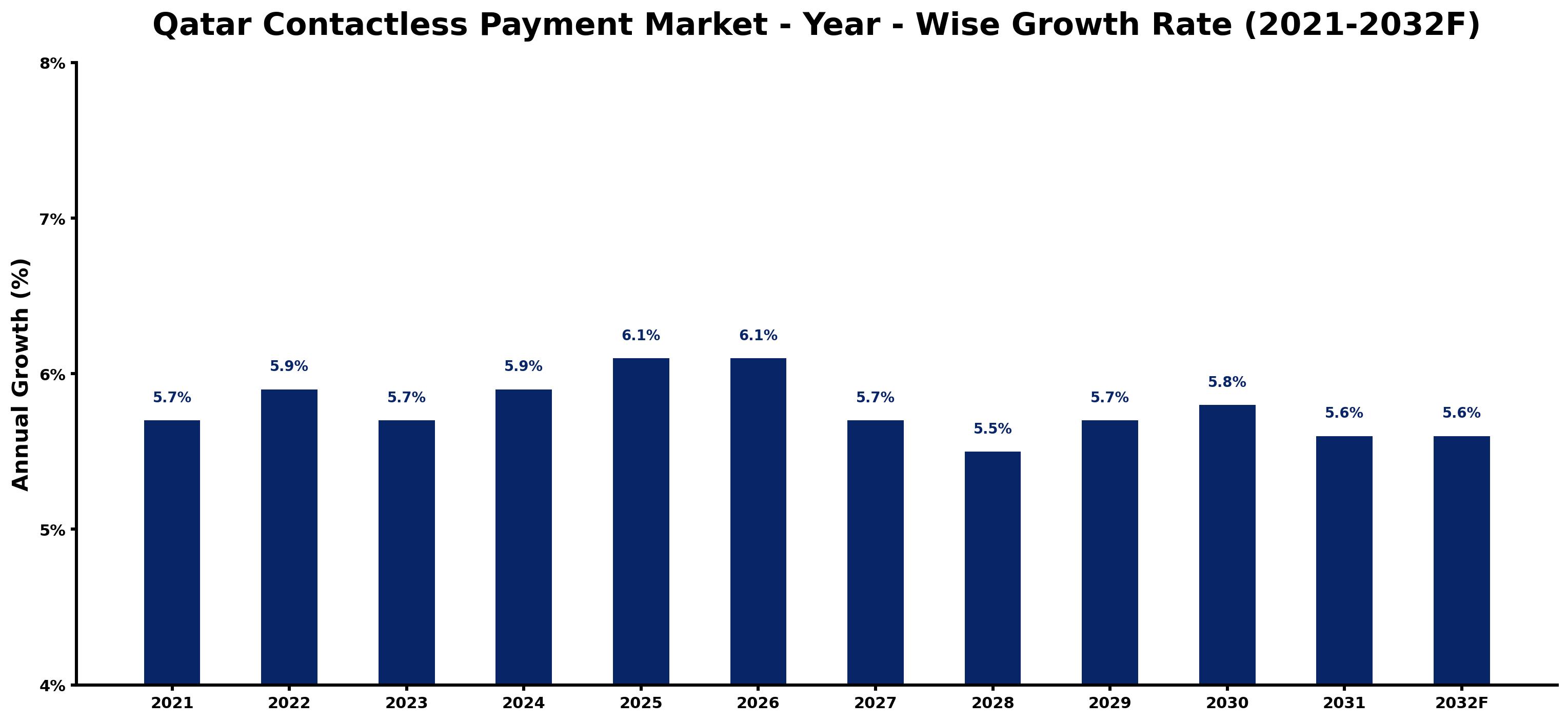
The table below presents the year‑wise growth rates along with the key drivers influencing the market
| Year | Growth Rate | Major Drivers |
| 2021 | 5.7% | Rapid mobile wallet adoption among Qatari consumers |
| 2022 | 5.9% | Increased smartphone penetration boosting contactless usage |
| 2023 | 5.7% | Government's digital transformation initiatives promoting cashless transactions |
| 2024 | 5.9% | Qatar hosting major international events driving payment innovation |
| 2025 | 6.1% | Local banks enhancing contactless card offerings for consumers |
| 2026 | 6.1% | Surge in retail sector investments adopting contactless technology |
| 2027 | 5.7% | Growing youth demographic favoring digital payment solutions |
| 2028 | 5.5% | Rising consumer preference for secure online shopping methods |
| 2029 | 5.7% | Partnerships with fintech startups expanding payment options |
| 2030 | 5.8% | Increased focus on loyalty programs utilizing contactless payments |
| 2031 | 5.6% | Enhanced regulatory support for secure digital transactions |
| 2032 | 5.6% | Growth in tourism demand leading to contactless services increase |
Note: Market size estimations and growth projections presented in this report are based on 6Wresearch's proprietary forecasting methodology, utilizing the latest available industry data, government publications, and primary research inputs.
Qatar Contactless Payment Market Key Takeaways
Below are some of the specific key takeaways from the market, including:
- Contactless payment methods are increasingly popular due to changing consumer preferences for hygienic and convenient transactions.
- The integration of advanced technologies like NFC is enhancing the adoption rates of contactless payments.
- Government initiatives aimed at promoting digital transactions are significantly impacting market growth.
- The COVID-19 pandemic acted as a catalyst for the transition to contactless payment solutions.
- Businesses are upgrading their payment infrastructures to meet the rising demand for contactless options.
Evaluation of Restraints in Qatar Contactless Payment Market
Despite the positive growth outlook, the Qatar Contactless Payment Market faces notable restraints. Chief among them is the lingering consumer skepticism surrounding the security of contactless transactions. Many potential users still harbor concerns about fraud and data protection. This hesitance can stall widespread adoption unless businesses and financial institutions prioritize consumer education and trust-building measures. Additionally, the need for compatible technology in smaller retail environments may slow down the rollout of these systems.
Qatar Contactless Payment Market Trends
The market is witnessing a strong trend towards the integration of mobile wallets and wearable payment devices. As smartphones become ubiquitous, their role in facilitating contactless transactions is expanding. Simultaneously, loyalty programs linked to contactless payments are gaining traction, incentivizing users to adopt these technologies. The focus on user experience is also driving innovation, with businesses exploring new ways to enhance the speed and convenience of contactless transactions.
Qatar Contactless Payment Market Opportunities
The potential for growth in the Qatar Contactless Payment Market is substantial. Investment opportunities exist in the development of mobile payment applications that enhance user experience and security. Additionally, businesses can capitalize on the growing trend of integrating contactless payment systems into existing infrastructure. The ongoing expansion of e-commerce presents a fertile ground for contactless solutions, especially as consumers continue to shift towards online shopping.
Government Initiatives in the Qatar Contactless Payment Market
Government policy is actively shaping the Qatar Contactless Payment Market, emphasizing the transition to a cashless economy. Regulatory support and initiatives are crucial for fostering a secure and efficient payment environment. These policies not only aim to boost economic growth but also to enhance the digital infrastructure necessary for modern payment systems.
- A national digital infrastructure upgrade programme now in its rollout phase, aimed at enhancing connectivity for payment systems.
- A regulatory framework introduced in 2025 mandating the acceptance of contactless payments in all retail establishments.
- A public awareness campaign launched recently to educate consumers on the benefits and safety of contactless payments.
- A planned initiative expected to expand the reach of contactless payment solutions in rural areas by 2028.
Future Insights of the Qatar Contactless Payment Market
Looking ahead to 2026-2032, the Qatar Contactless Payment Market is set to continue its upward trajectory, driven by technological advancements and changing consumer behaviors. As digital payment methods become more entrenched in everyday life, businesses that prioritize contactless solutions will likely lead in the competitive landscape. The ongoing collaboration between financial institutions and technology providers will further enhance the capabilities and security of contactless payment systems, solidifying their role in Qatar's economy.
Qatar Contactless Payment Market Latest Developments
Recent activity in the Qatar Contactless Payment Market reflects a dynamic shift towards innovation and consumer-centric solutions. Stakeholders are increasingly focused on integrating advanced technologies and improving user experiences, demonstrating a commitment to adapting to evolving market demands.
- A major technology vendor launched an enhanced mobile wallet solution in early 2025, featuring improved security protocols and user interfaces.
- A partnership between local banks and fintech companies is currently underway to develop a unified contactless payment platform, enhancing cross-institutional compatibility.
- An initiative that began in mid-2025 and remains underway aims to implement contactless payment options at public transportation hubs across Qatar.
- A rollout expected to begin in the second half of 2026 focuses on expanding contactless payment options in small retail businesses.
Qatar Contactless Payment Market - Key Attractiveness of the Report
- 10 Years of Market Numbers
- Historical Data Starting from 2022 to 2025
- Base Year: 2025
- Forecast Data until 2032
- Key Performance Indicators Impacting the Market
- Major Upcoming Developments and Projects
Key Highlights of the Report:
- Qatar Contactless Payment Market Outlook
- Market Size of Qatar Contactless Payment Market, 2025
- Forecast of Qatar Contactless Payment Market, 2032
- Historical Data and Forecast of Qatar Contactless Payment Revenues & Volume for the Period 2022-2032F
- Qatar Contactless Payment Market Trend Evolution
- Qatar Contactless Payment Market Drivers and Challenges
- Qatar Contactless Payment Price Trends
- Qatar Contactless Payment Porter's Five Forces
- Qatar Contactless Payment Industry Life Cycle
- Historical Data and Forecast of Qatar Contactless Payment Market Revenues & Volume By Component for the Period 2022-2032F
- Historical Data and Forecast of Qatar Contactless Payment Market Revenues & Volume By Hardware for the Period 2022-2032F
- Historical Data and Forecast of Qatar Contactless Payment Market Revenues & Volume By Solutions for the Period 2022-2032F
- Historical Data and Forecast of Qatar Contactless Payment Market Revenues & Volume By Services for the Period 2022-2032F
- Historical Data and Forecast of Qatar Contactless Payment Market Revenues & Volume By Vertical for the Period 2022-2032F
- Historical Data and Forecast of Qatar Contactless Payment Market Revenues & Volume By Retail for the Period 2022-2032F
- Historical Data and Forecast of Qatar Contactless Payment Market Revenues & Volume By Hospitality for the Period 2022-2032F
- Historical Data and Forecast of Qatar Contactless Payment Market Revenues & Volume By Healthcare for the Period 2022-2032F
- Historical Data and Forecast of Qatar Contactless Payment Market Revenues & Volume By Energy and Utilities for the Period 2022-2032F
- Historical Data and Forecast of Qatar Contactless Payment Market Revenues & Volume By Transportation and Logistics for the Period 2022-2032F
- Historical Data and Forecast of Qatar Contactless Payment Market Revenues & Volume By BFSI for the Period 2022-2032F
- Historical Data and Forecast of Qatar Contactless Payment Market Revenues & Volume By Others (Government, telecommunications, and education) for the Period 2022-2032F
- Qatar Contactless Payment Import Export Trade Statistics
- Market Opportunity Assessment By Component
- Market Opportunity Assessment By Vertical
- Qatar Contactless Payment Top Companies Market Share
- Qatar Contactless Payment Competitive Benchmarking By Technical and Operational Parameters
- Qatar Contactless Payment Company Profiles
- Qatar Contactless Payment Key Strategic Recommendations






































