United Kingdom (UK) Contactless Payment Market Size & Growth Rate (2026-2032)
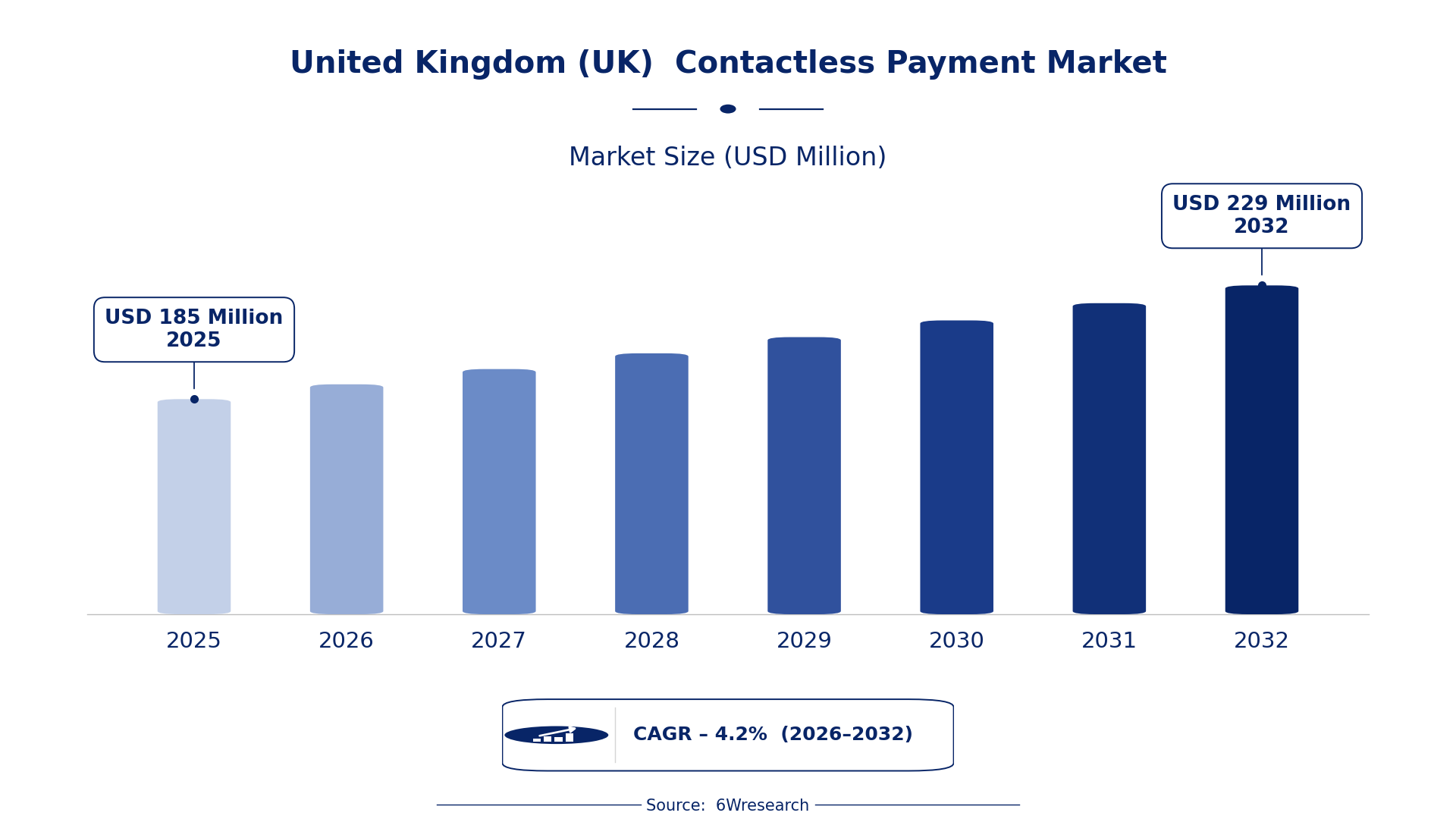
The United Kingdom (UK) Contactless Payment Market was estimated at USD 185 Million in 2025 and is projected to reach USD 229 Million by 2032, growing at a CAGR of 4.2% from 2026 to 2032.
United Kingdom (UK) Contactless Payment Market Synopsis
The United Kingdom's contactless payment market has seen remarkable momentum in recent years, fueled by the increasing preference for quick and hygienic payment methods. As technology evolves and consumer behavior shifts, this market is set to transform further, driven by innovation and the demand for seamless transactions.
Looking ahead, the integration of advanced technologies will play a critical role in shaping the future of contactless payments in the UK. With a focus on enhancing security and expanding infrastructure, the landscape promises to evolve, catering to both consumer needs and merchant capabilities.
United Kingdom (UK) Contactless Payment Market Year-wise Growth Rate and Key Drivers
This graph illustrates the annual growth rates of the United Kingdom (UK) Contactless Payment Market from 2021 to 2032, highlighting a steady upward trajectory and projected expansion over the forecast period.
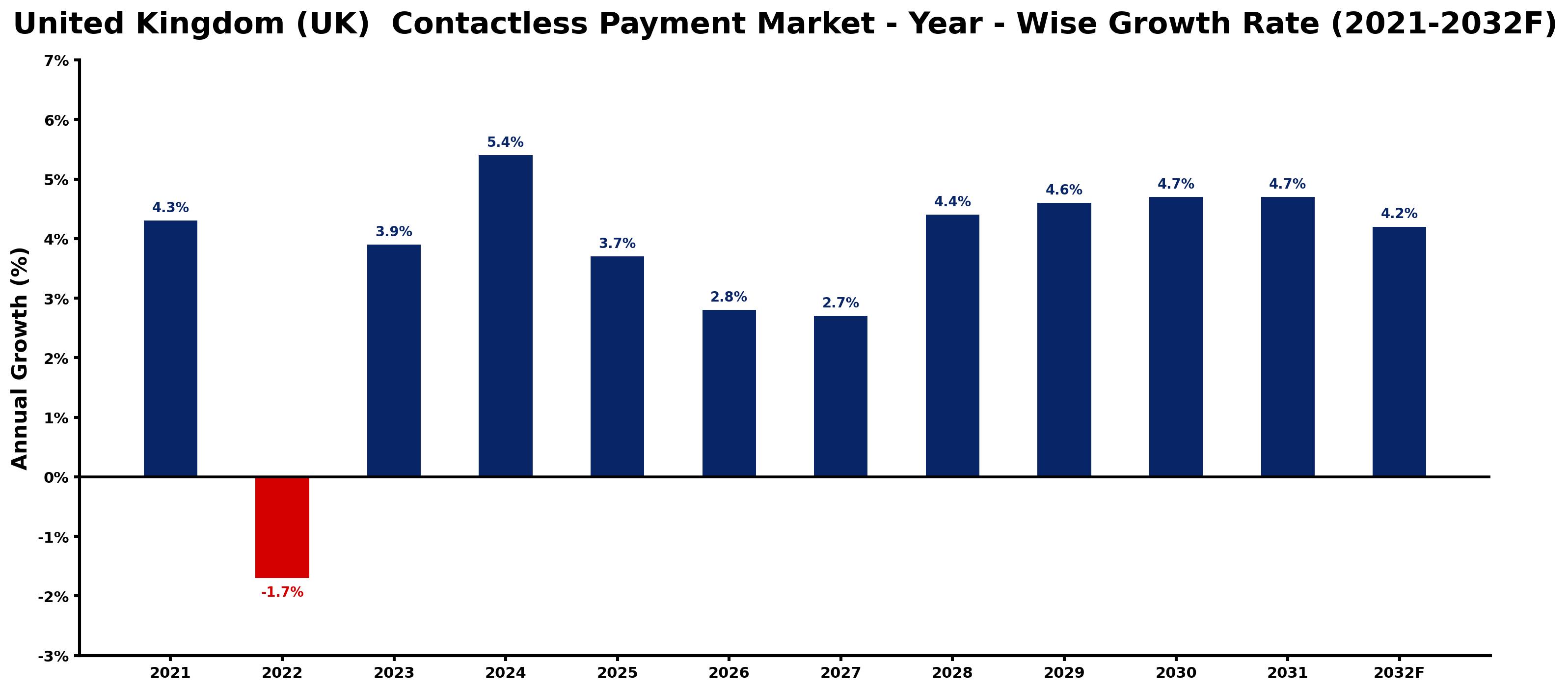
The table below presents the year‑wise growth rates along with the key drivers influencing the market
| Year | Growth Rate | Major Drivers |
| 2021 | 4.3% | Increase in adoption of mobile payment apps. |
| 2022 | -1.7% | Bank of England hike raised borrowing costs significantly. |
| 2023 | 3.9% | Rise in consumer preference for convenience and safety. |
| 2024 | 5.4% | Introduction of regulations supporting contactless transactions. |
| 2025 | 3.7% | Financial institutions promoting contactless card usage. |
| 2026 | 2.8% | E-commerce growth boosting online contactless transactions. |
| 2027 | 2.7% | Shift towards cashless societies in urban areas. |
| 2028 | 4.4% | Increased merchant acceptance of contactless payments. |
| 2029 | 4.6% | Enhanced security features for digital transactions. |
| 2030 | 4.7% | Government initiatives promoting digital financial services. |
| 2031 | 4.7% | Rise of smartphone payment integration with retail. |
| 2032 | 4.2% | Growing consumer trust in contactless payment security. |
Note: Market size estimations and growth projections presented in this report are based on 6Wresearch's proprietary forecasting methodology, utilizing the latest available industry data, government publications, and primary research inputs.
United Kingdom (UK) Contactless Payment Market Key Takeaways
Below are some of the specific key takeaways from the market, including:
- Contactless payment methods are rapidly gaining acceptance across various sectors, particularly retail and transportation.
- Technological advancements in NFC and mobile wallets enhance consumer convenience and security.
- Regulatory initiatives are pushing for cashless transactions, promoting broader adoption of contactless payments.
- Ongoing concerns about data security continue to shape consumer trust and market dynamics.
- Investment in payment infrastructure is crucial for accommodating growing transaction volumes.
Evaluation of Restraints in United Kingdom (UK) Contactless Payment Market
Despite its growth, the UK contactless payment market faces significant challenges. Security vulnerabilities remain a top concern for both consumers and businesses. Incidents of data breaches and fraudulent activities can erode trust, making it essential for companies to adopt stringent security measures. on top of that, interoperability issues between different payment systems can complicate the user experience, hindering broader acceptance. Infrastructure investments are necessary to support the increasing volume of contactless transactions, yet they require significant financial commitment from stakeholders.
United Kingdom (UK) Contactless Payment Market Trends
Several trends are emerging in the UK contactless payment market that will influence future demand. The rise of mobile wallets, coupled with advancements in NFC technology, is redefining how consumers interact with payment systems. Contactless transactions are increasingly being integrated with loyalty programs, enhancing the overall customer experience. Additionally, the push for sustainability is encouraging businesses to adopt digital payment solutions that reduce the reliance on cash and paper-based transactions.
United Kingdom (UK) Contactless Payment Market Opportunities
Opportunities for growth in the UK contactless payment market are abundant. The ongoing shift towards cashless transactions opens doors for innovative payment solutions that cater to various consumer preferences. As businesses seek to enhance operational efficiency, investments in contactless payment technology can yield significant returns. on top of that, partnerships between fintech companies and traditional financial institutions can accelerate the development of secure and user-friendly payment platforms.
Government Initiatives in the United Kingdom (UK) Contactless Payment Market
Government initiatives play a crucial role in shaping the United Kingdom's contactless payment market. A regulatory framework focused on enhancing payment security standards and consumer protection is essential in fostering trust and encouraging adoption. With an emphasis on promoting cashless transactions, these policies are designed to support the ongoing evolution of the payment ecosystem.
- A regulatory framework introduced in 2025 mandating enhanced security protocols for digital transactions.
- A national digital infrastructure upgrade programme currently underway to improve payment processing capabilities.
- Initiatives promoting financial literacy among consumers to enhance awareness of digital payment solutions.
- A planned public-private partnership expected to expand contactless payment acceptance in rural areas by 2028.
Future Insights of the United Kingdom (UK) Contactless Payment Market
From 2026 to 2032, the UK contactless payment market is expected to continue its upward trajectory, driven by technological innovations and shifting consumer preferences. The integration of AI and machine learning will likely enhance transaction security and streamline processes. As more merchants adopt contactless systems, the demand for efficient payment solutions will only grow, paving the way for a more interconnected payment environment.
United Kingdom (UK) Contactless Payment Market Latest Developments
Recent months have seen a flurry of activity in the UK contactless payment market, reflecting the industry's commitment to innovation and customer satisfaction. Companies are increasingly focused on enhancing the user experience and ensuring security across platforms.
- A major technology vendor launched a new mobile wallet feature in early 2025 that integrates loyalty rewards with contactless payments.
- An initiative that began in mid-2025 and remains underway is aimed at expanding contactless payment acceptance among small and medium-sized enterprises.
- A partnership between a regional bank and a fintech company was announced in Q3 2025 to develop a secure contactless payment solution tailored for online shopping.
- A rollout expected to begin in the second half of 2026 focuses on upgrading existing payment terminals to support enhanced contactless capabilities.
United Kingdom (UK) Contactless Payment Market - Key Attractiveness of the Report
- 10 Years of Market Numbers
- Historical Data Starting from 2022 to 2025
- Base Year: 2025
- Forecast Data until 2032
- Key Performance Indicators Impacting the Market
- Major Upcoming Developments and Projects
Key Highlights of the Report:
- United Kingdom (UK) Contactless Payment Market Outlook
- Market Size of United Kingdom (UK) Contactless Payment Market, 2025
- Forecast of United Kingdom (UK) Contactless Payment Market, 2032
- Historical Data and Forecast of United Kingdom (UK) Contactless Payment Revenues & Volume for the Period 2022-2032F
- United Kingdom (UK) Contactless Payment Market Trend Evolution
- United Kingdom (UK) Contactless Payment Market Drivers and Challenges
- United Kingdom (UK) Contactless Payment Price Trends
- United Kingdom (UK) Contactless Payment Porter's Five Forces
- United Kingdom (UK) Contactless Payment Industry Life Cycle
- Historical Data and Forecast of United Kingdom (UK) Contactless Payment Market Revenues & Volume By Component for the Period 2022-2032F
- Historical Data and Forecast of United Kingdom (UK) Contactless Payment Market Revenues & Volume By Hardware for the Period 2022-2032F
- Historical Data and Forecast of United Kingdom (UK) Contactless Payment Market Revenues & Volume By Solutions for the Period 2022-2032F
- Historical Data and Forecast of United Kingdom (UK) Contactless Payment Market Revenues & Volume By Services for the Period 2022-2032F
- Historical Data and Forecast of United Kingdom (UK) Contactless Payment Market Revenues & Volume By Vertical for the Period 2022-2032F
- Historical Data and Forecast of United Kingdom (UK) Contactless Payment Market Revenues & Volume By Retail for the Period 2022-2032F
- Historical Data and Forecast of United Kingdom (UK) Contactless Payment Market Revenues & Volume By Hospitality for the Period 2022-2032F
- Historical Data and Forecast of United Kingdom (UK) Contactless Payment Market Revenues & Volume By Healthcare for the Period 2022-2032F
- Historical Data and Forecast of United Kingdom (UK) Contactless Payment Market Revenues & Volume By Energy and Utilities for the Period 2022-2032F
- Historical Data and Forecast of United Kingdom (UK) Contactless Payment Market Revenues & Volume By Transportation and Logistics for the Period 2022-2032F
- Historical Data and Forecast of United Kingdom (UK) Contactless Payment Market Revenues & Volume By BFSI for the Period 2022-2032F
- Historical Data and Forecast of United Kingdom (UK) Contactless Payment Market Revenues & Volume By Others (Government, telecommunications, and education) for the Period 2022-2032F
- United Kingdom (UK) Contactless Payment Import Export Trade Statistics
- Market Opportunity Assessment By Component
- Market Opportunity Assessment By Vertical
- United Kingdom (UK) Contactless Payment Top Companies Market Share
- United Kingdom (UK) Contactless Payment Competitive Benchmarking By Technical and Operational Parameters
- United Kingdom (UK) Contactless Payment Company Profiles
- United Kingdom (UK) Contactless Payment Key Strategic Recommendations






































