Qatar Critical Infrastructure Protection Market Size & Growth Rate (2026-2032)
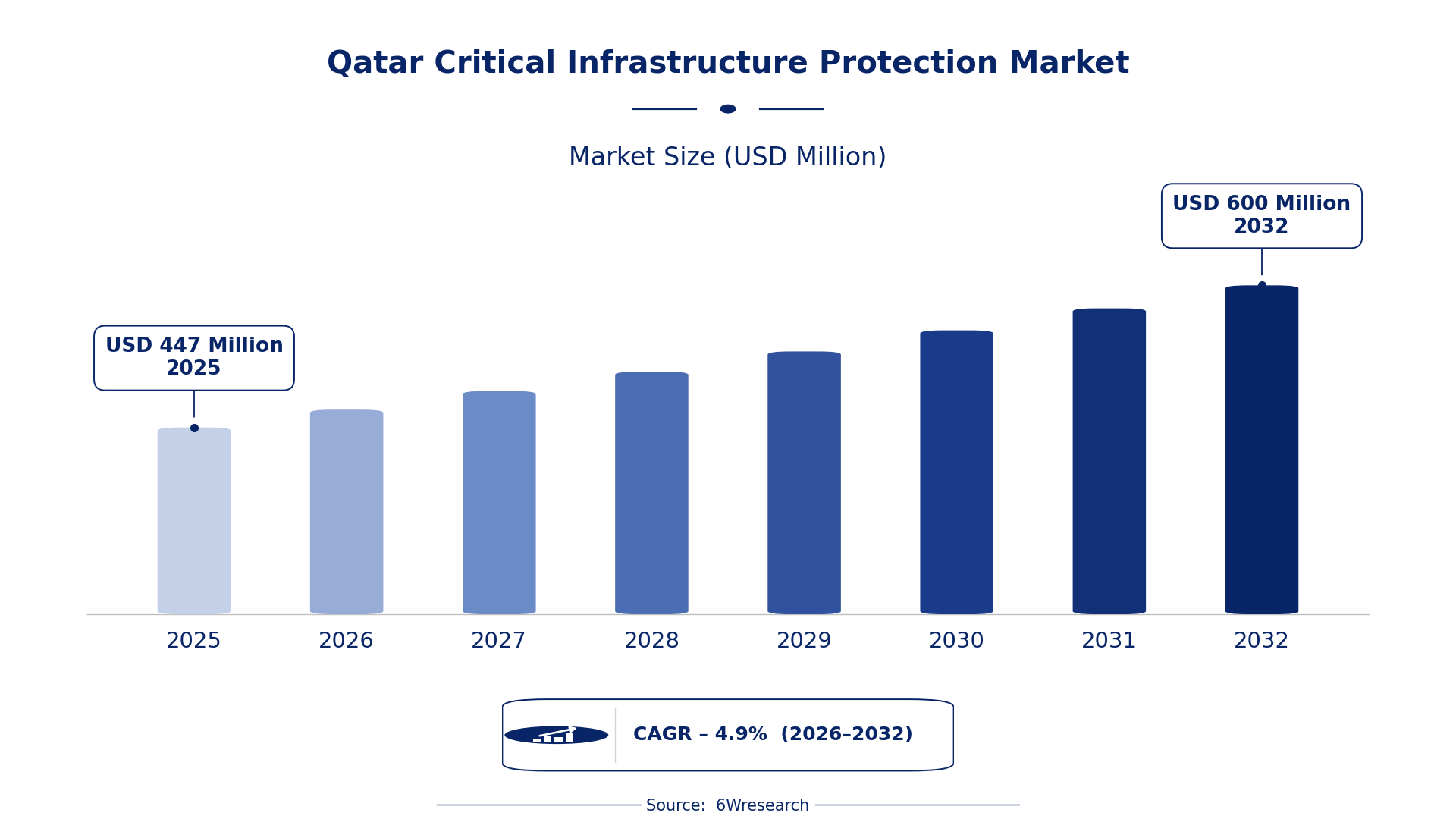
The Qatar Critical Infrastructure Protection Market was estimated at USD 447 Million in 2025 and is projected to reach USD 600 Million by 2032, growing at a CAGR of 4.9% from 2026 to 2032.
Qatar Critical Infrastructure Protection Market Synopsis
The critical infrastructure protection efforts in Qatar are gaining momentum as the nation prioritizes the safeguarding of its essential services. A notable concern for Qatar's security landscape is the increasing threat of cyber-attacks targeting vital sectors such as energy and transportation.
In response, substantial investments are being channeled into advanced security technologies, reflecting a clear commitment to enhancing both physical and cyber defenses. The integration of these security measures is not merely a trend; it is a necessity driven by the interconnected nature of modern infrastructure.
Qatar Critical Infrastructure Protection Market Year-wise Growth Rate and Key Drivers
This graph illustrates the annual growth rates of the Qatar Critical Infrastructure Protection Market from 2021 to 2032, highlighting a steady upward trajectory and projected expansion over the forecast period.
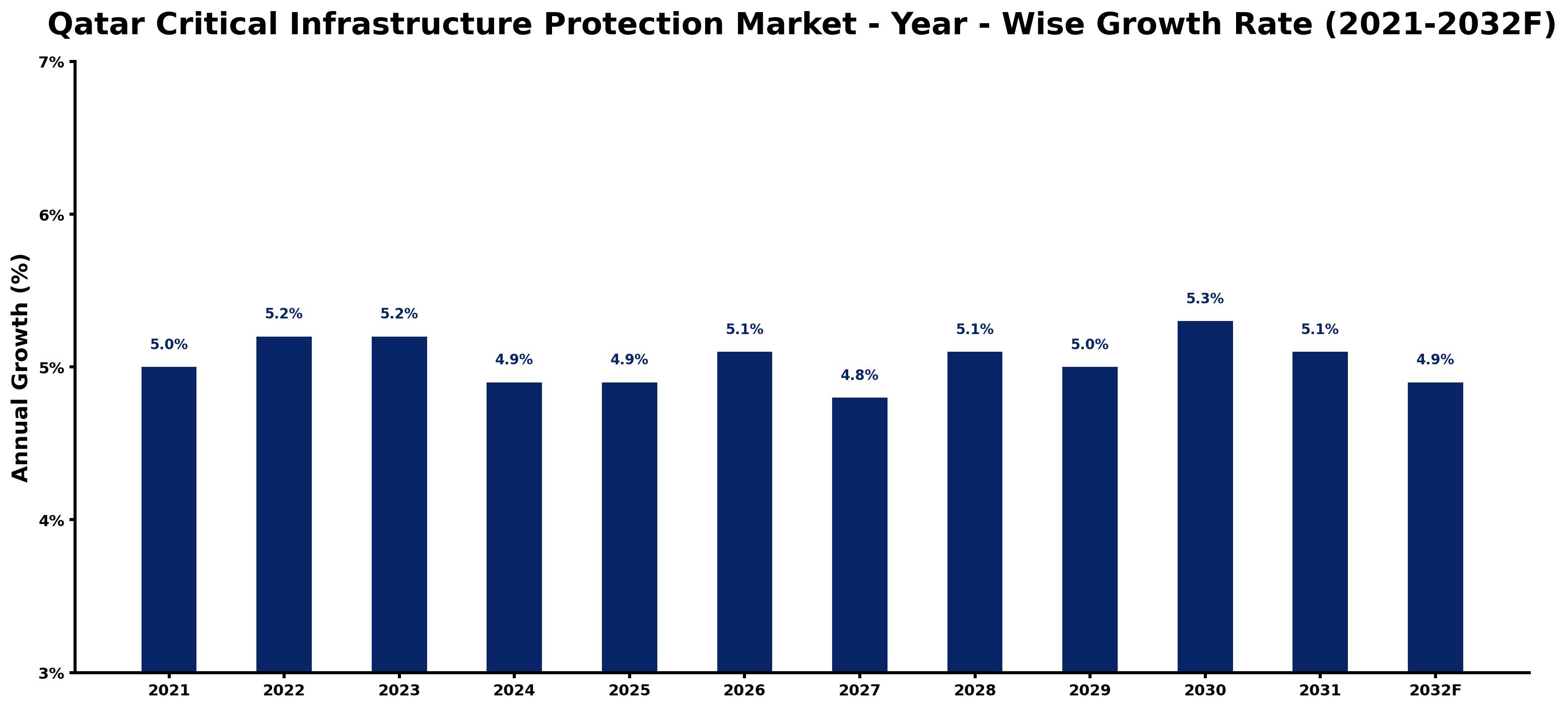
The table below presents the year‑wise growth rates along with the key drivers influencing the market
| Year | Growth Rate | Major Drivers |
| 2021 | 5.0% | Qatar National Vision 2030 enhances investment in safety. |
| 2022 | 5.2% | Increased cybersecurity threats prompt stronger regulatory measures. |
| 2023 | 5.2% | Hosting global events boosts demand for security systems. |
| 2024 | 4.9% | Growth in major construction projects requires enhanced protection. |
| 2025 | 4.9% | Government funding increases for public safety initiatives. |
| 2026 | 5.1% | New security technology adoption by local enterprises rises. |
| 2027 | 4.8% | Qatar's tourism sector growth drives infrastructure security needs. |
| 2028 | 5.1% | Joint military exercises elevate focus on critical asset protection. |
| 2029 | 5.0% | Rising geopolitical tensions necessitate stronger infrastructure defenses. |
| 2030 | 5.3% | Investment in smart city development increases infrastructure resilience. |
| 2031 | 5.1% | Enhanced public-private partnerships improve security response capabilities. |
| 2032 | 4.9% | Local demand for disaster recovery plans surges post-pandemic. |
Note: Market size estimations and growth projections presented in this report are based on 6Wresearch's proprietary forecasting methodology, utilizing the latest available industry data, government publications, and primary research inputs.
Qatar Critical Infrastructure Protection Market Key Takeaways
Below are some of the specific key takeaways from the market, including:
- The market is characterized by a growing recognition of the vulnerabilities in critical infrastructure sectors.
- Investment in risk assessment and incident response capabilities is becoming increasingly vital.
- Integration of physical and cybersecurity measures is essential for comprehensive protection.
- The emphasis on resilience within critical infrastructure sectors is driving ongoing developments.
- Collaboration among stakeholders is crucial for enhancing security capabilities.
Evaluation of Restraints in Qatar Critical Infrastructure Protection Market
The Qatar Critical Infrastructure Protection Market is encountering significant barriers, largely due to the escalating sophistication of cyber threats. Organizations struggle with the dual challenge of integrating cyber and physical security, which is essential for safeguarding their critical assets. The complex landscape of interdependent infrastructure components demands comprehensive risk assessments and effective incident response strategies, adding layers of difficulty in achieving optimal security. As Qatar develops its smart city initiatives, these challenges will only multiply, necessitating innovative solutions and strategic collaborations.
Qatar Critical Infrastructure Protection Market Trends
Several key trends are influencing the Qatar Critical Infrastructure Protection Market. There is an increasing shift towards integrated security systems that combine cyber and physical security measures. This trend is driven by the recognition that threats are no longer confined to one domain. Additionally, the rise of smart city projects in Qatar is pushing for advanced security solutions that can adapt to new technologies and connectivity requirements.
on top of that, businesses are actively seeking partnerships with technology providers to enhance their security capabilities. The demand for advanced threat intelligence and proactive incident management solutions is on the rise, pushing the market towards more holistic approaches in critical infrastructure protection.
Qatar Critical Infrastructure Protection Market Opportunities
Opportunities abound in the Qatar Critical Infrastructure Protection Market as organizations look to bolster their defenses. The growing investment in digital infrastructure upgrades presents avenues for security enhancements. Additionally, the ongoing focus on national security is likely to lead to new initiatives aimed at fortifying critical sectors against emerging threats.
Companies that provide advanced security technology solutions are well-positioned to capitalize on this trend. With the convergence of physical and cybersecurity measures becoming a priority, firms specializing in integrated solutions will find a receptive market eager for innovation.
Government Initiatives in the Qatar Critical Infrastructure Protection Market
The Qatari government is taking decisive action to enhance the security of its critical infrastructure, recognizing the necessity for comprehensive policies to address emerging threats. Public sector priorities are increasingly focused on the development of a regulatory framework that mandates collaboration between various stakeholders in the security domain. These initiatives are crucial for creating a resilient infrastructure capable of withstanding cyber and physical attacks.
- A national digital infrastructure upgrade programme launched in early 2025 is aimed at enhancing cybersecurity measures across sectors.
- Ongoing collaboration efforts with international cybersecurity agencies to strengthen knowledge sharing and threat intelligence.
- A planned public-private partnership initiative expected to improve incident response capabilities by 2026.
- Implementation of a regulatory framework in 2025 that requires regular cybersecurity audits for critical infrastructure operators.
Future Insights of the Qatar Critical Infrastructure Protection Market
Looking ahead to 2026-2032, the Qatar Critical Infrastructure Protection Market is on a path of steady growth. The increasing interdependence of various infrastructure sectors mandates an integrated approach to security solutions. As the threats evolve, the market will likely see advancements in artificial intelligence and machine learning technologies applied to threat detection and response.
Investment in training and education for personnel responsible for cybersecurity will also become paramount. In this evolving environment, the emphasis on resilience and adaptability will define the success of Qatar's critical infrastructure protection initiatives.
Qatar Critical Infrastructure Protection Market Latest Developments
In the past year, the Qatar Critical Infrastructure Protection Market has seen heightened activity, reflecting the urgency for enhanced security measures. The shift towards integrated solutions has driven a number of partnerships and initiatives aimed at fortifying the infrastructure landscape against cyber threats.
- A major technology vendor announced a collaboration in early 2025 to develop an integrated security platform for critical infrastructure.
- A pilot programme began in mid-2025 focusing on cybersecurity training for personnel managing critical assets, which remains ongoing.
- A regulatory update is anticipated in late 2026 to expand compliance requirements for security measures in the energy sector.
- Research initiatives to assess emerging threats and vulnerabilities were launched by the government in Q3 2025 and are currently underway.
Qatar Critical Infrastructure Protection Market - Key Attractiveness of the Report
- 10 Years of Market Numbers
- Historical Data Starting from 2022 to 2025
- Base Year: 2025
- Forecast Data until 2032
- Key Performance Indicators Impacting the Market
- Major Upcoming Developments and Projects
Key Highlights of the Report:
- Qatar Critical Infrastructure Protection Market Outlook
- Market Size of Qatar Critical Infrastructure Protection Market, 2025
- Forecast of Qatar Critical Infrastructure Protection Market, 2032
- Historical Data and Forecast of Qatar Critical Infrastructure Protection Revenues & Volume for the Period 2022-2032F
- Qatar Critical Infrastructure Protection Market Trend Evolution
- Qatar Critical Infrastructure Protection Market Drivers and Challenges
- Qatar Critical Infrastructure Protection Price Trends
- Qatar Critical Infrastructure Protection Porter's Five Forces
- Qatar Critical Infrastructure Protection Industry Life Cycle
- Historical Data and Forecast of Qatar Critical Infrastructure Protection Market Revenues & Volume By Solution for the Period 2022-2032F
- Historical Data and Forecast of Qatar Critical Infrastructure Protection Market Revenues & Volume By Physical Safety for the Period 2022-2032F
- Historical Data and Forecast of Qatar Critical Infrastructure Protection Market Revenues & Volume By Security Video Surveillance Systems for the Period 2022-2032F
- Historical Data and Forecast of Qatar Critical Infrastructure Protection Market Revenues & Volume By Screening for the Period 2022-2032F
- Historical Data and Forecast of Qatar Critical Infrastructure Protection Market Revenues & Volume By Scanning for the Period 2022-2032F
- Historical Data and Forecast of Qatar Critical Infrastructure Protection Market Revenues & Volume By Cybersecurity for the Period 2022-2032F
- Historical Data and Forecast of Qatar Critical Infrastructure Protection Market Revenues & Volume By Encryption for the Period 2022-2032F
- Historical Data and Forecast of Qatar Critical Infrastructure Protection Market Revenues & Volume By Threat Intelligence for the Period 2022-2032F
- Historical Data and Forecast of Qatar Critical Infrastructure Protection Market Revenues & Volume By Component for the Period 2022-2032F
- Historical Data and Forecast of Qatar Critical Infrastructure Protection Market Revenues & Volume By Solution for the Period 2022-2032F
- Historical Data and Forecast of Qatar Critical Infrastructure Protection Market Revenues & Volume By Services for the Period 2022-2032F
- Historical Data and Forecast of Qatar Critical Infrastructure Protection Market Revenues & Volume By Vertical for the Period 2022-2032F
- Historical Data and Forecast of Qatar Critical Infrastructure Protection Market Revenues & Volume By Financial Institutions for the Period 2022-2032F
- Historical Data and Forecast of Qatar Critical Infrastructure Protection Market Revenues & Volume By Government for the Period 2022-2032F
- Historical Data and Forecast of Qatar Critical Infrastructure Protection Market Revenues & Volume By Defense for the Period 2022-2032F
- Historical Data and Forecast of Qatar Critical Infrastructure Protection Market Revenues & Volume By Transport and Logistics for the Period 2022-2032F
- Historical Data and Forecast of Qatar Critical Infrastructure Protection Market Revenues & Volume By Energy and Power for the Period 2022-2032F
- Historical Data and Forecast of Qatar Critical Infrastructure Protection Market Revenues & Volume By Commercial Sector for the Period 2022-2032F
- Historical Data and Forecast of Qatar Critical Infrastructure Protection Market Revenues & Volume By Telecom for the Period 2022-2032F
- Historical Data and Forecast of Qatar Critical Infrastructure Protection Market Revenues & Volume By Chemicals and Manufacturing for the Period 2022-2032F
- Qatar Critical Infrastructure Protection Import Export Trade Statistics
- Market Opportunity Assessment By Solution
- Market Opportunity Assessment By Cybersecurity
- Market Opportunity Assessment By Component
- Market Opportunity Assessment By Vertical
- Qatar Critical Infrastructure Protection Top Companies Market Share
- Qatar Critical Infrastructure Protection Competitive Benchmarking By Technical and Operational Parameters
- Qatar Critical Infrastructure Protection Company Profiles
- Qatar Critical Infrastructure Protection Key Strategic Recommendations






































