Qatar Curtains and Blinds Market Summary
The qatar curtains and blinds market was estimated at USD 1350 Million in 2025 and is projected to reach USD 2511 Million by 2032, growing at a CAGR of 10.7% from 2026 to 2032.
Qatar Curtains and Blinds Market Year-wise Growth Rate and Key Drivers
This graph highlights how the Qatar Curtains and Blinds Market has steadily grown over the past five years, supported by major growth factors.
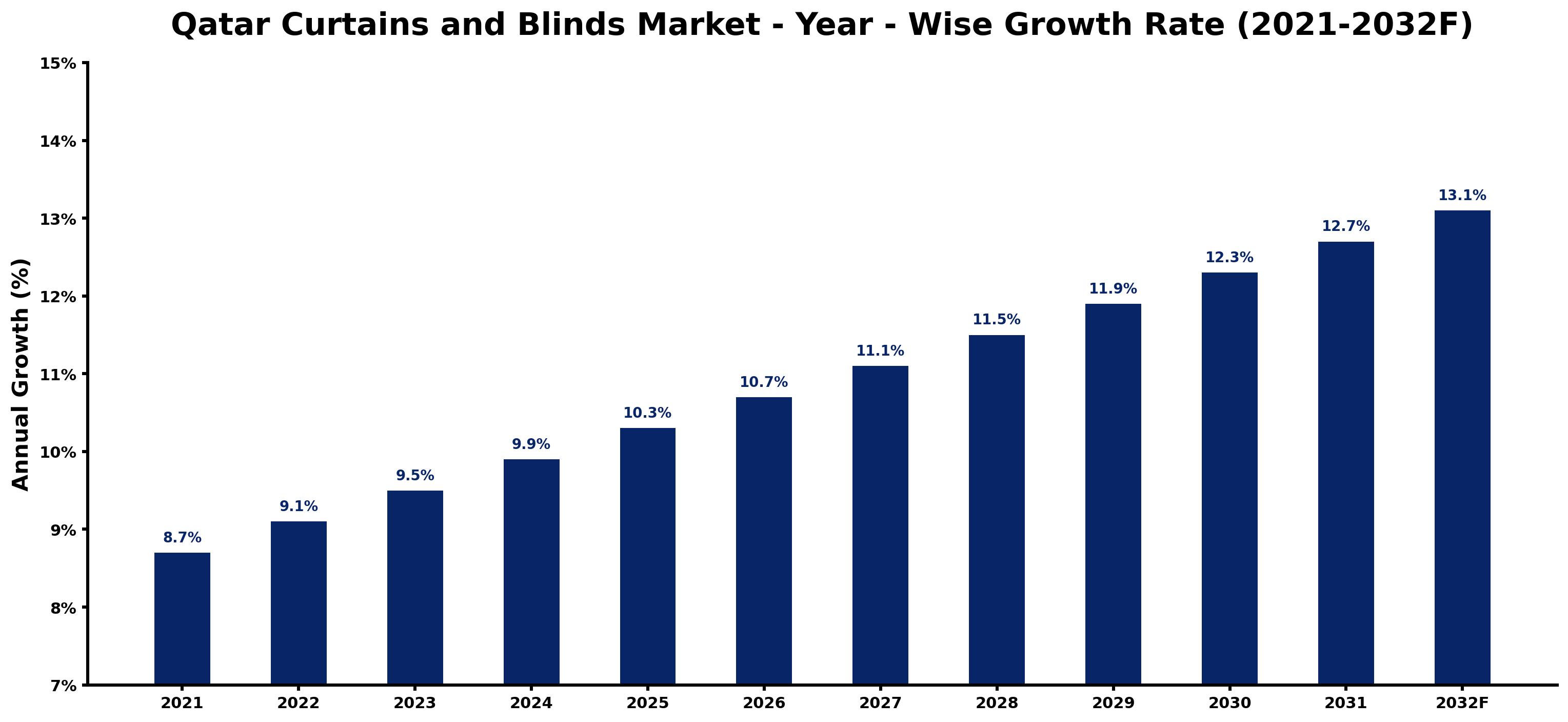
The table below presents the year wise growth rates along with the key drivers influencing the market
| Year | Growth Rate | Major Drivers |
| 2021 | 8.7% | Market recovery post-COVID-19 initiated renewed interest in home improvement projects. |
| 2022 | 9.1% | Rising disposable income led to increased consumer spending on interior decor options. |
| 2023 | 9.5% | Ongoing construction projects, including luxury developments, stimulated demand for high-quality curtains. |
| 2024 | 9.9% | Sustainability trends encourage eco-friendly materials in curtains and blinds manufacturing. |
| 2025 | 10.3% | Increased urbanization in Doha drives the need for residential window treatment solutions. |
| 2026 | 10.7% | Technological advancements enable smart home integration, influencing consumer choices significantly. |
| 2027 | 11.1% | A cultural shift towards personalized interior design creates diverse market opportunities. |
| 2028 | 11.5% | Growing expatriate population demands varied styles and functionalities in window coverings. |
| 2029 | 11.9% | High-profile international events boost tourism, stimulating hospitality sector upgrades and requirements. |
| 2030 | 12.3% | Investment in smart city initiatives enhances the integration of automated window solutions. |
| 2031 | 12.7% | Emergence of local manufacturers reduces reliance on imports, improving market dynamics. |
| 2032 | 13.1% | Increased awareness of UV protection drives growth in specialized blinds offerings. |
Note - Market size estimations and growth projections presented in this report are based on 6Wresearch's advanced forecasting approach, validated with industry datasets as of June 2026.
Qatar Curtains and Blinds Market Synopsis
The Qatar Curtains and Blinds Market is projected to reach 10.7% and witness significant growth during the forecast period (2026-2032). This growth can be attributed to a surge in both commercial and residential construction activities, driven by an increasing demand for luxury furnishings and décor. Changing lifestyles influenced by Western culture and rising disposable incomes contribute to a robust market environment for curtains and blinds, catering to both homes and office spaces.
Qatar Curtains and Blinds Market Growth Drivers
Several key factors are propelling the growth of the Qatar curtains and blinds market:
- The influx of expatriates and an increase in local populations have escalated the demand for residential properties, which often prioritize high-quality furnishings.
- With urbanization rates on the rise, there is a notable shift in consumer preferences towards luxury and customized interior decorations, including curtains and blinds.
- The tourism sector is expanding, prompting hospitality businesses to invest in premium furnishings, significantly enhancing the demand for curtains and blinds.
- Government initiatives aimed at infrastructure development are further stimulating the market, with new residential complexes and hotels emerging to accommodate growing populations.
- Innovation in materials and designs for curtains and blinds, including energy-efficient options, is attracting environmentally conscious consumers and contributing to market growth.
Qatar Curtains and Blinds Market Challenges and Restraints
Despite the promising outlook for the Qatar curtains and blinds market, several challenges exist that may restrain growth:
- The high cost of premium curtains and blinds may deter price-sensitive consumers, who might opt for lower-quality alternatives available in local markets.
- Competition from substitute products, such as synthetic shutters and window shades, creates downward pressure on pricing and profit margins for manufacturers.
- The economic aftermath of the COVID-19 pandemic has led to consumer prioritization of essential goods over decorative items, impacting sales in the short term.
- Supply chain disruptions and logistical challenges may further complicate the access to quality materials required for high-end curtain and blind production.
- Market entry barriers remain for new businesses, particularly in the absence of robust local manufacturing capabilities and established distribution channels.
Qatar Curtains and Blinds Market Government Investment and Initiatives
The government of Qatar has enacted several initiatives that positively impact the curtains and blinds market:
- Investment in infrastructure projects, including residential and commercial developments, is a key driver for demand in the curtains and blinds sector.
- Plans for enhancing urban living standards through improved housing options coincide with an increasing requirement for interior design elements, including curtains and blinds.
- The promotion of tourism through initiatives that improve hospitality services leads to increased demand for premium furnishings in hotels and resorts.
- Public spending on national projects indirectly supports the curtains and blinds market by creating additional employment and income opportunities, boosting overall consumer spending.
- Regulatory frameworks aimed at enhancing quality standards and promoting local manufacturing can support sustainable growth in the curtains and blinds market.
Qatar Curtains and Blinds Market Latest Developments (May 2025 - June 2026)
The period between May 2025 and June 2026 has witnessed notable developments in the Qatar curtains and blinds market:
- Manufacturers have been increasingly focusing on sustainability, introducing eco-friendly materials and designs to meet consumer demand for environmentally responsible products.
- Technological advancements in production processes have emerged, allowing for enhanced customization options that cater to individual client needs and preferences.
- Market participants are exploring digital marketing strategies to reach a wider audience, emphasizing the convenience of online sales during ongoing economic recovery.
- Collaborations with interior designers and architects have become more prevalent, aiding in the promotion and integration of curtains and blinds in new residential and commercial projects.
- The influence of international design trends continues to shape local markets, with Qatari consumers increasingly seeking out innovative styles and functionalities in their interior decor.
Qatar Curtains and Blinds Market - Key Attractiveness of the Report
- 10 Years of Market Numbers
- Historical Data Starting from 2022 to 2025
- Base Year: 2025
- Forecast Data until 2032
- Key Performance Indicators Impacting the Market
- Major Upcoming Developments and Projects
Key Highlights of the Report:
- Qatar Curtains and Blinds Market Outlook
- Market Size of Qatar Curtains and Blinds Market, 2025
- Forecast of Qatar Curtains and Blinds Market, 2032
- Historical Data and Forecast of Qatar Curtains and Blinds Revenues & Volume for the Period 2022-2032F
- Qatar Curtains and Blinds Market Trend Evolution
- Qatar Curtains and Blinds Market Drivers and Challenges
- Qatar Curtains and Blinds Price Trends
- Qatar Curtains and Blinds Porter's Five Forces
- Qatar Curtains and Blinds Industry Life Cycle
- Historical Data and Forecast of Qatar Curtains and Blinds Market Revenues & Volume By Types for the Period 2022-2032F
- Historical Data and Forecast of Qatar Curtains and Blinds Market Revenues & Volume By Curtain for the Period 2022-2032F
- Historical Data and Forecast of Qatar Curtains and Blinds Market Revenues & Volume By Blinds for the Period 2022-2032F
- Historical Data and Forecast of Qatar Curtains and Blinds Market Revenues & Volume By Application for the Period 2022-2032F
- Historical Data and Forecast of Qatar Curtains and Blinds Market Revenues & Volume By Traditional for the Period 2022-2032F
- Historical Data and Forecast of Qatar Curtains and Blinds Market Revenues & Volume By Motorised for the Period 2022-2032F
- Qatar Curtains and Blinds Import Export Trade Statistics
- Market Opportunity Assessment By Types
- Market Opportunity Assessment By Application
- Qatar Curtains and Blinds Top Companies Market Share
- Qatar Curtains and Blinds Competitive Benchmarking By Technical and Operational Parameters
- Qatar Curtains and Blinds Company Profiles
- Qatar Curtains and Blinds Key Strategic Recommendations






































