Qatar Cutting Equipment Market Size, Share & Growth Rate
The Qatar Cutting Equipment Market was estimated at USD 441 Million in 2025 and is projected to reach USD 588 Million by 2032, growing at a CAGR of 4.2% from 2026 to 2032. This upward trajectory is largely attributed to the burgeoning construction and manufacturing sectors, which are investing heavily in advanced cutting technologies. The demand for precision and efficiency in metal cutting is prompting local industries to upgrade their equipment, further driving market growth.
Qatar Cutting Equipment Market Year-wise Growth Rate and Key Drivers
This graph highlights how the Qatar Cutting Equipment Market has steadily grown over the years, supported by major growth factors.
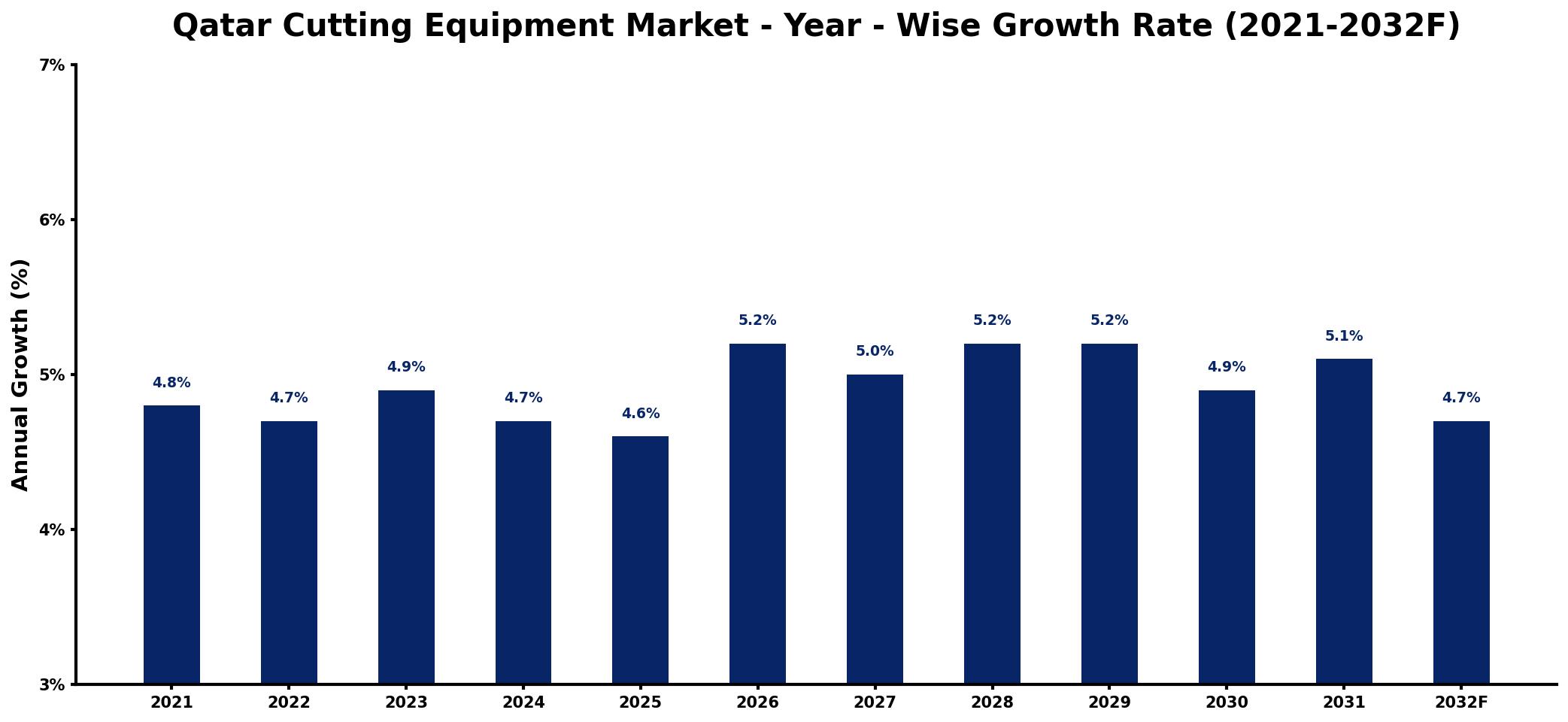
The table below presents the year‑wise growth rates along with the key drivers influencing the market
| Year | Growth Rate | Major Drivers |
| 2021 | 4.8% | Rising construction project investments |
| 2022 | 4.7% | Increased manufacturing sector output |
| 2023 | 4.9% | Growing demand for precision tools |
| 2024 | 4.7% | Expansion in renewable energy projects |
| 2025 | 4.6% | Surge in automotive industry needs |
| 2026 | 5.2% | Technological advancements in production |
| 2027 | 5.0% | Boost in infrastructure development plans |
| 2028 | 5.2% | growing regional consumption patterns |
| 2029 | 5.2% | Increased focus on safety regulations |
| 2030 | 4.9% | Rising popularity of DIY projects |
| 2031 | 5.1% | Growing trend of automation integration |
| 2032 | 4.7% | Increased demand for eco-friendly solutions |
Note: Market size estimations and growth projections presented in this report are based on 6Wresearch's proprietary forecasting methodology, utilizing the latest available industry data, government publications, and primary research inputs.
Qatar Cutting Equipment Market Synopsis
Recent developments in Qatar's construction and manufacturing sectors have unveiled a burgeoning demand for cutting equipment, highlighting the crucial role this technology plays in industrial operations. With a focus on efficiency, industries are increasingly adopting advanced solutions such as laser cutters, plasma cutters, and waterjet cutters to enhance their production capabilities.
Moreover, the integration of automation and smart technology in manufacturing processes is reshaping the landscape of the cutting equipment market. As companies seek to optimize operations while adhering to sustainability guidelines, investments in eco-friendly cutting solutions are becoming the norm, reflecting a commitment to both quality and environmental responsibility.
Qatar Cutting Equipment Market Key Takeaways
- The market is experiencing robust growth fueled by the expanding construction and manufacturing sectors.
- Technological advancements in cutting equipment are driving demand, particularly for automation and smart features.
- Environmentally sustainable practices are influencing equipment design and selection, promoting energy-efficient options.
- Local manufacturers are innovating to meet evolving market needs, enhancing their competitive edge.
- Qatar's strategic diversification efforts are creating new opportunities for cutting equipment applications across industries.
Evaluation of Restraints in Qatar Cutting Equipment Market
Despite the promising growth trajectory of the cutting equipment market in Qatar, several restraints can hinder its full potential. One of the primary challenges is the limited availability of skilled technicians for the maintenance and repair of advanced cutting equipment. As technology evolves, the skills required to operate and service these machines become increasingly specialized. Furthermore, economic fluctuations can adversely affect construction activities, leading to fluctuations in equipment demand. Establishing a robust after-sales service network and diversifying product offerings will be essential strategies to mitigate these challenges and ensure sustained market growth.
Qatar Cutting Equipment Market Trends
The Qatar Cutting Equipment Market is currently witnessing several key trends that are shaping its future. One prominent trend is the increasing focus on automation and Industry 4.0, which is driving manufacturers to integrate smart technologies into their cutting solutions. These technologies enhance precision and reduce waste, aligning with the country's sustainability goals. Additionally, there is a growing preference for versatile cutting equipment capable of handling various materials, including metals and composites, further broadening application fields.
Qatar Cutting Equipment Market Opportunities
Opportunities for growth within the Qatar Cutting Equipment Market are abundant, particularly in sectors driven by Qatar's ambitious infrastructure projects. As the government continues to invest in large-scale construction initiatives, the demand for cutting-edge equipment will likely increase. Furthermore, the push for energy-efficient solutions presents an avenue for manufacturers to innovate and expand their product lines. Investing in training programs to enhance the skill set of technicians will also create a more competent workforce, facilitating the deployment of advanced cutting technologies.
Government Initiatives in the Qatar Cutting Equipment Market
The Qatari government is actively promoting initiatives to enhance industrial growth, which directly impacts the cutting equipment market. Policies aimed at diversifying the economy encourage investments in technology and infrastructure, thereby creating a conducive environment for the expansion of cutting equipment applications. Additionally, public spending on infrastructure projects supports a robust demand for cutting technologies, reinforcing the connection between government initiatives and market growth.
Future Insights of the Qatar Cutting Equipment Market
Looking ahead to 2026-2032, the Qatar Cutting Equipment Market is expected to continue its upward trajectory, driven by technological advancements and increasing industrial activities. With the governments commitment to infrastructure development and sustainability, there will be significant opportunities for cutting equipment providers to offer innovative solutions. As industries increasingly adopt automated and eco-friendly technologies, the market will likely see a shift towards more sophisticated equipment that aligns with the evolving needs of the manufacturing and construction sectors.
Qatar Cutting Equipment Market Latest Developments (2025 - 2026)
In recent months, the cutting equipment market in Qatar has experienced a wave of innovation, with companies launching new products featuring advanced automation capabilities. Additionally, partnerships between local manufacturers and technology providers are on the rise, aimed at enhancing product offerings and expanding market reach. As the construction industry rebounds post-pandemic, there is a renewed focus on high-efficiency cutting solutions to meet the demands of upcoming infrastructure projects.
Qatar Cutting Equipment Market - Key Attractiveness of the Report
- 10 Years of Market Numbers
- Historical Data Starting from 2022 to 2025
- Base Year: 2025
- Forecast Data until 2032
- Key Performance Indicators Impacting the Market
- Major Upcoming Developments and Projects
Key Highlights of the Report:
- Qatar Cutting Equipment Market Outlook
- Market Size of Qatar Cutting Equipment Market, 2025
- Forecast of Qatar Cutting Equipment Market, 2032
- Historical Data and Forecast of Qatar Cutting Equipment Revenues & Volume for the Period 2022-2032F
- Qatar Cutting Equipment Market Trend Evolution
- Qatar Cutting Equipment Market Drivers and Challenges
- Qatar Cutting Equipment Price Trends
- Qatar Cutting Equipment Porter's Five Forces
- Qatar Cutting Equipment Industry Life Cycle
- Historical Data and Forecast of Qatar Cutting Equipment Market Revenues & Volume By Equipment Type for the Period 2022-2032F
- Historical Data and Forecast of Qatar Cutting Equipment Market Revenues & Volume By Manual for the Period 2022-2032F
- Historical Data and Forecast of Qatar Cutting Equipment Market Revenues & Volume By Mechanized for the Period 2022-2032F
- Historical Data and Forecast of Qatar Cutting Equipment Market Revenues & Volume By Cutting Technology for the Period 2022-2032F
- Historical Data and Forecast of Qatar Cutting Equipment Market Revenues & Volume By Plasma cutting for the Period 2022-2032F
- Historical Data and Forecast of Qatar Cutting Equipment Market Revenues & Volume By Oxy-fuel cutting for the Period 2022-2032F
- Historical Data and Forecast of Qatar Cutting Equipment Market Revenues & Volume By Laser cutting for the Period 2022-2032F
- Historical Data and Forecast of Qatar Cutting Equipment Market Revenues & Volume By Waterjet cutting for the Period 2022-2032F
- Historical Data and Forecast of Qatar Cutting Equipment Market Revenues & Volume By Carbon arc cutting for the Period 2022-2032F
- Historical Data and Forecast of Qatar Cutting Equipment Market Revenues & Volume By End Use Industry for the Period 2022-2032F
- Historical Data and Forecast of Qatar Cutting Equipment Market Revenues & Volume By Construction for the Period 2022-2032F
- Historical Data and Forecast of Qatar Cutting Equipment Market Revenues & Volume By Heavy metal fabrication for the Period 2022-2032F
- Historical Data and Forecast of Qatar Cutting Equipment Market Revenues & Volume By Shipbuilding & offshore for the Period 2022-2032F
- Historical Data and Forecast of Qatar Cutting Equipment Market Revenues & Volume By Automotive for the Period 2022-2032F
- Historical Data and Forecast of Qatar Cutting Equipment Market Revenues & Volume By Others for the Period 2022-2032F
- Historical Data and Forecast of Qatar Cutting Equipment Market Revenues & Volume By Type for the Period 2022-2032F
- Historical Data and Forecast of Qatar Cutting Equipment Market Revenues & Volume By Equipment for the Period 2022-2032F
- Historical Data and Forecast of Qatar Cutting Equipment Market Revenues & Volume By Consumables/Accessories for the Period 2022-2032F
- Qatar Cutting Equipment Import Export Trade Statistics
- Market Opportunity Assessment By Equipment Type
- Market Opportunity Assessment By Cutting Technology
- Market Opportunity Assessment By End Use Industry
- Market Opportunity Assessment By Type
- Qatar Cutting Equipment Top Companies Market Share
- Qatar Cutting Equipment Competitive Benchmarking By Technical and Operational Parameters
- Qatar Cutting Equipment Company Profiles
- Qatar Cutting Equipment Key Strategic Recommendations






































