Qatar Decorative Film Market Summary
The qatar decorative film market was estimated at USD 464 Million in 2025 and is projected to reach USD 633 Million by 2032, growing at a CAGR of 5.6% from 2026 to 2032.
Qatar Decorative Film Market Year-wise Growth Rate and Key Drivers
This graph highlights how the Qatar Decorative Film Market has steadily grown over the past five years, supported by major growth factors.
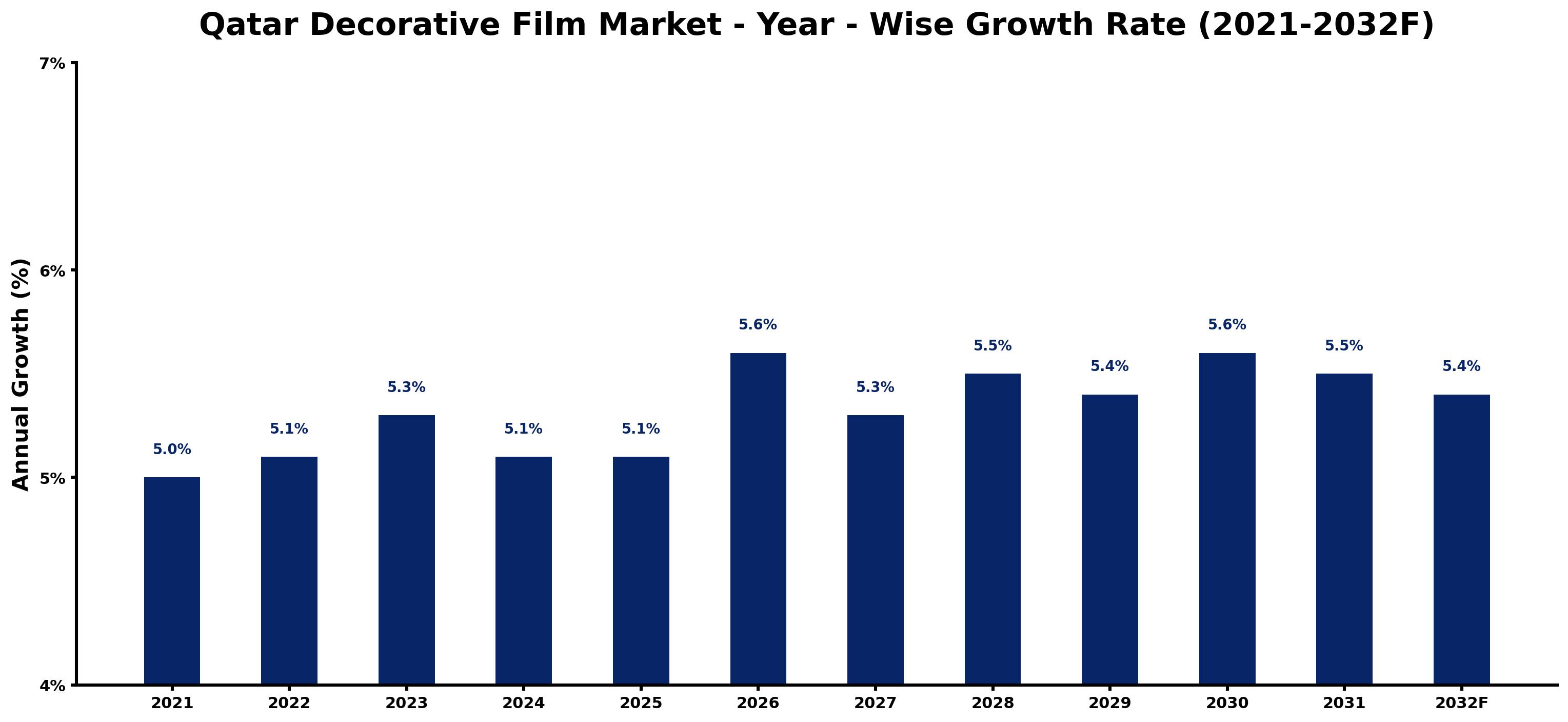
The table below presents the year wise growth rates along with the key drivers influencing the market
| Year | Growth Rate | Major Drivers |
| 2021 | 5.0% | Post-lockdown retail projects prompted a renewed focus on decorative aesthetics. |
| 2022 | 5.1% | Increased tourism activities enhanced the demand for attractive commercial spaces. |
| 2023 | 5.3% | Construction pipelines for luxury developments further stimulated decorative film applications. |
| 2024 | 5.1% | Energy efficiency concerns led to interest in reflective and UV-protective films. |
| 2025 | 5.1% | Localized manufacturing capabilities emerged, reducing costs and delivery times significantly. |
| 2026 | 5.6% | Architectural trends embraced innovative design, integrating decorative films into new builds. |
| 2027 | 5.3% | Growing awareness of sustainability influenced choices in eco-friendly decorative film options. |
| 2028 | 5.5% | Rising expatriate population created diverse preferences for interior design solutions. |
| 2029 | 5.4% | Collaborations between designers and decorative film manufacturers surged, boosting market visibility. |
| 2030 | 5.6% | Technological advancements in film materials improved durability and aesthetic appeal remarkably. |
| 2031 | 5.5% | Real estate investments in mixed-use developments reinforced the decorative film market's growth. |
| 2032 | 5.4% | Cultural festivals and events increased demand for temporary decorative installations significantly. |
Note - Market size estimations and growth projections presented in this report are based on 6Wresearch's advanced forecasting approach, validated with industry datasets as of June 2026.
Qatar Decorative Film Market Synopsis
The Qatar Decorative Film Market is projected to reach 5.6% and witness significant growth during the forecast period (2026-2032). This market is being fueled by increasing innovation in decorative film technologies and a rising demand for these films owing to their multitude of benefits, including protection from UV rays, safety against scratches, glare reduction, and temperature control. The upward trend in investments in the Qatar construction sector, spurred by government initiatives aimed at developing infrastructure, is expected to lead to greater utilization of decorative film products in various building and residential projects. Additionally, the growing inclination towards interior decoration featuring creative art designs further enhances the growth trajectory of this market.
Qatar Decorative Film Market Growth Drivers
The Qatar construction industry has experienced significant growth since 2018, primarily due to various government initiatives aimed at enhancing infrastructure across both public and private sectors. Consequently, this has led to an increased demand for decorative films in building projects, significantly boosting its market share over the forecast period. Key drivers influencing this market include:
- Growing investments in infrastructure development resulting from government spending initiatives aimed at modernizing urban environments.
- Changing lifestyle trends among the Qatari population, particularly among the middle class, who are increasingly allocating funds for home decor projects.
- An upsurge in the use of decorative films within residential areas, driven by an elevated interest in aesthetic enhancements.
- Innovation from manufacturers focusing on specialty films, including ultraviolet stable window tints for automotive applications and heat reflective films for commercial establishments.
- Increased awareness about the functional advantages of decorative films, which contribute to energy efficiency and improved indoor environments.
Qatar Decorative Film Market Challenges and Restraints
Despite its promising growth, the Qatar Decorative Film Market faces several challenges that could hinder its expansion. Key issues include:
- Rapidly changing consumer preferences and trends, which necessitate continuous innovation and updates in product offerings to remain competitive.
- The challenge of counterfeit or low-quality decorative films emerging within the market, which can undermine consumer trust and impact the market share of legitimate manufacturers.
- A saturation of decorative materials, such as paints and wallpapers, that compete with decorative films, requiring effective marketing strategies to highlight their benefits.
- Customer education on the significance of selecting high-quality decorative films over cheaper, inferior alternatives with lesser durability and aesthetic appeal.
- Economic fluctuations that may affect consumer spending on non-essential items such as decorative films, especially during economic downturns.
Qatar Decorative Film Market Government Investment and Initiatives
The Qatari government has made significant investments and implemented various initiatives to bolster the construction industry, which consequently impacts the decorative film market positively. Various development plans aimed at enhancing urban infrastructure have been outlined, focusing on sustainability and aesthetic improvements. Additionally, incentives such as tax rebates and subsidies for construction projects that utilize innovative materials, including decorative films, have been introduced. These government-led efforts serve to create a conducive environment for market growth by encouraging the adoption of modern decor solutions in both commercial and residential settings.
Qatar Decorative Film Market Latest Developments (May 2025 - June 2026)
In the period from May 2025 to June 2026, the Qatar Decorative Film Market has seen various developments that indicate an evolving landscape. As more people focus on home improvements during increased time spent at home, there has been a spike in interest for decorative films suitable for windows and glass surfaces. Manufacturers have also started to enhance their product portfolios by introducing more versatile designs and eco-friendly options to attract environmentally conscious consumers. The supply chain has experienced adjustments in response to global trade fluctuations, compelling companies to explore local sourcing strategies for raw materials, thereby ensuring timely product availability while maintaining quality standards.
Qatar Decorative Film Market - Key Attractiveness of the Report
- 10 Years of Market Numbers
- Historical Data Starting from 2022 to 2025
- Base Year: 2025
- Forecast Data until 2032
- Key Performance Indicators Impacting the Market
- Major Upcoming Developments and Projects
Key Highlights of the Report:
- Qatar Decorative Film Market Outlook
- Market Size of Qatar Decorative Film Market, 2025
- Forecast of Qatar Decorative Film Market, 2032
- Historical Data and Forecast of Qatar Decorative Film Revenues & Volume for the Period 2022-2032F
- Qatar Decorative Film Market Trend Evolution
- Qatar Decorative Film Market Drivers and Challenges
- Qatar Decorative Film Price Trends
- Qatar Decorative Film Porter's Five Forces
- Qatar Decorative Film Industry Life Cycle
- Historical Data and Forecast of Qatar Decorative Film Market Revenues & Volume By Product Type for the Period 2022-2032F
- Historical Data and Forecast of Qatar Decorative Film Market Revenues & Volume By Stained Window Film for the Period 2022-2032F
- Historical Data and Forecast of Qatar Decorative Film Market Revenues & Volume By Frosted Window Film for the Period 2022-2032F
- Historical Data and Forecast of Qatar Decorative Film Market Revenues & Volume By Applications for the Period 2022-2032F
- Historical Data and Forecast of Qatar Decorative Film Market Revenues & Volume By Residential for the Period 2022-2032F
- Historical Data and Forecast of Qatar Decorative Film Market Revenues & Volume By Commercial for the Period 2022-2032F
- Qatar Decorative Film Import Export Trade Statistics
- Market Opportunity Assessment By Product Type
- Market Opportunity Assessment By Applications
- Qatar Decorative Film Top Companies Market Share
- Qatar Decorative Film Competitive Benchmarking By Technical and Operational Parameters
- Qatar Decorative Film Company Profiles
- Qatar Decorative Film Key Strategic Recommendations






































