Qatar Dehydrated Culture Media Market Size, Share & Growth Rate
The Qatar Dehydrated Culture Media Market was estimated at USD 196 Million in 2025 and is projected to reach USD 270 Million by 2032, growing at a CAGR of 4.7% from 2026 to 2032. This growth trajectory is primarily driven by significant investments in healthcare and biotechnology, with Qatar focusing on improving its diagnostic and research capabilities. Furthermore, the rising demand for precise microbial testing across various sectors further strengthens the market landscape.
Qatar Dehydrated Culture Media Market Year-wise Growth Rate and Key Drivers
This graph highlights how the Qatar Dehydrated Culture Media Market has steadily grown over the years, supported by major growth factors.
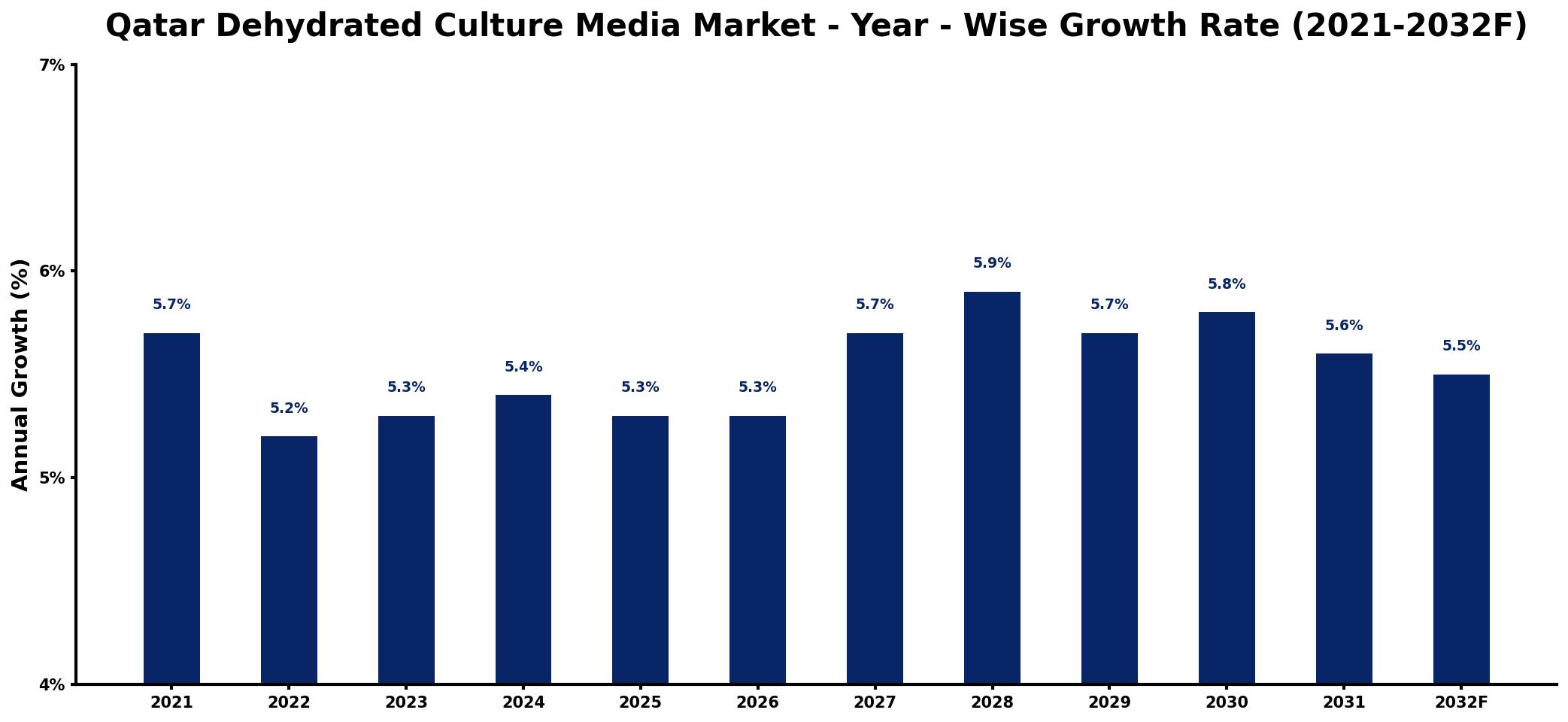
The table below presents the year‑wise growth rates along with the key drivers influencing the market
| Year | Growth Rate | Major Drivers |
| 2021 | 5.7% | rising investments in biotechnology |
| 2022 | 5.2% | increased demand from research labs |
| 2023 | 5.3% | expansion of pharmaceutical sector |
| 2024 | 5.4% | growth in food safety testing |
| 2025 | 5.3% | enhanced focus on clinical diagnostics |
| 2026 | 5.3% | surge in academic research funding |
| 2027 | 5.7% | development of innovative testing methods |
| 2028 | 5.9% | growing emphasis on quality control |
| 2029 | 5.7% | rising popularity of personalized medicine |
| 2030 | 5.8% | increased adoption of automation technologies |
| 2031 | 5.6% | stronger distribution network expansion |
| 2032 | 5.5% | growing investment in healthcare solutions |
Note: Market size estimations and growth projections presented in this report are based on 6Wresearch's proprietary forecasting methodology, utilizing the latest available industry data, government publications, and primary research inputs.
Qatar Dehydrated Culture Media Market Synopsis
The dehydrated culture media market in Qatar has recently gained substantial momentum, reflecting the nation's commitment to enhancing healthcare infrastructure and research capabilities. As the biotechnology sector expands, there is a corresponding increase in demand for reliable culture media, essential for microbiological diagnostics and pharmaceutical development.
Looking ahead, the market is poised for steady growth, influenced by continued advancements in manufacturing and quality assurance. This growth aligns with Qatar's vision for a robust healthcare system, prioritizing disease prevention and innovative research practices, ensuring that the demand for high-quality dehydrated culture media remains strong.
Qatar Dehydrated Culture Media Market Key Takeaways
- The market is experiencing growth fueled by investments in healthcare and biotechnology.
- Dehydrated culture media are critical for diagnostic and research applications.
- Quality control and consistency are vital to meeting market demands.
- The ongoing emphasis on disease prevention drives the need for accurate microbial testing.
- Recent market dynamics highlight a shift in focus toward advanced manufacturing techniques.
Evaluation of Restraints in Qatar Dehydrated Culture Media Market
While the Qatar dehydrated culture media market is on an upward trajectory, several key restraints present challenges to its growth. The region's hot and humid climate poses risks to the quality and stability of the products, making stringent quality control essential. Additionally, maintaining a reliable supply chain for raw materials is critical for manufacturers, as disruptions can impede production and distribution. Fluctuating economic conditions may also affect investments in healthcare and research initiatives, presenting further challenges that need to be navigated.
Qatar Dehydrated Culture Media Market Trends
Several trends are shaping the demand for dehydrated culture media in Qatar. The increasing focus on personalized medicine and rapid diagnostic technologies is driving innovation in microbial testing methods. Moreover, the adoption of advanced manufacturing techniques, including automation and real-time quality monitoring, is enhancing product reliability. The integration of digital solutions in laboratory management is also emerging, optimizing workflows and improving data accuracy, which collectively contribute to elevating standards in the market.
Qatar Dehydrated Culture Media Market Opportunities
The market presents numerous growth opportunities driven by heightened research activities and a focus on public health. Expanding partnerships between academia and industry can lead to innovations in culture media formulations tailored for specific applications. Furthermore, the growing interest in environmental microbiology opens avenues for specialized products designed for ecological research. By tapping into these niches, stakeholders can enhance their market presence and meet the evolving demands of healthcare and biotechnology sectors.
Government Initiatives in the Qatar Dehydrated Culture Media Market
The Qatari government has demonstrated a robust commitment to bolstering its healthcare infrastructure through various initiatives and public investments. Programs aimed at enhancing research capabilities in health and biotechnology are becoming increasingly prevalent. Policies that support local manufacturing of medical products, alongside incentives for research and development in microbiology, further highlight the government's role in fostering a conducive environment for the dehydrated culture media market.
Future Insights of the Qatar Dehydrated Culture Media Market
As the Qatar dehydrated culture media market evolves from 2026 to 2032, it is expected to witness an intensified focus on advanced diagnostic solutions and innovative research methodologies. The continual expansion of healthcare facilities and enhanced laboratory capabilities will sustain the growth momentum. Additionally, the interplay between global health challenges and local needs will likely drive demand for high-quality, reliable culture media, ultimately positioning the market as a pivotal player in the region's biotechnology landscape.
Qatar Dehydrated Culture Media Market Latest Developments (2025 - 2026)
In recent months, the dehydrated culture media market in Qatar has witnessed increased collaboration among stakeholders, emphasizing the importance of quality assurance and adherence to international standards. There have also been advancements in the research community, with a focus on developing specialized culture media tailored for unique microbial studies. Overall, these developments reflect the dynamic nature of the market, positioning it to respond effectively to both domestic and international demands.
Qatar Dehydrated Culture Media Market - Key Attractiveness of the Report
- 10 Years of Market Numbers
- Historical Data Starting from 2022 to 2025
- Base Year: 2025
- Forecast Data until 2032
- Key Performance Indicators Impacting the Market
- Major Upcoming Developments and Projects
Key Highlights of the Report:
- Qatar Dehydrated Culture Media Market Outlook
- Market Size of Qatar Dehydrated Culture Media Market, 2025
- Forecast of Qatar Dehydrated Culture Media Market, 2032
- Historical Data and Forecast of Qatar Dehydrated Culture Media Revenues & Volume for the Period 2022-2032F
- Qatar Dehydrated Culture Media Market Trend Evolution
- Qatar Dehydrated Culture Media Market Drivers and Challenges
- Qatar Dehydrated Culture Media Price Trends
- Qatar Dehydrated Culture Media Porter's Five Forces
- Qatar Dehydrated Culture Media Industry Life Cycle
- Historical Data and Forecast of Qatar Dehydrated Culture Media Market Revenues & Volume By Type for the Period 2022-2032F
- Historical Data and Forecast of Qatar Dehydrated Culture Media Market Revenues & Volume By Natural Medium for the Period 2022-2032F
- Historical Data and Forecast of Qatar Dehydrated Culture Media Market Revenues & Volume By Mixed Medium for the Period 2022-2032F
- Historical Data and Forecast of Qatar Dehydrated Culture Media Market Revenues & Volume By Semi-Composite Medium for the Period 2022-2032F
- Historical Data and Forecast of Qatar Dehydrated Culture Media Market Revenues & Volume By End-User for the Period 2022-2032F
- Historical Data and Forecast of Qatar Dehydrated Culture Media Market Revenues & Volume By Hospitals for the Period 2022-2032F
- Historical Data and Forecast of Qatar Dehydrated Culture Media Market Revenues & Volume By Diagnostic centers for the Period 2022-2032F
- Historical Data and Forecast of Qatar Dehydrated Culture Media Market Revenues & Volume By Biotechnology & Pharmaceutical Industries for the Period 2022-2032F
- Historical Data and Forecast of Qatar Dehydrated Culture Media Market Revenues & Volume By Academic and Research Institutes for the Period 2022-2032F
- Historical Data and Forecast of Qatar Dehydrated Culture Media Market Revenues & Volume By Others for the Period 2022-2032F
- Qatar Dehydrated Culture Media Import Export Trade Statistics
- Market Opportunity Assessment By Type
- Market Opportunity Assessment By End-User
- Qatar Dehydrated Culture Media Top Companies Market Share
- Qatar Dehydrated Culture Media Competitive Benchmarking By Technical and Operational Parameters
- Qatar Dehydrated Culture Media Company Profiles
- Qatar Dehydrated Culture Media Key Strategic Recommendations






































