Qatar Educational Toys Market Size, Share & Growth Rate
The Qatar Educational Toys Market was estimated at USD 153 Million in 2025 and is projected to reach USD 214 Million by 2032, growing at a CAGR of 4.9% from 2026 to 2032. This growth trajectory is being propelled by an increasing recognition among parents and educators of the vital role that educational toys play in childhood development. The ongoing digital transformation also supports this trend, as toys are increasingly designed to facilitate interactive and technology-enhanced learning experiences.
Qatar Educational Toys Market Year-wise Growth Rate and Key Drivers
This graph highlights how the Qatar Educational Toys Market has steadily grown over the years, supported by major growth factors.
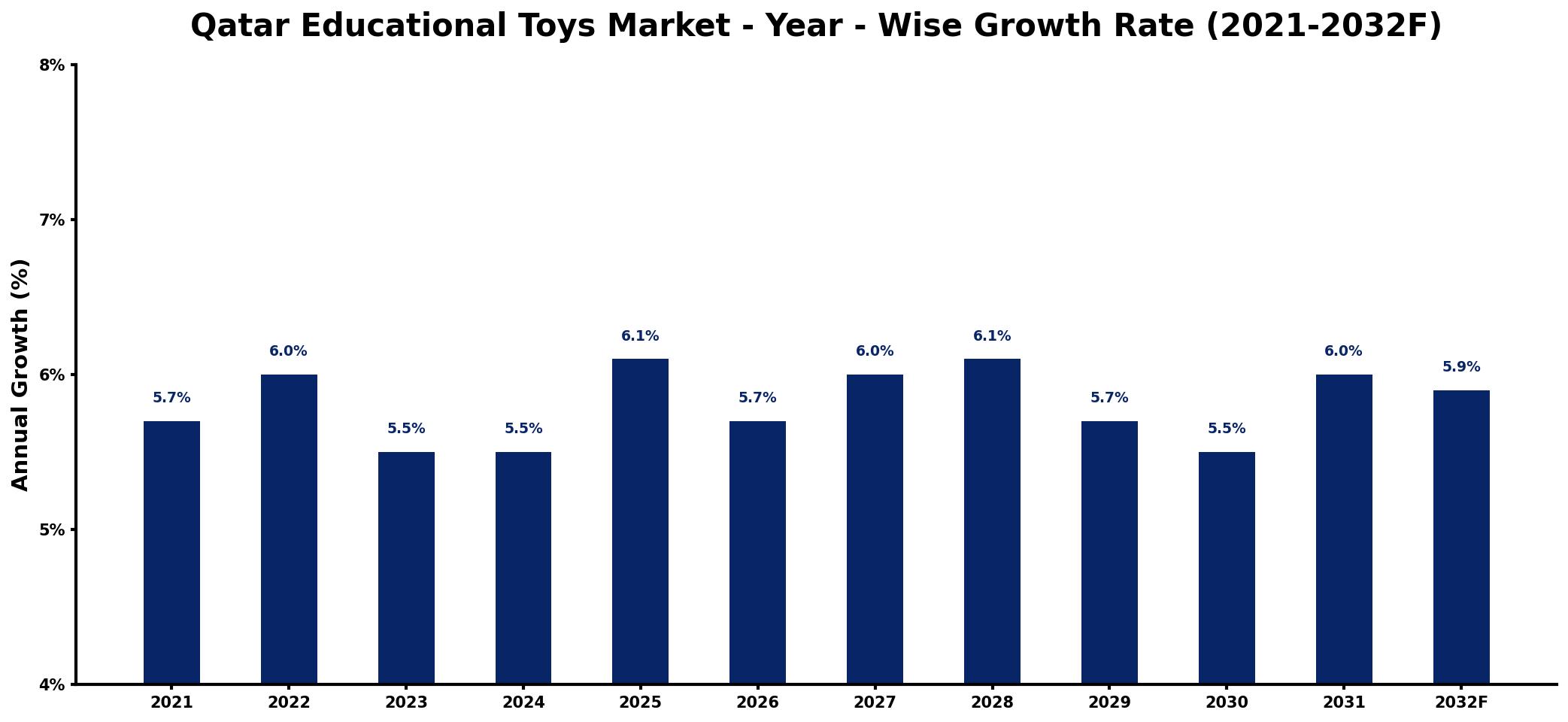
The table below presents the year‑wise growth rates along with the key drivers influencing the market
| Year | Growth Rate | Major Drivers |
| 2021 | 5.7% | Increased parental investment in development |
| 2022 | 6.0% | Rising awareness of cognitive benefits |
| 2023 | 5.5% | Growth in e-commerce platforms availability |
| 2024 | 5.5% | Expansion of interactive learning methods |
| 2025 | 6.1% | Surge in local manufacturing initiatives |
| 2026 | 5.7% | Increased collaborations with educators |
| 2027 | 6.0% | Growing interest in STEM-related activities |
| 2028 | 6.1% | Higher government funding for education |
| 2029 | 5.7% | Flourishing market for eco-friendly options |
| 2030 | 5.5% | Strengthened community engagement programs |
| 2031 | 6.0% | Enhanced marketing strategies targeting families |
| 2032 | 5.9% | Broadening distribution channel networks |
Note: Market size estimations and growth projections presented in this report are based on 6Wresearch's proprietary forecasting methodology, utilizing the latest available industry data, government publications, and primary research inputs.
Qatar Educational Toys Market Synopsis
The strongest force shaping the Qatar Educational Toys Market today is the growing endorsement of play-based learning methodologies. Parents are increasingly seeking toys that not only entertain but also contribute meaningfully to cognitive and developmental growth in their children. This evolving mindset has fostered a flourishing market characterized by a diverse array of products tailored to different educational goals and age groups.
Moreover, the synergy between technological advancements and educational objectives is a game-changer in the market. Toys that incorporate digital elements are gaining traction, providing engaging and interactive experiences that align with modern learning paradigms. This dynamic is driving innovation and expanding the variety of options available to consumers in Qatar.
Qatar Educational Toys Market Key Takeaways
- The market is witnessing a robust growth trajectory fueled by the increasing demand for educational toys that enhance cognitive skills.
- Play-based learning is now widely recognized by educators and parents as essential for childhood development.
- Digital integration in educational toys is creating opportunities for more interactive and engaging learning experiences.
- Affordability and accessibility remain critical concerns as some educational toys can be prohibitively expensive for families.
- COVID-19 has accelerated the shift towards home-based learning, boosting demand for educational toys.
Evaluation of Restraints in Qatar Educational Toys Market
While the Qatar Educational Toys Market is on an upward trajectory, it faces several constraints that could impact its long-term growth. One notable challenge lies in balancing the integration of digital technology with traditional play-based learning. Ensuring that toys remain effective for educational purposes while also being engaging can be a difficult task for manufacturers. Additionally, the high price point of many educational toys could restrict their reach across various socioeconomic demographics, thereby limiting market penetration. As parents and educators prioritize quality in educational toys, the challenge of accessibility remains a significant concern that stakeholders must address.
Qatar Educational Toys Market Trends
Current trends in the Qatar Educational Toys Market indicate a shift towards incorporating STEM (Science, Technology, Engineering, and Mathematics) themes into toy designs. Educational toys that promote coding skills, robotics, and problem-solving are gaining popularity among both parents and educational institutions. Furthermore, eco-friendly materials and sustainable manufacturing practices are becoming increasingly important, aligning with global trends toward environmental consciousness. This pivot not only meets consumer demand but also supports broader educational goals, encouraging children to think critically about their environment.
Qatar Educational Toys Market Opportunities
The Qatar Educational Toys Market presents substantial growth and investment opportunities, particularly in technology-driven learning solutions. Innovative startups focusing on combining education and entertainment through augmented reality (AR) and virtual reality (VR) are poised to attract interest and funding. Additionally, as more families adopt home-based learning models, there is a clear demand for versatile educational toys that can cater to different learning styles and preferences. Companies that can effectively harness these trends may find a receptive market eager for new and engaging products.
Government Initiatives in the Qatar Educational Toys Market
The Qatari government is increasingly recognizing the significance of quality education as a foundational element for national development. As part of this commitment, initiatives aimed at enhancing educational resources and integrating technology into learning environments are being prioritized. Public spending on education is expected to create a supportive ecosystem for educational toys, as efforts to modernize curricula and teaching methods continue to evolve. This environment presents favorable conditions for market growth, with opportunities for collaborations between educational toy manufacturers and educational institutions.
Future Insights of the Qatar Educational Toys Market
Looking ahead to the period from 2026 to 2032, the Qatar Educational Toys Market is expected to continue on its growth path, driven by the dual forces of innovation and educational reform. As the demand for interactive and engaging learning experiences intensifies, manufacturers will need to focus on creating products that meet the evolving needs of both children and educators. Furthermore, as public and private stakeholders invest more in educational infrastructure, the potential for market expansion becomes even more pronounced. The interplay of education, technology, and development will shape the future landscape of this market.
Qatar Educational Toys Market Latest Developments (2025 - 2026)
Recent developments in the Qatar Educational Toys Market indicate a continued focus on innovative learning solutions that integrate technology. Companies are increasingly launching new products designed to enhance educational experiences at home and in educational settings. There is a notable rise in collaborations between educational institutions and toy manufacturers, aimed at developing resources that align with evolving educational standards. This trend suggests that the sector is moving toward more targeted educational outcomes through creative partnerships.
Qatar Educational Toys Market - Key Attractiveness of the Report
- 10 Years of Market Numbers
- Historical Data Starting from 2022 to 2025
- Base Year: 2025
- Forecast Data until 2032
- Key Performance Indicators Impacting the Market
- Major Upcoming Developments and Projects
Key Highlights of the Report:
- Qatar Educational Toys Market Outlook
- Market Size of Qatar Educational Toys Market, 2025
- Forecast of Qatar Educational Toys Market, 2032
- Historical Data and Forecast of Qatar Educational Toys Revenues & Volume for the Period 2022-2032F
- Qatar Educational Toys Market Trend Evolution
- Qatar Educational Toys Market Drivers and Challenges
- Qatar Educational Toys Price Trends
- Qatar Educational Toys Porter's Five Forces
- Qatar Educational Toys Industry Life Cycle
- Historical Data and Forecast of Qatar Educational Toys Market Revenues & Volume By Product Type for the Period 2022-2032F
- Historical Data and Forecast of Qatar Educational Toys Market Revenues & Volume By Academic toys for the Period 2022-2032F
- Historical Data and Forecast of Qatar Educational Toys Market Revenues & Volume By Cognitive toys for the Period 2022-2032F
- Historical Data and Forecast of Qatar Educational Toys Market Revenues & Volume By Motor skills toys for the Period 2022-2032F
- Historical Data and Forecast of Qatar Educational Toys Market Revenues & Volume By Others for the Period 2022-2032F
- Historical Data and Forecast of Qatar Educational Toys Market Revenues & Volume By Age Group for the Period 2022-2032F
- Historical Data and Forecast of Qatar Educational Toys Market Revenues & Volume By 1 ?? 4 years for the Period 2022-2032F
- Historical Data and Forecast of Qatar Educational Toys Market Revenues & Volume By 4 ?? 8 years for the Period 2022-2032F
- Historical Data and Forecast of Qatar Educational Toys Market Revenues & Volume By Above 8 years for the Period 2022-2032F
- Historical Data and Forecast of Qatar Educational Toys Market Revenues & Volume By Others for the Period 2022-2032F
- Historical Data and Forecast of Qatar Educational Toys Market Revenues & Volume By End-Users for the Period 2022-2032F
- Historical Data and Forecast of Qatar Educational Toys Market Revenues & Volume By Residential for the Period 2022-2032F
- Historical Data and Forecast of Qatar Educational Toys Market Revenues & Volume By Commercial for the Period 2022-2032F
- Qatar Educational Toys Import Export Trade Statistics
- Market Opportunity Assessment By Product Type
- Market Opportunity Assessment By Age Group
- Market Opportunity Assessment By End-Users
- Qatar Educational Toys Top Companies Market Share
- Qatar Educational Toys Competitive Benchmarking By Technical and Operational Parameters
- Qatar Educational Toys Company Profiles
- Qatar Educational Toys Key Strategic Recommendations






































