Qatar Fashion Belt Market Size, Share & Growth Rate
The Qatar Fashion Belt Market was estimated at USD 164 Million in 2025 and is projected to reach USD 224 Million by 2032, growing at a CAGR of 4.6% from 2026 to 2032. This growth trajectory is fueled by rising disposable income levels among consumers, coupled with an increasing inclination towards premium, high-quality fashion accessories. Moreover, the evolving lifestyle trends in Qatar, particularly among the younger demographic, have significantly contributed to the demand for fashionable belts that not only serve a functional purpose but also enhance personal style.
Qatar Fashion Belt Market Year-wise Growth Rate and Key Drivers
This graph highlights how the Qatar Fashion Belt Market has steadily grown over the years, supported by major growth factors.
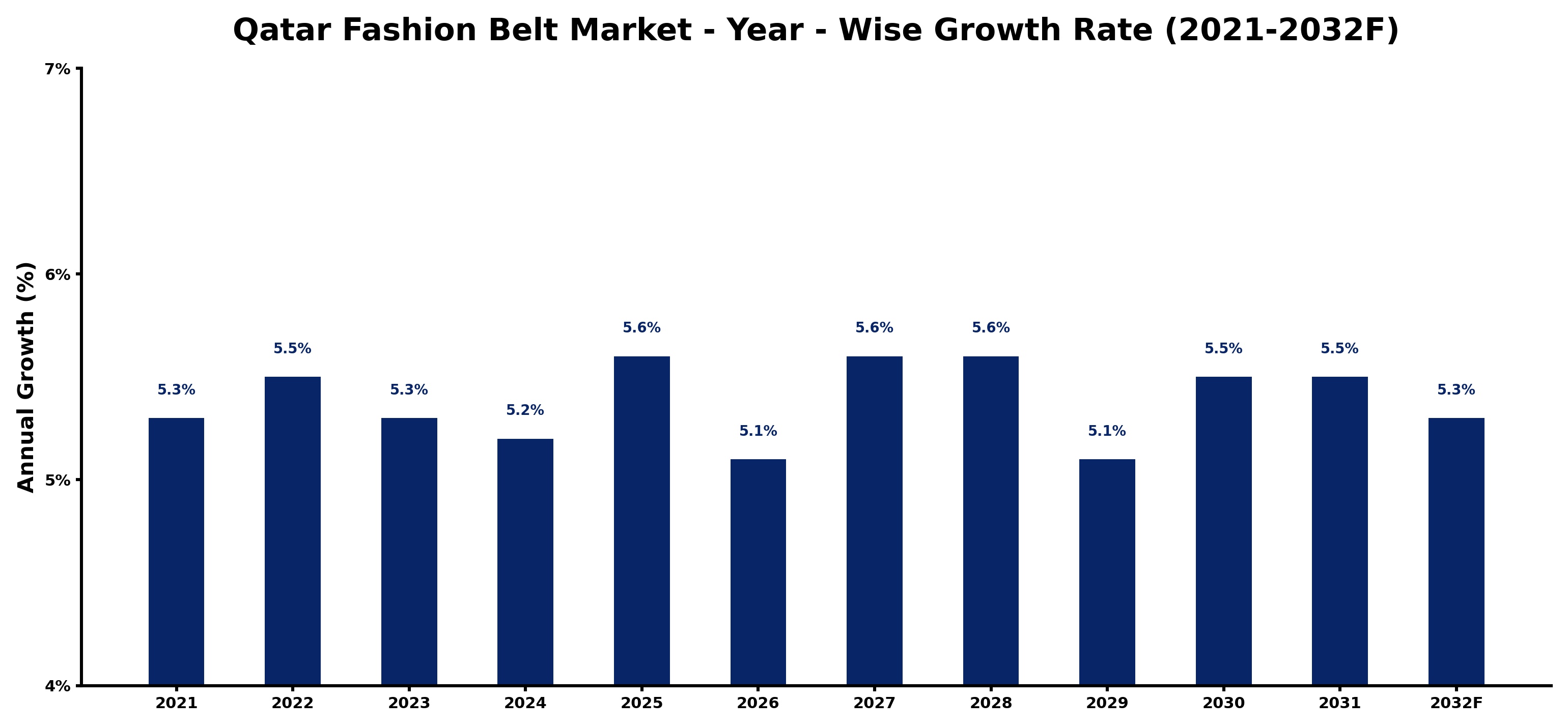
The table below presents the year‑wise growth rates along with the key drivers influencing the market
| Year | Growth Rate | Major Drivers |
| 2021 | 5.3% | Technology integration in construction modernized project delivery and execution |
| 2022 | 5.5% | Export driven demand for luxury textiles boosts local manufacturing capabilities |
| 2023 | 5.3% | Manufacturing investments boost textile machinery production for local brands |
| 2024 | 5.2% | Construction modernization drives demand for advanced manufacturing machinery |
| 2025 | 5.6% | Manufacturing investments boost local textile production capabilities and efficiency |
| 2026 | 5.1% | Smart textile manufacturing integration boosts operational efficiency in fashion sector |
| 2027 | 5.6% | Modernized textile manufacturing drives demand for advanced weaving technologies |
| 2028 | 5.6% | LNG infrastructure upgrades demand advanced materials and construction solutions |
| 2029 | 5.1% | Refinery maintenance schedules boost demand for specialized industrial tools |
| 2030 | 5.5% | Improved textile manufacturing facilities enhance regional apparel production capacity |
| 2031 | 5.5% | Technology integration in garment production enhanced textile export capabilities |
| 2032 | 5.3% | Infrastructure modernization drives demand for advanced manufacturing technologies |
Note - Market size estimations and growth projections presented in this report are based on 6Wresearch’s advanced forecasting approach, validated with industry datasets as of June 2026.
Qatar Fashion Belt Market Synopsis
In Qatar, fashion belts have transcended their traditional role as mere accessories, evolving into essential components of both formal and casual attire. With the burgeoning luxury retail sector and a vibrant calendar of fashion events, consumers are increasingly seeking to express their individuality through stylish belts that complement their outfits.
The market is characterized by a healthy mix of local and international brands, each vying for a share of the growing demand. As Qatar's fashion landscape matures, the increasing exposure to global fashion trends enables consumers to make more informed choices, thereby propelling the market forward.
Qatar Fashion Belt Market Key Takeaways
- The market is projected to grow significantly, driven by higher disposable incomes and fashion consciousness.
- There is a rising trend in the demand for unique, high-quality fashion belts that serve as style statements.
- The luxury retail scene in Qatar is expanding, influencing consumer preferences in fashion accessories.
- Adapting to fast-changing trends and maintaining quality are critical for manufacturers and retailers.
- Sustainability and ethical sourcing are becoming essential considerations for market participants.
Evaluation of Restraints in Qatar Fashion Belt Market
Despite the promising growth potential, several restraints can hinder the progress of the Qatar Fashion Belt Market. A notable challenge is the fluctuating consumer preferences, influenced by dynamic fashion trends. This variation can create difficulties for brands in maintaining product relevance and demand. Additionally, the prevalence of counterfeit products poses a significant risk to brand integrity and consumer trust, necessitating rigorous efforts to ensure authenticity. As the market matures, the need for alignment with sustainable practices presents another layer of complexity that brands must navigate to meet consumer expectations.
Qatar Fashion Belt Market Trends
Current trends in the Qatar Fashion Belt Market reflect a shift towards personalization and exclusivity. Consumers are increasingly gravitating towards unique designs and customizable options that allow them to showcase their individuality. Furthermore, the rise of digital shopping platforms is reshaping how consumers purchase fashion belts, enabling greater access to international brands and niche designers. Another trend is the integration of eco-friendly materials and production practices, aligning with the global movement towards sustainability in fashion.
Qatar Fashion Belt Market Opportunities
The Qatar Fashion Belt Market is ripe with opportunities for growth and innovation. As lifestyle trends evolve, there is a considerable demand for belts that offer functionality without compromising on style. Brands that focus on innovative designs, coupled with high-quality materials, stand to gain a competitive edge. Additionally, the expansion of e-commerce platforms presents an avenue for reaching wider audiences, particularly younger consumers who prefer online shopping. Collaborations between local artisans and fashion brands could also create unique offerings that resonate well with Qatari consumers.
Government Initiatives in the Qatar Fashion Belt Market
The Qatari government has implemented various initiatives aimed at boosting the retail and fashion sectors, including the fashion belt market. Investments in infrastructure and public-private partnerships are encouraged to promote local manufacturing and design capabilities. Furthermore, programs aimed at fostering innovation and entrepreneurship in the fashion industry contribute to a more dynamic marketplace, providing support for emerging brands and enhancing the overall attractiveness of Qatar as a fashion hub in the region.
Future Insights of the Qatar Fashion Belt Market
Looking ahead to the period of 2026-2032, the Qatar Fashion Belt Market is expected to undergo significant transformations driven by technological advancements and changing consumer expectations. As digital platforms become increasingly integral to retail, brands will need to invest in online presence and consumer engagement strategies. Additionally, the ongoing shift towards sustainability will shape product offerings, encouraging brands to adopt eco-friendly practices. Overall, the market is set to flourish, supported by a combination of local talent, international collaboration, and a growing appetite for fashion.
Qatar Fashion Belt Market Latest Developments (May 2025 - June 2026)
Recent developments in the Qatar Fashion Belt Market indicate a marked shift towards digital retail strategies, with brands increasingly harnessing social media to connect with consumers. In light of changing consumer behaviors post-pandemic, several local retailers have reported a pivot to online sales, enhancing their e-commerce capabilities. Additionally, collaborations between designers and local influencers have emerged as a popular marketing strategy, further boosting consumer engagement and brand visibility.
Qatar Fashion Belt Market - Key Attractiveness of the Report
- 10 Years of Market Numbers
- Historical Data Starting from 2022 to 2025
- Base Year: 2025
- Forecast Data until 2032
- Key Performance Indicators Impacting the Market
- Major Upcoming Developments and Projects
Key Highlights of the Report:
- Qatar Fashion Belt Market Outlook
- Market Size of Qatar Fashion Belt Market, 2025
- Forecast of Qatar Fashion Belt Market, 2032
- Historical Data and Forecast of Qatar Fashion Belt Revenues & Volume for the Period 2022-2032F
- Qatar Fashion Belt Market Trend Evolution
- Qatar Fashion Belt Market Drivers and Challenges
- Qatar Fashion Belt Price Trends
- Qatar Fashion Belt Porter's Five Forces
- Qatar Fashion Belt Industry Life Cycle
- Historical Data and Forecast of Qatar Fashion Belt Market Revenues & Volume By Types for the Period 2022-2032F
- Historical Data and Forecast of Qatar Fashion Belt Market Revenues & Volume By Grommet Belt for the Period 2022-2032F
- Historical Data and Forecast of Qatar Fashion Belt Market Revenues & Volume By Chain Belt for the Period 2022-2032F
- Historical Data and Forecast of Qatar Fashion Belt Market Revenues & Volume By Leather Belt for the Period 2022-2032F
- Historical Data and Forecast of Qatar Fashion Belt Market Revenues & Volume By Others for the Period 2022-2032F
- Historical Data and Forecast of Qatar Fashion Belt Market Revenues & Volume By Industry for the Period 2022-2032F
- Historical Data and Forecast of Qatar Fashion Belt Market Revenues & Volume By Online Sales for the Period 2022-2032F
- Historical Data and Forecast of Qatar Fashion Belt Market Revenues & Volume By Offline Sales for the Period 2022-2032F
- Qatar Fashion Belt Import Export Trade Statistics
- Market Opportunity Assessment By Types
- Market Opportunity Assessment By Industry
- Qatar Fashion Belt Top Companies Market Share
- Qatar Fashion Belt Competitive Benchmarking By Technical and Operational Parameters
- Qatar Fashion Belt Company Profiles
- Qatar Fashion Belt Key Strategic Recommendations






































