Qatar Field Service Management Market Size, Share & Growth Rate
The Qatar Field Service Management Market was estimated at USD 173 Million in 2025 and is projected to reach USD 242 Million by 2032, growing at a CAGR of 4.9% from 2026 to 2032. This growth trajectory is largely fueled by a burgeoning demand for operational efficiency as organizations increasingly recognize the value of optimized field service operations. The swift adoption of mobile technologies and enhanced customer expectations for service quality and transparency further amplify this market's potential.
Qatar Field Service Management Market Year-wise Growth Rate and Key Drivers
This graph highlights how the Qatar Field Service Management Market has steadily grown over the years, supported by major growth factors.
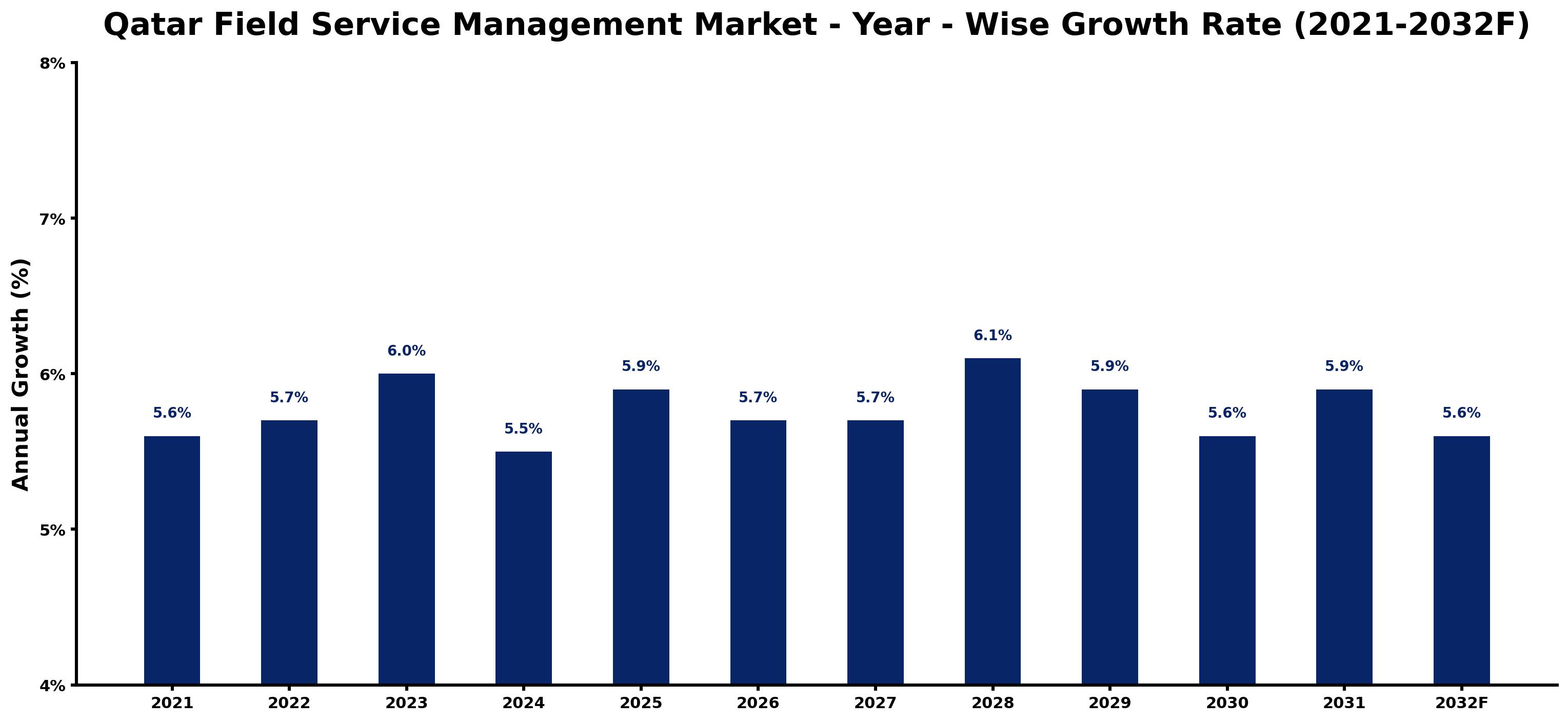
The table below presents the year‑wise growth rates along with the key drivers influencing the market
| Year | Growth Rate | Major Drivers |
| 2021 | 5.6% | Expansion of manufacturing activities |
| 2022 | 5.7% | Increasing adoption of advanced technologies |
| 2023 | 6.0% | Rising electricity demand across industries |
| 2024 | 5.5% | Growing renewable energy integration projects |
| 2025 | 5.9% | Increasing industrial automation investments |
| 2026 | 5.7% | Government infrastructure modernization initiatives |
| 2027 | 5.7% | Rapid growth in telecom and data center sectors |
| 2028 | 6.1% | Growing urbanization and commercial development |
| 2029 | 5.9% | Government infrastructure modernization initiatives |
| 2030 | 5.6% | Growing urbanization and commercial development |
| 2031 | 5.9% | Increasing industrial infrastructure investments |
| 2032 | 5.6% | Growing renewable energy integration projects |
Note - Market size estimations and growth projections presented in this report are based on 6Wresearch’s advanced forecasting approach, validated with industry datasets as of June 2026.
Qatar Field Service Management Market Synopsis
In Qatar, the evolution of field service management is being propelled by the rise of smart technologies and mobile applications that facilitate seamless communication between field technicians and back-office personnel. This technological integration not only enhances productivity but also empowers companies to respond promptly to customer inquiries and service requests.
Moreover, Qatar's commitment to diversifying its economy beyond oil and gas is leading to an increased focus on sectors that benefit from effective field service management. As industries such as construction, utilities, and telecommunications expand, the demand for sophisticated FSM solutions continues to grow.
Qatar Field Service Management Market Key Takeaways
- The market is projected to grow significantly, reflecting organizations' need for efficient service operations.
- Mobile technology adoption is driving improved technician productivity and customer satisfaction.
- Real-time visibility into operations is becoming essential for enhancing customer experiences.
- Qatar's economic diversification is generating new opportunities for FSM solutions across various sectors.
- Integration with existing IT systems remains a challenge but also a focal point for strategic development.
Evaluation of Restraints in Qatar Field Service Management Market
Despite its promising outlook, the Qatar Field Service Management market faces significant barriers, primarily centered on the integration of new FSM solutions with legacy IT systems. Many organizations still rely on outdated platforms that lack compatibility with modern FSM technologies. This integration challenge can lead to operational disruptions, often deterring businesses from fully embracing FSM solutions. Additionally, concerns surrounding data security and privacy create apprehension among potential adopters, as organizations must navigate strict compliance regulations to protect sensitive customer information.
Qatar Field Service Management Market Trends
Several trends are currently shaping the Qatar Field Service Management landscape. The integration of Artificial Intelligence (AI) is streamlining scheduling and dispatching, while predictive analytics helps organizations anticipate service needs and improve resource allocation. Furthermore, there is a noticeable shift towards cloud-based FSM solutions, which offer scalability and flexibility to adapt to changing business needs. Additionally, the focus on customer-centric service delivery is pushing companies to enhance transparency and communication with clients through real-time tracking features.
Qatar Field Service Management Market Opportunities
The potential for growth in the Qatar Field Service Management market is vast. With increased investments in infrastructure and smart city initiatives, sectors such as transportation and utilities are seeking FSM solutions to optimize their operations. Furthermore, the rise of remote work and digital customer engagement strategies post-COVID-19 creates an opportunity for FSM technologies to facilitate seamless service delivery. Organizations that innovate in these areas stand to gain significant competitive advantages.
Government Initiatives in the Qatar Field Service Management Market
The Qatari government is actively promoting initiatives aimed at bolstering technological adoption across various sectors, including field service management. Public spending on digital transformation projects is on the rise, as the government seeks to enhance service efficiency and economic resilience. Programs aimed at fostering innovation in technology and infrastructure development further support the growth of FSM solutions, establishing a conducive environment for investment and expansion.
Future Insights of the Qatar Field Service Management Market
Looking ahead to 2026-2032, the Qatar Field Service Management market is poised for substantial advancements driven by continued technological integration and evolving customer expectations. As companies increasingly prioritize operational efficiency, investments in AI and machine learning will likely reshape service delivery models. Furthermore, expanding industries such as healthcare and logistics will demand tailored FSM solutions that enhance service quality and responsiveness, solidifying the market's growth potential over the coming years.
Qatar Field Service Management Market Latest Developments (May 2025 - June 2026)
In the latest developments within the Qatar Field Service Management market, several organizations have begun pilot programs to test AI-driven FSM platforms, aiming to enhance field technician efficiency. There's also been a noticeable uptick in partnerships between technology providers and service organizations, focusing on cloud-based solutions that promise better scalability. Additionally, companies are increasingly prioritizing data security measures to address customer concerns, further enhancing trust in FSM solutions.
Qatar Field Service Management Market - Key Attractiveness of the Report
- 10 Years of Market Numbers
- Historical Data Starting from 2022 to 2025
- Base Year: 2025
- Forecast Data until 2032
- Key Performance Indicators Impacting the Market
- Major Upcoming Developments and Projects
Key Highlights of the Report:
- Qatar Field Service Management Market Outlook
- Market Size of Qatar Field Service Management Market, 2025
- Forecast of Qatar Field Service Management Market, 2032
- Historical Data and Forecast of Qatar Field Service Management Revenues & Volume for the Period 2022-2032F
- Qatar Field Service Management Market Trend Evolution
- Qatar Field Service Management Market Drivers and Challenges
- Qatar Field Service Management Price Trends
- Qatar Field Service Management Porter's Five Forces
- Qatar Field Service Management Industry Life Cycle
- Historical Data and Forecast of Qatar Field Service Management Market Revenues & Volume By Component for the Period 2022-2032F
- Historical Data and Forecast of Qatar Field Service Management Market Revenues & Volume By Solutions for the Period 2022-2032F
- Historical Data and Forecast of Qatar Field Service Management Market Revenues & Volume By Services for the Period 2022-2032F
- Historical Data and Forecast of Qatar Field Service Management Market Revenues & Volume By Verticals for the Period 2022-2032F
- Historical Data and Forecast of Qatar Field Service Management Market Revenues & Volume By Telecom for the Period 2022-2032F
- Historical Data and Forecast of Qatar Field Service Management Market Revenues & Volume By Manufacturing & Construction for the Period 2022-2032F
- Historical Data and Forecast of Qatar Field Service Management Market Revenues & Volume By Healthcare for the Period 2022-2032F
- Historical Data and Forecast of Qatar Field Service Management Market Revenues & Volume By Energy & Utility for the Period 2022-2032F
- Historical Data and Forecast of Qatar Field Service Management Market Revenues & Volume By Others for the Period 2022-2032F
- Historical Data and Forecast of Qatar Field Service Management Market Revenues & Volume By Deployment Mode for the Period 2022-2032F
- Historical Data and Forecast of Qatar Field Service Management Market Revenues & Volume By Cloud for the Period 2022-2032F
- Historical Data and Forecast of Qatar Field Service Management Market Revenues & Volume By On-premise for the Period 2022-2032F
- Qatar Field Service Management Import Export Trade Statistics
- Market Opportunity Assessment By Component
- Market Opportunity Assessment By Verticals
- Market Opportunity Assessment By Deployment Mode
- Qatar Field Service Management Top Companies Market Share
- Qatar Field Service Management Competitive Benchmarking By Technical and Operational Parameters
- Qatar Field Service Management Company Profiles
- Qatar Field Service Management Key Strategic Recommendations






































