Qatar Fire Resistant Glass Market Size, Share & Growth Rate
The Qatar Fire Resistant Glass Market was estimated at USD 493 Million in 2025 and is projected to reach USD 698 Million by 2032, growing at a CAGR of 5.1% from 2026 to 2032. This growth trajectory is primarily fueled by the rapid expansion of the construction industry in Qatar, particularly in high-rise developments where safety is paramount. Additionally, stringent regulatory frameworks are pushing builders and architects to incorporate fire-resistant materials into their designs, ensuring compliance with modern safety standards.
Qatar Fire Resistant Glass Market Year-wise Growth Rate and Key Drivers
This graph highlights how the Qatar Fire Resistant Glass Market has steadily grown over the years, supported by major growth factors.
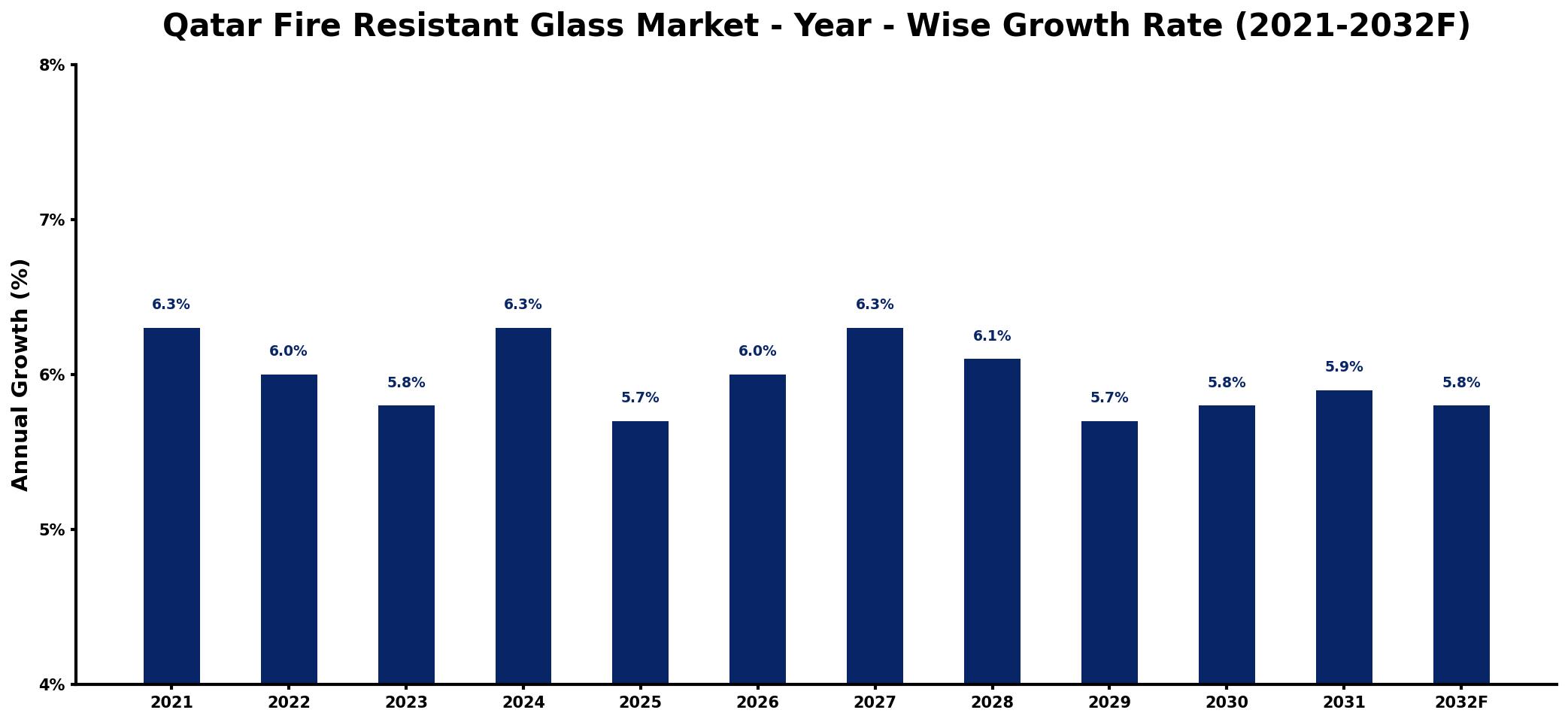
The table below presents the year‑wise growth rates along with the key drivers influencing the market
| Year | Growth Rate | Major Drivers |
| 2021 | 6.3% | Increased construction project investments |
| 2022 | 6.0% | Growing demand from commercial buildings |
| 2023 | 5.8% | Expansion of safety regulations globally |
| 2024 | 6.3% | Rising interest in energy efficiency |
| 2025 | 5.7% | Boost in architectural design innovations |
| 2026 | 6.0% | Higher consumer awareness on safety |
| 2027 | 6.3% | Surge in infrastructure development projects |
| 2028 | 6.1% | Increased focus on sustainable materials |
| 2029 | 5.7% | Growing trends in urbanization initiatives |
| 2030 | 5.8% | increased capital investment inflows |
| 2031 | 5.9% | Increased government infrastructure spending |
| 2032 | 5.8% | Rising demand for advanced technologies |
Note: Market size estimations and growth projections presented in this report are based on 6Wresearch's proprietary forecasting methodology, utilizing the latest available industry data, government publications, and primary research inputs.
Qatar Fire Resistant Glass Market Synopsis
The increasing emphasis on occupant safety in commercial and residential buildings in Qatar has led to a significant rise in the adoption of fire-resistant glass. This material not only provides a necessary barrier against flames but also allows for natural light and visibility, aligning with contemporary architectural trends.
As Qatar prepares for a future marked by heightened safety standards and construction activity, the demand for high-quality, compliant fire-resistant glass is set to soar. Manufacturers that offer customizable solutions tailored to specific project needs will find themselves well-positioned to capture a share of this burgeoning market.
Qatar Fire Resistant Glass Market Key Takeaways
- Increased demand driven by rapid construction growth and safety regulation adherence.
- High-rise developments are a key segment fueling market expansion.
- Technological advancements enhancing fire resistance and aesthetic options.
- Education and awareness among architects and builders critical for market penetration.
- Post-pandemic recovery is expected to rejuvenate the construction sector and market demand.
Evaluation of Restraints in Qatar Fire Resistant Glass Market
Despite its growth potential, the Qatar fire-resistant glass market faces certain restraints. Meeting evolving safety standards demands continuous innovation and investment in advanced materials. Furthermore, the architectural community's understanding and acceptance of fire-resistant glass products can be inconsistent, posing a challenge for manufacturers aiming to educate and persuade decision-makers on the benefits and applications of such materials. Navigating the complexities of compliance with local regulations and building codes also adds layers of difficulty to market entry and expansion.
Qatar Fire Resistant Glass Market Trends
Several current trends are shaping the Qatar fire-resistant glass market. One significant trend is the integration of smart technology into glass products, which enhances functionality and safety. Additionally, there is a growing inclination towards energy-efficient buildings, encouraging the use of fire-resistant glass with thermal insulation properties. Architectural designs are increasingly prioritizing open spaces and natural light, further driving the adoption of transparent yet fire-safe materials.
Qatar Fire Resistant Glass Market Opportunities
The Qatar fire-resistant glass market offers substantial growth and investment opportunities. Manufacturers can capitalize on the increasing number of mega-projects in the region, particularly those linked to infrastructure and hospitality. Additionally, emerging applications in residential sectors, driven by high safety awareness, provide avenues for product diversification and expansion. Customized solutions catering to specific architectural requirements represent another key opportunity for growth.
Government Initiatives in the Qatar Fire Resistant Glass Market
The Qatari government is actively promoting stringent safety regulations and building codes aimed at enhancing public safety and sustainability. Public spending on infrastructure projects, particularly in preparation for events like the FIFA World Cup, has catalyzed investment in safer building materials, including fire-resistant glass. Additionally, initiatives encouraging sustainable construction practices further support the market by advocating for advanced fire-resistant solutions that align with global safety standards.
Future Insights of the Qatar Fire Resistant Glass Market
Looking ahead, the Qatar fire-resistant glass market is poised for significant growth through 2032. The anticipated surge in construction activities, coupled with continuous advancements in glass technology, will create a favorable landscape for market expansion. As the country further commits to safety and sustainability, we expect fire-resistant glass to become a standard in construction projects, ensuring both regulatory compliance and occupant safety.
Qatar Fire Resistant Glass Market Latest Developments (2025 - 2026)
Recent developments in the Qatar fire-resistant glass market have shown an increasing focus on innovative manufacturing processes. Companies are prioritizing the research and development of materials that offer greater fire resistance while maintaining aesthetic appeal. Collaborative efforts among stakeholders in the construction and safety industries are emerging, aimed at enhancing education and awareness of fire safety measures among builders and architects.
Qatar Fire Resistant Glass Market - Key Attractiveness of the Report
- 10 Years of Market Numbers
- Historical Data Starting from 2022 to 2025
- Base Year: 2025
- Forecast Data until 2032
- Key Performance Indicators Impacting the Market
- Major Upcoming Developments and Projects
Key Highlights of the Report:
- Qatar Fire Resistant Glass Market Outlook
- Market Size of Qatar Fire Resistant Glass Market, 2025
- Forecast of Qatar Fire Resistant Glass Market, 2032
- Historical Data and Forecast of Qatar Fire Resistant Glass Revenues & Volume for the Period 2022-2032F
- Qatar Fire Resistant Glass Market Trend Evolution
- Qatar Fire Resistant Glass Market Drivers and Challenges
- Qatar Fire Resistant Glass Price Trends
- Qatar Fire Resistant Glass Porter's Five Forces
- Qatar Fire Resistant Glass Industry Life Cycle
- Historical Data and Forecast of Qatar Fire Resistant Glass Market Revenues & Volume By Type for the Period 2022-2032F
- Historical Data and Forecast of Qatar Fire Resistant Glass Market Revenues & Volume By Integrity (E) for the Period 2022-2032F
- Historical Data and Forecast of Qatar Fire Resistant Glass Market Revenues & Volume By Integrity & Radiation Limitation (EW) for the Period 2022-2032F
- Historical Data and Forecast of Qatar Fire Resistant Glass Market Revenues & Volume By Integrity & Insulation (EI) for the Period 2022-2032F
- Historical Data and Forecast of Qatar Fire Resistant Glass Market Revenues & Volume By Application for the Period 2022-2032F
- Historical Data and Forecast of Qatar Fire Resistant Glass Market Revenues & Volume By Building and Construction for the Period 2022-2032F
- Historical Data and Forecast of Qatar Fire Resistant Glass Market Revenues & Volume By Other Applications for the Period 2022-2032F
- Qatar Fire Resistant Glass Import Export Trade Statistics
- Market Opportunity Assessment By Type
- Market Opportunity Assessment By Application
- Qatar Fire Resistant Glass Top Companies Market Share
- Qatar Fire Resistant Glass Competitive Benchmarking By Technical and Operational Parameters
- Qatar Fire Resistant Glass Company Profiles
- Qatar Fire Resistant Glass Key Strategic Recommendations






































