Qatar Food & Beverages Processing Equipment Market Summary
The qatar food & beverages processing equipment market was estimated at USD 860 Million in 2025 and is projected to reach USD 1591 Million by 2032, growing at a CAGR of 10.6% from 2026 to 2032.
Qatar Food & Beverages Processing Equipment Market Year-wise Growth Rate and Key Drivers
This graph highlights how the Qatar Food & Beverages Processing Equipment Market has steadily grown over the past five years, supported by major growth factors.
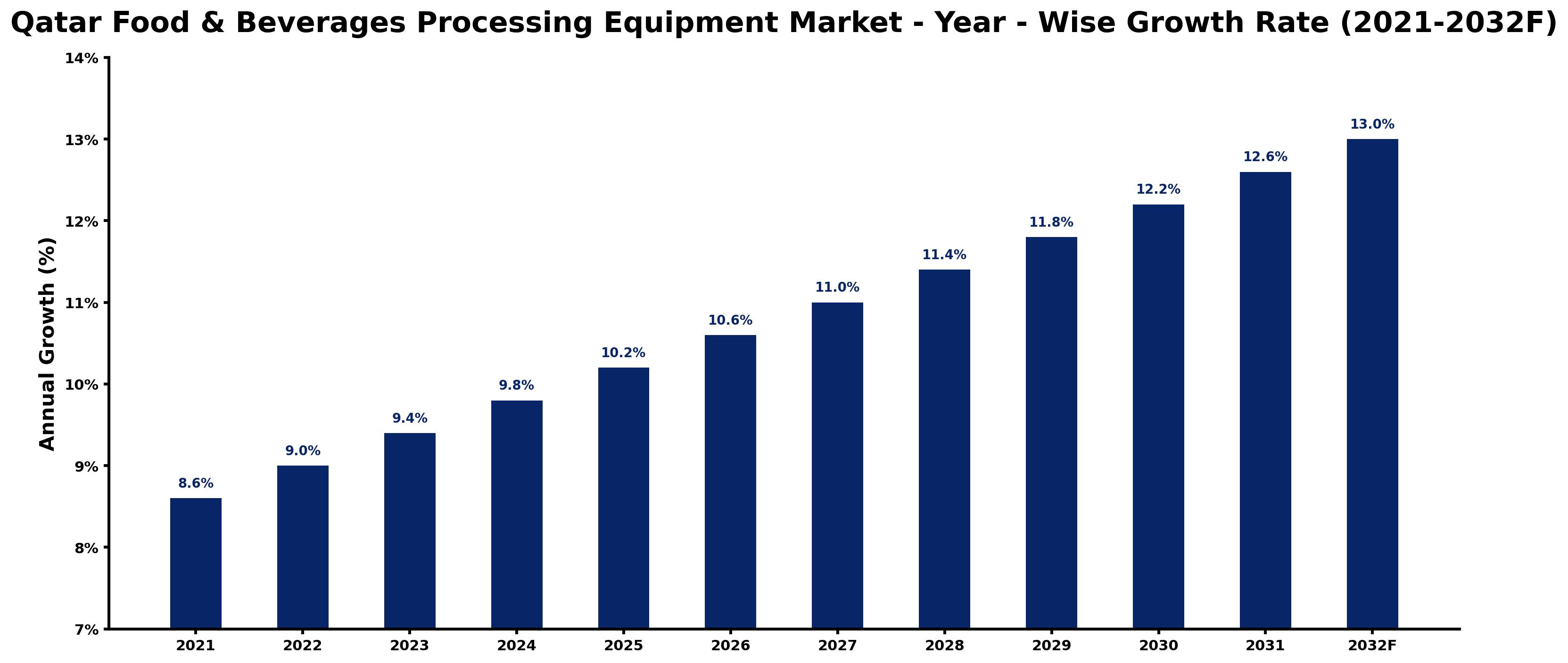
The table below presents the year wise growth rates along with the key drivers influencing the market
| Year | Growth Rate | Major Drivers |
| 2021 | 8.6% | Post-lockdown retail projects stimulate demand for modern food processing equipment. |
| 2022 | 9.0% | Growing interest in health trends influences equipment designed for organic food processing. |
| 2023 | 9.4% | Consumer preferences shift towards sustainability, boosting demand for eco-friendly machinery. |
| 2024 | 9.8% | Expansion of food delivery services necessitates investment in efficient processing technology. |
| 2025 | 10.2% | Local production initiatives promote equipment localization, enhancing supply chain resilience. |
| 2026 | 10.6% | Technological integration in processing equipment improves efficiency and reduces labor costs. |
| 2027 | 11.0% | Merger and acquisition activities increase, consolidating market players for competitive advantage. |
| 2028 | 11.4% | Rising urbanization leads to higher consumption rates, warranting increased production capacities. |
| 2029 | 11.8% | Emerging culinary trends call for innovative equipment tailored to diverse food offerings. |
| 2030 | 12.2% | Research and development in food safety technologies elevates equipment standards across sectors. |
| 2031 | 12.6% | International trade agreements open new markets for Qatari food processing equipment exports. |
| 2032 | 13.0% | Sustainable practices gain traction, driving investment in energy-efficient processing solutions. |
Note - Market size estimations and growth projections presented in this report are based on 6Wresearch's advanced forecasting approach, validated with industry datasets as of June 2026.
Qatar Food & Beverages Processing Equipment Market Synopsis
The Qatar Food Beverages Processing Equipment Market is projected to reach 10.6% and witness significant growth during the forecast period (2026-2032). This growth is attributed to the country's strong economic development, driven by a rapidly evolving food processing landscape. As the population increases and consumer preferences shift towards convenience and quality, the demand for advanced food and beverage processing equipment has surged. This upward trend has encouraged both domestic and foreign investments in the sector, further enhancing operational capacities within Qatar.
Qatar Food & Beverages Processing Equipment Market Growth Drivers
Several key factors are contributing to the growth of the Qatar Food & Beverages Processing Equipment Market. Firstly, the increasing population has heightened demand for processed food items, leading to greater reliance on food processing technologies. Secondly, changing lifestyles have resulted in a shift towards pre-packaged and convenience foods, further boosting the need for efficient processing equipment.
- The availability of raw materials has improved due to low import duties, facilitating easier access for food and beverage manufacturers.
- Government initiatives, such as tax incentives on imported machinery, have enhanced the attractiveness of investing in food processing technologies.
- Stricter regulations regarding food safety and quality standards established by the Gulf Standardization Organization (GSO) are prompting companies to modernize their processing equipment.
- The hospitality industry is thriving, supported by an expanding tourism sector, which in turn is increasing the demand for high-quality food and beverage products.
- Technological advancements are making production processes more efficient, leading to enhanced productivity and lower operational costs for manufacturers.
Qatar Food & Beverages Processing Equipment Market Challenges and Restraints
While the Qatar Food & Beverages Processing Equipment Market is experiencing growth, it faces certain challenges that could impact its trajectory. One significant challenge is the lack of standardization in pricing for packaging machinery across the Gulf Cooperation Council (GCC) region, which can create discrepancies in cost structures.
- High installation costs associated with modern processing equipment can deter smaller manufacturers from upgrading their facilities.
- Limited local manufacturing capabilities due to stringent environmental regulations affecting wastewater discharge can restrict production capacities.
- Pricing competition from Chinese manufacturers offering lower-cost alternatives can pose challenges, especially for local companies that may struggle to compete on price.
- The need for continuous advancements in technology may necessitate additional investments, which could strain resources for some businesses.
- Fluctuations in global commodity prices could also impact the costs of raw materials used in the food processing sector.
Qatar Food & Beverages Processing Equipment Market Government Investment and Initiatives
The Qatari government plays a crucial role in fostering the growth of the food and beverages processing equipment sector through various investments and initiatives. Strategic development plans place a significant emphasis on diversifying the economy, which includes supporting the food processing industry.
- Public spending on infrastructure developments is aimed at improving logistics and supply chain capabilities, which benefits food processing operations.
- Government policies provide tax exemptions for imported processing machinery, encouraging local companies to upgrade their technology.
- Initiatives to boost the agricultural sector, including incentives for sustainable farming practices, indirectly support the food processing equipment market by ensuring a steady supply of raw materials.
- Regulatory frameworks are being enhanced to ensure compliance with international standards, thus encouraging investment from foreign players.
- The government is actively promoting export capabilities for Qatari food products, which relies heavily on efficient processing systems to meet international quality standards.
Qatar Food & Beverages Processing Equipment Market Latest Developments (May 2025 - June 2026)
Recent developments in the Qatar Food & Beverages Processing Equipment Market indicate a dynamic shift towards modernization and efficiency. Many manufacturers are investing in advanced technologies, including automation and smart processing solutions, to streamline operations and reduce waste.
- There has been an increased focus on sustainable practices, with companies exploring eco-friendly processing solutions to meet consumer demands for environmentally responsible products.
- Partnerships between local companies and international technology providers are emerging, facilitating knowledge transfer and enhancing production capabilities.
- Trade shows and exhibitions have witnessed growing participation, reflecting the industry's emphasis on showcasing innovations and networking opportunities.
- Research and development efforts are intensifying, with companies looking to tailor their equipment to better accommodate specific local market needs.
- Government support for food safety initiatives has reinforced the need for compliance, pushing manufacturers to upgrade their equipment and processes accordingly.
Qatar Food & Beverages Processing Equipment Market - Key Attractiveness of the Report
- 10 Years of Market Numbers
- Historical Data Starting from 2022 to 2025
- Base Year: 2025
- Forecast Data until 2032
- Key Performance Indicators Impacting the Market
- Major Upcoming Developments and Projects
Key Highlights of the Report:
- Qatar Food & Beverages Processing Equipment Market Outlook
- Market Size of Qatar Food & Beverages Processing Equipment Market, 2025
- Forecast of Qatar Food & Beverages Processing Equipment Market, 2032
- Historical Data and Forecast of Qatar Food & Beverages Processing Equipment Revenues & Volume for the Period 2022-2032F
- Qatar Food & Beverages Processing Equipment Market Trend Evolution
- Qatar Food & Beverages Processing Equipment Market Drivers and Challenges
- Qatar Food & Beverages Processing Equipment Price Trends
- Qatar Food & Beverages Processing Equipment Porter's Five Forces
- Qatar Food & Beverages Processing Equipment Industry Life Cycle
- Historical Data and Forecast of Qatar Food & Beverages Processing Equipment Market Revenues & Volume By Types for the Period 2022-2032F
- Historical Data and Forecast of Qatar Food & Beverages Processing Equipment Market Revenues & Volume By Pre-processing Equipment for the Period 2022-2032F
- Historical Data and Forecast of Qatar Food & Beverages Processing Equipment Market Revenues & Volume By Sorting & Grading for the Period 2022-2032F
- Historical Data and Forecast of Qatar Food & Beverages Processing Equipment Market Revenues & Volume By Processing Equipment for the Period 2022-2032F
- Historical Data and Forecast of Qatar Food & Beverages Processing Equipment Market Revenues & Volume By Mode of Operations for the Period 2022-2032F
- Historical Data and Forecast of Qatar Food & Beverages Processing Equipment Market Revenues & Volume By Automatic for the Period 2022-2032F
- Historical Data and Forecast of Qatar Food & Beverages Processing Equipment Market Revenues & Volume By Semi-Automatic for the Period 2022-2032F
- Historical Data and Forecast of Qatar Food & Beverages Processing Equipment Market Revenues & Volume By Forms for the Period 2022-2032F
- Historical Data and Forecast of Qatar Food & Beverages Processing Equipment Market Revenues & Volume By Liquid for the Period 2022-2032F
- Historical Data and Forecast of Qatar Food & Beverages Processing Equipment Market Revenues & Volume By Solid for the Period 2022-2032F
- Historical Data and Forecast of Qatar Food & Beverages Processing Equipment Market Revenues & Volume By Semi-Solid for the Period 2022-2032F
- Historical Data and Forecast of Qatar Food & Beverages Processing Equipment Market Revenues & Volume By Applications for the Period 2022-2032F
- Historical Data and Forecast of Qatar Food & Beverages Processing Equipment Market Revenues & Volume By Bakery & Confectionery Products for the Period 2022-2032F
- Historical Data and Forecast of Qatar Food & Beverages Processing Equipment Market Revenues & Volume By Meat & Poultry Products for the Period 2022-2032F
- Historical Data and Forecast of Qatar Food & Beverages Processing Equipment Market Revenues & Volume By Fish & Sea food for the Period 2022-2032F
- Historical Data and Forecast of Qatar Food & Beverages Processing Equipment Market Revenues & Volume By Dairy Products for the Period 2022-2032F
- Historical Data and Forecast of Qatar Food & Beverages Processing Equipment Market Revenues & Volume By Alcoholic Beverages for the Period 2022-2032F
- Historical Data and Forecast of Qatar Food & Beverages Processing Equipment Market Revenues & Volume By Non-Alcoholic Beverages for the Period 2022-2032F
- Historical Data and Forecast of Qatar Food & Beverages Processing Equipment Market Revenues & Volume By Others for the Period 2022-2032F
- Qatar Food & Beverages Processing Equipment Import Export Trade Statistics
- Market Opportunity Assessment By Types
- Market Opportunity Assessment By Mode of Operations
- Market Opportunity Assessment By Forms
- Market Opportunity Assessment By Applications
- Qatar Food & Beverages Processing Equipment Top Companies Market Share
- Qatar Food & Beverages Processing Equipment Competitive Benchmarking By Technical and Operational Parameters
- Qatar Food & Beverages Processing Equipment Company Profiles
- Qatar Food & Beverages Processing Equipment Key Strategic Recommendations






































