Qatar Food Processing & Handling Equipment Market Summary
The qatar food processing & handling equipment market was estimated at USD 262 Million in 2025 and is projected to reach USD 363 Million by 2032, growing at a CAGR of 5.3% from 2026 to 2032.
Qatar Food Processing & Handling Equipment Market Year-wise Growth Rate and Key Drivers
This graph highlights how the Qatar Food Processing & Handling Equipment Market has steadily grown over the past five years, supported by major growth factors.
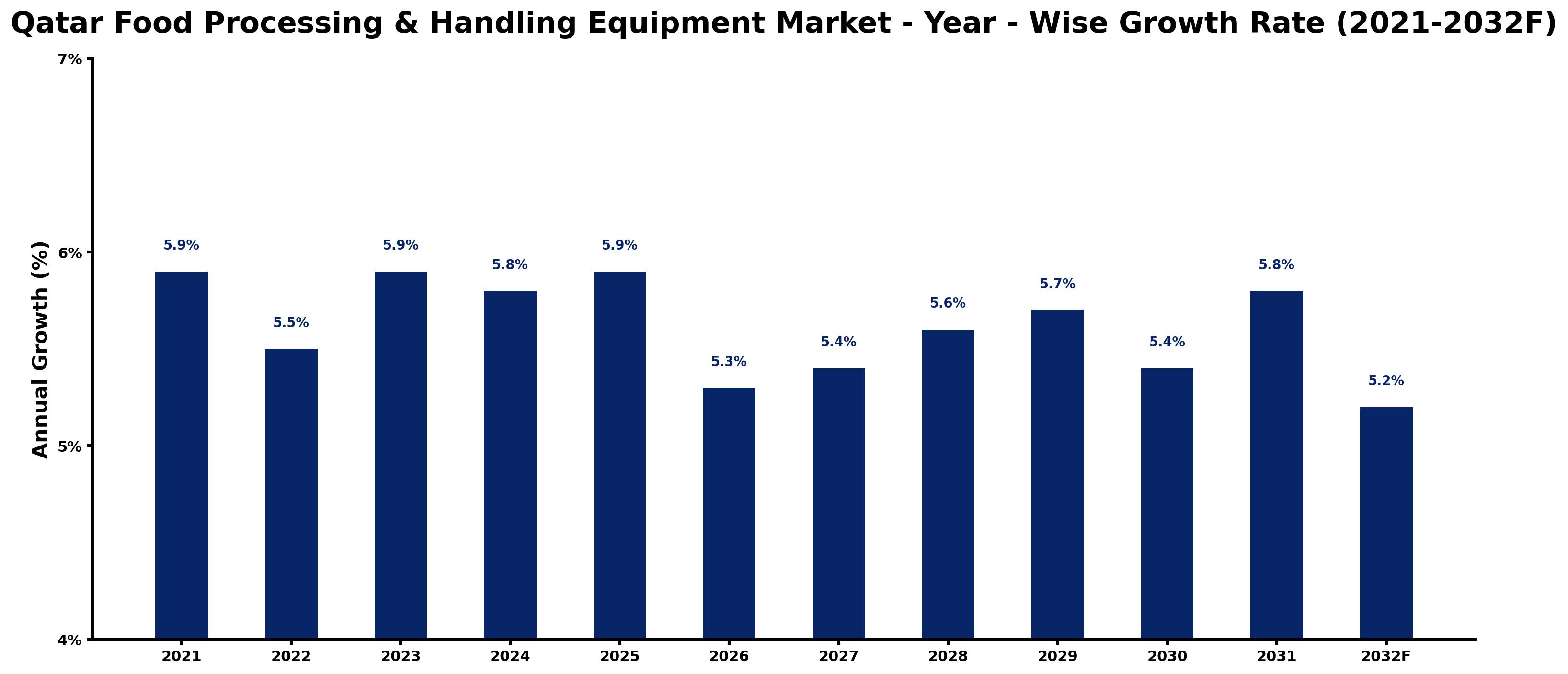
The table below presents the year wise growth rates along with the key drivers influencing the market
| Year | Growth Rate | Major Drivers |
| 2021 | 5.9% | Market recovery post-pandemic emphasized efficiency and safety in food processing sectors. |
| 2022 | 5.5% | Local food production initiatives led to increased demand for advanced handling equipment. |
| 2023 | 5.9% | Economic diversification strategies focused on enhancing the overall food supply chain resilience. |
| 2024 | 5.8% | Technological innovations began reshaping traditional manufacturing practices within the industry. |
| 2025 | 5.9% | Sustainability trends encouraged investments in energy-efficient food processing technologies. |
| 2026 | 5.3% | Increased global trade agreements expanded market access for Qatari food products. |
| 2027 | 5.4% | Consumer preference shifted towards healthier food options, driving equipment upgrades. |
| 2028 | 5.6% | Expansion of Qatar's hospitality sector created higher demand for food processing solutions. |
| 2029 | 5.7% | Local agricultural investments underscored the need for advanced food handling technologies. |
| 2030 | 5.4% | Integration of IoT systems aimed at enhancing operational efficiency was widely embraced. |
| 2031 | 5.8% | Collaborations between industry stakeholders focused on innovative food processing techniques emerged. |
| 2032 | 5.2% | Emerging markets within the region demanded tailored food handling solutions for niche segments. |
Note - Market size estimations and growth projections presented in this report are based on 6Wresearch's advanced forecasting approach, validated with industry datasets as of June 2026.
Qatar Food Processing & Handling Equipment Market Synopsis
The Qatar Food Processing Handling Equipment Market is projected to reach 5.3% and witness significant growth during the forecast period (2026-2032). This market encompasses the manufacturing, sale, and distribution of machinery and equipment that facilitate various stages of food production, processing, and packaging. Key activities supported by this equipment include cutting, grinding, mixing, cooking, and packaging of a wide range of food products.
Qatar Food Processing & Handling Equipment Market Growth Drivers
Several factors contribute to the growth of the Qatar Food Processing & Handling Equipment Market. The continuous urbanization and fast-paced lifestyles of the population have intensified the demand for processed and convenience food options. This shift in consumer behavior requires advanced food processing technologies to meet both quality and efficiency standards. Furthermore, the ongoing population growth in Qatar is creating a heightened need for food products, subsequently increasing the requirement for efficient food processing and handling equipment.
- The surge in urbanization is a primary driver, creating a shift towards consumption of processed foods that necessitates sophisticated processing equipment.
- Population increases in Qatar are prompting a rise in food demand, thus amplifying the need for updated food processing mechanisms.
- Supportive governmental initiatives aimed at bolstering the food processing sector contribute significantly to market expansion.
- The trend towards convenient food options among consumers bolsters the demand for advanced handling equipment, driving manufacturers to innovate.
- Investment opportunities in food processing technology are also guided by consumer preferences for higher quality and safety standards in food products.
Qatar Food Processing & Handling Equipment Market Challenges and Restraints
Despite its growth potential, the Qatar Food Processing & Handling Equipment Market faces several challenges. A significant concern for the industry is Qatar's heavy reliance on food imports, which renders it vulnerable to global market fluctuations that can impact the demand for local food processing equipment. Additionally, the relatively small population of Qatar restricts the domestic market size, posing a challenge for local manufacturers who may struggle to achieve economies of scale.
- Dependence on food imports limits local production capacities, impacting the growth of related equipment manufacturing sectors.
- The small population size restricts market opportunities, making it difficult for domestic manufacturers to scale their operations efficiently.
- Keeping pace with rapid technological advancements can be a challenge, as manufacturers must continually innovate to stay competitive.
- Economic fluctuations and changes in global food supply chains can directly affect the demand for food processing technologies.
- Compliance with evolving hygiene and safety regulations requires ongoing investment in upgrading equipment capabilities.
Qatar Food Processing & Handling Equipment Market COVID-19 Impact
The Covid-19 pandemic has had a multifaceted impact on the Qatar Food Processing & Handling Equipment Market. Initially, the pandemic led to significant disruptions in supply chains, which resulted in reduced production capacities for food processing machinery. Consumer demand for specific types of processed foods also experienced fluctuation due to changing eating habits during lockdown conditions.
- Disruptions in supply chains initially hindered equipment availability and delayed project timelines within the food processing sector.
- Production capacities were challenged, causing a temporary decline in output from manufacturers of processing equipment.
- There was a notable shift in consumer preferences towards safer and more hygienic food options, impacting the types of equipment sought after.
- The need for automation in food processing has increased, pushing manufacturers to adapt quickly to technological innovations.
- Government responses and stimulus measures have been crucial in supporting the food processing sector's recovery post-pandemic, fostering innovation and investment.
Qatar Food Processing & Handling Equipment Market Government Investment and Initiatives
The Qatari government plays a pivotal role in fostering the growth of the food processing industry through various investments and initiatives aimed at enhancing food security and processing capabilities. Public spending directed towards the food processing sector has increased, driven by national development plans that prioritize food safety and quality.
- Government investments focus on modernizing food processing facilities to ensure they meet international safety and quality standards.
- Initiatives to encourage private sector participation in the food processing industry are supported through favorable regulatory frameworks and incentives.
- The government has implemented policies aimed at improving the local sourcing of raw materials, thus enhancing the resilience of the food processing supply chain.
- Funding is often allocated for research and development in food processing technologies to spur innovation within the industry.
- Collaborative efforts between public sector entities and private companies are integral to fostering a competitive food processing landscape in Qatar.
Qatar Food Processing & Handling Equipment Market Latest Developments (May 2025 - June 2026)
In the period between May 2025 and June 2026, the Qatar Food Processing & Handling Equipment Market has seen pivotal developments focusing on technological advancements and enhanced processing capabilities. The industry has increasingly embraced automation solutions, improving operational efficiency and hygiene standards across food processing plants. Additionally, industry stakeholders have been active in exploring partnerships to advance innovation and bolster supply chain resilience.
- There has been a marked increase in the implementation of automated systems to mitigate labor risks and enhance production efficiency in food processing facilities.
- Investment in smart technologies is trending, with companies exploring IoT applications to monitor and optimize production processes.
- Collaborations between local enterprises and international technology providers have been fostering knowledge transfer and enhancing local capabilities.
- The market is witnessing a rise in the adoption of sustainable practices, driven by governmental support for environmental initiatives within the food sector.
- Supply chain diversification strategies are being prioritized as companies adjust to global market changes for enhanced operational flexibility.
Qatar Food Processing & Handling Equipment Market - Key Attractiveness of the Report
- 10 Years of Market Numbers
- Historical Data Starting from 2022 to 2025
- Base Year: 2025
- Forecast Data until 2032
- Key Performance Indicators Impacting the Market
- Major Upcoming Developments and Projects
Key Highlights of the Report:
- Qatar Food Processing & Handling Equipment Market Outlook
- Market Size of Qatar Food Processing & Handling Equipment Market, 2025
- Forecast of Qatar Food Processing & Handling Equipment Market, 2032
- Historical Data and Forecast of Qatar Food Processing & Handling Equipment Revenues & Volume for the Period 2022-2032F
- Qatar Food Processing & Handling Equipment Market Trend Evolution
- Qatar Food Processing & Handling Equipment Market Drivers and Challenges
- Qatar Food Processing & Handling Equipment Price Trends
- Qatar Food Processing & Handling Equipment Porter's Five Forces
- Qatar Food Processing & Handling Equipment Industry Life Cycle
- Historical Data and Forecast of Qatar Food Processing & Handling Equipment Market Revenues & Volume By Equipment Type for the Period 2022-2032F
- Historical Data and Forecast of Qatar Food Processing & Handling Equipment Market Revenues & Volume By Food Processing equipment for the Period 2022-2032F
- Historical Data and Forecast of Qatar Food Processing & Handling Equipment Market Revenues & Volume By Foodservice equipment for the Period 2022-2032F
- Historical Data and Forecast of Qatar Food Processing & Handling Equipment Market Revenues & Volume By Food Packaging equipment for the Period 2022-2032F
- Historical Data and Forecast of Qatar Food Processing & Handling Equipment Market Revenues & Volume By Application for the Period 2022-2032F
- Historical Data and Forecast of Qatar Food Processing & Handling Equipment Market Revenues & Volume By Bakery & confectionery products for the Period 2022-2032F
- Historical Data and Forecast of Qatar Food Processing & Handling Equipment Market Revenues & Volume By Meat & poultry products for the Period 2022-2032F
- Historical Data and Forecast of Qatar Food Processing & Handling Equipment Market Revenues & Volume By Dairy products for the Period 2022-2032F
- Historical Data and Forecast of Qatar Food Processing & Handling Equipment Market Revenues & Volume By Alcoholic beverages for the Period 2022-2032F
- Historical Data and Forecast of Qatar Food Processing & Handling Equipment Market Revenues & Volume By Non-alcoholic beverages for the Period 2022-2032F
- Historical Data and Forecast of Qatar Food Processing & Handling Equipment Market Revenues & Volume By Fish & seafood products for the Period 2022-2032F
- Historical Data and Forecast of Qatar Food Processing & Handling Equipment Market Revenues & Volume By Others? for the Period 2022-2032F
- Historical Data and Forecast of Qatar Food Processing & Handling Equipment Market Revenues & Volume By Form for the Period 2022-2032F
- Historical Data and Forecast of Qatar Food Processing & Handling Equipment Market Revenues & Volume By Solid for the Period 2022-2032F
- Historical Data and Forecast of Qatar Food Processing & Handling Equipment Market Revenues & Volume By Liquid for the Period 2022-2032F
- Historical Data and Forecast of Qatar Food Processing & Handling Equipment Market Revenues & Volume By Semi-solid for the Period 2022-2032F
- Qatar Food Processing & Handling Equipment Import Export Trade Statistics
- Market Opportunity Assessment By Equipment Type
- Market Opportunity Assessment By Application
- Market Opportunity Assessment By Form
- Qatar Food Processing & Handling Equipment Top Companies Market Share
- Qatar Food Processing & Handling Equipment Competitive Benchmarking By Technical and Operational Parameters
- Qatar Food Processing & Handling Equipment Company Profiles
- Qatar Food Processing & Handling Equipment Key Strategic Recommendations






































