Qatar Food Service Equipment Market Summary
The qatar food service equipment market was estimated at USD 196 Million in 2025 and is projected to reach USD 268 Million by 2032, growing at a CAGR of 5.2% from 2026 to 2032.
Qatar Food Service Equipment Market Year-wise Growth Rate and Key Drivers
This graph highlights how the Qatar Food Service Equipment Market has steadily grown over the past five years, supported by major growth factors.
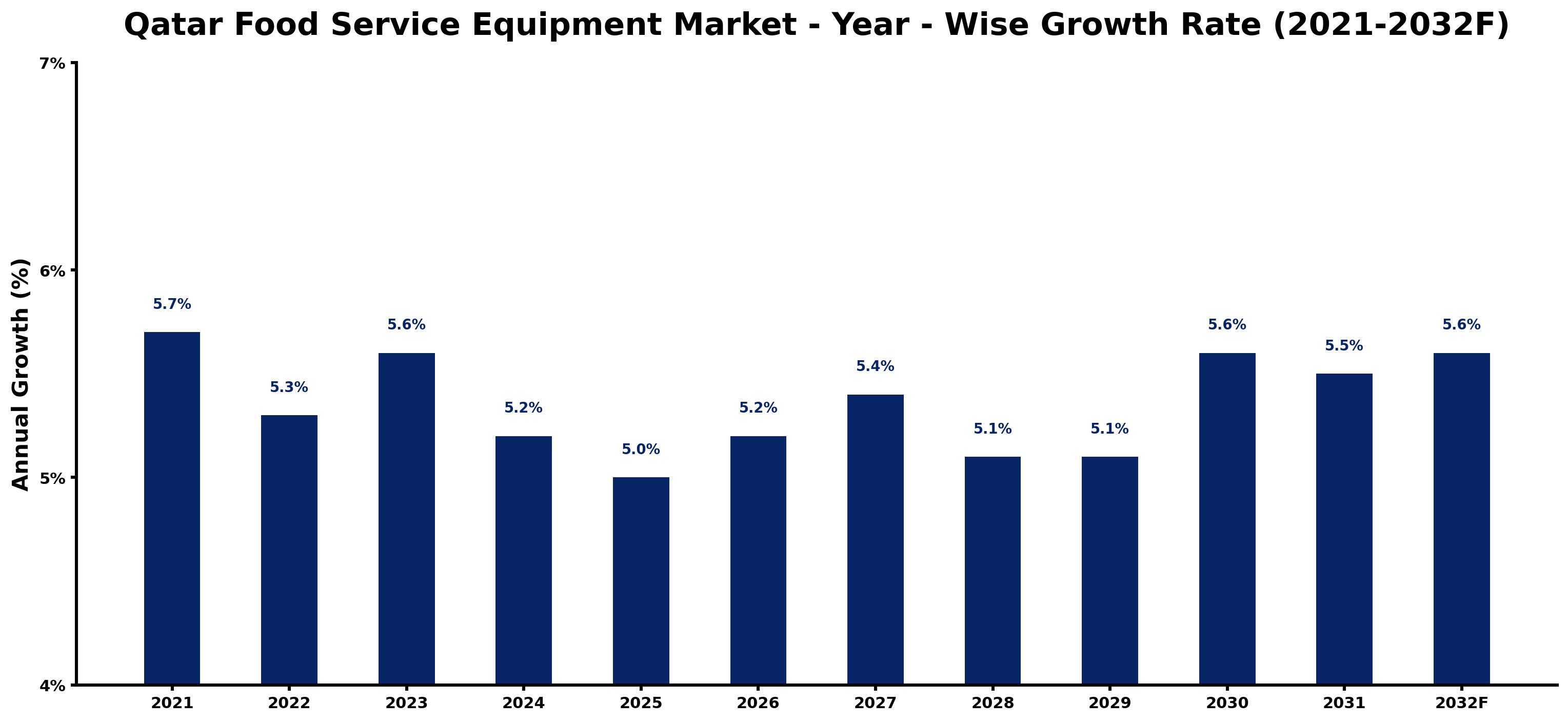
The table below presents the year wise growth rates along with the key drivers influencing the market
| Year | Growth Rate | Major Drivers |
| 2021 | 5.7% | Post-lockdown retail projects are boosting the demand for food service equipment. |
| 2022 | 5.3% | Hospitality sector recovery has sparked investments in advanced cooking technologies. |
| 2023 | 5.6% | The influx of expatriates requires more diverse culinary offerings and equipment. |
| 2024 | 5.2% | Expansion of local restaurants emphasizes the need for high-quality kitchen appliances. |
| 2025 | 5.0% | Increased tourism from major events drives the demand for innovative food solutions. |
| 2026 | 5.2% | Sustainability trends push operators towards energy-efficient food service equipment. |
| 2027 | 5.4% | Smart technology integration in kitchens enhances operational efficiency and safety. |
| 2028 | 5.1% | Corporate and social events create opportunities for catering-focused equipment sales. |
| 2029 | 5.1% | The push for local sourcing affects equipment preferences in the food industry. |
| 2030 | 5.6% | Rapid urbanization in Qatar requires scalable solutions for quick-service restaurants. |
| 2031 | 5.5% | E-commerce growth in food services highlights the importance of delivery-friendly equipment. |
| 2032 | 5.6% | Cultural diversification leads to an expansion of specialty cuisines and related equipment. |
Note - Market size estimations and growth projections presented in this report are based on 6Wresearch's advanced forecasting approach, validated with industry datasets as of June 2026.
Qatar Food Service Equipment Market Synopsis
The Qatar Food Service Equipment Market is projected to reach 5.2% and witness significant growth during the forecast period (2026-2032). This market encompasses a range of appliances and tools essential for the operation of commercial food service establishments, including restaurants, hotels, cafes, and catering services. Key equipment types within this sector consist of cooking appliances, refrigeration units, food preparation equipment, and dishwashers, all tailored to enhance efficiency and service quality within the foodservice industry.
Qatar Food Service Equipment Market Growth Drivers
A combination of factors is fueling the growth of the Qatar food service equipment market. Firstly, the increasing population is contributing to a heightened demand for diverse dining options, driving up the need for efficient foodservice equipment. Secondly, the ongoing expansion of the tourism sector, characterized by an influx of visitors, enhances the demand for high-quality food service in hotels and restaurants.
- Economic growth in Qatar plays a pivotal role, as rising disposable incomes lead consumers to prefer dining out and using food delivery services, thereby creating a robust market for effective foodservice equipment.
- The shift towards urban living, coupled with evolving consumer preferences, necessitates the adoption of advanced cooking and preparation technologies capable of meeting contemporary demands.
- The hospitality sector, which is crucial to Qatar's economy, is driving investments in modern food service equipment to ensure competitive dining experiences.
- Technological advancements, particularly in energy efficiency and smart technologies, are transforming food service operations, attracting an increasing number of establishments to upgrade their equipment.
Qatar Food Service Equipment Market Challenges and Restraints
Despite significant growth opportunities, the Qatar food service equipment market faces several challenges. The high initial costs associated with purchasing and installing food service equipment can deter small and medium-sized businesses from acquiring the latest technologies.
- Continuous maintenance and upgrades are essential, presenting an ongoing financial burden for establishments that may be operating on tighter margins.
- The competitive landscape includes numerous local and international vendors, making it challenging for businesses to differentiate themselves while seeking the best value equipment.
- As sustainability gains traction, businesses are increasingly pressured to invest in eco-friendly equipment, which may be more expensive initially but is necessary for long-term viability.
- The disruptions caused by the Covid-19 pandemic highlighted vulnerabilities in supply chains, resulting in sourcing challenges and delays in the delivery of essential foodservice equipment.
Qatar Food Service Equipment Market Government Investment and Initiatives
The Qatari government recognizes the importance of a flourishing food service industry as part of its broader economic diversification goals. Investment initiatives focus on enhancing infrastructure to support the hospitality and food service sectors. Programs aimed at fostering innovation within this market encourage the adoption of modern food service technologies. Additionally, there are incentives for businesses investing in energy-efficient and sustainable equipment to promote environmental responsibility in line with Qatar National Vision 2030.
Qatar Food Service Equipment Market Latest Developments (May 2025 - June 2026)
Recent developments in the Qatar food service equipment market reveal a trend towards increased adoption of smart kitchen technologies. As businesses seek to optimize operational efficiency, smart appliances equipped with IoT capabilities are gaining traction. This period also witnessed a surge in demand for takeout and delivery-focused equipment, responding to shifts in consumer behavior influenced by the Covid-19 pandemic. The emphasis on energy efficiency and sustainability has spurred innovation among manufacturers, driving the introduction of new products designed to meet stringent environmental standards.
Qatar Food Service Equipment Market - Key Attractiveness of the Report
- 10 Years of Market Numbers
- Historical Data Starting from 2022 to 2025
- Base Year: 2025
- Forecast Data until 2032
- Key Performance Indicators Impacting the Market
- Major Upcoming Developments and Projects
Key Highlights of the Report:
- Qatar Food Service Equipment Market Outlook
- Market Size of Qatar Food Service Equipment Market, 2025
- Forecast of Qatar Food Service Equipment Market, 2032
- Historical Data and Forecast of Qatar Food Service Equipment Revenues & Volume for the Period 2022-2032F
- Qatar Food Service Equipment Market Trend Evolution
- Qatar Food Service Equipment Market Drivers and Challenges
- Qatar Food Service Equipment Price Trends
- Qatar Food Service Equipment Porter's Five Forces
- Qatar Food Service Equipment Industry Life Cycle
- Historical Data and Forecast of Qatar Food Service Equipment Market Revenues & Volume By Type for the Period 2022-2032F
- Historical Data and Forecast of Qatar Food Service Equipment Market Revenues & Volume By Cooking Equipment for the Period 2022-2032F
- Historical Data and Forecast of Qatar Food Service Equipment Market Revenues & Volume By Storage & Handling Equipment for the Period 2022-2032F
- Historical Data and Forecast of Qatar Food Service Equipment Market Revenues & Volume By Ware washing Equipment for the Period 2022-2032F
- Historical Data and Forecast of Qatar Food Service Equipment Market Revenues & Volume By Food & Beverage Preparation Equipment for the Period 2022-2032F
- Historical Data and Forecast of Qatar Food Service Equipment Market Revenues & Volume By Serving Equipment for the Period 2022-2032F
- Historical Data and Forecast of Qatar Food Service Equipment Market Revenues & Volume By End-Use for the Period 2022-2032F
- Historical Data and Forecast of Qatar Food Service Equipment Market Revenues & Volume By Full-service Restaurants & Hotels for the Period 2022-2032F
- Historical Data and Forecast of Qatar Food Service Equipment Market Revenues & Volume By Quick-service Restaurants & Pubs for the Period 2022-2032F
- Historical Data and Forecast of Qatar Food Service Equipment Market Revenues & Volume By Catering for the Period 2022-2032F
- Qatar Food Service Equipment Import Export Trade Statistics
- Market Opportunity Assessment By Type
- Market Opportunity Assessment By End-Use
- Qatar Food Service Equipment Top Companies Market Share
- Qatar Food Service Equipment Competitive Benchmarking By Technical and Operational Parameters
- Qatar Food Service Equipment Company Profiles
- Qatar Food Service Equipment Key Strategic Recommendations






































