Qatar General Merchandise Market Summary
The qatar general merchandise market was estimated at USD 224 Million in 2025 and is projected to reach USD 302 Million by 2032, growing at a CAGR of 5.0% from 2026 to 2032.
Qatar General Merchandise Market Year-wise Growth Rate and Key Drivers
This graph highlights how the Qatar General Merchandise Market has steadily grown over the past five years, supported by major growth factors.
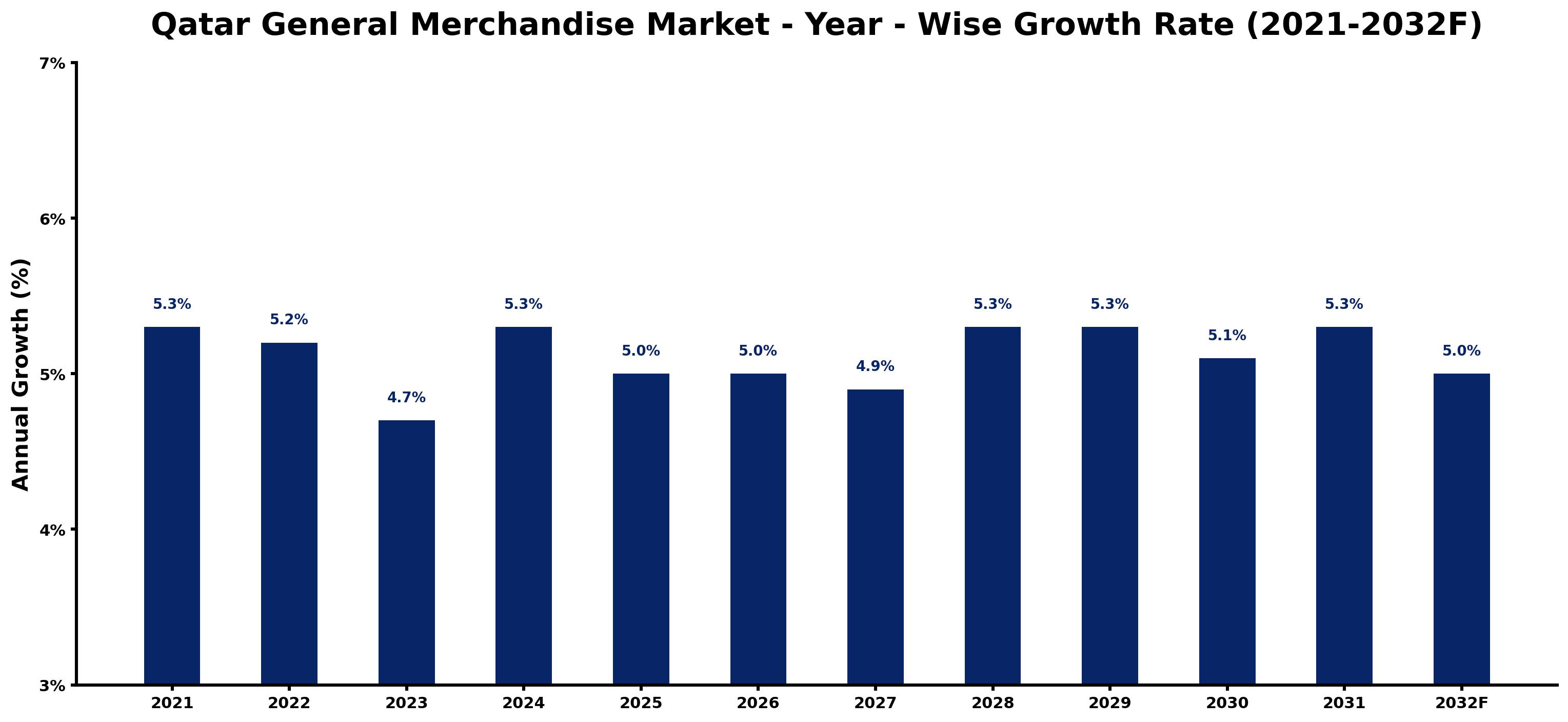
The table below presents the year wise growth rates along with the key drivers influencing the market
| Year | Growth Rate | Major Drivers |
| 2021 | 5.3% | Post-lockdown retail projects initiated a resurgence in consumer spending habits across Qatar. |
| 2022 | 5.2% | Expansion in luxury brand offerings attracted affluent consumers seeking unique shopping experiences. |
| 2023 | 4.7% | Local manufacturers began to emphasize sustainability in product development, appealing to environmentally conscious buyers. |
| 2024 | 5.3% | Digital transformation strategies gained traction, significantly enhancing e-commerce capabilities in the market. |
| 2025 | 5.0% | Major construction projects in Qatar fueled demand for home goods and interior furnishings. |
| 2026 | 5.0% | Increased tourism due to major events stimulated demand for general merchandise across various sectors. |
| 2027 | 4.9% | Emerging local entrepreneurs explored niche markets, diversifying offerings in general merchandise spaces. |
| 2028 | 5.3% | Collaborations between retailers and tech companies improved customer experience through personalized shopping solutions. |
| 2029 | 5.3% | Shifts in demographics led to a higher demand for affordable and functional merchandise options. |
| 2030 | 5.1% | Logistics improvements and infrastructure investments streamlined supply chains for quicker product availability. |
| 2031 | 5.3% | Consumer preferences increasingly leaned towards local products, bolstering domestic production and sales. |
| 2032 | 5.0% | Innovative marketing campaigns focused on cultural relevance, resonating strongly with the local population. |
Note - Market size estimations and growth projections presented in this report are based on 6Wresearch's advanced forecasting approach, validated with industry datasets as of June 2026.
Qatar General Merchandise Market Synopsis
The Qatar General Merchandise Market is projected to reach 5.0% and witness significant growth during the forecast period (2026-2032). This market encompasses a diverse array of consumer products available through retail outlets, including clothing, electronics, household goods, personal care items, toys, and other non-specialized products. As Qatar continues to develop into a regional hub for commerce and retail, the general merchandise sector is expected to expand in response to evolving consumer preferences and economic conditions.
Qatar General Merchandise Market Growth Drivers
Several key factors are propelling the growth of the Qatar General Merchandise Market. First, the nation's economic growth combined with rising disposable incomes is significantly boosting consumer spending on general merchandise items. As income levels rise, consumers are more inclined to invest in a variety of goods that enhance their lifestyles.
- The retail sector's evolution, characterized by the emergence of modern shopping malls and supermarkets, is enhancing accessibility and availability of general merchandise products across various regions in Qatar.
- Urbanization is rapidly increasing in Qatar, leading to a growing population that drives demand for consumer goods. This demographic shift is pivotal in fostering an environment ripe for retail expansion.
- The burgeoning tourism industry contributes significantly to the general merchandise market. As Qatar attracts more international visitors, there is increased demand for retail goods, particularly in hospitality sectors catering to tourists.
- Innovations in marketing and distribution channels, particularly through online platforms, are enhancing the reach of retailers in the general merchandise market, promoting both convenience and diverse product offerings.
- Furthermore, cultural events and festivals often stimulate consumer spending, further synergizing with economic growth to enhance market dynamics.
Qatar General Merchandise Market Challenges and Restraints
Despite its growth potential, the Qatar General Merchandise Market faces several challenges. One significant concern is the rise of e-commerce platforms, which may reduce foot traffic in traditional brick-and-mortar retail stores. As consumers increasingly opt for the convenience of online shopping, physical retailers must innovate to maintain relevance.
- Compliance with stringent import regulations and customs duties poses additional hurdles for international suppliers wanting to enter the general merchandise market in Qatar.
- Seasonal demand fluctuations and rapidly changing fashion trends create pressures on retailers to balance inventory and adapt product offerings in a timely manner.
- The lingering effects of the Covid-19 pandemic continue to shape consumer behavior, emphasizing the need for retailers to understand shifting spending patterns, especially towards essential items.
- Economic uncertainties and geopolitical tensions in the region may also dampen consumer confidence, affecting spending in the general merchandise sector.
- Finally, maintaining a competitive edge in product quality and pricing can be challenging due to increasing competition within the market.
Qatar General Merchandise Market Covid-19 Impact
The Covid-19 pandemic exerted considerable pressure on the Qatar General Merchandise Market, significantly altering consumer behavior during peak restrictions. Lockdowns imposed a shift in spending habits towards essential items such as food and household products, while non-essential goods saw a decline in demand. However, as restrictions eased and public confidence was gradually restored, the market is anticipated to rebound, supported by renewed consumer spending as economic activities resume.
Qatar General Merchandise Market Government Investment and Initiatives
The government of Qatar is actively investing in initiatives to bolster the general merchandise market as part of its broader economic diversification strategy. Policies have been implemented to promote retail sector growth through incentives that facilitate investments in infrastructure and logistics. Additionally, ongoing urban development projects are enhancing shopping environments nationwide, making general merchandise more accessible to consumers. The introduction of favorable trade policies and investment incentives continues to attract international retailers, thus enriching the local market landscape.
Qatar General Merchandise Market Latest Developments (May 2025 - June 2026)
Between May 2025 and June 2026, the Qatar General Merchandise Market is expected to witness pivotal developments that will shape its trajectory. Retailers are likely to adapt to changing consumer preferences, particularly in response to the trends initiated during the pandemic. Enhanced omnichannel strategies will gain focus, as businesses seek to provide seamless shopping experiences across physical and digital platforms. Additionally, there will be increased emphasis on sustainability practices, with retailers exploring eco-friendly product lines to meet the demands of environmentally conscious consumers.
Qatar General Merchandise Market - Key Attractiveness of the Report
- 10 Years of Market Numbers
- Historical Data Starting from 2022 to 2025
- Base Year: 2025
- Forecast Data until 2032
- Key Performance Indicators Impacting the Market
- Major Upcoming Developments and Projects
Key Highlights of the Report:
- Qatar General Merchandise Market Outlook
- Market Size of Qatar General Merchandise Market, 2025
- Forecast of Qatar General Merchandise Market, 2032
- Historical Data and Forecast of Qatar General Merchandise Revenues & Volume for the Period 2022-2032F
- Qatar General Merchandise Market Trend Evolution
- Qatar General Merchandise Market Drivers and Challenges
- Qatar General Merchandise Price Trends
- Qatar General Merchandise Porter's Five Forces
- Qatar General Merchandise Industry Life Cycle
- Historical Data and Forecast of Qatar General Merchandise Market Revenues & Volume By Types for the Period 2022-2032F
- Historical Data and Forecast of Qatar General Merchandise Market Revenues & Volume By Home and Furniture for the Period 2022-2032F
- Historical Data and Forecast of Qatar General Merchandise Market Revenues & Volume By Garden for the Period 2022-2032F
- Historical Data and Forecast of Qatar General Merchandise Market Revenues & Volume By Electrical for the Period 2022-2032F
- Historical Data and Forecast of Qatar General Merchandise Market Revenues & Volume By Food and Drink for the Period 2022-2032F
- Historical Data and Forecast of Qatar General Merchandise Market Revenues & Volume By Others for the Period 2022-2032F
- Historical Data and Forecast of Qatar General Merchandise Market Revenues & Volume By Applications for the Period 2022-2032F
- Historical Data and Forecast of Qatar General Merchandise Market Revenues & Volume By Supermarket for the Period 2022-2032F
- Historical Data and Forecast of Qatar General Merchandise Market Revenues & Volume By Retail market for the Period 2022-2032F
- Historical Data and Forecast of Qatar General Merchandise Market Revenues & Volume By Specialty store for the Period 2022-2032F
- Historical Data and Forecast of Qatar General Merchandise Market Revenues & Volume By E-tailer for the Period 2022-2032F
- Historical Data and Forecast of Qatar General Merchandise Market Revenues & Volume By Others for the Period 2022-2032F
- Qatar General Merchandise Import Export Trade Statistics
- Market Opportunity Assessment By Types
- Market Opportunity Assessment By Applications
- Qatar General Merchandise Top Companies Market Share
- Qatar General Merchandise Competitive Benchmarking By Technical and Operational Parameters
- Qatar General Merchandise Company Profiles
- Qatar General Merchandise Key Strategic Recommendations






































