Qatar Glass Beads Market Size, Share & Growth Rate
The Qatar Glass Beads Market was estimated at USD 374 Million in 2025 and is projected to reach USD 487 Million by 2032, growing at a CAGR of 3.8% from 2026 to 2032. This growth is predominantly fueled by a surge in infrastructure projects and a heightened emphasis on road safety measures across the nation. As Qatar advances its urbanization efforts, the construction and automotive sectors are increasingly adopting glass beads for their myriad applications.
Qatar Glass Beads Market Year-wise Growth Rate and Key Drivers
This graph highlights how the Qatar Glass Beads Market has steadily grown over the years, supported by major growth factors.
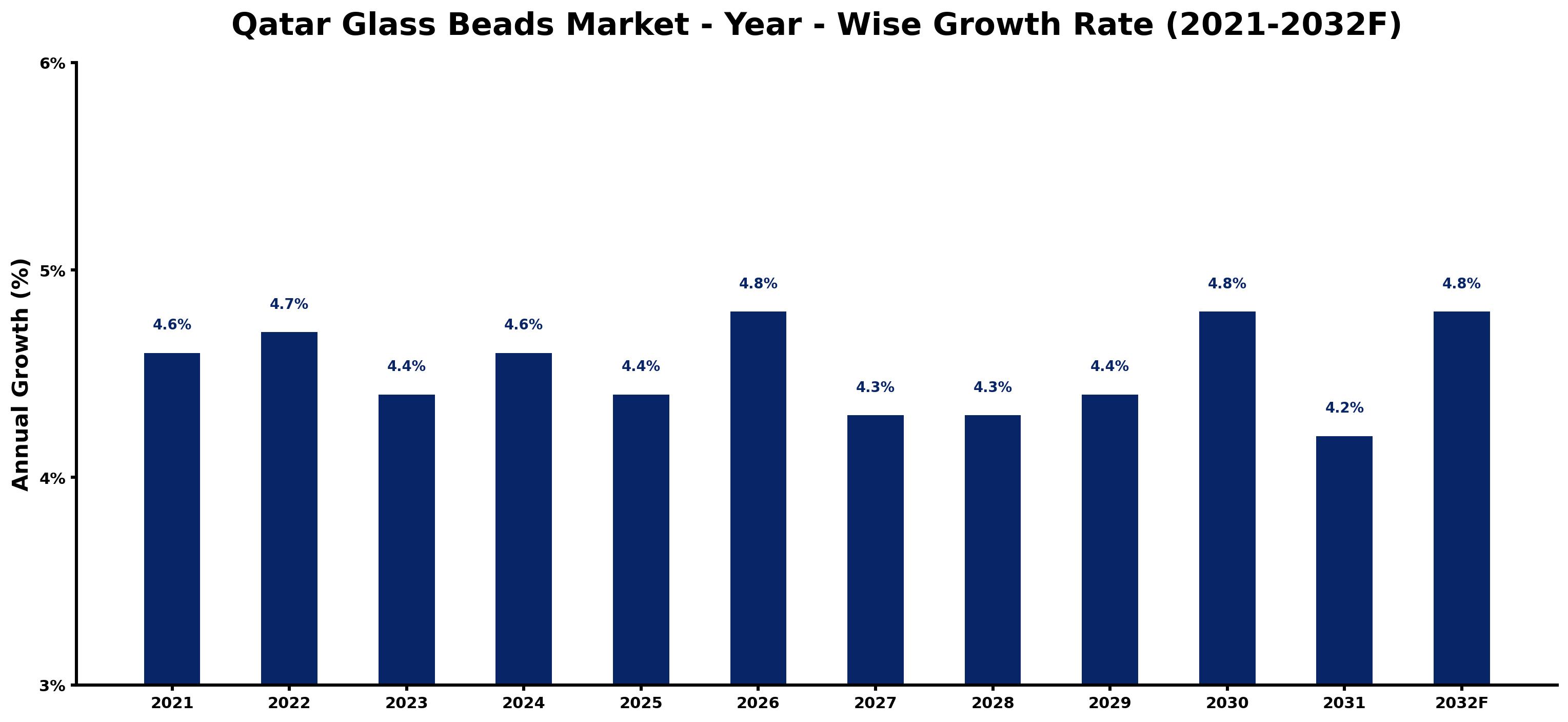
The table below presents the year‑wise growth rates along with the key drivers influencing the market
| Year | Growth Rate | Major Drivers |
| 2021 | 4.6% | Government infrastructure modernization initiatives |
| 2022 | 4.7% | Rising electricity demand across industries |
| 2023 | 4.4% | Expansion of commercial construction activities |
| 2024 | 4.6% | Rising electricity demand across industries |
| 2025 | 4.4% | Expansion of manufacturing activities |
| 2026 | 4.8% | Expansion of commercial construction activities |
| 2027 | 4.3% | Rising electricity demand across industries |
| 2028 | 4.3% | Rising electricity demand across industries |
| 2029 | 4.4% | Expansion of transportation and logistics networks |
| 2030 | 4.8% | Rising electricity demand across industries |
| 2031 | 4.2% | Growing renewable energy integration projects |
| 2032 | 4.8% | Expansion of manufacturing activities |
Note - Market size estimations and growth projections presented in this report are based on 6Wresearch's advanced forecasting approach, validated with industry datasets as of June 2026.
Qatar Glass Beads Market Synopsis
Currently, the Qatar glass beads market is expanding in response to both governmental initiatives and private sector demands. With a robust focus on enhancing road safety through reflective materials, the market has experienced significant upward momentum. Glass beads serve as crucial components in reflective road markings, industrial blasting, and various applications in construction and automotive manufacturing.
The growing realization of the advantages that glass beads offer—especially in terms of visibility and durability—has prompted various industries to integrate them into their products. This trend is further amplified by an increasing awareness of sustainability and the need for high-quality materials in the construction sector.
Qatar Glass Beads Market Key Takeaways
- The market is witnessing steady growth driven by infrastructure development and increased construction activities.
- Reflective road markings are a significant application area, enhancing road safety standards nationwide.
- The automotive industry's demand for glass beads is rising, particularly in reflective paints and coatings.
- Industry awareness of the benefits of glass beads is leading to broader adoption across various sectors.
- Challenges include competition from alternative materials and fluctuating raw material prices affecting profitability.
Evaluation of Restraints in Qatar Glass Beads Market
Despite its promising growth, the Qatar glass beads market faces several restraints that limit its full potential. Competing materials, such as thermoplastic road markings and ceramic beads, pose significant threats by offering alternative solutions that may appeal to cost-conscious end-users. Moreover, the volatility of raw material prices, primarily silica sand and soda ash, creates unpredictability for manufacturers. This fluctuation can lead to increased production costs, affecting their profit margins and overall market viability. Furthermore, the industry's dependency on the pace of construction and automotive manufacturing adds another layer of uncertainty in forecasting demand.
Qatar Glass Beads Market Trends
Emerging trends within the Qatar glass beads market include a growing focus on sustainability and eco-friendly manufacturing practices. As industries increasingly prioritize environmental considerations, the demand for recyclable materials and production processes that minimize waste is on the rise. Additionally, technological advancements are paving the way for enhanced product performance and functionality. Innovations in glass bead formulation and application methods are set to improve the quality of reflective materials, thereby expanding their utility across various sectors. The construction industry's quest for higher durability in materials is also shaping market dynamics, making glass beads a valuable addition to modern construction practices.
Qatar Glass Beads Market Opportunities
The Qatar glass beads market presents several promising growth opportunities. The ongoing government infrastructure projects, particularly those aimed at enhancing transportation networks, provide a fertile ground for glass bead applications. The automotive sector's transition towards safer vehicles equipped with advanced reflective coatings also indicates a sustained demand for glass beads. Furthermore, as public awareness regarding road safety increases, potential collaborations with government agencies and private sectors could lead to more stringent regulations promoting the use of reflective materials, further solidifying market growth.
Government Initiatives in the Qatar Glass Beads Market
The Qatari government has actively invested in enhancing infrastructure and road safety, which directly benefits the glass beads market. Initiatives include various construction projects aimed at expanding the nation's transport networks, along with regulatory measures promoting the use of reflective materials. These government policies not only aim to improve public safety but also encourage the adoption of modern technologies in road construction and maintenance. Such measures are poised to support the growth of the glass beads market while reinforcing the commitment to sustainable urban development.
Future Insights of the Qatar Glass Beads Market
Looking ahead to 2026-2032, the Qatar glass beads market is set to continue its upward trajectory, bolstered by ongoing infrastructure investments and increasing applications across industries. The sustained focus on road safety measures is expected to significantly elevate the demand for reflective road markings. Additionally, the adoption of innovative technologies in production methods is likely to enhance product quality, thus attracting more end-users. As industries prioritize safety and durability, glass beads will remain a fundamental component in various applications, ensuring a bright future for the market.
Qatar Glass Beads Market Latest Developments (May 2025 - June 2026)
Recent developments in the Qatar glass beads market indicate a proactive approach towards sustainability and innovation. Industry stakeholders are increasingly exploring partnerships with local authorities to enhance road safety through reflective materials. Furthermore, advancements in the manufacturing processes are being reported, aimed at improving the efficiency and environmental impact of glass bead production. The market is also seeing heightened interest from international suppliers looking to enter the growing Qatari infrastructure sector.
Qatar Glass Beads Market - Key Attractiveness of the Report
- 10 Years of Market Numbers
- Historical Data Starting from 2022 to 2025
- Base Year: 2025
- Forecast Data until 2032
- Key Performance Indicators Impacting the Market
- Major Upcoming Developments and Projects
Key Highlights of the Report:
- Qatar Glass Beads? Market Outlook
- Market Size of Qatar Glass Beads? Market, 2025
- Forecast of Qatar Glass Beads? Market, 2032
- Historical Data and Forecast of Qatar Glass Beads? Revenues & Volume for the Period 2022-2032F
- Qatar Glass Beads? Market Trend Evolution
- Qatar Glass Beads? Market Drivers and Challenges
- Qatar Glass Beads? Price Trends
- Qatar Glass Beads? Porter's Five Forces
- Qatar Glass Beads? Industry Life Cycle
- Historical Data and Forecast of Qatar Glass Beads? Market Revenues & Volume By Type for the Period 2022-2032F
- Historical Data and Forecast of Qatar Glass Beads? Market Revenues & Volume By Soild for the Period 2022-2032F
- Historical Data and Forecast of Qatar Glass Beads? Market Revenues & Volume By Hollow for the Period 2022-2032F
- Historical Data and Forecast of Qatar Glass Beads? Market Revenues & Volume By Other for the Period 2022-2032F
- Historical Data and Forecast of Qatar Glass Beads? Market Revenues & Volume By Application for the Period 2022-2032F
- Historical Data and Forecast of Qatar Glass Beads? Market Revenues & Volume By Reflective meterial for the Period 2022-2032F
- Historical Data and Forecast of Qatar Glass Beads? Market Revenues & Volume By Industry polishing& meterial for the Period 2022-2032F
- Historical Data and Forecast of Qatar Glass Beads? Market Revenues & Volume By Thermal insulating meterial for the Period 2022-2032F
- Historical Data and Forecast of Qatar Glass Beads? Market Revenues & Volume By Other for the Period 2022-2032F
- Qatar Glass Beads? Import Export Trade Statistics
- Market Opportunity Assessment By Type
- Market Opportunity Assessment By Application
- Qatar Glass Beads? Top Companies Market Share
- Qatar Glass Beads? Competitive Benchmarking By Technical and Operational Parameters
- Qatar Glass Beads? Company Profiles
- Qatar Glass Beads? Key Strategic Recommendations






































