Qatar Glass Fiber Reinforced Concrete Market Summary
The qatar glass fiber reinforced concrete market was estimated at USD 349 Million in 2025 and is projected to reach USD 504 Million by 2032, growing at a CAGR of 6.4% from 2026 to 2032.
Qatar Glass Fiber Reinforced Concrete Market Year-wise Growth Rate and Key Drivers
This graph highlights how the Qatar Glass Fiber Reinforced Concrete Market has steadily grown over the past five years, supported by major growth factors.
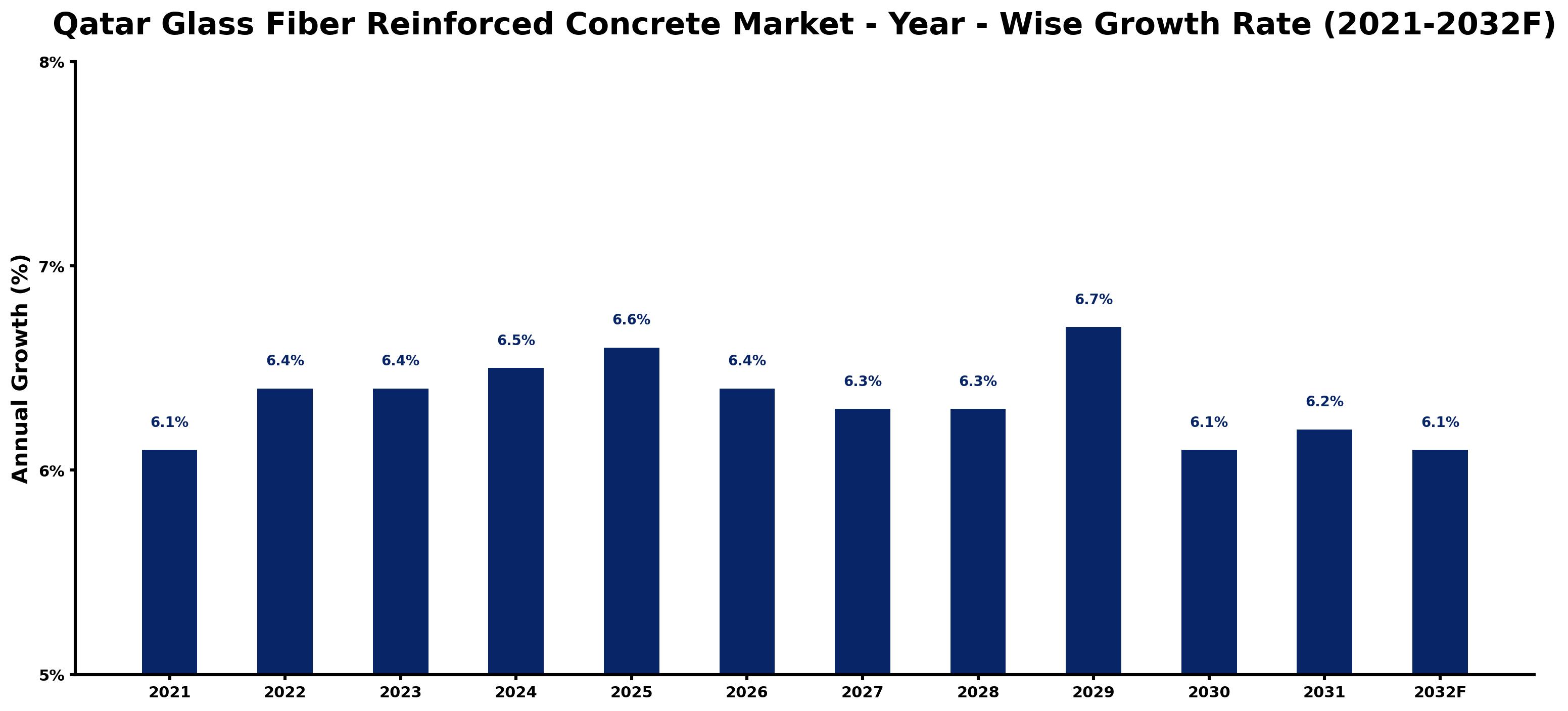
The table below presents the year wise growth rates along with the key drivers influencing the market
| Year | Growth Rate | Major Drivers |
| 2021 | 6.1% | Post-lockdown retail projects highlight the need for durable construction materials. |
| 2022 | 6.4% | Increasing urbanization drives significant infrastructure expansion across Qatar's cities. |
| 2023 | 6.4% | High temperatures necessitate materials with superior thermal resistance and durability. |
| 2024 | 6.5% | Local manufacturers are enhancing production capabilities to meet emerging market needs. |
| 2025 | 6.6% | Sustainability trends are pushing construction firms to utilize eco-friendly materials. |
| 2026 | 6.4% | Major projects, like Qatar's World Cup initiatives, require innovative construction solutions. |
| 2027 | 6.3% | The booming tourism sector elevates demand for aesthetic and resilient architectural designs. |
| 2028 | 6.3% | Regional construction pipelines emphasize advanced materials for seismic resilience. |
| 2029 | 6.7% | Collaboration between firms helps share knowledge on glass fiber technology advancements. |
| 2030 | 6.1% | Potential shifts toward modular construction influence material preferences among contractors. |
| 2031 | 6.2% | Increasing local craftsmanship fosters a unique blend of tradition and modern techniques. |
| 2032 | 6.1% | Market players invest in research, enhancing performance characteristics of existing products. |
Note - Market size estimations and growth projections presented in this report are based on 6Wresearch's advanced forecasting approach, validated with industry datasets as of June 2026.
Qatar Glass Fiber Reinforced Concrete Market Synopsis
The Qatar Glass Fiber Reinforced Concrete Market is projected to reach 6.4% and witness significant growth during the forecast period (2026-2032). As an engineered building material, glass fiber reinforced concrete (GFRC) is composed of high-strength glass fibers embedded within a concrete matrix, providing a lightweight solution with superior strength characteristics. The increasing demand for durable and lightweight construction materials is fueling the expansion of the Qatar Glass Fiber Reinforced Concrete Market. Furthermore, urbanization and rising infrastructure development projects in the region are additional factors bolstering market growth during this period.
Qatar Glass Fiber Reinforced Concrete Market Growth Drivers
The growth of the Qatar Glass Fiber Reinforced Concrete Market is primarily driven by several key factors:
- The construction industry's increasing demand for lightweight materials enhances the structural integrity of buildings by reducing the dead load on foundations.
- GFRC offers exceptional strength characteristics, allowing structures to withstand dynamic loading up to ten times higher than traditional concrete, a crucial attribute for earthquake-prone regions.
- The material's versatility enables its application across a wide range of construction projects, including residential, commercial, and infrastructural developments.
- Ongoing public and private sector investments in infrastructure projects in Qatar contribute significantly to the demand for innovative and efficient building materials like GFRC.
- The enhanced aesthetic appeal provided by GFRC, which can be molded into various shapes and finishes, attracts architects and designers looking for creative solutions in modern constructions.
Qatar Glass Fiber Reinforced Concrete Market Challenges and Restraints
Despite its promising growth prospects, the Qatar Glass Fiber Reinforced Concrete Market faces certain challenges:
- Fluctuations in the prices of raw materials, such as cement, resin, calcium carbonate, and alkali-resistant glass fibers, can escalate production costs, thereby constraining market growth.
- The reliance on imported components for GFRC production can lead to higher costs and create vulnerability to global supply chain disruptions.
- A lack of awareness and understanding among contractors regarding the benefits of GFRC over traditional concrete may hinder market penetration and adoption rates.
- The technical expertise required for manufacturing high-quality GFRC is limited in certain areas, impacting the overall efficiency and productivity of local suppliers.
- Market participants may face regulatory challenges that affect the introduction of new GFRC products and innovations, potentially slowing down development in this segment.
Qatar Glass Fiber Reinforced Concrete Market Government Investment and Initiatives
The government of Qatar is actively investing in infrastructure development, which directly influences the Glass Fiber Reinforced Concrete Market. Significant public spending is directed towards projects that enhance the nation's urban landscape, such as housing, transportation, and public facilities. Initiatives aimed at diversifying the economy include plans for sustainable construction, where GFRC's lightweight and durable properties align well with these goals. Additionally, governmental support for research and development in advanced construction materials is expected to pave the way for more widespread adoption and innovation in GFRC applications, ultimately enhancing the overall market landscape.
Qatar Glass Fiber Reinforced Concrete Market Latest Developments (May 2025 - June 2026)
Recent developments in the Qatar Glass Fiber Reinforced Concrete Market indicate a robust shift towards innovative construction practices. The industry is witnessing heightened interest in GFRC due to its ability to meet contemporary architectural demands while adhering to sustainability standards. Ongoing infrastructure projects are set to leverage GFRC for its efficient construction timelines and cost-effectiveness. Various stakeholders in the construction sector are actively collaborating to enhance the performance and adaptability of GFRC, ensuring its suitability across diverse climatic conditions and applications. This focus on collaboration is expected to result in a more resilient and competitive market environment by the end of the forecast period.
Qatar Glass Fiber Reinforced Concrete Market - Key Attractiveness of the Report
- 10 Years of Market Numbers
- Historical Data Starting from 2022 to 2025
- Base Year: 2025
- Forecast Data until 2032
- Key Performance Indicators Impacting the Market
- Major Upcoming Developments and Projects
Key Highlights of the Report:
- Qatar Glass Fiber Reinforced Concrete Market Outlook
- Market Size of Qatar Glass Fiber Reinforced Concrete Market, 2025
- Forecast of Qatar Glass Fiber Reinforced Concrete Market, 2032
- Historical Data and Forecast of Qatar Glass Fiber Reinforced Concrete Revenues & Volume for the Period 2022-2032F
- Qatar Glass Fiber Reinforced Concrete Market Trend Evolution
- Qatar Glass Fiber Reinforced Concrete Market Drivers and Challenges
- Qatar Glass Fiber Reinforced Concrete Price Trends
- Qatar Glass Fiber Reinforced Concrete Porter's Five Forces
- Qatar Glass Fiber Reinforced Concrete Industry Life Cycle
- Historical Data and Forecast of Qatar Glass Fiber Reinforced Concrete Market Revenues & Volume By Process for the Period 2022-2032F
- Historical Data and Forecast of Qatar Glass Fiber Reinforced Concrete Market Revenues & Volume By Spray for the Period 2022-2032F
- Historical Data and Forecast of Qatar Glass Fiber Reinforced Concrete Market Revenues & Volume By Premix for the Period 2022-2032F
- Historical Data and Forecast of Qatar Glass Fiber Reinforced Concrete Market Revenues & Volume By Hybrid for the Period 2022-2032F
- Historical Data and Forecast of Qatar Glass Fiber Reinforced Concrete Market Revenues & Volume By Applications for the Period 2022-2032F
- Historical Data and Forecast of Qatar Glass Fiber Reinforced Concrete Market Revenues & Volume By Architecture for the Period 2022-2032F
- Historical Data and Forecast of Qatar Glass Fiber Reinforced Concrete Market Revenues & Volume By Civil Construction for the Period 2022-2032F
- Historical Data and Forecast of Qatar Glass Fiber Reinforced Concrete Market Revenues & Volume By Engineering for the Period 2022-2032F
- Historical Data and Forecast of Qatar Glass Fiber Reinforced Concrete Market Revenues & Volume By Commercial for the Period 2022-2032F
- Historical Data and Forecast of Qatar Glass Fiber Reinforced Concrete Market Revenues & Volume By Residential for the Period 2022-2032F
- Historical Data and Forecast of Qatar Glass Fiber Reinforced Concrete Market Revenues & Volume By Building for the Period 2022-2032F
- Historical Data and Forecast of Qatar Glass Fiber Reinforced Concrete Market Revenues & Volume By Defense for the Period 2022-2032F
- Historical Data and Forecast of Qatar Glass Fiber Reinforced Concrete Market Revenues & Volume By Others for the Period 2022-2032F
- Qatar Glass Fiber Reinforced Concrete Import Export Trade Statistics
- Market Opportunity Assessment By Process
- Market Opportunity Assessment By Applications
- Qatar Glass Fiber Reinforced Concrete Top Companies Market Share
- Qatar Glass Fiber Reinforced Concrete Competitive Benchmarking By Technical and Operational Parameters
- Qatar Glass Fiber Reinforced Concrete Company Profiles
- Qatar Glass Fiber Reinforced Concrete Key Strategic Recommendations






































