Qatar Grape Wine Lees Market Size, Share & Growth Rate
The Qatar Grape Wine Lees Market was estimated at USD 247 Million in 2025 and is projected to reach USD 334 Million by 2032, growing at a CAGR of 4.4% from 2026 to 2032. This growth trajectory is driven by an emerging appreciation for wine culture, characterized by increased consumption of artisanal products and heightened consumer interest in innovative uses for grape wine lees. As the market matures, businesses are recognizing the potential of these byproducts in diverse applications ranging from culinary uses to cosmetic formulations.
Qatar Grape Wine Lees Market Year-wise Growth Rate and Key Drivers
This graph highlights how the Qatar Grape Wine Lees Market has steadily grown over the years, supported by major growth factors.
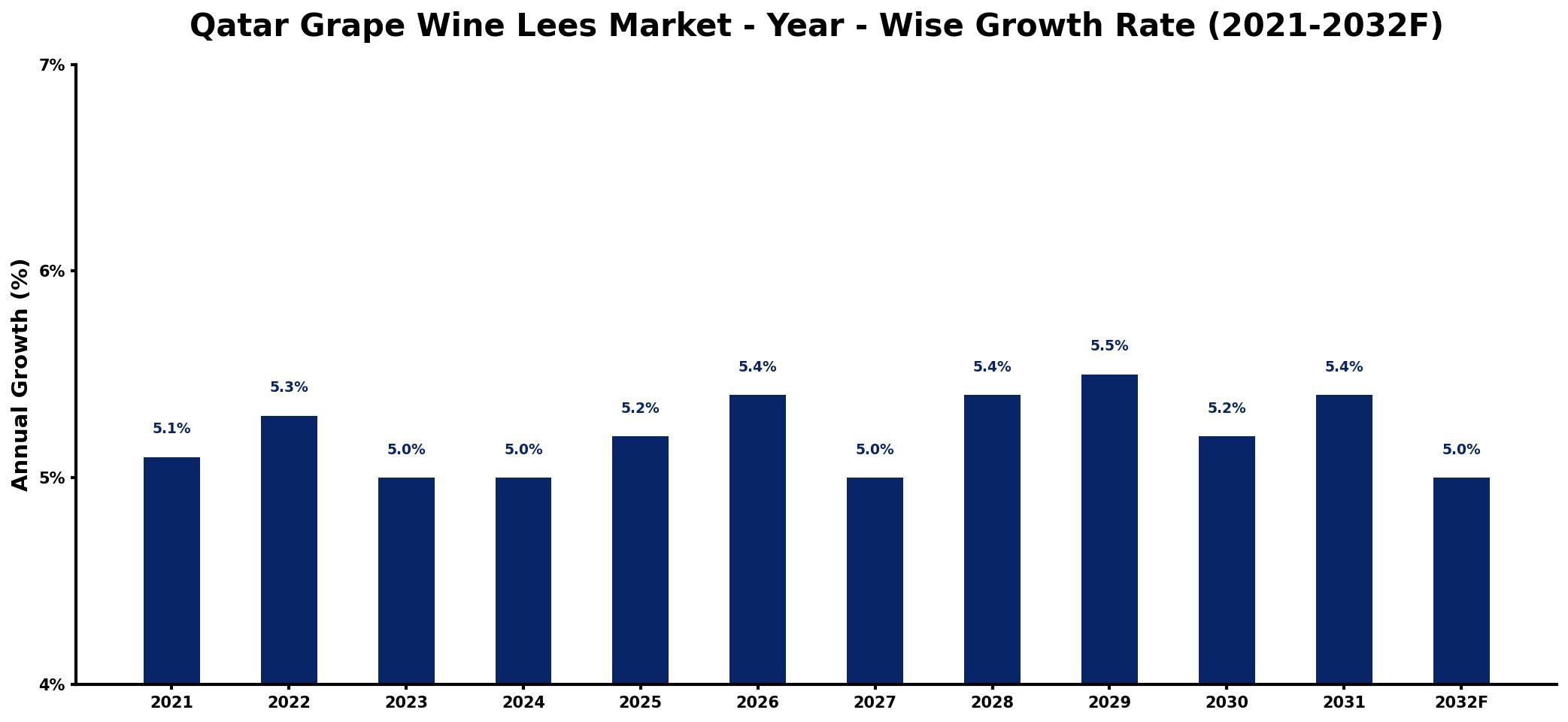
The table below presents the year‑wise growth rates along with the key drivers influencing the market
| Year | Growth Rate | Major Drivers |
| 2021 | 5.1% | Rising consumer interest in alternatives |
| 2022 | 5.3% | Increased production capabilities established |
| 2023 | 5.0% | Expansion of local distribution networks |
| 2024 | 5.0% | Growing popularity of sustainable practices |
| 2025 | 5.2% | Emergence of new market segments |
| 2026 | 5.4% | Strengthened partnerships with suppliers |
| 2027 | 5.0% | Investments in innovative processing technologies |
| 2028 | 5.4% | Enhanced marketing strategies deployed |
| 2029 | 5.5% | Diversification of product offerings available |
| 2030 | 5.2% | Strengthened export opportunities identified |
| 2031 | 5.4% | Growing trend of premium products |
| 2032 | 5.0% | Rising demand for organic solutions |
Note: Market size estimations and growth projections presented in this report are based on 6Wresearch's proprietary forecasting methodology, utilizing the latest available industry data, government publications, and primary research inputs.
Qatar Grape Wine Lees Market Synopsis
In recent years, the Qatar Grape Wine Lees Market has started to gain traction, reflecting a broader shift towards a more sophisticated wine culture within the region. With an increase in boutique wineries, grape wine lees are becoming more accessible, presenting exciting opportunities for local entrepreneurs and product developers alike.
The exploration of grape wine lees for various applications, particularly in food additives and cosmetic products, is indicative of the industry's adaptability. As consumer preferences evolve, the market is witnessing a growing demand for unique, premium ingredients that align with health-conscious lifestyles, thus positioning grape wine lees as a valuable asset in multiple sectors.
Qatar Grape Wine Lees Market Key Takeaways
- Consumer awareness and appreciation for fine wines are expanding, driving the demand for grape wine lees.
- Innovative applications in culinary and cosmetic industries are propelling market growth.
- The rise of artisanal wineries is facilitating a broader availability of grape wine lees products.
- Health-conscious consumers are increasingly drawn to the potential benefits of grape-derived products.
- The gradual recovery of the hospitality sector is expected to support increased production and sales of grape wine lees.
Evaluation of Restraints in Qatar Grape Wine Lees Market
Despite its growth potential, the Qatar Grape Wine Lees Market faces notable challenges that hinder its expansion. One significant barrier is the limited consumer awareness of grape wine lees and their applications. Many potential buyers may not fully understand the benefits or versatility of these byproducts, necessitating targeted educational efforts to build interest and stimulate demand. Additionally, regulatory constraints concerning alcohol sales and imports may affect the market dynamics and accessibility of raw materials, which can further complicate growth strategies for companies involved.
Qatar Grape Wine Lees Market Trends
Several current and emerging trends are shaping the Qatar Grape Wine Lees Market. A significant trend is the growing consumer focus on sustainability, pushing wineries to explore eco-friendly practices, including the valorization of byproducts like grape wine lees. Additionally, the rise of wellness trends encourages the use of natural ingredients in food and beauty products, driving demand for grape-derived substances. The innovative integration of grape wine lees into culinary recipes and skincare formulations is gaining momentum, attracting a niche but enthusiastic consumer base.
Qatar Grape Wine Lees Market Opportunities
There are substantial growth and investment opportunities within the Qatar Grape Wine Lees Market. Companies can leverage the increasing demand for unique culinary experiences by developing gourmet food products that highlight grape wine lees. Additionally, the cosmetic industry presents a burgeoning avenue for innovation, as consumers increasingly seek products that harness natural ingredients. Establishing collaborations with local artisans and food producers can also enhance market presence and stimulate interest in grape wine lees.
Government Initiatives in the Qatar Grape Wine Lees Market
The Qatari government is gradually recognizing the potential of a thriving wine industry, as evidenced by recent initiatives aimed at fostering local production and consumption. Policies aimed at improving tourism and hospitality sectors indirectly support the grape wine lees market by enhancing the overall wine culture. Furthermore, there are efforts to promote sustainable agricultural practices, which can facilitate the development of a more integrated supply chain for grape byproducts.
Future Insights of the Qatar Grape Wine Lees Market
Looking ahead to the period from 2026 to 2032, the Qatar Grape Wine Lees Market is poised for significant transformation. As local production ramps up and consumer interest continues to grow, we expect the market to witness increased diversification in product offerings. A shift towards more innovative and sustainable uses of grape wine lees will likely emerge, coupled with an expansion in awareness driven by culinary and beauty influencers. This alignment of market forces suggests a promising future filled with potential for both established players and new entrants in the sector.
Qatar Grape Wine Lees Market Latest Developments (2025 - 2026)
In the most recent developments, the Qatar Grape Wine Lees Market is seeing a surge in interest from local businesses looking to capitalize on the versatility of grape wine lees. Innovations in product formulation are emerging, with culinary applications gaining traction among chefs and home cooks alike. Meanwhile, the cosmetic industry is beginning to embrace these byproducts for their potential skincare benefits. The ongoing recovery of the hospitality sector is expected to create new avenues for the promotion and utilization of grape wine lees, reinforcing its presence in the market.
Qatar Grape Wine Lees Market - Key Attractiveness of the Report
- 10 Years of Market Numbers
- Historical Data Starting from 2022 to 2025
- Base Year: 2025
- Forecast Data until 2032
- Key Performance Indicators Impacting the Market
- Major Upcoming Developments and Projects
Key Highlights of the Report:
- Qatar Grape Wine Lees Market Outlook
- Market Size of Qatar Grape Wine Lees Market, 2025
- Forecast of Qatar Grape Wine Lees Market, 2032
- Historical Data and Forecast of Qatar Grape Wine Lees Revenues & Volume for the Period 2022-2032F
- Qatar Grape Wine Lees Market Trend Evolution
- Qatar Grape Wine Lees Market Drivers and Challenges
- Qatar Grape Wine Lees Price Trends
- Qatar Grape Wine Lees Porter's Five Forces
- Qatar Grape Wine Lees Industry Life Cycle
- Historical Data and Forecast of Qatar Grape Wine Lees Market Revenues & Volume By Vinification for the Period 2022-2032F
- Historical Data and Forecast of Qatar Grape Wine Lees Market Revenues & Volume By First Fermentation Lees for the Period 2022-2032F
- Historical Data and Forecast of Qatar Grape Wine Lees Market Revenues & Volume By Second Fermentation Lees for the Period 2022-2032F
- Historical Data and Forecast of Qatar Grape Wine Lees Market Revenues & Volume By Aging Wine Lees for the Period 2022-2032F
- Historical Data and Forecast of Qatar Grape Wine Lees Market Revenues & Volume By Particle Size for the Period 2022-2032F
- Historical Data and Forecast of Qatar Grape Wine Lees Market Revenues & Volume By Heavy Lees for the Period 2022-2032F
- Historical Data and Forecast of Qatar Grape Wine Lees Market Revenues & Volume By Light Lees for the Period 2022-2032F
- Qatar Grape Wine Lees Import Export Trade Statistics
- Market Opportunity Assessment By Vinification
- Market Opportunity Assessment By Particle Size
- Qatar Grape Wine Lees Top Companies Market Share
- Qatar Grape Wine Lees Competitive Benchmarking By Technical and Operational Parameters
- Qatar Grape Wine Lees Company Profiles
- Qatar Grape Wine Lees Key Strategic Recommendations






































