Qatar Greenhouse, Nursery, And Flowers Market Size, Share & Growth Rate
The Qatar Greenhouse, Nursery, And Flowers Market was estimated at USD 149 Million in 2025 and is projected to reach USD 163 Million by 2032, growing at a CAGR of 1.3% from 2026 to 2032. This growth trajectory is fueled by an increasing appreciation for landscaping and ornamental gardening, along with government initiatives aimed at urban beautification. Home gardening trends are also encouraging a stronger demand for quality nursery plants and flowers in both residential and commercial settings.
Qatar Greenhouse, Nursery, And Flowers Market Year-wise Growth Rate and Key Drivers
This graph highlights how the Qatar Greenhouse, Nursery, And Flowers Market has steadily grown over the years, supported by major growth factors.
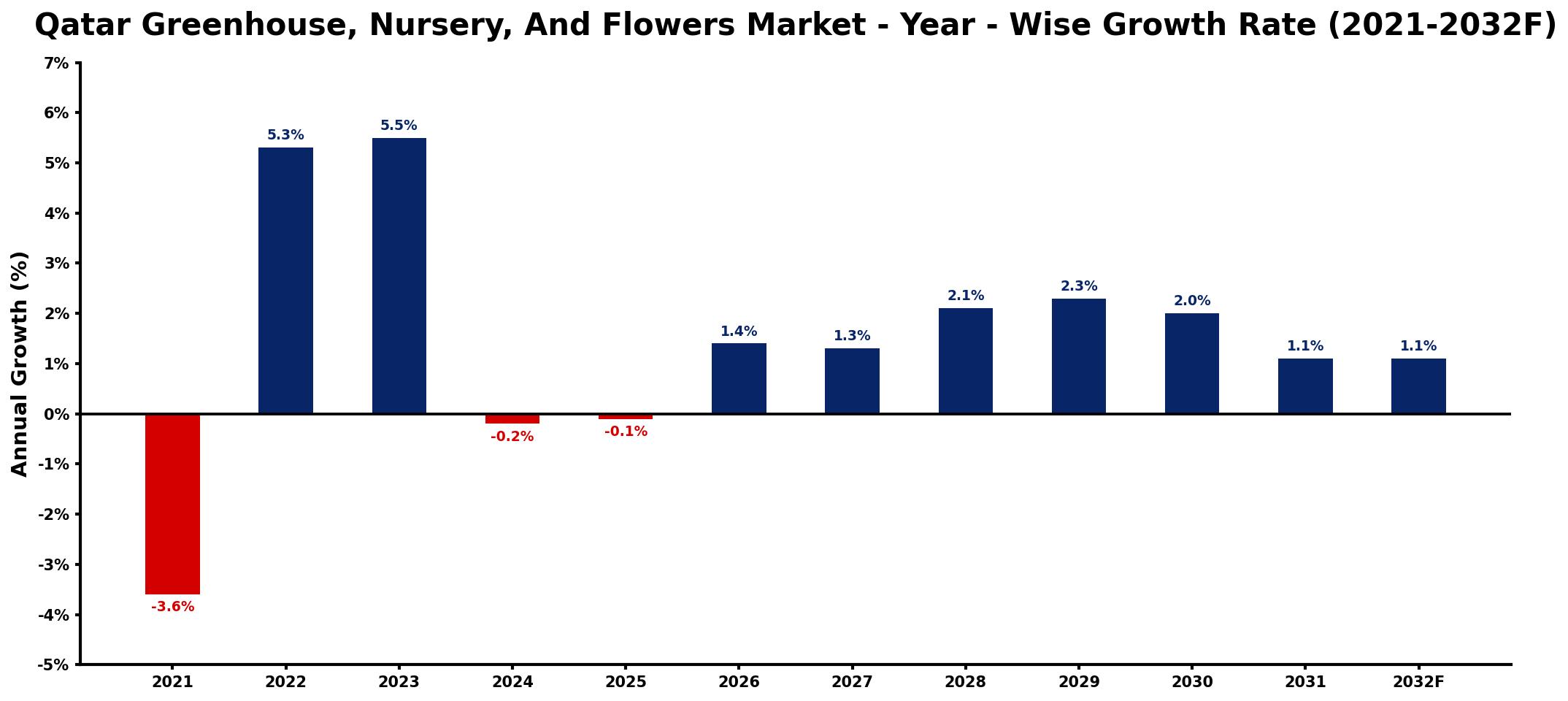
The table below presents the year‑wise growth rates along with the key drivers influencing the market
| Year | Growth Rate | Major Drivers |
| 2021 | -3.6% | decreased consumer spending on landscaping |
| 2022 | 5.3% | increased investment in sustainable gardening |
| 2023 | 5.5% | expansion of urban gardening initiatives |
| 2024 | -0.2% | reduction in commercial landscaping projects |
| 2025 | -0.1% | decline in landscaping service demand |
| 2026 | 1.4% | growth in eco-friendly gardening practices |
| 2027 | 1.3% | rise in residential gardening popularity |
| 2028 | 2.1% | enhanced focus on local sourcing |
| 2029 | 2.3% | development of new gardening technologies |
| 2030 | 2.0% | increased interest in vertical gardening |
| 2031 | 1.1% | growth of community gardening programs |
| 2032 | 1.1% | strengthening international trade flows |
Note: Market size estimations and growth projections presented in this report are based on 6Wresearch's proprietary forecasting methodology, utilizing the latest available industry data, government publications, and primary research inputs.
Qatar Greenhouse, Nursery, And Flowers Market Synopsis
The primary force shaping the Qatar Greenhouse, Nursery, And Flowers Market is the government's vigorous push for enhancing urban greenery. This initiative aligns with Qatar's vision for a more sustainable and aesthetically pleasing environment, propelling demand for nursery products and ornamental plants. Furthermore, the cultural shift towards appreciating greenery as an essential aspect of home aesthetics is solidifying market potential.
In addition, the surge in home gardening and landscaping practices among Qatar's residents signifies a burgeoning interest in horticulture. The controlled environments provided by greenhouses enhance the quality and diversity of offerings, thereby catering to both seasoned gardeners and novices alike. This multifaceted growth environment presents ample opportunities for market participants willing to innovate and adapt.
Qatar Greenhouse, Nursery, And Flowers Market Key Takeaways
- Government initiatives play a pivotal role in driving demand for greenhouse and nursery products.
- Rising trends in home gardening and landscaping are significantly contributing to market expansion.
- The quality of greenhouse-grown plants is enhancing customer satisfaction and broadening the market.
- Heightened awareness of the psychological benefits of greenery is encouraging indoor plant purchases.
- Market players are focusing on sustainability and diversification of product offerings to cater to changing consumer preferences.
Evaluation of Restraints in Qatar Greenhouse, Nursery, And Flowers Market
While the Qatar Greenhouse, Nursery, And Flowers Market showcases promising growth, it faces several restraints that may hinder full potential. Seasonality impacts demand fluctuations, which can complicate inventory management. Additionally, evolving consumer preferences necessitate adaptability in product offerings, presenting challenges in forecasting trends. Lastly, establishing a sustainable supply chain for nursery products remains a critical consideration for market participants striving for both profitability and environmental responsibility.
Qatar Greenhouse, Nursery, And Flowers Market Trends
Current trends in the Qatar Greenhouse, Nursery, And Flowers Market highlight an increasing preference for sustainable practices and organic products. Eco-friendly gardening is rapidly gaining traction, influencing consumer purchases and prompting suppliers to offer greener alternatives. Furthermore, the rise of technology in horticulture, such as smart greenhouses and automated systems, is changing how plants are cultivated and managed. Consumers are also showing a greater interest in indigenous plants, which require less water and maintenance, further shaping market demand.
Qatar Greenhouse, Nursery, And Flowers Market Opportunities
The Qatar Greenhouse, Nursery, And Flowers Market holds a wealth of opportunities for growth and investment. As urban spaces continue to expand, there is a pronounced need for ornamental plants and landscaping solutions. Collaborations with local authorities on beautification projects can yield fruitful partnerships. Additionally, the increasing popularity of e-commerce presents a chance for businesses to reach consumers directly, providing convenient access to a wider range of products. By diversifying product lines to include organic and sustainable options, market players can attract environmentally conscious consumers.
Government Initiatives in the Qatar Greenhouse, Nursery, And Flowers Market
The Qatari government has undertaken several initiatives aimed at enhancing urban greenery and promoting sustainable landscaping practices. Programs focusing on public parks and gardens, as well as incentives for private landscaping projects, are creating a conducive environment for market growth. Such policies not only reflect a commitment to beautifying urban spaces but also support local nurseries and greenhouse operations, encouraging the cultivation of diverse plant species that are well-suited to the local climate.
Future Insights of the Qatar Greenhouse, Nursery, And Flowers Market
Looking ahead to 2026-2032, the Qatar Greenhouse, Nursery, And Flowers Market is poised for gradual yet steady growth. The continued urbanization of Qatar, coupled with an unwavering commitment to sustainability, will drive demand for high-quality nursery plants. As consumer preferences evolve towards more personalized and eco-friendly options, market participants who adapt to these trends will likely thrive. This evolving landscape will also encourage innovation in greenhouse technologies, enhancing productivity and ensuring sustainable practices.
Qatar Greenhouse, Nursery, And Flowers Market Latest Developments (2025 - 2026)
Recent developments in the Qatar greenhouse, nursery, and flowers market indicate a noticeable shift towards integrating technology with traditional horticulture. Companies are exploring e-commerce platforms to enhance customer reach, while innovations in greenhouse technology aim to improve efficiency and product quality. Furthermore, collaborations between private and public sectors are becoming more common, focusing on large-scale landscaping projects designed to beautify urban settings and promote community engagement with nature.
Qatar Greenhouse, Nursery, And Flowers Market - Key Attractiveness of the Report
- 10 Years of Market Numbers
- Historical Data Starting from 2022 to 2025
- Base Year: 2025
- Forecast Data until 2032
- Key Performance Indicators Impacting the Market
- Major Upcoming Developments and Projects
Key Highlights of the Report:
- Qatar Greenhouse, Nursery, And Flowers Market Outlook
- Market Size of Qatar Greenhouse, Nursery, And Flowers Market, 2025
- Forecast of Qatar Greenhouse, Nursery, And Flowers Market, 2032
- Historical Data and Forecast of Qatar Greenhouse, Nursery, And Flowers Revenues & Volume for the Period 2022-2032F
- Qatar Greenhouse, Nursery, And Flowers Market Trend Evolution
- Qatar Greenhouse, Nursery, And Flowers Market Drivers and Challenges
- Qatar Greenhouse, Nursery, And Flowers Price Trends
- Qatar Greenhouse, Nursery, And Flowers Porter's Five Forces
- Qatar Greenhouse, Nursery, And Flowers Industry Life Cycle
- Historical Data and Forecast of Qatar Greenhouse, Nursery, And Flowers Market Revenues & Volume By Type for the Period 2022-2032F
- Historical Data and Forecast of Qatar Greenhouse, Nursery, And Flowers Market Revenues & Volume By Food Crops Grown Under Cover for the Period 2022-2032F
- Historical Data and Forecast of Qatar Greenhouse, Nursery, And Flowers Market Revenues & Volume By Nursery and Floriculture Production for the Period 2022-2032F
- Historical Data and Forecast of Qatar Greenhouse, Nursery, And Flowers Market Revenues & Volume By End-User for the Period 2022-2032F
- Historical Data and Forecast of Qatar Greenhouse, Nursery, And Flowers Market Revenues & Volume By B2B for the Period 2022-2032F
- Historical Data and Forecast of Qatar Greenhouse, Nursery, And Flowers Market Revenues & Volume By B2C for the Period 2022-2032F
- Qatar Greenhouse, Nursery, And Flowers Import Export Trade Statistics
- Market Opportunity Assessment By Type
- Market Opportunity Assessment By End-User
- Qatar Greenhouse, Nursery, And Flowers Top Companies Market Share
- Qatar Greenhouse, Nursery, And Flowers Competitive Benchmarking By Technical and Operational Parameters
- Qatar Greenhouse, Nursery, And Flowers Company Profiles
- Qatar Greenhouse, Nursery, And Flowers Key Strategic Recommendations






































