Qatar Grinding Mills Market Size, Share & Growth Rate
The Qatar Grinding Mills Market was estimated at USD 313 Million in 2025 and is projected to reach USD 418 Million by 2032, growing at a CAGR of 4.2% from 2026 to 2032. This growth trajectory is predominantly driven by the robust expansion of the construction and manufacturing sectors in Qatar, which is fueled by ongoing infrastructure projects and governmental initiatives aimed at economic diversification. The demand for quality processed materials, particularly in the cement and aggregates segments, is increasingly supporting the adoption of advanced grinding technologies.
Qatar Grinding Mills Market Year-wise Growth Rate and Key Drivers
This graph highlights how the Qatar Grinding Mills Market has steadily grown over the years, supported by major growth factors.
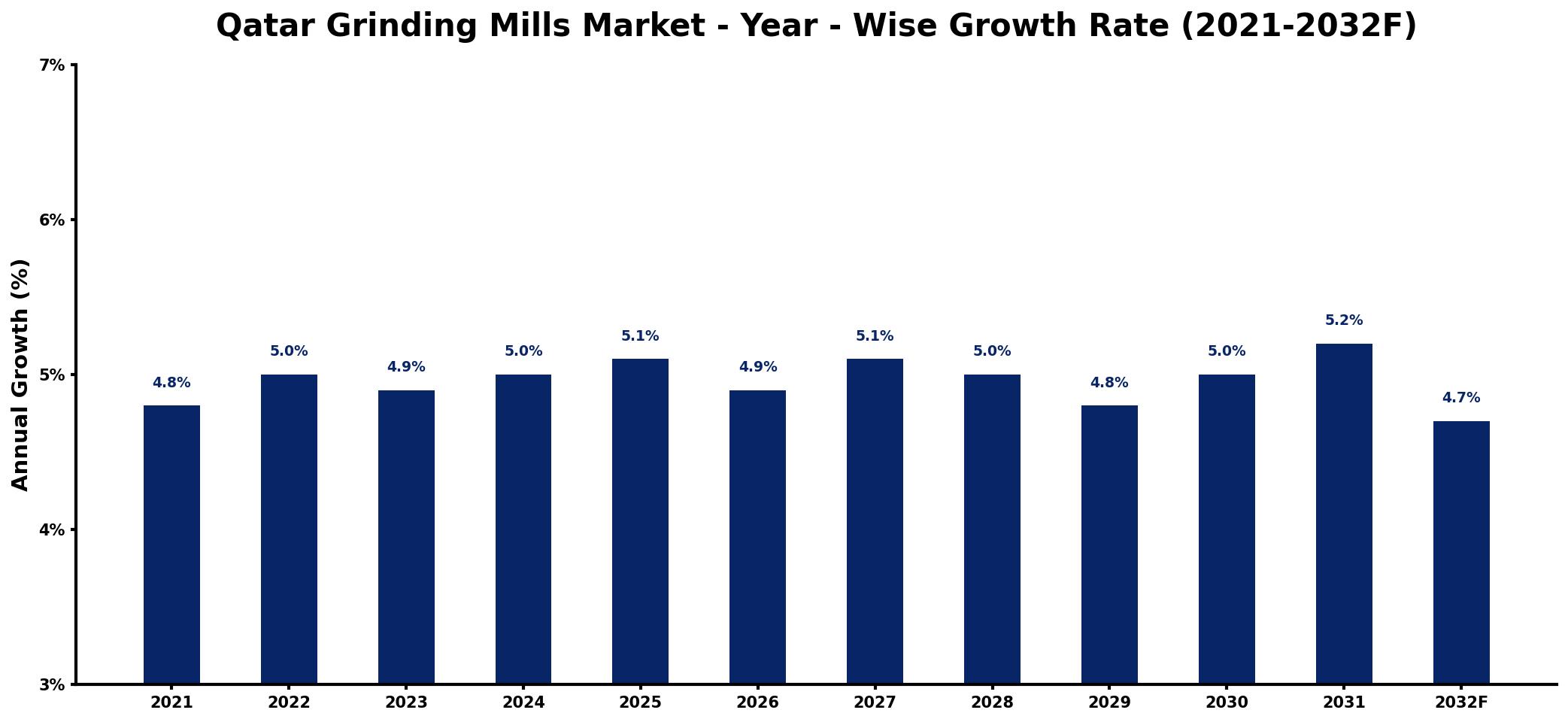
The table below presents the year‑wise growth rates along with the key drivers influencing the market
| Year | Growth Rate | Major Drivers |
| 2021 | 4.8% | Rising construction sector investments |
| 2022 | 5.0% | Food processing industry expansion |
| 2023 | 4.9% | Increased demand for materials |
| 2024 | 5.0% | Infrastructure projects driving demand |
| 2025 | 5.1% | Technological advancements in production |
| 2026 | 4.9% | Growing export markets for products |
| 2027 | 5.1% | Surge in local manufacturing initiatives |
| 2028 | 5.0% | Sustainable practices gaining traction |
| 2029 | 4.8% | Emerging markets requiring resources |
| 2030 | 5.0% | Innovations in supply chain efficiency |
| 2031 | 5.2% | Investment in renewable energy sources |
| 2032 | 4.7% | Shift towards automation technologies |
Note: Market size estimations and growth projections presented in this report are based on 6Wresearch's proprietary forecasting methodology, utilizing the latest available industry data, government publications, and primary research inputs.
Qatar Grinding Mills Market Synopsis
The foremost force shaping the Qatar Grinding Mills Market is the flourishing construction industry. As Qatar embarks on numerous infrastructural developments, the demand for effective milling solutions for cement and construction aggregates is at an all-time high. Furthermore, the government's commitment to enhancing food security is prompting investment in milling technologies for agricultural applications.
In tandem with the growing domestic market, Qatar's strategic position as a regional trade hub fosters export opportunities, subsequently bolstering the need for high-efficiency grinding mills. Key market players are actively innovating to meet these industry demands, ensuring that their offerings align with both quality and efficiency expectations.
Qatar Grinding Mills Market Key Takeaways
- Steady growth is expected due to the expanding construction and manufacturing sectors in Qatar.
- Advanced grinding technologies are increasingly being adopted to meet quality demands.
- Government initiatives support local milling capabilities, particularly in food production.
- Qatar's strategic trade position enhances export opportunities for milling products.
- Market players are innovating to address sustainability concerns and improve energy efficiency.
Evaluation of Restraints in Qatar Grinding Mills Market
While the Qatar Grinding Mills Market is on an upward trajectory, it faces certain restraints that could impede its overall growth. The industry's reliance on technology capable of processing various grains and seeds can be challenging, as it demands high versatility and innovation from manufacturers. Additionally, local milling businesses contend with competition from imported ground products, which can offer lower prices and impact market share. Sustainability concerns, particularly regarding energy consumption and waste reduction in milling processes, also loom large as significant factors that must be addressed to align with Qatar's environmental objectives.
Qatar Grinding Mills Market Trends
Emerging trends in the Qatar Grinding Mills Market include a shift towards automation and smart technologies that enhance operational efficiency. Additionally, there is a growing emphasis on environmentally friendly milling processes aimed at reducing carbon footprints. As industries increasingly prioritize sustainability, the introduction of energy-efficient grinding solutions is becoming more prevalent. Another key trend is the increasing collaboration between local businesses and international technology providers, aiming to leverage advanced innovations tailored for the Qatar market.
Qatar Grinding Mills Market Opportunities
The market presents genuine opportunities for growth and investment, particularly in the sectors of construction materials and food processing. Investments in modern grinding equipment are vital to meet the demand for high-quality processed materials. Furthermore, the government's initiatives promoting local manufacturing and food security will likely lead to increased demand for milling solutions. There is also a significant opportunity for companies that can provide sustainable and energy-efficient grinding technologies, aligning with Qatar's environmental goals.
Government Initiatives in the Qatar Grinding Mills Market
The Qatari government plays a pivotal role in shaping the grinding mills market through various initiatives aimed at economic diversification and sustainability. Policies encouraging self-sufficiency in food production are crucial, enhancing the local milling industry's capabilities. Public spending on infrastructure development not only stimulates demand for construction materials but also indirectly supports the grinding mills market. Furthermore, incentives for businesses that invest in advanced milling technologies align with the national vision of a diversified economy away from hydrocarbons.
Future Insights of the Qatar Grinding Mills Market
Looking ahead to the period from 2026 to 2032, the Qatar Grinding Mills Market is expected to continue its growth trajectory, driven by sustained infrastructure developments and an increasing focus on food security. As local industries adapt to evolving consumer demands and sustainability practices, innovative milling technologies are likely to emerge. Additionally, with Qatars commitment to enhancing its position as a trade hub, the grinding mills market will benefit from both domestic and export-driven growth, creating a dynamic landscape for stakeholders.
Qatar Grinding Mills Market Latest Developments (2025 - 2026)
Recent developments in the Qatar Grinding Mills Market indicate a robust shift toward modernization and technological advancement. Various industry participants are introducing sophisticated grinding solutions designed for enhanced efficiency and reduced environmental impact. Initiatives reflecting the governments commitment to food security have prompted expansions in local milling capabilities, ensuring a steady supply of essential products. As the sector adapts to changing market conditions, investments in innovative equipment and processes are becoming increasingly prevalent.
Qatar Grinding Mills Market - Key Attractiveness of the Report
- 10 Years of Market Numbers
- Historical Data Starting from 2022 to 2025
- Base Year: 2025
- Forecast Data until 2032
- Key Performance Indicators Impacting the Market
- Major Upcoming Developments and Projects
Key Highlights of the Report:
- Qatar Grinding Mills Market Outlook
- Market Size of Qatar Grinding Mills Market, 2025
- Forecast of Qatar Grinding Mills Market, 2032
- Historical Data and Forecast of Qatar Grinding Mills Revenues & Volume for the Period 2022-2032F
- Qatar Grinding Mills Market Trend Evolution
- Qatar Grinding Mills Market Drivers and Challenges
- Qatar Grinding Mills Price Trends
- Qatar Grinding Mills Porter's Five Forces
- Qatar Grinding Mills Industry Life Cycle
- Historical Data and Forecast of Qatar Grinding Mills Market Revenues & Volume By Types for the Period 2022-2032F
- Historical Data and Forecast of Qatar Grinding Mills Market Revenues & Volume By Wet Grinding Mills for the Period 2022-2032F
- Historical Data and Forecast of Qatar Grinding Mills Market Revenues & Volume By Dry Grinding Mills for the Period 2022-2032F
- Historical Data and Forecast of Qatar Grinding Mills Market Revenues & Volume By Applications for the Period 2022-2032F
- Historical Data and Forecast of Qatar Grinding Mills Market Revenues & Volume By Metal Mining for the Period 2022-2032F
- Historical Data and Forecast of Qatar Grinding Mills Market Revenues & Volume By Mineral Mining for the Period 2022-2032F
- Historical Data and Forecast of Qatar Grinding Mills Market Revenues & Volume By Others for the Period 2022-2032F
- Qatar Grinding Mills Import Export Trade Statistics
- Market Opportunity Assessment By Types
- Market Opportunity Assessment By Applications
- Qatar Grinding Mills Top Companies Market Share
- Qatar Grinding Mills Competitive Benchmarking By Technical and Operational Parameters
- Qatar Grinding Mills Company Profiles
- Qatar Grinding Mills Key Strategic Recommendations






































