Qatar Hams, Shoulders and Cuts of Swine Market Size, Share & Growth Rate
The Qatar Hams, Shoulders and Cuts of Swine Market was estimated at USD 366 Million in 2025 and is projected to reach USD 531 Million by 2032, growing at a CAGR of 5.5% from 2026 to 2032. This growth is predominantly fueled by the increasing demand among the expatriate community and non-Muslim residents, driven by Qatar's burgeoning hospitality sector and the diversification of its culinary offerings. As the nation continues to evolve its food landscape to cater to a global audience, the market is poised to flourish within its unique cultural framework.
Qatar Hams, Shoulders and Cuts of Swine Market Year-wise Growth Rate and Key Drivers
This graph highlights how the Qatar Hams, Shoulders and Cuts of Swine Market has steadily grown over the years, supported by major growth factors.
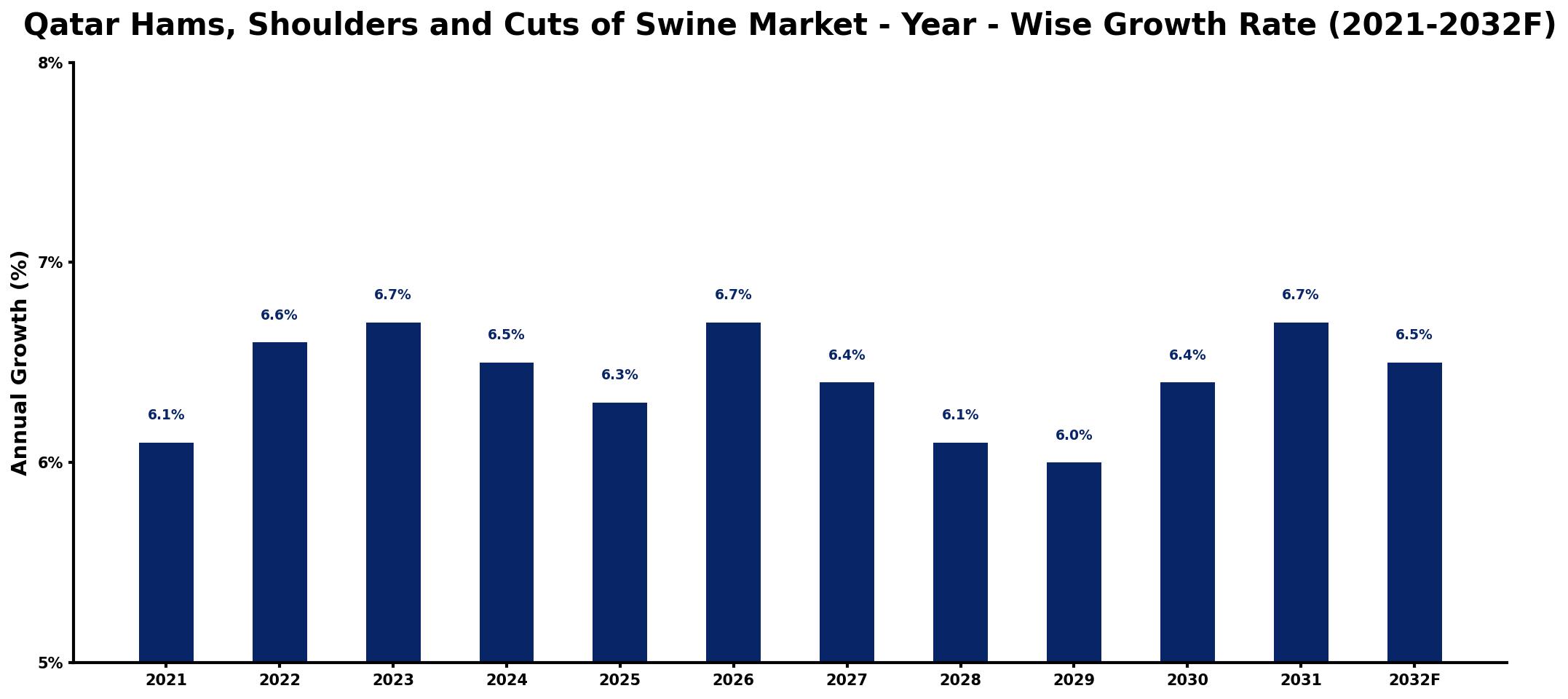
The table below presents the year‑wise growth rates along with the key drivers influencing the market
| Year | Growth Rate | Major Drivers |
| 2021 | 6.1% | Rising consumer demand for protein |
| 2022 | 6.6% | Growth in food service establishments |
| 2023 | 6.7% | Increased health consciousness among consumers |
| 2024 | 6.5% | Expansion of retail distribution channels |
| 2025 | 6.3% | Surge in e-commerce food sales |
| 2026 | 6.7% | Growing popularity of gourmet products |
| 2027 | 6.4% | Investment in sustainable farming practices |
| 2028 | 6.1% | Emergence of new culinary trends |
| 2029 | 6.0% | Strengthening of local supply chains |
| 2030 | 6.4% | Increase in food tourism activities |
| 2031 | 6.7% | Adoption of innovative processing technologies |
| 2032 | 6.5% | Collaborations between food brands |
Note: Market size estimations and growth projections presented in this report are based on 6Wresearch's proprietary forecasting methodology, utilizing the latest available industry data, government publications, and primary research inputs.
Qatar Hams, Shoulders and Cuts of Swine Market Synopsis
The most powerful force currently shaping the Qatar Hams, Shoulders and Cuts of Swine Market is the expanding diversity of its consumer base. With a substantial expatriate community and an increasing number of international tourists, the market for pork products has developed a niche that is steadily carving its path despite cultural constraints. The hospitality sector's growth is further propelling this market, introducing pork dishes into fine dining and casual settings alike.
Consumer preferences are evolving, reflecting a demand for a wider range of culinary experiences that include pork. This shift is particularly visible in urban centers, where expatriates are looking for familiar tastes from their home countries. While cultural and religious factors present inherent challenges, they simultaneously enhance the intrigue surrounding pork products, as they are perceived as exotic and appealing to non-Muslim consumers.
Qatar Hams, Shoulders and Cuts of Swine Market Key Takeaways
- The market is primarily driven by the demand from expatriate communities and non-Muslim residents.
- Growth in Qatar's hospitality sector plays a critical role in the market's expansion.
- Cultural diversity is fostering evolving consumer preferences, leading to increased demand for pork products.
- Regulatory challenges regarding the importation of pork products persist, influencing market dynamics.
- The impact of COVID-19 has led to temporary setbacks, but recovery signs are evident as supply chains stabilize.
Evaluation of Restraints in Qatar Hams, Shoulders and Cuts of Swine Market
Despite promising growth, the Qatar Hams, Shoulders and Cuts of Swine Market is fundamentally constrained by cultural and religious factors that limit the broader consumer acceptance of pork products. Islamic dietary laws prohibit pork, significantly narrowing the potential customer base primarily to expatriates and non-Muslims. Regulatory hurdles complicate import processes and add financial burdens due to taxes. Navigating these obstacles while attempting to respect cultural sensitivities remains a complex challenge for stakeholders in the market.
Qatar Hams, Shoulders and Cuts of Swine Market Trends
A notable trend in the Qatar market is the increasing popularity of gourmet pork products as international culinary influences permeate local dining experiences. High-end restaurants are introducing innovative pork dishes, catering to both curiosity and nostalgia among non-Muslim diners. Moreover, social media and food tourism are playing significant roles in shaping consumer preferences, as people share their culinary experiences and seek unique dining adventures. As consumers become more adventurous, the appetite for diverse pork offerings is set to rise further.
Qatar Hams, Shoulders and Cuts of Swine Market Opportunities
The Qatar Hams, Shoulders and Cuts of Swine Market presents genuine opportunities for growth through tailored product offerings that resonate with the expatriate demographic. Retailers can explore partnerships with international suppliers to ensure a steady flow of high-quality pork products. Furthermore, creating unique marketing campaigns that highlight the authenticity and cultural stories behind various pork dishes can enhance consumer engagement. The growing trend of culinary tourism also offers a platform for pork products to be showcased within the vibrant local dining scene.
Government Initiatives in the Qatar Hams, Shoulders and Cuts of Swine Market
The Qatari government has initiated various policies aimed at bolstering the country's food security, which indirectly affects the Hams, Shoulders and Cuts of Swine Market. Investments in the hospitality sector, along with public spending in tourism and infrastructure, support an environment conducive to international dining experiences. Regulatory frameworks are also evolving, which may eventually facilitate smoother import processes for pork products while maintaining necessary compliance with cultural standards.
Future Insights of the Qatar Hams, Shoulders and Cuts of Swine Market
Looking ahead to 2026-2032, the Qatar Hams, Shoulders and Cuts of Swine Market is anticipated to grow steadily, benefiting from demographic trends that favor increased expatriate populations and a burgeoning tourism sector. As Qatar continues to position itself as a global destination for culinary experiences, the market's resilience will likely enhance. Strategic partnerships and innovative marketing approaches will play crucial roles in navigating cultural sensitivities while capturing the appetite for pork products.
Qatar Hams, Shoulders and Cuts of Swine Market Latest Developments (2025 - 2026)
In recent months, the industry has seen a shift toward more artisanal and locally sourced pork products as consumers seek authenticity in their dining experiences. Retailers are increasingly collaborating with gourmet suppliers to offer premium cuts that cater to the adventurous palates of expatriates. Additionally, restaurant chains are expanding their menus to include a wider array of pork dishes, responding to the growing demand for diverse culinary offerings.
Qatar Hams, Shoulders and Cuts of Swine Market - Key Attractiveness of the Report
- 10 Years of Market Numbers
- Historical Data Starting from 2022 to 2025
- Base Year: 2025
- Forecast Data until 2032
- Key Performance Indicators Impacting the Market
- Major Upcoming Developments and Projects
Key Highlights of the Report:
- Qatar Hams, Shoulders and Cuts of Swine Market Outlook
- Market Size of Qatar Hams, Shoulders and Cuts of Swine Market, 2025
- Forecast of Qatar Hams, Shoulders and Cuts of Swine Market, 2032
- Historical Data and Forecast of Qatar Hams, Shoulders and Cuts of Swine Revenues & Volume for the Period 2022-2032F
- Qatar Hams, Shoulders and Cuts of Swine Market Trend Evolution
- Qatar Hams, Shoulders and Cuts of Swine Market Drivers and Challenges
- Qatar Hams, Shoulders and Cuts of Swine Price Trends
- Qatar Hams, Shoulders and Cuts of Swine Porter's Five Forces
- Qatar Hams, Shoulders and Cuts of Swine Industry Life Cycle
- Historical Data and Forecast of Qatar Hams, Shoulders and Cuts of Swine Market Revenues & Volume By Product Type for the Period 2022-2032F
- Historical Data and Forecast of Qatar Hams, Shoulders and Cuts of Swine Market Revenues & Volume By Processed Meat for the Period 2022-2032F
- Historical Data and Forecast of Qatar Hams, Shoulders and Cuts of Swine Market Revenues & Volume By Frozen Meat for the Period 2022-2032F
- Historical Data and Forecast of Qatar Hams, Shoulders and Cuts of Swine Market Revenues & Volume By Chilled Meat for the Period 2022-2032F
- Historical Data and Forecast of Qatar Hams, Shoulders and Cuts of Swine Market Revenues & Volume By Canned Meat for the Period 2022-2032F
- Historical Data and Forecast of Qatar Hams, Shoulders and Cuts of Swine Market Revenues & Volume By Fresh Meat for the Period 2022-2032F
- Historical Data and Forecast of Qatar Hams, Shoulders and Cuts of Swine Market Revenues & Volume By Animal Type for the Period 2022-2032F
- Historical Data and Forecast of Qatar Hams, Shoulders and Cuts of Swine Market Revenues & Volume By Cattle and Buffalo for the Period 2022-2032F
- Historical Data and Forecast of Qatar Hams, Shoulders and Cuts of Swine Market Revenues & Volume By Pig for the Period 2022-2032F
- Historical Data and Forecast of Qatar Hams, Shoulders and Cuts of Swine Market Revenues & Volume By Poultry for the Period 2022-2032F
- Historical Data and Forecast of Qatar Hams, Shoulders and Cuts of Swine Market Revenues & Volume By Sheep and Goat for the Period 2022-2032F
- Historical Data and Forecast of Qatar Hams, Shoulders and Cuts of Swine Market Revenues & Volume By Other Animals for the Period 2022-2032F
- Historical Data and Forecast of Qatar Hams, Shoulders and Cuts of Swine Market Revenues & Volume By Distribution Channel for the Period 2022-2032F
- Historical Data and Forecast of Qatar Hams, Shoulders and Cuts of Swine Market Revenues & Volume By Business to Consumers (B2C) for the Period 2022-2032F
- Historical Data and Forecast of Qatar Hams, Shoulders and Cuts of Swine Market Revenues & Volume By Modern Groceries for the Period 2022-2032F
- Historical Data and Forecast of Qatar Hams, Shoulders and Cuts of Swine Market Revenues & Volume By Wet & Butcher Shops for the Period 2022-2032F
- Historical Data and Forecast of Qatar Hams, Shoulders and Cuts of Swine Market Revenues & Volume By Convenience Stores for the Period 2022-2032F
- Historical Data and Forecast of Qatar Hams, Shoulders and Cuts of Swine Market Revenues & Volume By Business to Business (B2B) for the Period 2022-2032F
- Historical Data and Forecast of Qatar Hams, Shoulders and Cuts of Swine Market Revenues & Volume By Other Channel for the Period 2022-2032F
- Qatar Hams, Shoulders and Cuts of Swine Import Export Trade Statistics
- Market Opportunity Assessment By Product Type
- Market Opportunity Assessment By Animal Type
- Market Opportunity Assessment By Distribution Channel
- Qatar Hams, Shoulders and Cuts of Swine Top Companies Market Share
- Qatar Hams, Shoulders and Cuts of Swine Competitive Benchmarking By Technical and Operational Parameters
- Qatar Hams, Shoulders and Cuts of Swine Company Profiles
- Qatar Hams, Shoulders and Cuts of Swine Key Strategic Recommendations






































