Qatar Hand Carts & Trolleys Market Summary
The qatar hand carts & trolleys market was estimated at USD 694 Million in 2025 and is projected to reach USD 1015 Million by 2032, growing at a CAGR of 6.5% from 2026 to 2032.
Qatar Hand Carts & Trolleys Market Year-wise Growth Rate and Key Drivers
This graph highlights how the Qatar Hand Carts & Trolleys Market has steadily grown over the past five years, supported by major growth factors.
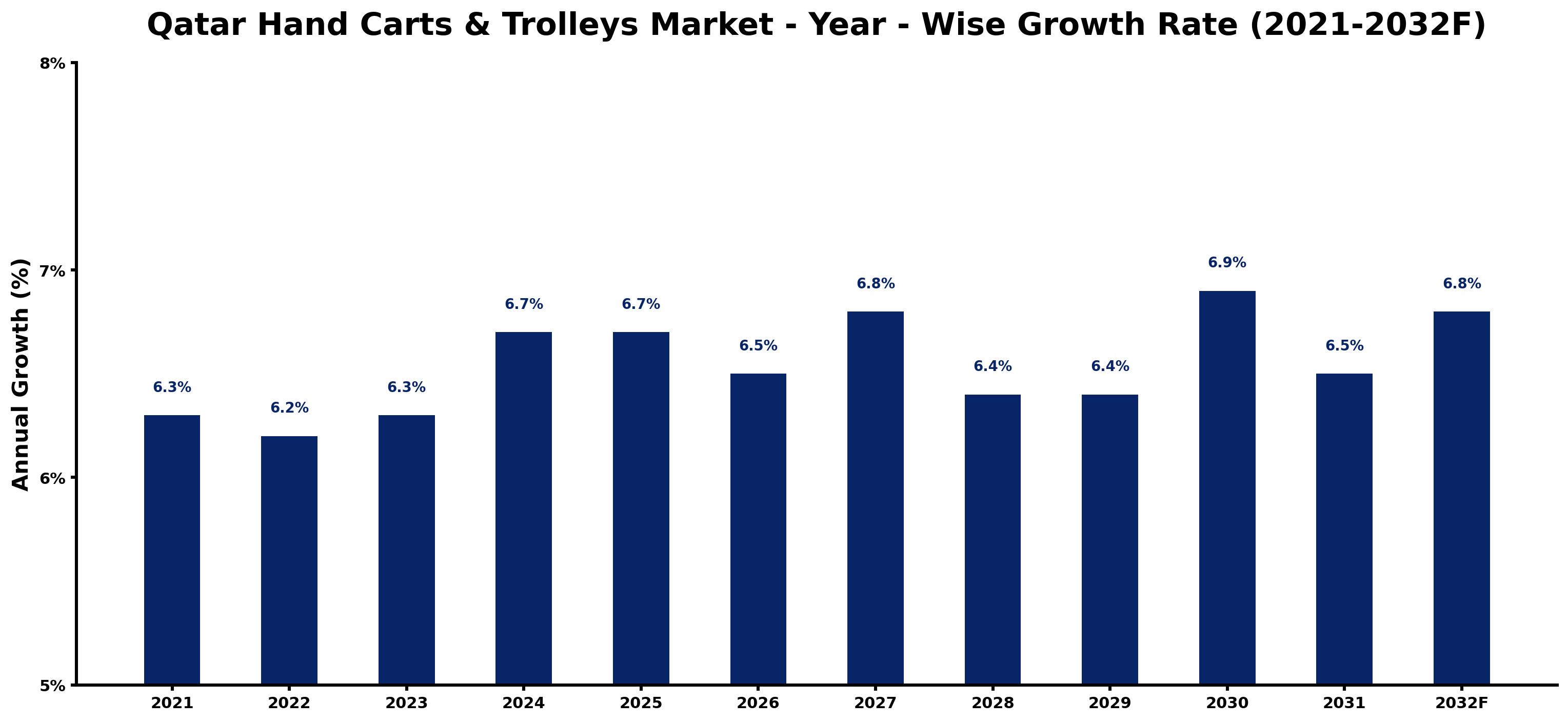
The table below presents the year wise growth rates along with the key drivers influencing the market
| Year | Growth Rate | Major Drivers |
| 2021 | 6.3% | Post-lockdown retail projects spurred demand for efficient hand carts and trolleys. |
| 2022 | 6.2% | Urbanization trends intensified focus on material handling solutions across bustling markets. |
| 2023 | 6.3% | Construction sector growth highlighted the need for durable, high-capacity transport equipment. |
| 2024 | 6.7% | Local manufacturers began emphasizing high-quality, climate-resilient cart designs for Qatar's conditions. |
| 2025 | 6.7% | Emergence of e-commerce platforms increased last-mile delivery reliance on effective transport solutions. |
| 2026 | 6.5% | Economic diversification strategies shifted logistics focus, enhancing cart procurement budgets significantly. |
| 2027 | 6.8% | Demand from food vendors surged, fostering innovation in lightweight, portable trolley designs. |
| 2028 | 6.4% | Investment in tourism drove increased need for mobility solutions in various service sectors. |
| 2029 | 6.4% | Sustainability considerations shaped product features, promoting eco-friendly materials for carts. |
| 2030 | 6.9% | Technological integration in logistics created opportunities for smart trolleys with tracking capabilities. |
| 2031 | 6.5% | Regional partnerships encouraged collaborative development of customized carts for diverse industries. |
| 2032 | 6.8% | Robust trade agreements boosted import options, enriching market offerings in hand carts. |
Note - Market size estimations and growth projections presented in this report are based on 6Wresearch's advanced forecasting approach, validated with industry datasets as of June 2026.
Qatar Hand Carts & Trolleys Market Synopsis
The Qatar Hand Carts Trolleys Market is projected to reach 6.5% and witness significant growth during the forecast period (2026-2032). The market is primarily driven by the escalation in industrial and commercial activities across the nation, leading to an increased demand for effective material handling solutions. As the infrastructure landscape evolves, the necessity for hand carts and trolleys, which facilitate seamless transportation of goods and materials, is becoming more pronounced.
Qatar Hand Carts & Trolleys Market Growth Drivers
Several key factors are propelling the growth of the Qatar Hand Carts & Trolleys Market. Firstly, the continued expansion of the industrial and commercial sectors is generating substantial demand for efficient material handling equipment. This trend is complemented by a marked shift towards automated transportation solutions, particularly among end-users seeking to enhance operational efficiency.
- The boom in construction activities driven by government infrastructure projects is creating a surge in demand for hand carts and trolleys, which are vital for material transportation on construction sites.
- Increased urbanization and population growth within Qatar are fostering a greater need for efficient transport solutions, thereby opening new avenues for manufacturers in this market.
- The government's focus on diversifying the economy away from hydrocarbons is leading to investments in various sectors, which indirectly boosts the demand for handling equipment.
- Technological advancements in the design and functionality of hand carts and trolleys are encouraging adoption, as they offer enhanced efficiency and ease of use.
- Growing awareness and preference for ergonomically designed carts that reduce worker fatigue are pivotal in driving market growth.
Qatar Hand Carts & Trolleys Market Challenges and Restraints
Despite a favorable growth outlook, the Qatar Hand Carts & Trolleys Market faces certain challenges. Notably, the high costs associated with advanced hand carts and trolleys may deter adoption in price-sensitive segments or regions. Moreover, the market's reliance on imported goods can introduce vulnerabilities related to supply chain disruptions and fluctuating prices.
- The initial investment required for high-quality equipment may be a deterrent for small and medium-sized businesses in the market.
- Competition from alternative material handling solutions may negatively impact the growth of traditional hand carts and trolleys.
- Lack of awareness regarding the advantages of modern hand carts can slow down the transition from older models to newer, more efficient alternatives.
- Economic fluctuations and geopolitical tensions in the region could impact consumer confidence and spending in the market.
- The need for ongoing maintenance and servicing of equipment may introduce additional costs for end-users.
Qatar Hand Carts & Trolleys Market Government Investment and Initiatives
The Qatari government has been actively investing in infrastructure development, which directly benefits the hand carts and trolleys market. Recent initiatives include substantial funding for construction projects and urban development programs aimed at enhancing public facilities. These government-backed initiatives are conducive to creating a favorable environment for material handling equipment, including hand carts and trolleys.
- Public spending on infrastructure is expected to drive demand for efficient material handling solutions in both public and private sectors.
- The government's commitment to transforming Qatar into a logistics hub is likely to enhance the influx of automated transport solutions in the region.
- Incentives for businesses investing in modern equipment signify governmental support for advancing the market.
- Strategic partnerships between government agencies and private firms in infrastructure projects are creating avenues for integrating advanced material handling solutions.
- Policies aimed at promoting sustainability are encouraging manufacturers to innovate and produce environmentally friendly hand carts and trolleys.
Qatar Hand Carts & Trolleys Market Latest Developments (May 2025 - June 2026)
The period from May 2025 to June 2026 has witnessed significant trends in the Qatar Hand Carts & Trolleys Market. A clear shift towards automation and smart technologies has been noted, with an increasing number of businesses integrating advanced features into their material handling solutions. This aligns with global market trends where automation is becoming essential for efficiency in logistics and distribution.
- There has been a marked increase in R&D initiatives focusing on enhancing the ergonomics and functionality of hand carts and trolleys.
- Trade exhibitions and industry conferences have emerged as platforms for showcasing innovative designs and technology in material handling equipment.
- Collaborations between technology providers and equipment manufacturers have led to advancements in automated hand carts, improving efficiency in various sectors.
- The focus on sustainability has prompted manufacturers to explore eco-friendly materials and production methods for hand carts and trolleys.
- Market players are increasingly emphasizing after-sales services to enhance customer satisfaction and promote repeat business.
Qatar Hand Carts & Trolleys Market - Key Attractiveness of the Report
- 10 Years of Market Numbers
- Historical Data Starting from 2022 to 2025
- Base Year: 2025
- Forecast Data until 2032
- Key Performance Indicators Impacting the Market
- Major Upcoming Developments and Projects
Key Highlights of the Report:
- Qatar Hand Carts & Trolleys Market Outlook
- Market Size of Qatar Hand Carts & Trolleys Market, 2025
- Forecast of Qatar Hand Carts & Trolleys Market, 2032F
- Historical Data and Forecast of Qatar Hand Carts & Trolleys Revenues & Volume for the Period 2022-2032F
- Qatar Hand Carts & Trolleys Market Trend Evolution
- Qatar Hand Carts & Trolleys Market Drivers and Challenges
- Qatar Hand Carts & Trolleys Price Trends
- Qatar Hand Carts & Trolleys Porter's Five Forces
- Qatar Hand Carts & Trolleys Industry Life Cycle
- Historical Data and Forecast of Qatar Hand Carts & Trolleys Market Revenues & Volume By Types for the Period 2022-2032F
- Historical Data and Forecast of Qatar Hand Carts & Trolleys Market Revenues & Volume By Steel Hand Truck for the Period 2022-2032F
- Historical Data and Forecast of Qatar Hand Carts & Trolleys Market Revenues & Volume By Aluminium Hand Truck for the Period 2022-2032F
- Historical Data and Forecast of Qatar Hand Carts & Trolleys Market Revenues & Volume By Applications for the Period 2022-2032F
- Historical Data and Forecast of Qatar Hand Carts & Trolleys Market Revenues & Volume By Online Sales for the Period 2022-2032F
- Historical Data and Forecast of Qatar Hand Carts & Trolleys Market Revenues & Volume By Offline Sales for the Period 2022-2032F
- Qatar Hand Carts & Trolleys Import Export Trade Statistics
- Market Opportunity Assessment By Types
- Market Opportunity Assessment By Applications
- Qatar Hand Carts & Trolleys Top Companies Market Share
- Qatar Hand Carts & Trolleys Competitive Benchmarking By Technical and Operational Parameters
- Qatar Hand Carts & Trolleys Company Profiles
- Qatar Hand Carts & Trolleys Key Strategic Recommendations






































