Qatar Household furniture Market Summary
The qatar household furniture market was estimated at USD 246 Million in 2025 and is projected to reach USD 269 Million by 2032, growing at a CAGR of 1.3% from 2026 to 2032.
Qatar Household furniture Market Year-wise Growth Rate and Key Drivers
This graph highlights how the Qatar Household furniture Market has steadily grown over the past five years, supported by major growth factors.
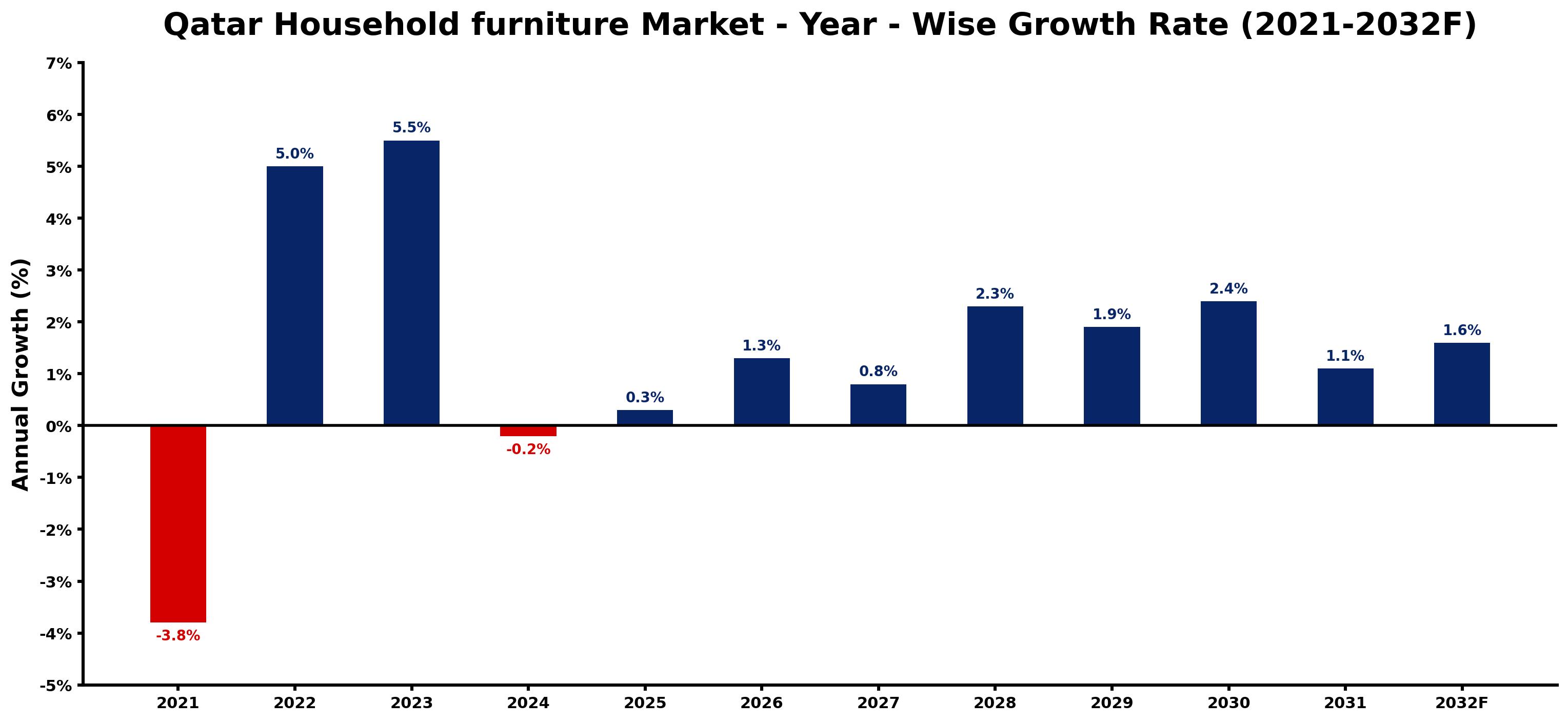
The table below presents the year wise growth rates along with the key drivers influencing the market
| Year | Growth Rate | Major Drivers |
| 2021 | -3.8% | Supply chain disruptions hindered imports, leading to limited availability and declining consumer purchases of household furniture. |
| 2022 | 5.0% | Continued population growth created a steady increase in housing demand and furniture sales. |
| 2023 | 5.5% | Expanding expatriate communities influenced preferences for modern and luxury furniture styles. |
| 2024 | -0.2% | Increased competition from lowcost imports pressured local manufacturers, leading to a decline in market share. |
| 2025 | 0.3% | E-commerce platforms gained traction, making furniture shopping more accessible to consumers. |
| 2026 | 1.3% | Local craftsmanship started appealing more to consumers seeking unique, handmade furniture pieces. |
| 2027 | 0.8% | Sustainability trends pushed furniture brands to focus on eco-friendly materials and practices. |
| 2028 | 2.3% | Urbanization trends prompted a rise in space-saving and multifunctional furniture solutions. |
| 2029 | 1.9% | Focus on smart home technologies began integrating with furniture design and functionality. |
| 2030 | 2.4% | Economic diversification strategies highlighted local brands, enhancing competitiveness in the furniture market. |
| 2031 | 1.1% | Changing lifestyle preferences drove demand for customizable and modular furniture options. |
| 2032 | 1.6% | International design fairs attracted global brands, enriching the local furniture landscape and choices. |
Note - Market size estimations and growth projections presented in this report are based on 6Wresearch's advanced forecasting approach, validated with industry datasets as of June 2026.
Qatar Household furniture Market Synopsis
The Qatar Household furniture Market is projected to reach 1.3% and witness significant growth during the forecast period (2026-2032). This burgeoning market is a product of Qatar's status as a rapidly developing nation characterized by a wealth of resources, particularly from its oil-rich economy. The affluence of its citizens, coupled with a steady influx of expatriates, has significantly influenced consumer behavior, leading to an increased demand for household furniture.
Qatar Household furniture Market Growth Drivers
Several factors are propelling the demand for household furniture in Qatar. Firstly, improving disposable income levels among residents significantly contribute to this trend. With higher employment rates and a diversified workforce, more consumers are willing to invest in quality furniture that aligns with contemporary lifestyle preferences.
- The growing inclination towards modern lifestyles has shifted consumer focus towards stylish and functional furniture solutions that cater to both aesthetic and practical needs.
- Infrastructure development projects such as the Lusail City Project and Doha Metro Project have spurred construction activities, resulting in increased demand for furniture in new residential and commercial spaces.
- There is a marked preference for luxury items among consumers, driving high-end furniture sales. This trend reflects an evolving consumer base aspiring to enhance their living environments.
- The ongoing transition towards the purchase of ready-made or assembled furniture, as opposed to highly customized artisanal offerings, makes it easier for consumers to acquire stylish solutions without extended waiting times.
- Government initiatives such as the Start Up Visa Program encourage foreign investment and innovation in various sectors, including furniture, thus broadening the market's scope and growth potential.
Qatar Household furniture Market Challenges and Restraints
Despite the favorable conditions for growth, the Qatar Household furniture Market faces several challenges. The high costs associated with production and importation hinder competitive pricing for both local and international suppliers.
- Import taxes and duties on foreign furniture drive up consumer prices, making local production a more appealing option but one that is currently limited in capacity.
- Quality standards within Qatar's furniture industry are inconsistent, complicating the purchasing decision for consumers seeking durable and stylish options.
- Limited access to financing options hampers smaller local manufacturers, making it difficult to compete with larger firms that possess more capital and resources.
- Consumer awareness regarding sustainability and eco-friendly products is increasing; however, the local market's slow adaptation to these preferences poses a challenge for furniture brands.
- The need for innovation and adaptation to meet evolving design and functionality requirements presents ongoing operational challenges within the sector.
Qatar Household furniture Market Government Investment and Initiatives
The Qatari government has implemented numerous initiatives aimed at bolstering the household furniture market. Significant public spending on infrastructure and urban development projects has created a conducive environment for furniture suppliers. Moreover, various policies are in place to encourage foreign direct investment, such as simplified business setup processes and innovation-friendly regulations.
Efforts are also being made to enhance local manufacturing capabilities, thereby reducing reliance on imports and fostering a self-sustained furniture industry. The government is committed to enhancing quality standards and promoting local craftsmanship while ensuring sustainability practices are incorporated across the sector.
Qatar Household furniture Market Latest Developments (May 2025 - June 2026)
During the period from May 2025 to June 2026, the Qatar Household furniture Market has undergone several notable transformations. Companies have increasingly adopted digital retail strategies, leveraging eCommerce platforms to improve market access and respond to changing consumer behaviors post-COVID-19.
Furthermore, a growing emphasis on health and safety has led to innovations in delivery processes, including contactless services, catering to consumer expectations for convenience and hygiene. These developments indicate a resilient sector adapting to challenges while maintaining growth potential through strategic pivots.
Qatar Household furniture Market - Key Attractiveness of the Report
- 10 Years of Market Numbers
- Historical Data Starting from 2022 to 2025
- Base Year: 2025
- Forecast Data until 2032
- Key Performance Indicators Impacting the Market
- Major Upcoming Developments and Projects
Key Highlights of the Report:
- Qatar Household furniture Market Outlook
- Market Size of Qatar Household furniture Market, 2025
- Forecast of Qatar Household furniture Market, 2032
- Historical Data and Forecast of Qatar Household furniture Revenues & Volume for the Period 2022-2032F
- Qatar Household furniture Market Trend Evolution
- Qatar Household furniture Market Drivers and Challenges
- Qatar Household furniture Price Trends
- Qatar Household furniture Porter's Five Forces
- Qatar Household furniture Industry Life Cycle
- Historical Data and Forecast of Qatar Household furniture Market Revenues & Volume By Types for the Period 2022-2032F
- Historical Data and Forecast of Qatar Household furniture Market Revenues & Volume By Wood Furniture for the Period 2022-2032F
- Historical Data and Forecast of Qatar Household furniture Market Revenues & Volume By Metal Furniture for the Period 2022-2032F
- Historical Data and Forecast of Qatar Household furniture Market Revenues & Volume By Plastic Furniture for the Period 2022-2032F
- Historical Data and Forecast of Qatar Household furniture Market Revenues & Volume By Others for the Period 2022-2032F
- Historical Data and Forecast of Qatar Household furniture Market Revenues & Volume By Area of Use for the Period 2022-2032F
- Historical Data and Forecast of Qatar Household furniture Market Revenues & Volume By ?Bedroom Furniture for the Period 2022-2032F
- Historical Data and Forecast of Qatar Household furniture Market Revenues & Volume By Living Room Furniture for the Period 2022-2032F
- Historical Data and Forecast of Qatar Household furniture Market Revenues & Volume By Dining Room Furniture for the Period 2022-2032F
- Historical Data and Forecast of Qatar Household furniture Market Revenues & Volume By Household Furniture for the Period 2022-2032F
- Historical Data and Forecast of Qatar Household furniture Market Revenues & Volume By Others for the Period 2022-2032F
- Qatar Household furniture Import Export Trade Statistics
- Market Opportunity Assessment By Types
- Market Opportunity Assessment By Area of Use
- Qatar Household furniture Top Companies Market Share
- Qatar Household furniture Competitive Benchmarking By Technical and Operational Parameters
- Qatar Household furniture Company Profiles
- Qatar Household furniture Key Strategic Recommendations






































